Astrology is a symbolic system that uses the positions and cycles of the planets to describe patterns in personality and time. It is not prediction, not destiny, not a science, and not the same as a daily horoscope column. The Western tradition has a roughly four-thousand-year documented history — Babylonian sky-records (c. 2000 BCE), Hellenistic synthesis in Alexandria (Ptolemy's Tetrabiblos, c. 150 CE), Islamic transmission, Renaissance European practice, and a twentieth-century psychological turn led by Jung, Dane Rudhyar and Liz Greene. Modern usage centres on self-reflection, life-stage timing and relationship insight — not fortune-telling.
If someone asked you, over coffee, what astrology actually is, you'd probably know roughly what to say — but only roughly. Most of us have absorbed a vague mix of horoscope columns, Instagram bios, and a friend's confident pronouncements about Mercury retrograde. None of it quite adds up to a clean answer.
This is the clean answer. Astrology is a symbolic system that uses the positions and cycles of the planets to describe patterns in personality and time — not to predict the future, not to issue verdicts, and not to tell you what's "meant" to happen. It's older than most religions, more structured than most people realise, and considerably more interesting than the daily sun-sign column it's usually reduced to.
In short. Astrology is a symbolic system that uses planetary positions and cycles, at the moment of someone's birth or as they move through time, to describe patterns in personality, life-stages, and events. It is not a method for predicting specific future events. The Western tradition draws on Babylonian sky-records, Hellenistic Greek synthesis (Ptolemy's Tetrabiblos, second century CE), Renaissance European practice, and a 20th-century psychological turn. Modern uses centre on self-reflection, life-stage timing, and relationship insight, not fortune-telling.
What astrology is (and isn't) at a glance
| Astrology is | Astrology isn't |
|---|---|
| A symbolic system describing patterns in personality and time | A predictive science |
| Older than 4,000 years (documented), Babylonian → Hellenistic → modern | A modern invention or social-media trend |
| Based on planetary positions calculated via the Swiss Ephemeris | Based on the constellations you see in the night sky |
| A vocabulary for noticing patterns you already half-know | A method for forecasting specific events |
| Useful for self-reflection, relationship insight, life-stage timing | A substitute for therapy, medical care or financial planning |
| Classified in the UK as entertainment for advertising purposes | Falsifiable in the scientific sense (Carlson 1985; Dean & Kelly 2003) |
 The honest version of the question is more interesting than the quick one.
A short history of astrology
Astrology has a roughly four-thousand-year history, and what most people in Britain call "astrology" today is a synthesis with at least five distinct historical layers. It begins with Babylonian sky-records and reaches the present via Greek Alexandria, the Islamic world, Renaissance Europe, and a small group of 20th-century writers who quietly turned the whole practice inwards. None of that is a marketing claim; it's the documented record, and it's worth knowing before deciding what you think of the subject.
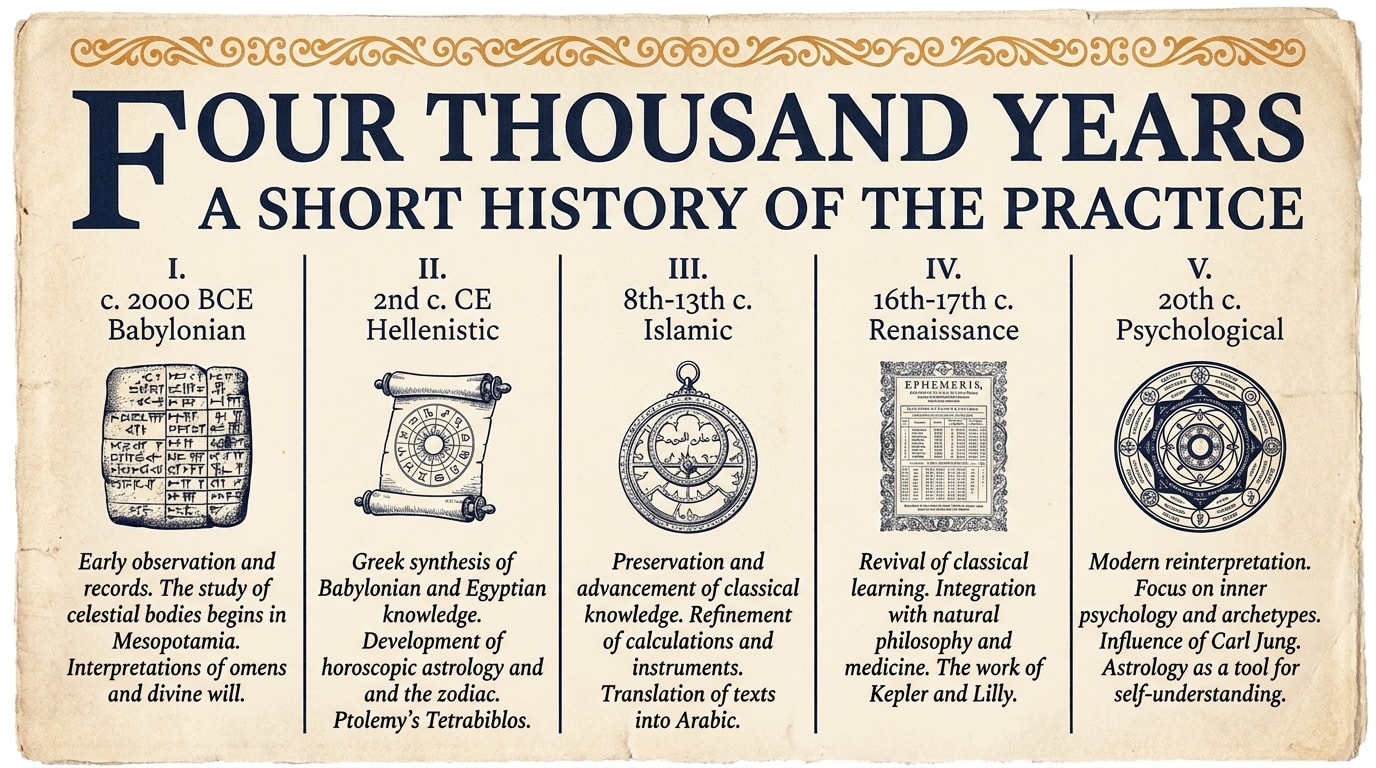
The Babylonian period (roughly 2000 BCE to the 6th century BCE) gave us systematic records of planetary positions and a catalogue of celestial omens. The compendium Enuma Anu Enlil, compiled over centuries and surviving on around seventy clay tablets, is largely mundane astrology — the interpretation of celestial events as signs about kings, harvests, and the state. Babylonian scribes weren't reading personality from charts; they were watching the sky for the public good. The maths, however, was real, and the records they left were precise enough that Greek astronomers later worked from them.
The Hellenistic synthesis, from roughly the second century BCE to the second century CE, is where astrology becomes recognisably modern. In Alexandria, Greek-trained scholars combined Babylonian celestial data with Egyptian astrological practice and Greek philosophy. The crystallising text is Claudius Ptolemy's Tetrabiblos, written around 150 CE, which set out the framework (the zodiac, the planets, the houses, the aspects) that the Western tradition has used, in one form or another, ever since. Most of what you'll read in any introductory astrology book is downstream of decisions made in Alexandria two thousand years ago.
The Islamic Golden Age, from roughly the 8th to the 13th century, preserved and transmitted Greek astrology while astronomy advanced in parallel. Abu Ma'shar al-Balkhi (787-886 CE, known in Latin Europe as Albumasar) wrote influential works on astrology that were later translated into Latin and shaped medieval European practice. Without the careful preservation done in this period, much of Hellenistic astrology would have been lost.
The Renaissance saw astrology returned to European courts and universities. Printed ephemerides (tables of planetary positions) made charts widely available; figures like Johannes Kepler practised astrology alongside the new astronomy. The two disciplines were not yet separate. The schism came later, in the 17th and 18th centuries, when astronomy moved into the new science and astrology was largely abandoned by educated Europe as superstition.
The twentieth century quietly revived it, but in a different form. Carl Jung's interest in synchronicity and symbol gave astrology psychological scaffolding; Dane Rudhyar's The Astrology of Personality (1936) reframed the practice as a tool for understanding inner life rather than predicting outer events. Liz Greene, Howard Sasportas, Stephen Arroyo and others built on this foundation through the 1970s and 80s, and the modern psychological school (the one most popular apps and blogs implicitly draw on, often without naming it) is the result. The version of astrology you'll encounter in most apps and in this article is, broadly, that synthesis.
What astrology is not
The fastest route to understanding what astrology is goes through what it is not, partly because most public misunderstanding comes from conflating astrology with the daily horoscope columns that dominate popular awareness. Those columns were invented for a newspaper feature in 1930 (R.H. Naylor's column on Princess Margaret's birth, published in the Sunday Express on 24 August that year). They were never the whole of astrology; they're one narrow application, and a fairly degraded one at that. A few things astrology isn't, then, worth getting out of the way.
Astrology is not prediction. It doesn't tell you the date you'll meet someone, the year you'll change careers, or whether the person you're dating is your soulmate. Anyone selling you a fixed future has wandered into a different business, usually one with worse return policies. Some astrological techniques look at timing (transits, progressions, returns), and those describe windows in which certain themes tend to surface; but a window is not an event, and a tendency is not a forecast. The honest version of astrology talks about climate, not weather.
Astrology is not destiny. The chart you were born with does not lock you into a fixed life; it describes patterns and tendencies you bring with you, which you then do something with. The same Saturn-Sun square can read as someone who fights authority all their life or as someone who, by forty, becomes the steadiest figure in their team. What changes is what the person does with the underlying material. The chart is the raw clay, not the finished sculpture.
Astrology is not the same as a horoscope column. A horoscope column is one forecast for one twelfth of the population at a time. A birth chart is a unique configuration calculated from your specific date, time, and place of birth, with ten planets, twelve signs and twelve houses interacting in millions of combinations. The two are related, in that the column is, very loosely, one paragraph about your Sun sign, but they're emphatically not the same kind of object. Most people who think astrology "doesn't fit them" are thinking of horoscope columns; the actual chart is much more specific.
Astrology is not a science, and doesn't pretend to be. There is no falsifiable mechanism by which planetary positions cause events on Earth, and the studies attempting to test astrological claims against control groups have generally failed to find effects (Carlson, 1985; Dean and Kelly, 2003). What astrology offers is symbolic and reflective: a structured vocabulary for talking about patterns. That's a useful thing, but it's not a scientific thing. In Britain it's explicitly classified as entertainment for advertising purposes, and the better astrologers (most of them) would tell you exactly that.
What astrology actually is
The cleanest single-sentence definition is this — astrology is a symbolic language for describing patterns in personality and in time. It uses the positions of the planets, at the moment of your birth (natal astrology) or as they move through the sky (transits and other timing techniques), as a structured way to talk about psychological tendencies, life-stages, and the connections between them. Three framings help make this concrete.
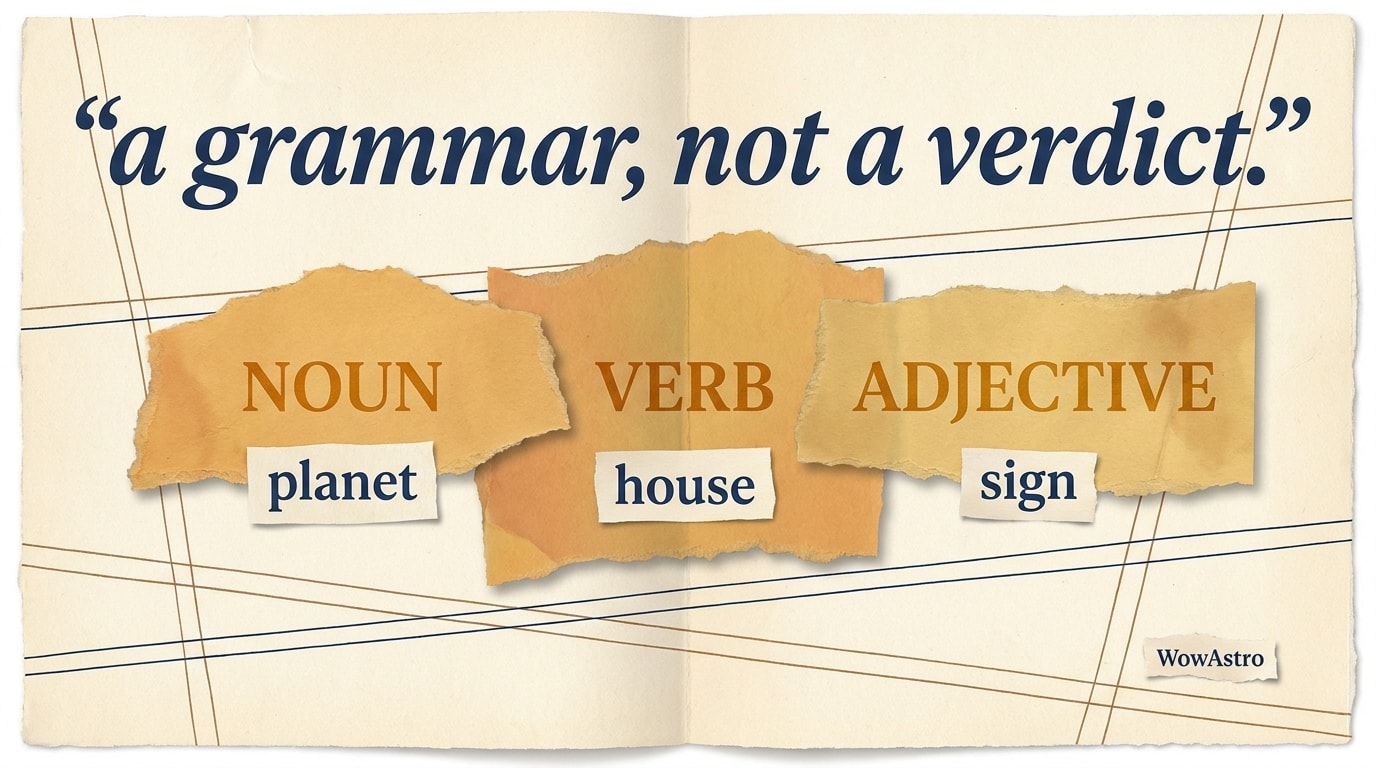
The first framing is language. Like English or German, astrology has a grammar (planets are nouns, signs are adjectives, houses are prepositions), a vocabulary (the symbols for each), and rules for combining them. A placement like "Venus in Scorpio in the 8th house" is a sentence. Like any language, it can be used to say something thoughtful or something inane, and like any language, fluency takes practice. The grammar itself is impartial; it can be wielded by serious astrologers or by people writing fortune-cookie copy, and the difference is in the wielder, not the language.
The second framing is mirror. Astrology, particularly in its modern psychological form, works as a structured reflective tool, a set of prompts that ask you to look at recurring patterns in how you think, feel, and act. The chart doesn't tell you anything you don't, somewhere, already know about yourself; it gives you an organised way to notice it. In this sense it sits in the same broad family as Enneagram types or MBTI: typological systems whose validity is debated, but whose usefulness as conversation-starters and reflection-prompts is harder to argue with.
The third framing is cycles. Beyond the static birth chart, astrology pays attention to the recurring cycles of the planets through the sky, Saturn's roughly 29.5-year orbit, Jupiter's 12-year cycle, Pluto's 248-year passage. Mapped against your birth chart, these cycles describe life-stages: the Saturn return at around 29-30 and again at 58-60, the Jupiter return at around 12, 24, 36, the long Pluto transits that mark major chapters. Used carefully, this gives a structural language for life-stages: not a prediction of events, but a description of which themes tend to surface when.
In one line. Astrology is a structured way of describing patterns in time and personality: a vocabulary, not a verdict.
The three components: planets, signs, houses
Every astrological reading uses three building-blocks: planets, signs, and houses. Planets describe what: which part of a person or situation is in play (will, emotion, thinking, love). Signs describe how: the style in which that function operates (bold, careful, restless, intense). Houses describe where: the area of life in which it shows up (work, relationships, home, friendships). These three are read together as one combined statement, not as separate facts, and the way they combine is what makes a chart specific to one person.
There are ten planets in modern Western astrology; by convention this includes the Sun and Moon, which are technically luminaries. The five inner planets describe individual character: Sun (will and identity), Moon (emotion and what makes you feel safe), Mercury (thinking and speaking), Venus (love and aesthetic), Mars (action and pursuit). The five outer planets describe broader themes: Jupiter (expansion, meaning), Saturn (structure, responsibility), Uranus (change, individuation), Neptune (imagination, dissolution), Pluto (depth, transformation). Each planet is one function in a person. A fuller guide to the ten and how to read them sits in your natal chart explained.
There are twelve zodiac signs, from Aries (the start of the zodiac at the vernal equinox in tropical astrology) through to Pisces. Each sign is a style: Aries is direct, fast, oppositional; Taurus is steady, sensual, fixed; Gemini is curious, quick, restless. The signs are organised by four elements (fire, earth, air, water) and three modalities (cardinal, fixed, mutable), which group them into recognisable families. A detailed look at all twelve lives in the twelve zodiac signs explained.
There are twelve houses, which divide the chart wheel into areas of life. The 1st house is the self you present to the world; the 4th is home and roots; the 7th is partnership; the 10th is career and public reputation. The remaining eight cover everything between: money and self-worth (2nd), learning and communication (3rd), creativity and play (5th), routine and health (6th), shared resources and transformation (8th), travel and meaning (9th), friendships and groups (11th), and the inward, hard-to-name material of the 12th. A guide to the twelve and how to use them is in astrology houses explained.
Read together, these three layers turn a placement from a label into a sentence. "Mercury in Gemini in the 3rd house" is not a verdict or a category; it's a description of a specific kind of mind: quick and curious in style (Gemini), showing up most visibly in everyday conversation, short messages, and small-scale daily exchanges (3rd house). The full guide to reading these as one connected description, rather than ten separate facts, is in how to read your birth chart.
 Picking the serious kind out from the rest.
Types of astrology
Western astrology has, traditionally, four main branches, each shaped around a different kind of question: natal, horary, electional, and mundane. Most of what you'll encounter in popular writing (apps, blogs, columns, this article) is natal astrology applied to personal life. The others are quieter but still practised, and worth knowing about, because they show what the system was originally built to do.
Natal astrology is the chart for the moment of birth, used to describe a person: their character, tendencies, life-stages, and patterns. This is the everyday meaning of "astrology" in most modern conversation. When someone says "what's your chart?" or "I had my chart read", they almost always mean natal. The full guide to the natal chart, including what each layer means and how it's read, is in your natal chart explained; the question of how a chart for two people is read together (relationships and synastry) is in what is synastry, explained.
Horary astrology is something quite different: a chart drawn for the moment a specific question is asked, used to answer that question from the configuration of that chart. The technique was systematised by William Lilly in the 17th century (his Christian Astrology, 1647, is still in print), and is practised in a smaller, more specialist community today. It feels more divinatory in spirit than natal astrology, and most modern personal astrologers don't use it.
Electional astrology asks the opposite question: given that you're planning to do something (get married, launch a business, sign a contract), when is a good time to do it? An astrologer picks a moment with a favourable chart for the purpose. This is one of the older techniques and still has its practitioners, but is increasingly niche; it sits oddly with the modern psychological frame.
Mundane astrology looks at collective events (national affairs, political moments, generational themes) by reading the charts of countries, organisations, or specific dates. This is where astrology started (the Babylonian work was mundane) and where serious historical astrology often does its most interesting work. Modern mundane astrology is more interesting than it gets credit for, but it's not what most people mean when they download an astrology app.
Modern schools and approaches
Most of the astrology you'll encounter today sits in or between three modern schools: psychological, evolutionary, and traditional/Hellenistic revival. The differences between them are worth knowing, because they shape the kind of language used, the assumptions made about what the chart is for, and the kind of guidance an astrologer in that tradition will offer.
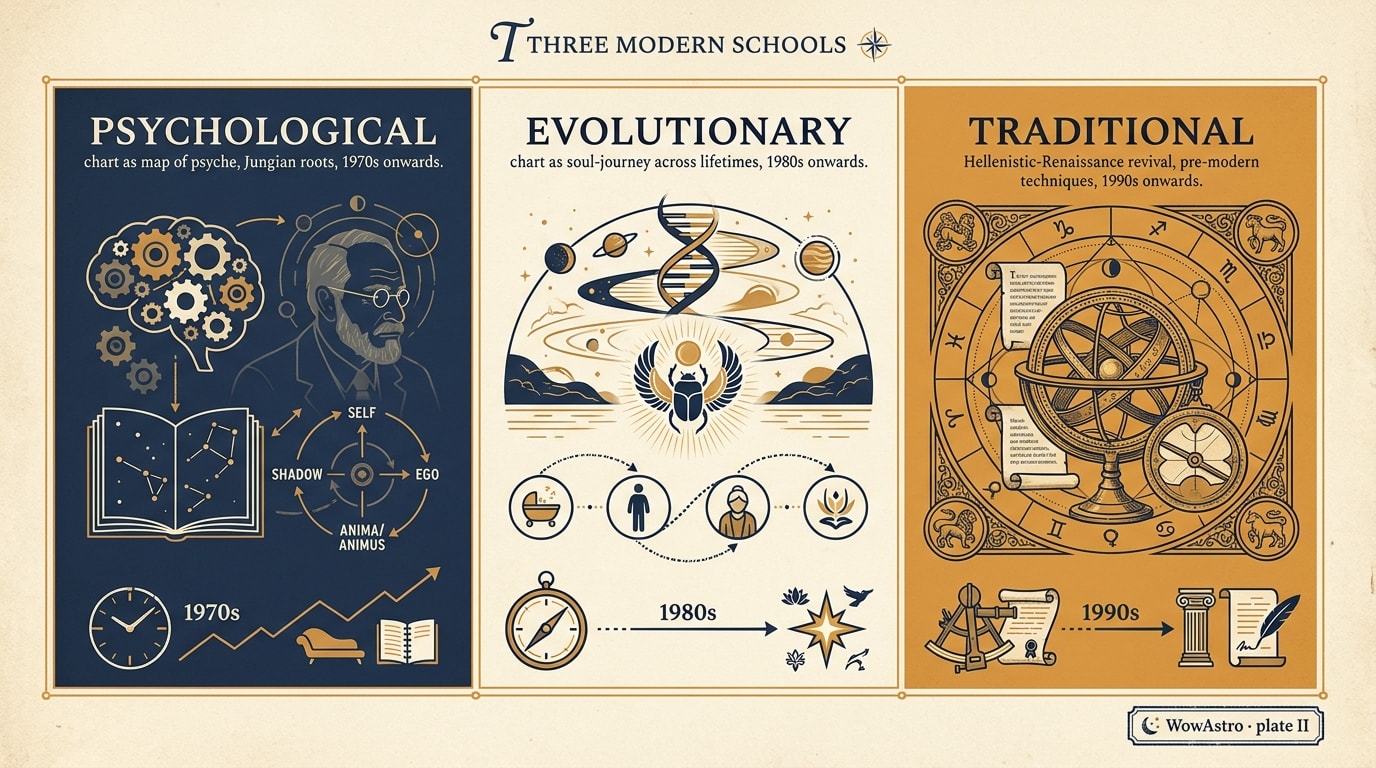
The psychological school treats the chart as a map of the inner life, a way of describing the structure of someone's psyche, their patterns of thought, feeling, and motivation. Its lineage runs through Carl Jung's interest in symbol and synchronicity to Dane Rudhyar (The Astrology of Personality, 1936), and reaches its modern peak with Liz Greene, Howard Sasportas, Stephen Arroyo, and the Centre for Psychological Astrology that Greene and Sasportas founded in London in 1983. Most contemporary popular astrology (the apps, the blog posts, this article) sits loosely in this tradition, often without naming it. The strength is depth and humanity; the weakness is a tendency to be vague and to over-promise insight.
The evolutionary school, associated principally with Jeffrey Wolf Green (Pluto: The Evolutionary Journey of the Soul, 1985) and Mark Jones, reads the chart as a snapshot of the soul's journey across lifetimes: a much larger frame, in which the current life is one chapter in a longer arc shaped by previous-life karma. The language is overtly spiritual and assumes reincarnation as a working premise. The strength is meaning-making power for those who find that frame resonant; the weakness is that for sceptical readers it asks a lot of metaphysical credit upfront.
The traditional or Hellenistic revival is the youngest of the three as a movement, though it draws on the oldest material. From the early 1990s onwards, particularly with Project Hindsight, founded in 1993 by Robert Hand, Robert Schmidt and Robert Zoller to translate pre-modern astrological texts, a generation of astrologers (Demetra George, Chris Brennan, Austin Coppock, and others) has returned to the techniques used by Hellenistic and medieval astrologers. The tone is more concrete and less psychological, with fewer adjectives and more specific predictions about timing and circumstance, though still framed within the modern entertainment / self-reflection register. The strength is rigour and historical depth; the weakness is that some techniques fit oddly with the assumptions of modern life.
Most personal astrologers today move between these schools depending on what they're working on. The shared core (the planets, signs, houses, aspects, the basic interpretive moves) is the same; the framing and the emphasis differ.
What astrology is used for today
The honest answer to "what is astrology used for" is: mainly for self-reflection, life-stage timing, and relationship insight, and only loosely for anything you'd call prediction. The fortune-telling end has receded as the psychological end has expanded, and most thoughtful contemporary practice treats the chart as a starting point for thinking rather than a verdict to obey. Five common modern uses are worth naming.
Self-understanding is the most widespread. Reading your own birth chart as a structured prompt (what your Moon sign might be asking of your emotional life, what your Saturn placement says about the part of you that's slow to relax) gives many readers a vocabulary for patterns they'd half-noticed but couldn't articulate. The full guide to using astrology this way sits in astrology for self-understanding; it's a useful place to start if this framing appeals.
Life-stage navigation is the second. The slow planetary cycles (Saturn return at around 29-30, mid-life Uranus opposition at 40-42, the second Saturn return at 58-60) map onto recognisable adult turning-points, and many people find astrology a more dignifying frame for those moments than the available alternatives. A detailed look at one of the most-discussed of these is in Saturn return, what it is.
Relationships and compatibility are the third: the chart-comparison technique known as synastry asks how two people's charts interact, where they meet easily, where the friction lives. This is more honest about complexity than the "which signs go together" quizzes; the full version sits in the astrological compatibility guide.
Timing (choosing or understanding a moment) is the fourth. Most modern personal use is structural rather than predictive: noticing that a particular six-month transit is bringing pressure on the part of the chart that handles work, for instance, and giving that pressure a name. The misuse of this (blaming every minor inconvenience on Mercury retrograde) is a separate problem, and there's a calmer take in Mercury retrograde, explained calmly.
Conversation is the fifth — and one of the less-noticed uses. Astrology gives a shared symbolic vocabulary for talking about patterns, behaviour, and the slightly hard-to-name parts of being a person. A friend who says "I'm in a Saturn return" is not making a metaphysical claim; she's giving you a useful shorthand. Used like that, the system earns its keep.
 The actual work is what you do with the description.
How to start, if you want to
If you want to explore astrology beyond the sun-sign column, start with your full birth chart — not another quiz. The chart is the working document; everything else (interpretations, columns, apps, books) is downstream of it, and reading the chart first means you can evaluate whatever you read next against something concrete that's actually about you.
The smallest useful first step is calculating your chart and reading the "big three" — your Sun (who you're becoming), Moon (what makes you feel safe), and Rising sign (how the world first reads you). The Rising sign in particular changes every couple of hours, so the exact birth time matters; if you don't have it, you'll still get most of the chart, but those two layers will be approximate. From the big three, you can read your way out to the personal planets (Mercury, Venus, Mars) and then to the slower planets and the houses. A patient guide to the actual reading is in how to read your birth chart.
If you'd like to see your own chart drawn rather than read another general description, WowAstro will calculate a free birth chart for you. Date, time and place; takes a couple of minutes; the result is yours to keep and read at your own pace. Charts are calculated using the Swiss Ephemeris, the same astronomical data professional astrologers and serious software use.
A short, honest note. If you're reading this at a difficult life pivot (a redundancy, a breakup, a bereavement, a milestone that's gone harder than expected), astrology can be one useful prompt for reflection, and that's a reasonable use of it. If what you're carrying is heavier than that, persistent low mood or thoughts of self-harm, please talk to your GP or contact Samaritans (116 123, free, 24/7). Astrology sits alongside professional support; it can't replace it.
Questions readers ask
Is astrology a science?
No, not in the modern sense. There is no falsifiable mechanism by which planetary positions cause measurable effects on Earth, and the studies attempting to test astrological claims against control groups have generally failed to find them. What astrology offers is a symbolic and reflective system, a vocabulary for describing patterns, rather than a predictive scientific one. Historically, astrology and astronomy weren't separated until the 17th century, when astronomy moved into the new science and astrology was largely abandoned by educated Europe; the modern psychological revival is a different project from either.
What's the difference between astrology and a horoscope?
Astrology is the whole symbolic system: ten planets, twelve signs, twelve houses, the angles between them, four main branches, several modern schools. A horoscope is one narrow application: in everyday British use, the daily or weekly newspaper forecast for one of the twelve sun signs, written for one twelfth of the population at a time. The two are related, in that a horoscope column uses one planet (the Sun) of one component of the system, but they're emphatically not the same. Most people who think astrology "doesn't fit them" are thinking of horoscope columns; the actual personal chart is far more specific.
How old is astrology?
About four thousand years, in the broadest sense; Babylonian astronomical records and celestial omen-lists go back to roughly 2000 BCE. About two thousand years in the form a modern astrologer would recognise, dating from the Hellenistic synthesis crystallised in Ptolemy's Tetrabiblos around 150 CE. About a hundred years in its modern psychological form, dating from Carl Jung's interest in symbol and Dane Rudhyar's The Astrology of Personality in 1936. The version most popular today is a recent layer on a very old practice.
Do astrologers believe the planets cause events?
Most modern astrologers don't think in terms of causation at all. The standard framing is correspondence: the idea that planetary positions correlate with patterns rather than causing them. The medieval phrase "as above, so below" is meant symbolically, not mechanically; Carl Jung's concept of synchronicity, where outer events and inner states are meaningfully connected without one causing the other, sits in the same family of ideas. The traditional/Hellenistic school is sometimes more comfortable with concrete predictive claims; the psychological and evolutionary schools are usually careful to stay with correspondence and meaning rather than mechanism.
A note on what this is. Astrology, as we use it at WowAstro, is a tool for self-reflection and self-understanding, not a method for predicting events, health, financial outcomes or the trajectory of relationships. Read it as a description of patterns, take what's useful, leave the rest.
About this article: WowAstro readings combine traditional astrological methodology (Swiss Ephemeris calculations, Hellenistic and modern psychological frameworks) with AI-assisted writing reviewed by Oksana Miatova before publication. For entertainment and self-reflection only — not medical, legal, or financial advice. Full editorial policy at /editorial-standards.
Written by Oksana Miatova, astrologer and writer at WowAstro. Charts calculated using the Swiss Ephemeris, the same astronomical data professional astrologers and serious software use.
Read your own natal chart
A personal AI reading, from £1
⭐ +50 Wow Stars cashback · sign up and get 100 ⭐
Build my chart →Comments
New here? Get −30% off your natal chart
Leave your email and we will send you the promo code WELCOME30. Straight after that you can comment — no passwords, all automatic.
Quick sign-in
Sign in with Telegram — one click.
Or by email (with a gift)
Already have an account? Enter the same email — we'll email you a sign-in link.