Three websites, three slightly different dates for the same sign. One friend swears she's "such a typical Capricorn", another tells you Capricorns are nothing like her. Somewhere in the middle, you'd quite like to know what the twelve zodiac signs actually are, where the dates come from, and whether your sign really describes you.
Short answer: the twelve signs are a four-thousand-year-old way of dividing the year into twelve seasonal slices, each with a recognisable temperament. Long answer needs the rest of this page. The thing most guides skip is that your Sun sign, the bit Cosmopolitan tells you on your birthday, describes roughly one tenth of your astrological chart. The other nine tenths are why two Capricorns can feel like different people.
In short. The twelve zodiac signs are twelve thirty-degree slices of the sky the Sun moves through over a year. Each sign has a date range (when the Sun is in it), an element (fire, earth, air or water — its temperament) and a mode (cardinal, fixed or mutable — how it moves). Your Sun sign captures one piece of you; a full chart describes the other nine planets. Dates shift by a day between years because the Sun changes sign at a different clock time each year.
 tea bag dangling, lost in thought.
What your Sun sign actually tells you (and what it doesn't)
Your Sun sign describes roughly a tenth of your astrological chart. A chart contains ten things astrologers call planets — Sun, Moon, Mercury, Venus, Mars, Jupiter, Saturn, Uranus, Neptune and Pluto — and the Sun is one of them. It tells you about the core you're growing into, the centre of your sense of self, the life that lights you up. It does not tell you about your emotional life, the impression you make on strangers, how you think, what you find beautiful, or how you act under pressure. Those are the other nine.
That is the structural reason two people of the same Sun sign can feel like completely different people. The Sun is one chapter; the other nine placements set the rest of the book. Two Capricorns with very different Moon signs, Rising signs and Venus signs will read the same horoscope on Sunday morning and one will think "yes, that's me" and the other will think "I'm nothing like that" — and they will both be right.
If you've ever read your sign description and thought "that's only half right", you weren't being difficult. You were right.
For most people the Sun sign is a true and useful slice. It does describe a real layer of you. It just isn't the whole portrait. The four-step way into the rest is to add Moon (what you need to feel safe), Rising (the first impression you didn't choose to make), then everything else — and there's a longer guide on how to read a full birth chart if you want to do that part properly.
Why the dates aren't fixed
Zodiac dates shift by about a day between years because the Sun crosses from one sign to the next at a different clock time each year. Most sites give a rounded range like "Aries: 21 March – 19 April", but the actual sign-change can fall on the 19th, 20th or 21st of March depending on the year and where you were born.
The astronomy is simple. A tropical year, the time it takes the Sun to return to the same position relative to the seasons, is about 365.25 days, not a neat 365. The extra quarter day means the Sun reaches the same point about six hours later each year, then snaps back when a leap year inserts a 29th of February. Whichever side of the boundary that six-hour drift puts you on decides your sign.
This is why two of the dates you see online for the same sign can differ by a day, and why neither of them is wrong; both are rounded averages of slightly different years. It's also why "cusp signs" as a category are a marketing simplification, not an astronomical thing. At the exact moment you were born, the Sun was either in one sign or the next; the boundary is a single instant, not a fuzzy week.
If you were born within a day of a sign-change, the only thing that settles which one is your exact birth time and place. Your free natal chart will calculate the precise sign-change for your year, and tell you which side of it you came in on.
The four elements and three modes: a short framework
Every zodiac sign belongs to one of four elements and one of three modes, and the combination explains the personality more efficiently than the sign's name alone. Elements describe what a sign is made of. Modes describe how it moves. Four elements multiplied by three modes gives exactly twelve combinations, which is exactly the number of signs; the maths is not a coincidence.
The four elements are fire (action and spark), earth (matter and steadiness), air (ideas and exchange) and water (emotion and depth). The three modes are cardinal (the sign that starts a season — initiating, kicking things off), fixed (the sign in the middle of a season — sustaining, holding the line) and mutable (the sign that ends a season — adapting, getting ready for the next thing). Read the element first, then the mode, and most of the "character" is already there before you get to the sign's name.
| Element | Cardinal | Fixed | Mutable |
|---|---|---|---|
| Fire | Aries | Leo | Sagittarius |
| Earth | Capricorn | Taurus | Virgo |
| Air | Libra | Aquarius | Gemini |
| Water | Cancer | Scorpio | Pisces |
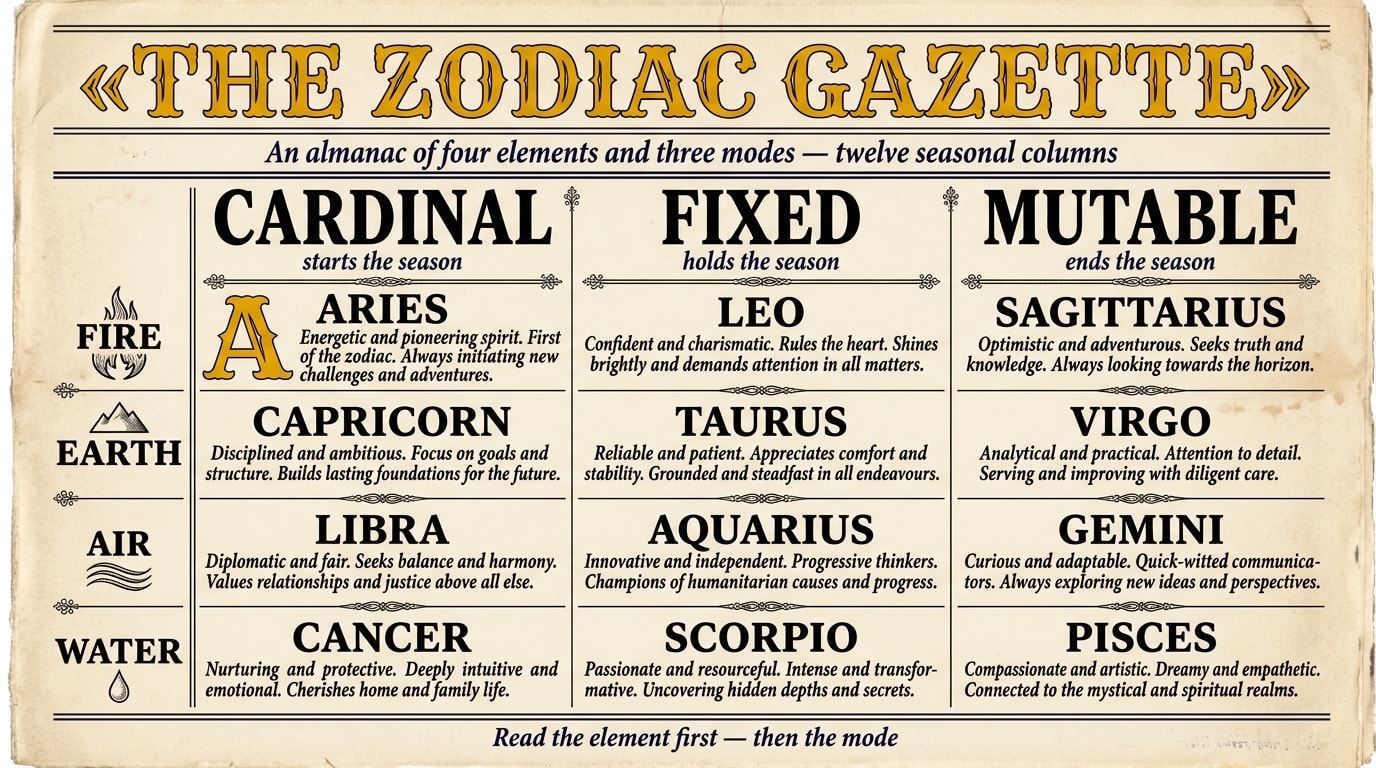
Once the matrix lands, individual signs stop looking like twelve unrelated archetypes and start looking like one orderly system. Cardinal water (Cancer) initiates through feeling; fixed water (Scorpio) holds emotional depth; mutable water (Pisces) absorbs and dissolves into the next thing. Cardinal earth (Capricorn) builds; fixed earth (Taurus) keeps; mutable earth (Virgo) refines. The same logic repeats through fire and air. That's most of the system.
The 12 zodiac signs in plain English
The twelve signs are below, grouped by their element. Element is the temperament, the dates are the range when the Sun is in them; remember the exact boundary shifts by a day between years.
Fire signs: Aries, Leo, Sagittarius
What the fire signs share is a spark — an outward, active charge, a temperature that other people can feel in the room. Fire signs lead with energy, ask questions later, and tend to be the ones who get the rest of you off the sofa.
Aries (cardinal fire, around 21 March – 19 April) is the starter. The sign that gets the new project moving, the new conversation opened, the new direction picked — and that often loses interest somewhere around week three when the next new thing appears. Best deployed when something needs beginning; less reliably deployed when something needs finishing.
Leo (fixed fire, around 23 July – 22 August) is the room-warmer. Leo wants to be seen, and at their best the room is genuinely better for them being in it; their warmth is real, the generosity comes first, and the show is part of the welcome. If you've ever been in a room that came alive when one specific person walked in, that's the Leo function — and yes, they probably knew.
Sagittarius (mutable fire, around 22 November – 21 December) is the one asking, while Aries starts the journey and Leo enjoys being on it, where exactly this road ends. The signature is restlessness with a point: the question is the work, not the answer. Sagittarius needs the horizon to be further away than the next chore, or the energy collapses into impatience.
Earth signs: Taurus, Virgo, Capricorn
What the earth signs share is a relationship with the actual — bodies, material things, the texture of how a life is built. They notice the chair you sat in. They prefer the plan that's been costed.
Taurus (fixed earth, around 20 April – 20 May) is the comfort-keeper. Senses first, slow to change, very good at building a life that is actually nice to live in. Sometimes accused of being stubborn; "consistent" is the kinder word, and it's usually closer to what's going on. A Taurus knows the difference between a tablecloth that lasts and one that doesn't, and has views.
Virgo (mutable earth, around 23 August – 22 September) is the one who quietly noticed. If you've known the colleague who spotted the error before the meeting and saved everyone six weeks of mess, you've met a working Virgo. Useful, exacting, often more anxious than they let on, almost never the one to take credit. The "critical perfectionist" caricature is the picture you get from outside; from the inside, the criticism is mostly directed at themselves.
Capricorn (cardinal earth, around 22 December – 19 January) is the long game. Takes responsibility early, plans further out than is fashionable, gets accused of being older than they are for most of their twenties. The pay-off is the version of life that takes thirty years to build and looks deceptively simple by the end — the small business, the steady marriage, the house that suits them, the work people quietly trust.
Air signs: Gemini, Libra, Aquarius
What the air signs share is language, ideas, the room between people. They think out loud, value the exchange itself, and have a deep allergy to being told what to think.
Gemini (mutable air, around 21 May – 20 June) is the talker. Thinking happens at the speed of conversation; ideas arrive in pairs, get tried on, swapped, refined. The classic Gemini stereotype, two-faced, is a misread. What is really going on is that they can hold both sides of an argument and find both partially true — which is more useful than choosing prematurely, even if it looks like indecision from outside.
Libra (cardinal air, around 23 September – 22 October) wants to think it through with you. Decisions arrive at via consultation, never by decree. The unfair caricature is "can't make their mind up". The fairer description is that Libra refuses to decide for everyone else at the table. Air signs care about ideas; cardinal air cares about a shared decision that holds up.
Aquarius (fixed air, around 20 January – 18 February) is the systems-thinker. Cares about the group, the abstract, the what-if-everyone-did-this. Famously friendly with everyone and intimate with very few. If a sign is going to disagree with you about something you assumed was obvious, the odds are good it's an Aquarius — and they will be quite kind about it while they do.
Water signs: Cancer, Scorpio, Pisces
What the water signs share is feeling as a first language. Atmosphere is data; the thing not said is often louder than the thing said. Water signs notice what other people are walking around with.
Cancer (cardinal water, around 21 June – 22 July) is the home-maker. Not necessarily a house, more a small contained world where the people inside are looked after. Soft on the outside, surprisingly indestructible on the inside; tries to leave, comes home, eats something good, decides again. Cancer is the sign most often confused for fragility; most Cancers are tougher than the people who feel sorry for them.
Scorpio (fixed water, around 23 October – 21 November) is the one who quietly filed it. If you've ever told a Scorpio one true thing about yourself and watched them notice and put it away for later, you've met the function. Goes deep, stays loyal to a very small number of people, suspects everyone else, often correctly. The mysterious-and-intense cliché is a stage description; the everyday Scorpio is just someone who can't do small talk and isn't pretending to.
Pisces (mutable water, around 19 February – 20 March) is the absorber. Takes the temperature of the room and walks home with it. Imaginative, porous, often artistic, sometimes overwhelmed. The kind of person who knows a song they haven't heard since they were seven will make them cry, and just lets it happen.
 tea + a folded newspaper, looking outside.
In short. Read your own sign for the broad shape, then read the signs of the three or four people you live and work with. Most of what's between you is already in those descriptions.
Zodiac signs vs constellations: an honest aside
Astrological zodiac signs and astronomical constellations are not the same thing, and the "13th sign Ophiuchus" story that went around in 2016 doesn't apply to Western astrology. Western astrology uses what's called the tropical zodiac, which divides the sky into twelve equal thirty-degree slices based on the seasons — 0° Aries is fixed to the spring equinox in the Northern Hemisphere, and the other eleven signs follow at thirty-degree intervals. It isn't anchored to the actual shape of the constellations.
The constellations themselves do drift relative to the seasons, very slowly, because of a wobble in the Earth's axis called the precession of the equinoxes; a full wobble takes around 26 000 years. A NASA explainer aimed at children pointed this out in a Space Place article, and a UK tabloid promptly misread it as "NASA changed astrology, your sign is wrong, also there's a new one called Ophiuchus". The story is still circulating; it was a misread then and remains one now.
What this means in practice: the twelve signs you see online are seasonal markers, not literal star groups. You don't need to take a position on whether astrology is real to use the system as a way of describing temperament. If you'd prefer a sceptical frame, the signs are a four-thousand-year-old shorthand for talking about people; if you'd prefer a working frame, they are the same shorthand still being used by working astrologers. Either way, the constellations don't come into it.
 phone face-down beside him, watching pigeons.
What to do with your zodiac sign now you know what it is
Your zodiac sign is most useful as a starting point, not a finishing one — read it as a one-page summary of one chapter, then go and read the rest of the book. Your Sun is one of ten placements. The full chart adds the Moon (inner weather, what you need to feel safe), the Rising sign (the first impression you didn't choose to make), Mercury, Venus, Mars and the slower planets that shape the longer arcs of your life. That is the structural reason people who go beyond the Sun sign tend to find that astrology suddenly "clicks"; they're reading a full sentence instead of one word.
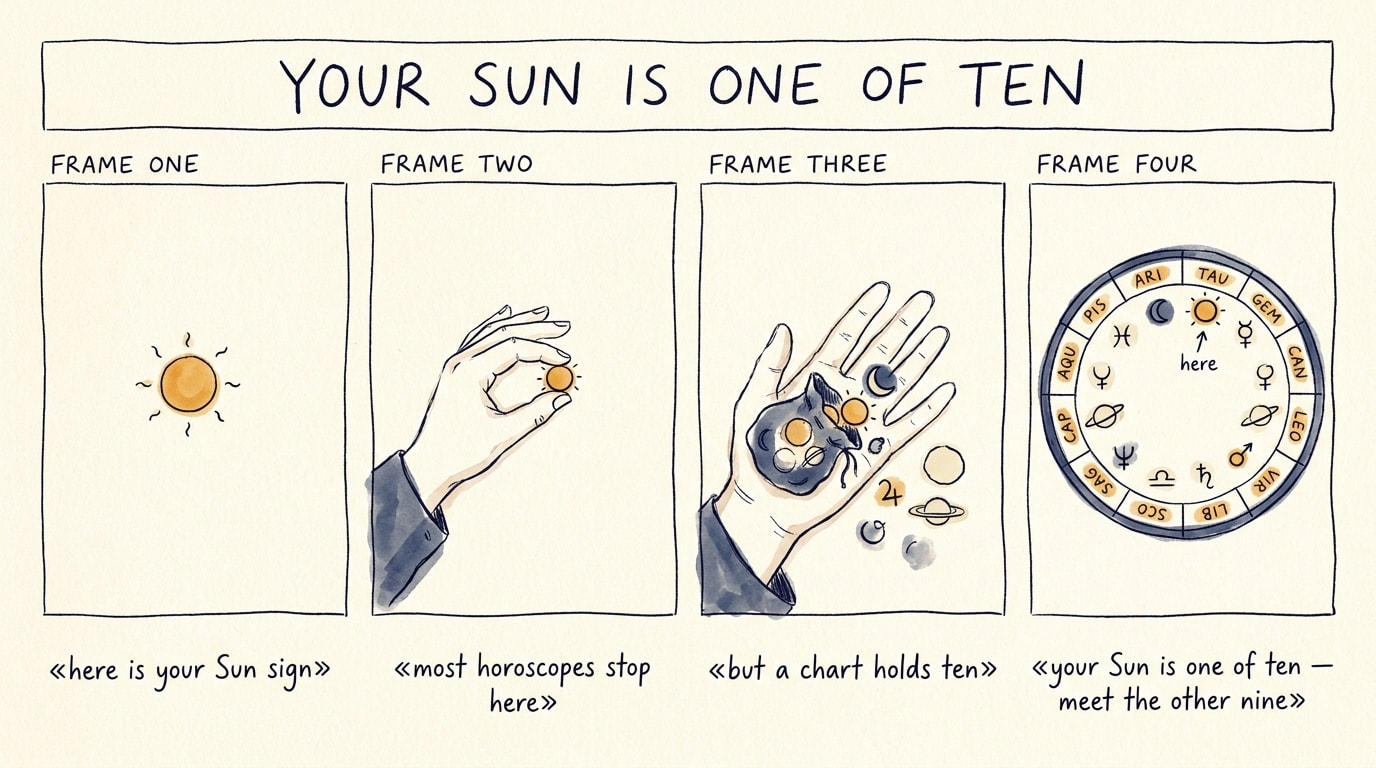
Three practical moves. First, re-read your own Sun sign and the Sun signs of the four or five people closest to you, as a quick character-key — already more than most of what daily horoscopes will ever give you. Second, look up your own Moon and Rising; they need your birth time and place, and together with your Sun they form what astrologers call the big three. Third, if it's still interesting at that point, do the full chart.
If you'd like to see the other nine, WowAstro will calculate your free birth chart — date, time and place, and it takes a couple of minutes. Most of the surprise of astrology lives there, in the difference between what your Sun sign says about you and what the other nine add.
Questions readers ask
What's the difference between zodiac signs and horoscope signs?
In everyday English they mean the same thing. "Zodiac sign" and "horoscope sign" both refer to the sign the Sun was in on your date of birth — what astrologers more precisely call your Sun sign. Strictly, the zodiac is the belt of twelve signs around the sky; a horoscope is a chart drawn for a specific moment, originally the moment of someone's birth (the Greek word hōroskopos literally means "time-watcher"). So the formal distinction is that "horoscope" is the diagram and "zodiac" is the wheel of signs the diagram uses. In casual use, the two words have collapsed into one another and almost always point to the same thing.
Why are the zodiac sign dates slightly different on different websites?
Because the Sun changes sign at a different clock time each year, and most sites give a rounded average rather than the exact boundary. A tropical year is about 365.25 days, so the moment the Sun moves from one sign to the next drifts by about six hours per year, then snaps back when a leap year adds a day. That drift is enough to land the sign-change on the 20th of March one year and the 21st the next. None of the sites is wrong; they're just rounding differently. If you were born within a day of a boundary, the only thing that decides your sign for certain is a chart calculated for your exact birth date, time and place.
What's a cusp sign, and am I one?
A "cusp" is a popular shorthand for being born close to the boundary between two signs — typically within a day or two on either side. Strictly, though, there's no such thing as a cusp sign astronomically: at the exact instant of your birth, the Sun was either in one sign or the next, with no in-between. People born near a boundary often relate to traits of both signs because the rest of their chart pulls in two directions; for example, the Sun might be in Aries but the Moon might be in Pisces, which gives a recognisable Aries-with-Pisces-flavour feel. The way to know for sure which sign your Sun was in is to have a chart calculated for your exact birth time.
How accurate are zodiac signs as personality descriptions?
A Sun sign description is one accurate layer of about ten, and how "accurate" it feels depends on the rest of your chart. If your Moon, Rising and Venus are in signs broadly similar to your Sun — say, three water signs in a chart — the Sun sign description will tend to feel uncannily right. If they pull in different directions, the same description will feel half-right, which is what most people experience. The Sun sign isn't wrong; it's just one chapter, and your chart is a whole book. People who find astrology suddenly useful are usually the ones who looked beyond the Sun and started reading the rest.
Read the wider context in our guide to your full birth chart
A note on what this is. Astrology, as we use it at WowAstro, is a tool for self-reflection and self-understanding, not a method for predicting events, health, or financial outcomes. Read your signs as descriptions of temperament, take what's useful, leave the rest.
About this article: WowAstro readings combine traditional astrological methodology (Swiss Ephemeris calculations, Hellenistic and modern psychological frameworks) with AI-assisted writing reviewed by Oksana Miatova before publication. For entertainment and self-reflection only — not medical, legal, or financial advice. Full editorial policy at /editorial-standards.
Written by Oksana Miatova, astrologer and writer at WowAstro. Charts calculated using the Swiss Ephemeris, the same astronomical data working astrologers use.
Read your own natal chart
A personal AI reading, from £1
⭐ +50 Wow Stars cashback · sign up and get 100 ⭐
Build my chart →Comments
New here? Get −30% off your natal chart
Leave your email and we will send you the promo code WELCOME30. Straight after that you can comment — no passwords, all automatic.
Quick sign-in
Sign in with Telegram — one click.
Or by email (with a gift)
Already have an account? Enter the same email — we'll email you a sign-in link.