Three horoscope sites can read Cancer and Scorpio and come back with "soulmates", "watch the possessiveness", and "difficult match", each writer perfectly confident. They aren't lying. They're all looking at the same one tenth of the chart and filling in the rest with mood. Astrological birth chart compatibility — the real version — has a mechanics underneath it. Four elements, three modalities, a handful of geometric angles between planets, and the question of which house each planet falls into when you overlay two charts. Once you can see the moving parts, the sign-pair verdicts start to make sense, and you stop needing the verdicts.
This guide is the framework, not a sign-pair lookup. We'll walk through how the elements (fire, earth, air, water) and modalities (cardinal, fixed, mutable) shape temperament, how aspects (square, trine, opposition) describe the conversation between planets, and how house overlays show where one person lands inside the other's life. Then we'll show the five synastry placements that actually carry the weight in a first read, and what so-called "difficult" aspects really mean.
→ For a quick sign-by-sign reference (Aries through Pisces, who works easily with whom), see Zodiac Compatibility by Sign — the sister piece to this one. This article explains the machinery; that article applies it twelve times.
In short. Astrological birth chart compatibility — properly called synastry — runs on four moving parts: the elements and modalities of each sign (temperament), the geometric aspects between planets (the conversation), the house overlays (where one chart sits inside the other), and a small set of load-bearing placements (Moon-Moon, Venus-Mars, Sun-Moon, overlays, Ascendants). Sun-sign tables only read one tenth of the picture. Difficult aspects describe friction, not doom; a chart describes a dynamic, not an outcome.
 writing in a journal, lamp on.
Why sun-sign tables disagree with each other
Sun-sign compatibility tables disagree because each table reads one planet out of ten and calls the result a relationship.

Your Sun sign covers roughly one twelfth of one placement in one of two charts; a real relationship runs on ten planets across two charts, plus the conversations the planets have with each other. Three big horoscope portals can each look at Cancer and Scorpio and come back with "soulmates", "watch the possessiveness" and "challenging match" because each writer privileges a different angle on the same single data point. Nobody is exactly wrong; everybody is reading the same one tenth of the chart and filling in the rest with mood. Before you trust any compatibility result, the most useful question is what it actually compared.
Synastry, the technique behind real compatibility work, comes from the Greek syn-astron, literally "stars together". It takes both birth charts and lays one over the other to see how the planets of one person sit in relation to the planets of the other. The output isn't a verdict; it's a description of the dynamic between you.
Here's the difference in one table.
| Sun-sign compatibility | Synastry | |
|---|---|---|
| What it compares | One Sun sign vs one Sun sign | All ten planets in chart A vs all ten in chart B |
| Data needed | Two dates of birth | Date, time and city of birth for both people |
| Possible results | 144 (one cell of a 12×12 grid) | Effectively unique for every pair |
| Houses (areas of life) | Not used | Used: where one person's planets land in the other's life |
One related word, in case it comes up. A composite chart is not the same as a synastry chart. Synastry overlays your two separate charts to see the conversation between you. A composite is a single new chart, calculated from the midpoints of both, that describes the relationship as a third entity. For a first read of compatibility, synastry is the one you want.
The five placements that actually matter
Five synastry placements carry most of the weight in a first read: Moon-to-Moon, Venus-to-Mars, Sun-to-Moon, house overlays, and the Ascendants.
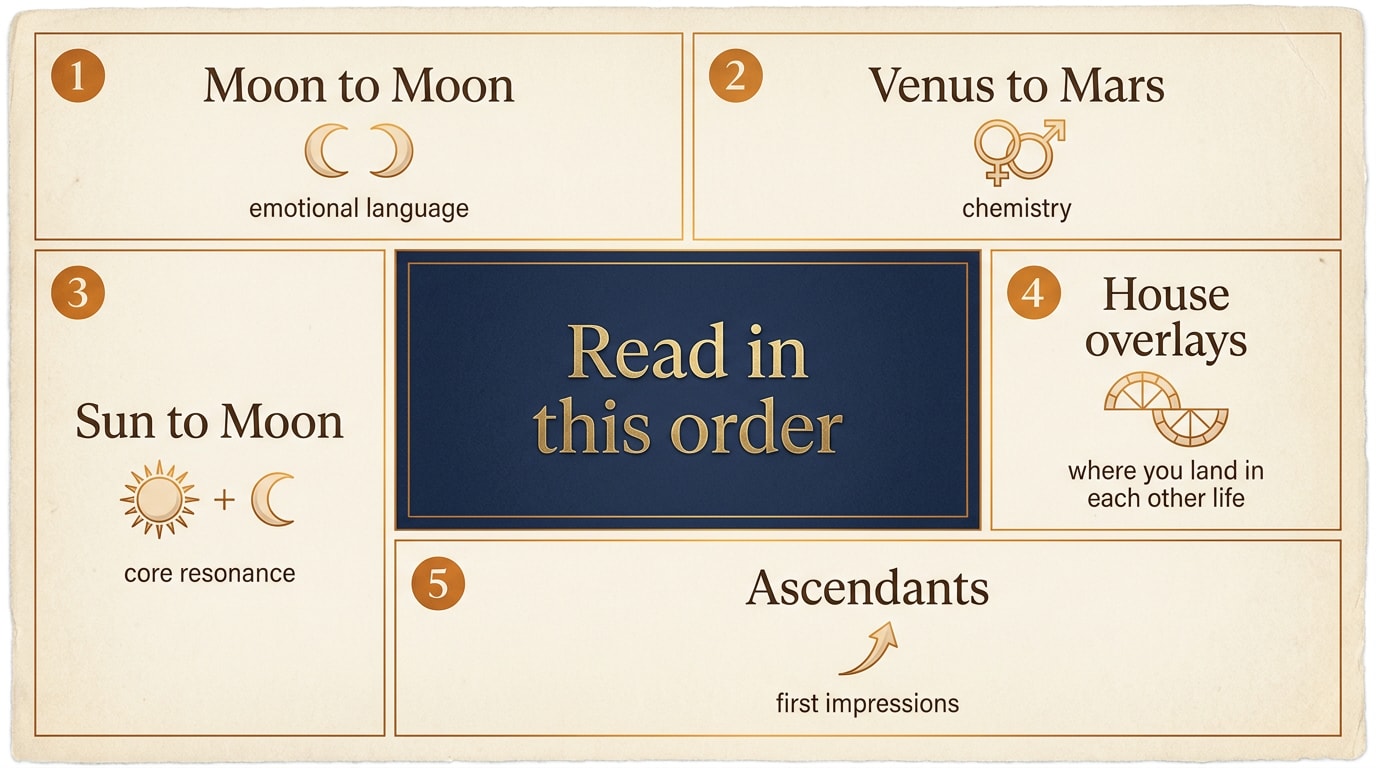
A full synastry chart has dozens of aspects, and reading them all at once is the standard way beginners stall. These five recur across the working canon of relationship astrology as the load-bearing factors. Read them in this order, and you'll have most of what the charts are telling you.
Moon to Moon: your emotional language
Your Moon describes your emotional reflex. How you recover from a hard day, what you need around you to feel at home, what comes out when you've stopped performing. When two Moons sit in an easy aspect to each other, there's a particular kind of relief in the other person's company; you don't have to explain why a sound bothered you or why you went quiet after a phone call.
A Cancer Moon trine a Pisces Moon is a soft, intuitive resonance: both people sense moods rather than wait to be told them. The same Cancer Moon meeting an Aries Moon by square is a different climate altogether. One person processes feeling by talking about it now; the other needs slow time. Neither is broken; the pair just have different operating systems and will keep finding the seam.
This is why Moon-to-Moon is the load-bearing factor. You can live with someone whose taste in films you don't share. If you don't share an emotional language, every minor disagreement reads as a wall.
Venus to Mars: the chemistry question
Venus describes how you love and what you find beautiful. Mars describes how you act and what you pursue. When one person's Venus meets the other person's Mars by aspect, you get the thing people clumsily call chemistry: the wanting, the leaning in.
A Taurus Venus flowing into a Virgo Mars is a quiet, steady chemistry. Attraction expressed through small acts of care, through being useful, through showing up. Not the fireworks; the long-burning fire. A Scorpio Venus square a Leo Mars is a louder business. The pull is strong and the friction is also strong; one person wants depth and intensity, the other wants admiration and freedom. The relationship probably never gets boring; it also probably never gets quiet for very long.
A useful filter: a chart with no Venus-Mars aspects between the two people often produces a friendship that everyone keeps insisting should be a relationship and never quite is.
Sun to Moon: the core resonance
When one person's Sun makes a supportive aspect to the other person's Moon, you get a quieter, deeper layer. The Sun person's basic way of being matches what the Moon person needs in order to feel safe. Without putting it into words, one of you feels recognised; the other feels at home being who they are. It's the placement that often sounds like "I felt like I'd known him for years" in the first month, and like a steady undertow in year ten.
House overlays: where you land in each other's life
A house overlay is what happens when you take your partner's planets and drop them into the wheel of your chart. The houses are the areas of life: your seventh is partnership; your fifth is play and romance; your fourth is home and the people you let close.
If a partner's Sun lands in your seventh house, you tend to read them as someone to take seriously, even on the first date. If their Venus lands in your fifth, the relationship feels playful, romantic, like a long flirtation; in your fourth, they feel like home from the first weekend. The overlays don't change who either of you are; they describe what each of you sees in the other almost involuntarily.
The Ascendants: the first-impression layer
Your Ascendant is the surface, the first impression you didn't choose to make. When one person's Ascendant sits close to the other person's Sun or Moon, there's an immediate sense of recognition. Not always pleasant, by the way; it can feel like an old argument from the first hello, depending on the rest of the chart. The Ascendants are the smallest of the five factors but the fastest acting, which is why they often dominate the first month.
In short. Read your synastry in this order: Moon-Moon (emotional language), Venus-Mars (chemistry), Sun-Moon (core resonance), house overlays (where you land in each other's life), then Ascendants. The rest of the chart can wait.
What "difficult" aspects actually mean
Squares and oppositions in synastry describe friction, not doom. Sun-sign tables call certain pairs "incompatible" because they treat friction as a failure mode, but in synastry friction often functions as the engine of a long relationship. A chart full of trines and sextiles, the so-called easy aspects, frequently produces a relationship that's pleasant and somehow flat. The pairings that last are usually the ones with at least one square that the two people have learned to work with. The trick is not to read a square as a verdict, but as a description of where you'll keep doing the work.
Three quick examples. A Saturn square Venus describes structure pressing on softness; one person plays the slightly older, more reserved role, the other sometimes feels as if affection has to be earned. It can read as "he's so cautious about us", and it can also read as the reason a relationship is still standing twenty years in.
 phone on lap face-down, hand on temple.
Mars square Mars describes two people who do conflict at different speeds; one wants the argument now, the other needs a day. Worked through, this is the couple who fight cleanly because they've stopped expecting the same rhythm from each other. Pluto in aspect to a Moon describes intensity, not toxicity: the conversations get deep quickly, the emotional weather gets heavy on bad days. With honest communication, the layer makes the relationship feel important.
If the synastry chart shows zero friction anywhere, by the way, it's worth double-checking you got the birth times right.
A worked example: reading one synastry chart step by step
Most compatibility guides explain the symbols and leave you to assemble them. Here's one chart, end to end. The two people below are illustrative, not a real couple, just a plausible pair of charts that shows the moves.
Partner A: Sun in Capricorn, Moon in Pisces, Venus in Sagittarius, Mars in Aries, Rising in Taurus. Partner B: Sun in Cancer, Moon in Taurus, Venus in Gemini, Mars in Virgo, Rising in Cancer.

Start with the Moons. Pisces and Taurus is a quiet sextile: water meeting earth, both signs receptive, both comfortable with slow time. Partner A, dreamier on the inside than the public face suggests, meets in Partner B someone who responds with grounded, sensory, food-and-blankets warmth. They will probably be very good at evenings in, and the Moon-to-Moon connection is the thing they'll fall back on when other parts of the chart pull harder.
Now the Venus-Mars. Partner A's Sagittarius Venus wants love expressed through movement, plans, a sense of going somewhere; Partner B's Virgo Mars acts through precision, through being useful, through doing it properly. Square aspect, so friction, but not the dramatic kind: more "can we just decide where to eat", week after week. Worked through, this becomes their longest-running and most affectionate negotiation.
Sun to Sun. Capricorn opposite Cancer is the classic complementary pairing — work and home, the long climb and the warm interior. Each one carries the side the other isn't doing. The risk is the easy projection of "you'll do that bit, so I won't have to"; the reward, when both stay responsible for their own side, is unusual range.
House overlays. Partner A's Capricorn Sun falls into Partner B's seventh house, the house of committed partnership; from the first conversation, Partner B reads Partner A as relationship-shaped, not friend-shaped. Partner B's Cancer Sun lands in Partner A's third house, communication and daily contact, which is why Partner A keeps finding reasons to text mid-workday. Ascendants: Partner A's Taurus Rising and Partner B's Cancer Rising are different but compatible surfaces, both reserved, both slow to warm, both more comfortable being asked than asking. They probably read each other accurately within the first conversation, and the recognition is part of why both of them stayed in touch.
What a synastry read does. It turns ten plus ten placements into a paragraph about a particular relationship: what's easy, where you'll keep working, what you bring each other that neither of you noticed needing. It doesn't tell you to stay or to leave. It describes the material you're working with.
What you end up with is a recognisable couple. Two people who fall asleep early and well together, who argue about which Tuesday to do the thing, who give each other something the other one hasn't been getting elsewhere. Not "compatible" or "incompatible" — a relationship with a shape.
How to actually check compatibility yourself
To check synastry yourself you need date, time and city of birth for both people; without exact birth times you can still read most of the picture. The Moon, Venus, Mars and the Sun-to-Sun and Sun-to-Moon dynamics work without precise birth times, with some loss of resolution. The Rising sign and the house overlays don't; both need the hour and minute. A partial read, in other words, still surfaces three of the five big factors, which is more than any sun-sign table will ever give you.
Four practical steps. First, get the data: date, time to the nearest minute if possible, and city of birth, for both of you. Hospital records, baby books, your mother's memory, your partner's birth certificate. Second, if a birth time is missing, do the partial read; on most days the Moon sign is unambiguous, and you'll lose roughly two of the five factors (the Ascendant and the house overlays). The other three still work. Third, look at the placements in order: Moons first, Venus-Mars second, then Sun-Sun and Sun-Moon, then house overlays, then Ascendants. Resist the temptation to chase obscure aspects (Chiron, the Vertex, midpoints) on a first read; they're not the load-bearing factors. Fourth, if you'd like to see this on your own charts rather than an illustrative one, WowAstro will run a synastry for both of you using the Swiss Ephemeris — the same astronomical data working astrologers use. Date, time and place for both; it takes a couple of minutes.
 sitting on bench drinking water.
What synastry is for, and what it isn't
A synastry chart is most useful as a mirror for what a relationship is doing, not a verdict on whether it should continue. The chart describes the dynamic between you: how you meet, attract, irritate, soothe and surprise each other. The dynamic is the raw material; what you make of it is the relationship. Couples with "hard" synastry have built long marriages; couples with "easy" synastry have parted. The chart is information, not the decision.
The most useful way to read your own synastry is as a prompt. This is the pattern — what do we want to do with it? Notice the parts of the description that ring true and the parts that don't. The ones that ring true are usually the work; the ones that don't are usually the parts the chart got right but the relationship has already grown past.
Questions readers ask
Is zodiac compatibility real?
Sun-sign compatibility is real in the limited sense that signs do colour personality, and a Sun-sign comparison can give you a vague flavour of a pairing. It's still only one tenth of the chart. Full synastry uses ten planets across two charts and is considerably more informative; that's why two sun-sign sites can give you opposite verdicts on the same pair and both feel internally consistent.
Can I check synastry without my partner's birth time?
Yes, partially. Without exact birth times you lose the Rising signs and the house overlays, which is roughly two of the five big factors. The Moon, Venus, Mars and the Sun-Sun and Sun-Moon dynamics still read, with some loss of precision around the Moon if your partner was born close to midnight or noon and the Moon was changing signs that day. A partial synastry read is still considerably more useful than a sun-sign table.
Does a Saturn square in synastry mean the relationship will fail?
No. A Saturn square in synastry describes structural pressure; one partner often plays the slightly older or more cautious role, sometimes both at different times. It tends to make a relationship feel more serious early on and, when both people name what's happening, more durable later on. Plenty of long marriages have a Saturn square at the centre of the chart. What they have in common is that they stopped taking it personally.
What's the difference between synastry and a composite chart?
Synastry overlays your two separate charts to see how you interact, planet by planet. A composite chart is a single new chart calculated from the midpoints of both, which describes the relationship as a third entity in its own right, separate from either of you. For a first read of a couple, synastry is the more direct tool; the composite is useful later, when you want a sense of the relationship's own character.
Read the wider context in our guide to your full birth chart
A note on what this is. Astrology, as we use it at WowAstro, is a tool for self-reflection and self-understanding, not a method for predicting events, health, financial outcomes or whether a relationship will last. Read a synastry chart as a description of a dynamic, take what's useful, leave the rest.
About this article: WowAstro readings combine traditional astrological methodology (Swiss Ephemeris calculations, Hellenistic and modern psychological frameworks) with AI-assisted writing reviewed by Oksana Miatova before publication. For entertainment and self-reflection only — not medical, legal, or financial advice. Full editorial policy at /editorial-standards.
Written by Oksana Miatova, astrologer and writer at WowAstro. Charts calculated using the Swiss Ephemeris, the same astronomical data working astrologers use.
See what your charts say about each other
A personal AI synastry reading — not a sun-sign table, but an analysis of both natal charts across 8 areas of the relationship
Comments
New here? Get −30% off your natal chart
Leave your email and we will send you the promo code WELCOME30. Straight after that you can comment — no passwords, all automatic.
Quick sign-in
Sign in with Telegram — one click.
Or by email (with a gift)
Already have an account? Enter the same email — we'll email you a sign-in link.