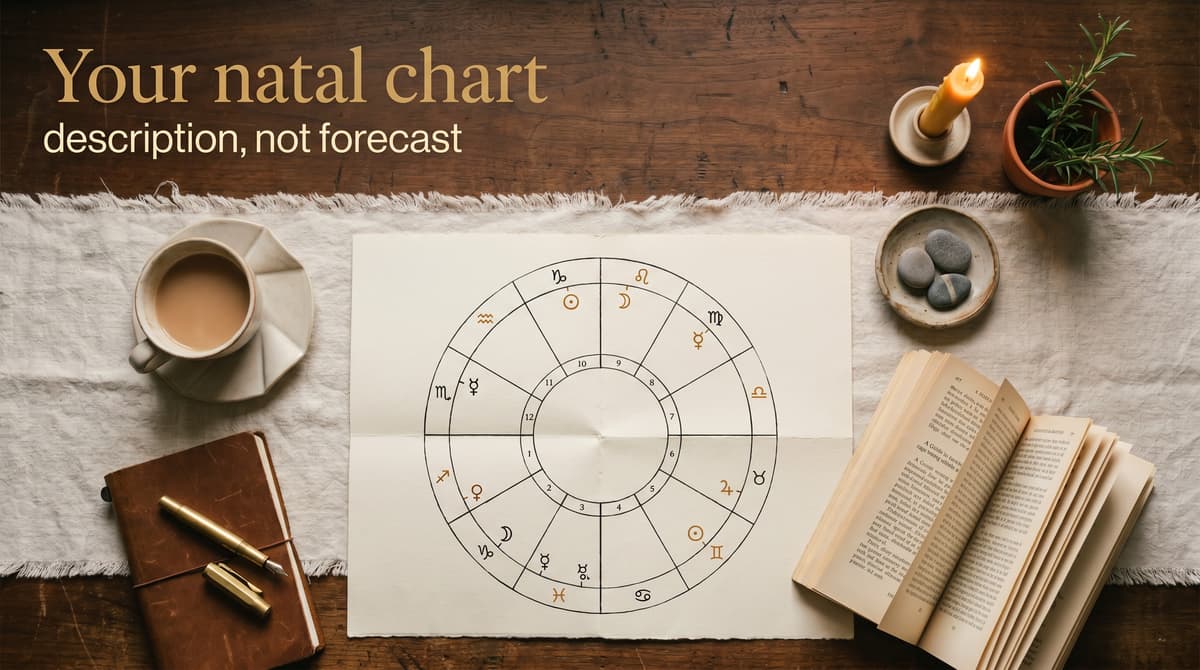
You were born somewhere, at some particular minute. A birth chart is simply a map of where the planets sat in the sky at that moment — drawn from your date, time and place of birth. That's the whole input. What it gives back is harder to summarise, which is probably why most guides skip the explaining and go straight to the jargon.
This is the walkthrough — practical steps to follow with your own chart open. If you want the concept side first (what a chart actually is, what each of the four layers means before you sit down to read), start with Your birth chart explained: a complete beginner's guide and come back when you're ready to apply it.
Reading your chart isn't about memorising symbols or bracing for a verdict. It's a way of looking at yourself from a slight distance — and most of what you'll find is less a prediction than a description of patterns you may already half-recognise.
In short. To read a birth chart, start with the big three, your Sun, Moon and Rising sign. Then read each planet as three things at once: a what (the planet), a how (its sign) and a where (its house). Finally, notice the major aspects — how the planets connect. A birth chart describes tendencies and patterns, not fixed events.
 A chart at the desk — less verdict, more conversation.
What a birth chart is, and what it can't tell you
A birth chart is a snapshot of the sky at the exact minute you were born. It takes three inputs (date, time and place) because the sky changes by the minute, and the chart maps how the planets sat at that single point. The Rising sign in particular moves on every couple of hours, so the time you were born actually changes the chart. WowAstro calculates charts using the Swiss Ephemeris, the same astronomical data working astrologers rely on. Before you read anything, dig up your birth time as exactly as you can; a noted minute makes a different chart from a guessed one.
What a birth chart describes is the shape of you: the tendencies you bring, the reflexes you fall into under pressure, the directions you tend to grow towards. It is a description, not a verdict.
What it doesn't do is predict events. Your chart will not name the date you meet someone or change jobs. If a guide tells you yours will, the writer has wandered out of astrology and into entertainment-as-fortune-telling. We're staying with the first kind here.
Start here: the four placements to read first
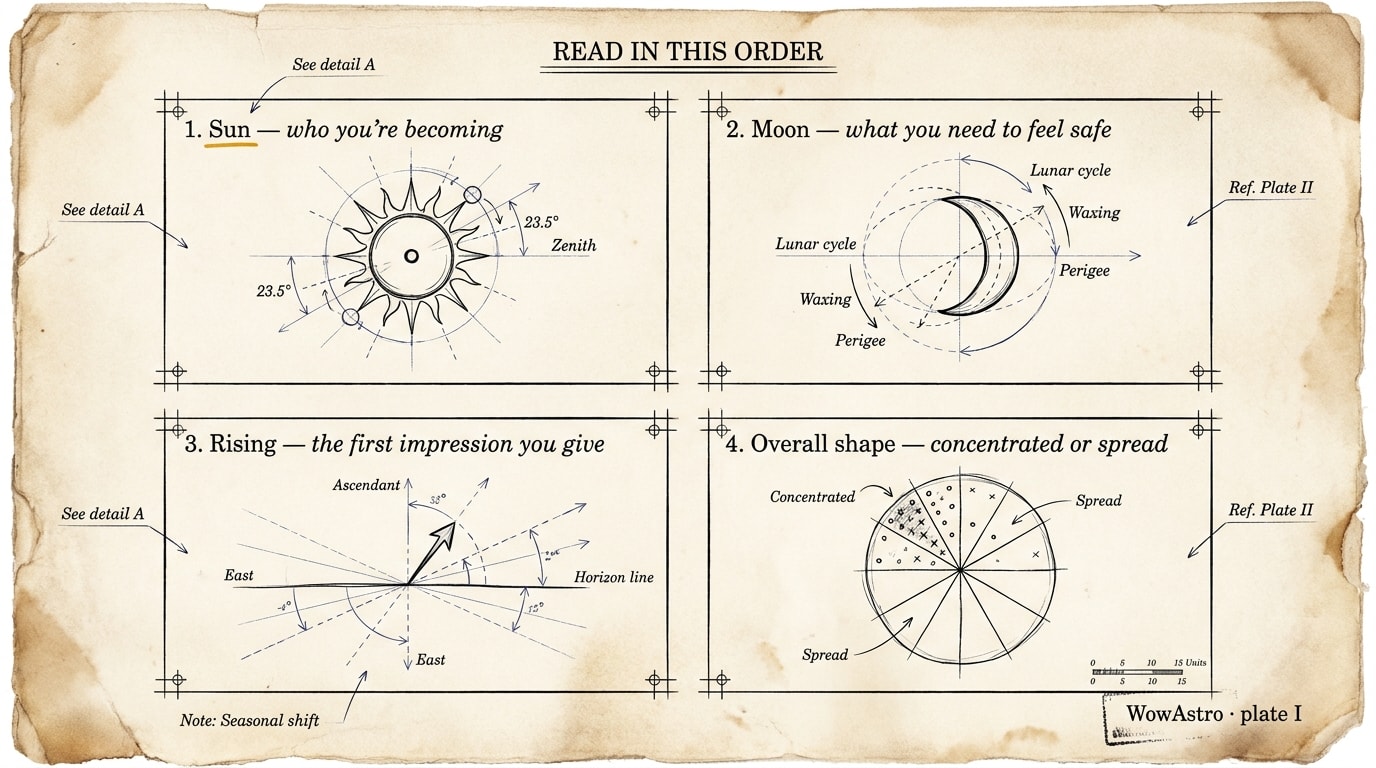
When you sit down with your birth chart for the first time, start with four placements, in this order: your Sun, your Moon, your Rising sign, and the chart's overall shape. A full chart has dozens of moving parts, and most beginners stall by trying to read everything at once. These four carry most of the chart's grammar; read them and you'll have the bulk of what the chart is saying about you. Read them first, and resist looking at anything else until they're sitting clearly in your head.
Sun: who you're becoming
Your Sun sign is the part most people mean when they say "I'm a Scorpio". It describes your sense of will, the life that lights you up, and the core you're growing into. The catch: the Sun is one of ten placements, so reading only your Sun sign is reading one tenth of the chart. That is why a horoscope column rarely quite fits.
Moon: your inner weather
Your Moon sign is what you need in order to feel safe: how you process emotion, what calms or unsettles you. It's the part that comes out at home, late, with people you don't need to perform for. The Moon changes signs every couple of days, so its position depends on the day of your birth.
Rising sign: the first impression you didn't choose
Your Rising sign, or Ascendant, is how strangers tend to read you in the first few seconds. It moves every two hours or so, which is why your birth time matters: without it, the Rising can't be calculated reliably.
Overall shape: concentrated or spread
Step back from the wheel and look at where the planets cluster. All on one side, spread evenly around, or held in one quarter? This shape (astrologers call it the chart pattern) tells you whether you're someone who concentrates intensely on a few areas of life or one who spreads attention across many.
In one line. Sun (who you're becoming), then Moon (what you need to feel safe), then Rising (how the world first reads you), then overall shape (concentrated or spread). Get these four straight before touching the rest.
How planets, signs and houses fit together
Each placement in a birth chart reads as three layers. The planet is the function: Mercury for thinking and speaking, Venus for love and values, Mars for action. The sign describes how that function operates; Gemini makes thinking quick and curious, Capricorn makes it careful and weighty. The house fixes the placement to an area of life, like everyday communication, partnership or public reputation. Once this three-layer reading clicks, the chart stops being a puzzle of separate symbols and starts behaving like a sentence with grammar.
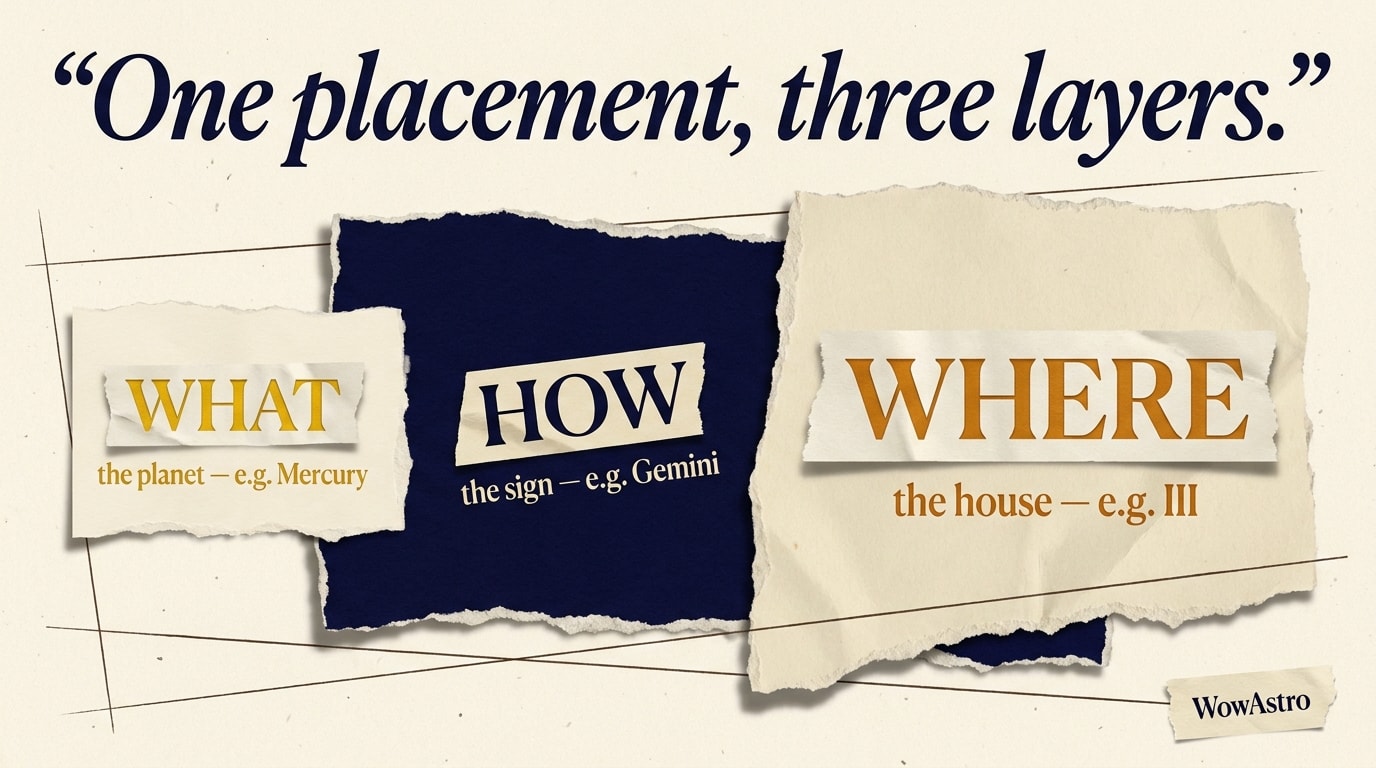
| Layer | The question it answers | Example |
|---|---|---|
| Planet | What function? | Mercury: thinking and speaking |
| Sign | How, in what style? | Gemini: quick, curious, restless |
| House | Where, in what area of life? | 3rd house: day-to-day communication |
Put them together. Mercury in Gemini in the 3rd house is a recognisable person: someone whose mind moves quickly between subjects, who thinks out loud, and who does this most visibly in everyday conversations, emails and short messages. The same Mercury planted instead in Capricorn in the 10th house becomes a careful, methodical thinker whose words land hardest in their work and public reputation. Same planet, completely different person, because the how and the where changed.
This is the move you make for every planet on the wheel. Read it as a sentence: what, how, where.
What aspects mean: how the planets connect
Aspects are the angles between planets in your chart — the conversations between different parts of you. For a first read, three of them carry most of the weight. A conjunction (two planets sitting on top of each other) merges them, so they amplify or interfere with one another. A trine (an angle of around 120°) is an easy, frictionless flow between two planets. A square (around 90°) is friction: a long-running tension that usually doubles as a point of growth. A Saturn–Sun square, for instance, often reads as discipline pressing against vitality: a long, slow fight to find your own authority.
You'll find more aspect types if you keep reading: sextiles, oppositions, quincunxes. For a first pass, ignore them. Pick out the two or three strongest aspects in your chart and read those. Mercury retrograde, while we're here, gets blamed for a great deal more than it actually causes.
A worked example: reading a birth chart step by step
Most chart guides explain the symbols and leave you to assemble them. Let's actually do it, with one chart, end to end. The chart below is illustrative (not a real person, just a plausible combination), but it shows the order of moves.
Sun in Capricorn. Moon in Pisces. Rising in Gemini.
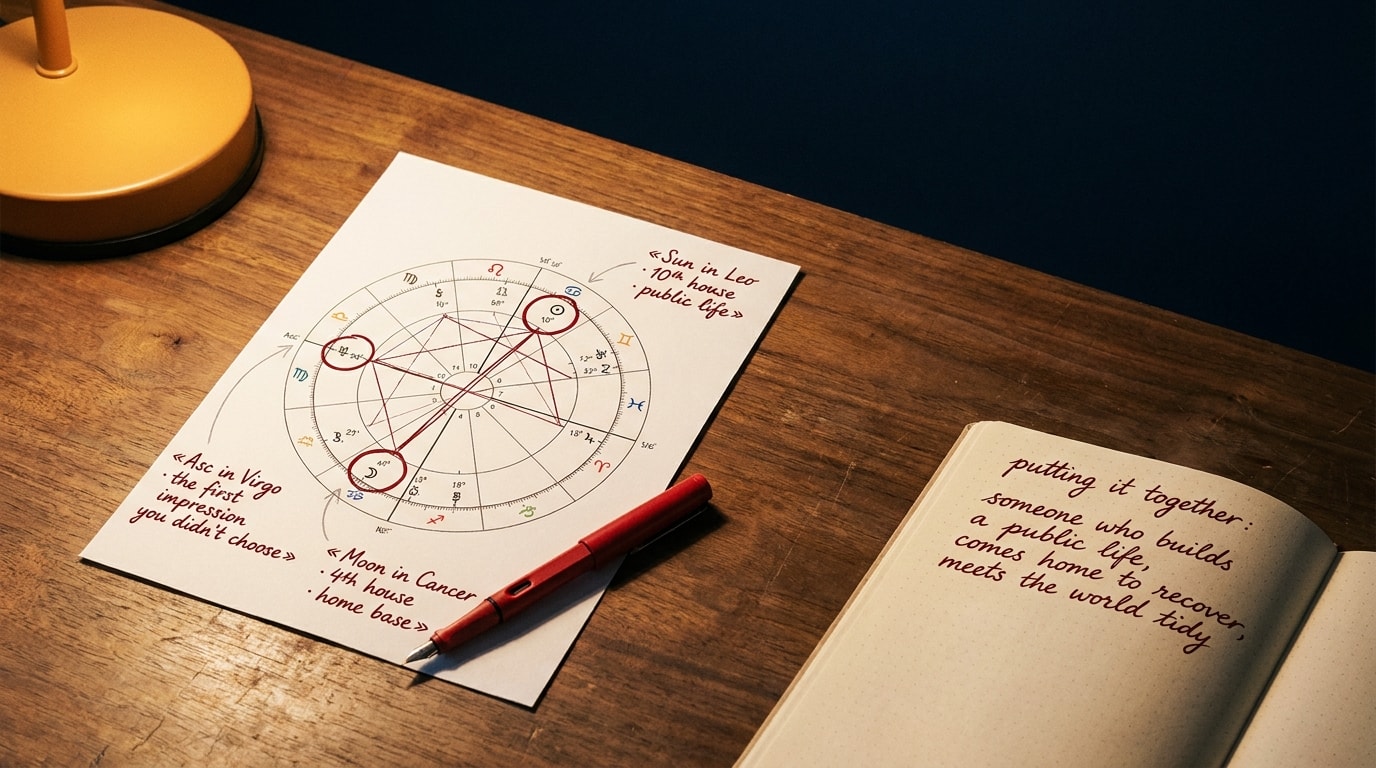
Start with the big three. The Sun in Capricorn names the core: someone growing into seriousness, responsibility, the long climb. The Moon in Pisces softens the inside, so this is a person whose private emotional life is more dreamy and porous than the public look at them suggests. The Rising in Gemini sets the surface as quick, curious, talkative, with a first impression of lightness that doesn't quite describe the inside.
Already there's a tension worth noting. The Capricorn Sun wants structure and the long view. The Pisces Moon needs space to drift. That's not a contradiction to fix; it's a description. This person probably alternates between disciplined stretches and quiet retreats, and probably feels best when both have room.
Now read one planet as a three-layer sentence. Suppose Mercury sits in Capricorn in the 6th house. Mercury is thinking and speaking. The Capricorn placement makes that thinking careful, weighty, structured. The 6th house plants it in work, habits and daily routine. Read together: a careful, methodical thinker whose mind comes most alive in the texture of everyday work.
 One placement at a time, read on a slow afternoon.
One aspect to anchor it. Suppose Saturn forms a square to that Sun. A Saturn–Sun square reads, as we said, as discipline pressing against vitality: a recurring sense that you have to earn your own right to take up space. Combined with the Capricorn Sun, this isn't a surprise; it's a familiar pattern that explains itself.
What emerges is a quietly serious person with a softer interior than they show, who thinks carefully and works through the texture of small things, and who carries an old sense that authority has to be built. Not a verdict — a description.
What a chart read does. It turns a wheel of symbols into a paragraph about a recognisable person. It doesn't tell that person what to do. It describes the material they're working with.
 The actual work happens after you put the chart down.
What your birth chart is for, and what to do next
A birth chart is most useful as a prompt for self-reflection, not a verdict to obey. The point isn't to memorise what your placements "mean"; it's to use the descriptions as questions you put to your own life. Where does this pattern show up? When does it serve me? When does it run me?
Try this with one placement at a time. Pick the one that struck you most as you read this. Sit with the description for a day. Notice the moments it describes you and the moments it doesn't. That noticing, not the symbol, is the actual work.
If you'd like to see this on your own chart rather than an illustrative one, WowAstro will calculate a free birth chart for you. Date, time and place; it takes a couple of minutes.
Questions readers ask
Do I need my exact birth time to read my birth chart?
If you can find your birth time to the minute, your chart will be accurate. Without it, you can still read your Sun, Moon, Mercury, Venus and Mars (most of the chart's information), but your Rising sign and house positions can't be calculated reliably. Hospital records, a baby book or your birth certificate usually have the time. If none of those exist, an astrologer can do something called rectification: working backwards from key life events to estimate the time.
Can I read my birth chart without knowing astrology?
Yes; the four-step method above is designed for exactly that. Start with your big three (Sun, Moon, Rising), read each planet as planet–sign–house, then notice your strongest two or three aspects. You won't catch every nuance on the first read, but you'll get most of the chart's shape. The rest builds with practice; after a few charts, the grammar becomes second nature.
Does my birth chart predict my future?
No, and astrologers who promise it does are reaching past what the chart actually shows. A birth chart describes tendencies and patterns: how you're wired, what you reach for, where you tend to grow. It doesn't name the date you'll meet someone or change jobs. The future is yours to make; the chart is a description of the material you're working with.
What is the most important part of a birth chart?
The big three (Sun, Moon and Rising sign) carry the most weight in any first read. They describe, respectively, who you're becoming, what you need to feel safe, and how others first see you. If you only ever read one part of your chart, read the Sun. If you read three, make it those three.
A note on what this is. Astrology, as we use it at WowAstro, is a tool for self-reflection and self-understanding, not a method for predicting events, health, or financial outcomes. Read your chart as a description, take what's useful, leave the rest.
About this article: WowAstro readings combine traditional astrological methodology (Swiss Ephemeris calculations, Hellenistic and modern psychological frameworks) with AI-assisted writing reviewed by Oksana Miatova before publication. For entertainment and self-reflection only — not medical, legal, or financial advice. Full editorial policy at /editorial-standards.
Written by Oksana Miatova, astrologer and writer at WowAstro. Charts calculated using the Swiss Ephemeris, the same astronomical data working astrologers use.
Read your own natal chart
A personal AI reading, from £1
⭐ +50 Wow Stars cashback · sign up and get 100 ⭐
Build my chart →Comments
New here? Get −30% off your natal chart
Leave your email and we will send you the promo code WELCOME30. Straight after that you can comment — no passwords, all automatic.
Quick sign-in
Sign in with Telegram — one click.
Or by email (with a gift)
Already have an account? Enter the same email — we'll email you a sign-in link.