Three Instagram stories in a row warn you that Mercury retrograde starts tomorrow. A chaos guide from a lifestyle site you half-trust tells you not to sign contracts, not to buy a laptop, not to text your ex. By the time you've finished your coffee, the next three weeks have become a sky-shaped problem you weren't asking for.
Here's the working astrologer's open secret about Mercury retrograde: most of what's said about it is louder than what astrology actually says. The astronomy is explainable in two paragraphs. The astrological tradition is calmer than the chaos guides suggest. The three-week window has a particular shape, but the shape isn't a doom calendar. It's a quieter, more inward stretch of the year, and the worst thing to do with it is brace.
In short. Mercury retrograde is an optical illusion. Mercury isn't actually moving backwards, it appears to, briefly, from Earth's vantage point. It happens three or four times a year for about three weeks each time. Astrologers read the window as quieter and more reflective — review, revise, revisit, rather than as a list of things to avoid.
 turning page of large hardback.
What's actually happening when Mercury 'goes retrograde'
Mercury isn't moving backwards. The planet keeps travelling forward around the Sun at roughly forty-seven kilometres per second, the way it has for billions of years. What changes, three or four times a year, is how Mercury looks from where you're standing on Earth. For about three weeks at a time, Mercury appears to slow down, slide backwards across the sky relative to the stars behind it, and then resume moving forward. Astronomers call this apparent retrograde motion. The crucial word is apparent.

The mechanism is plain orbital geometry. Earth and Mercury both orbit the Sun, but at different speeds. Mercury orbits every 88 days, Earth every 365. When Mercury overtakes Earth (the inner planet laps us regularly), there's a brief stretch when, from where we sit, Mercury looks like it's slipping backwards across the constellations. It's the same effect you get on a motorway: a faster car overtaking a slower one briefly looks, to the slower car, as though it's sliding backwards. NASA has a good plain-language explainer of the geometry if you want to see it drawn.
When astrologers calculate Mercury retrograde, they use exactly the same astronomical data: the Swiss Ephemeris, the high-precision tables working astrologers rely on. The astronomy isn't in dispute. What's in dispute is what to make of it.
Why Mercury retrograde got so famous
The first reason is frequency. Mercury retrogrades roughly three times a year, sometimes four, for about three weeks each. That's nine to twelve weeks per year, call it a quarter of every twelve months. Any given year, you spend close to a season under a Mercury retrograde, which gives plenty of chances to notice it and plenty of room to blame it.
The second reason is the symbolic territory the planet covers. In the western astrological tradition, Mercury is associated with thinking, talking, writing, technology, short journeys, contracts, deals: most of the small machinery of a modern day. When the symbol for the small machinery appears to slip backwards, the small machinery is felt to wobble. That's the cultural shorthand. Whether the wobble is empirically higher during the window than the rest of the year is much harder to defend; what's defensible is that the tradition reads the window as a time to slow the small machinery down rather than push it.
The three R's: how working astrologers actually read the window
The astrological tradition reads Mercury retrograde as a window that wants three things, none of which sound much like a doom calendar. The shorthand is review, revise, revisit — the three R's.
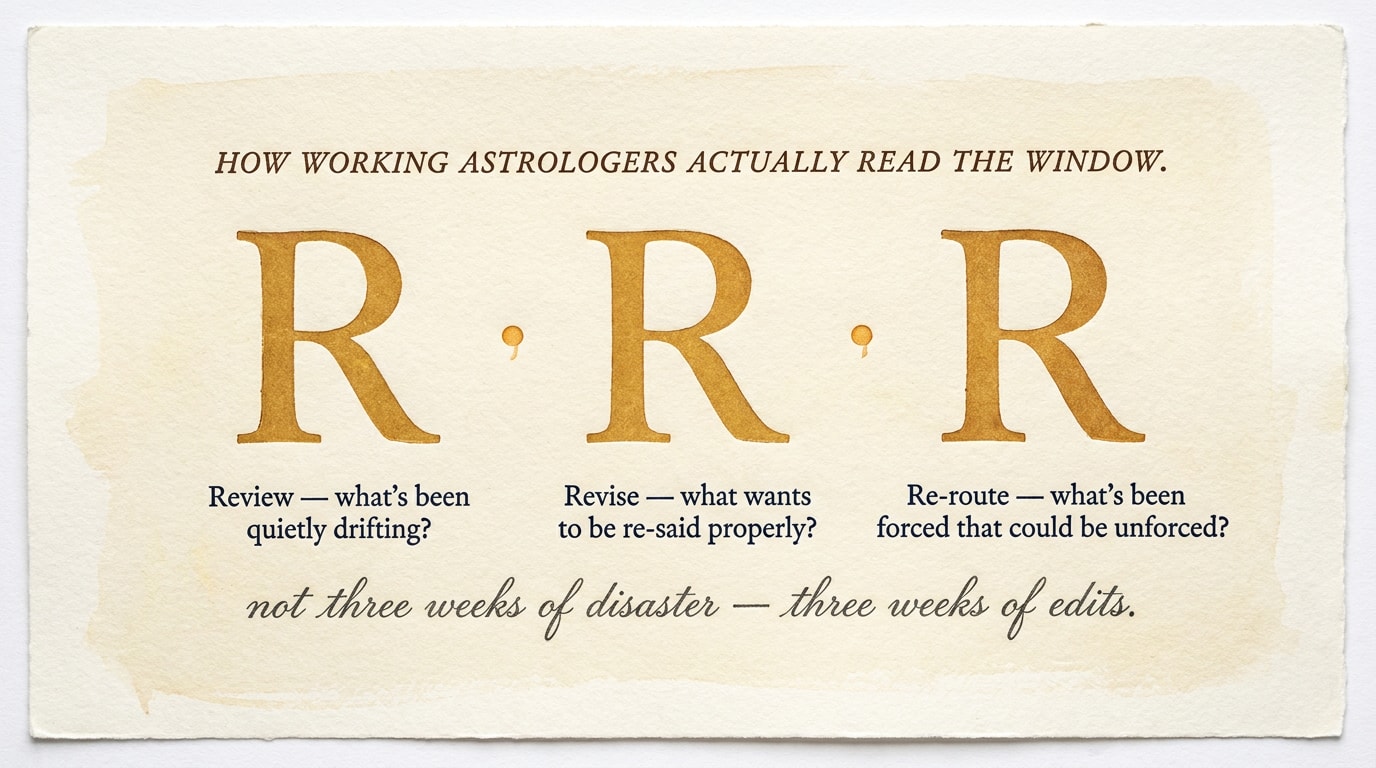
Review. Things from the recent past resurface for a second look. An old conversation drifts back into mind unprompted. A draft you'd marked finished asks to be reopened. A decision made at speed three months ago wants its working checked. None of this is supernatural; it is the inward-leaning tilt the window is read to have.
Revise. The work that wants doing during retrograde is editorial rather than generative. The tradition reads the window as a good one for second drafts and second reads, rather than for hitting send on something irreversible. Many people describe noticing more re-readings, more "let me look at that again" pauses, more conversations restarted.
Revisit. Old places, old voices, old patterns reappear, sometimes literally. An old friend pops up, a former colleague reaches out, a long-quiet group chat revives. The reading is that you're being handed a chance to look at unfinished things and decide what to do with them, not a script in which the old things take you over.
This is where one of the transits worth knowing sits in a year-ahead read of the sky: Mercury retrograde shows up three times every year, marking three short stretches the tradition reads inward.
What this window isn't. It isn't a doom calendar. It isn't a list of things to avoid. It isn't a cause-and-effect for your broken phone or your delayed train. It's a three-week window the astrological tradition reads as inward-leaning rather than outward-leaning. What you do with that, or whether you do anything at all — is still entirely yours.
How often Mercury retrograde happens, and when next
Mercury retrogrades roughly three times a year, sometimes four, for about three weeks each. That's nine to twelve weeks total — approximately a quarter of every year. If a quarter of every year was genuinely a crisis window, we'd need a different word for crisis.
 writing in a journal, lamp on.
The actual dates are calculable from the Swiss Ephemeris and don't change. Here are the windows for the next two years:
| Year | Dates | Sign(s) |
|---|---|---|
| 2025 | 15 March – 7 April | Aries, slipping back into Pisces |
| 2025 | 18 July – 11 August | Leo |
| 2025 | 9 November – 29 November | Sagittarius, slipping back into Scorpio |
| 2026 | 26 February – 20 March | Pisces |
| 2026 | 29 June – 23 July | Cancer, slipping back into Gemini |
| 2026 | 24 October – 13 November | Scorpio |
These are the sky dates — when Mercury, viewed from Earth, appears to move backwards across the constellations. Astrologers often add a shadow period of a few days either side, when Mercury is travelling slowly over the same stretch of sky. The shadow is read as a softer version of the same window. The dates are useful for noticing, not for bracing.
What working astrologers actually do during a Mercury retrograde
The honest answer is: not much, and quietly. The working astrologer doesn't cancel meetings, postpone surgery, or refuse to sign things during a Mercury retrograde. The working astrologer mostly notices. Two short questions do most of the work.

Which conversation from the recent past wants a second look? The first question yields a working note in about a minute — a message typed too quickly and never returned to, a meeting in which something was said that's been quietly carried since. The retrograde window tends to surface these on its own; the question just gives permission to take the surfacing seriously.
Which decision made at speed deserves a slow re-read? The second question is editorial. A project plan finalised three weeks before retrograde began. A contract signed at the end of a long evening. The retrograde window isn't a reason to undo the decision; it's a reason to read it again, calmly, and decide whether anything wants adjusting. Often nothing does. Sometimes a small fix surfaces. Either outcome is useful.
The illustrative shape: a project plan signed off three weeks before retrograde begins. The working note in the margin reads, "during the retrograde window, look at the plan once more before the final send." If the second look shows nothing, the plan goes as written. If it surfaces a small detail, the window has paid for itself.
If you want to see how Mercury retrograde sits alongside the other transits of the year, the wider article on transits walks through the five worth tracking, of which a retrograde landing on a personal placement in your birth chart is one.
The two-question filter. Each Mercury retrograde, the working astrologer's note is short. Which conversation from the recent past wants a second look? Which decision made at speed deserves a slow re-read? Two questions, three weeks, no panic.
"Isn't this just confirmation bias?"
A fair question, worth pausing on.
 phone on lap face-down, hand on temple.
Mercury retrograde happens whether you're watching for it or not. The astronomy is empirical: the Swiss Ephemeris will tell you to the minute when retrograde begins, and the dates above are calculable from the orbital mechanics. None of that depends on belief.
What's interpretive — what's astrology rather than astronomy — is what the window is read to mean. The tradition reads it as inward-leaning. People who watch for inward-leaning weather tend to find some during a three-week stretch when they're looking; that's confirmation bias doing its work, and it would be dishonest to pretend otherwise. It's also not the same as saying nothing useful happens. Being told, three times a year, that this is a window worth slowing for can be worth the price of admission on its own. Read it the way you might read a weather forecast for the next three weeks — useful context, not destiny.
Questions readers ask
Is Mercury actually moving backward?
No. From Earth's vantage point Mercury appears to move backwards across the sky for about three weeks at a time, because Earth and Mercury travel at different speeds around the Sun. The geometry produces an optical illusion — the closer, faster planet briefly appears to slip behind the further one. Astronomers call this apparent retrograde motion. Mercury itself never slows down.
How long does Mercury retrograde last?
Each Mercury retrograde lasts about three weeks. It happens three or four times a year — nine to twelve weeks total, approximately a quarter of every year. The window has a beginning, a middle, and a shadow period a few days either side; some astrologers count the shadow as part of the reading.
What should I really avoid during Mercury retrograde?
Astrology doesn't issue prohibitions. The tradition reads the window as inward-leaning — review, revise, revisit — rather than outward-leaning, and many people describe more re-readings, more old-conversation pings, more decisions wanting a second look. Whether that means you slow a signing or a launch is a personal call, not a rule. The tradition suggests slowing the small machinery, not stopping it. If a contract genuinely needs to be signed during a retrograde, sign it; the sky won't intervene.
How often does Mercury retrograde happen?
Three or four times a year, for about three weeks each. Mercury orbits the Sun in roughly 88 days and laps Earth's vantage point quite often, which is why it goes retrograde more frequently than any other planet. Venus retrogrades about every eighteen months for around six weeks. Mars about every twenty-six months for two to three months. The outer planets are technically retrograde for several months a year each, but those windows are largely indistinguishable from their direct ones. Of all the retrogrades, Mercury is simply the most frequent.
So, three weeks, three times a year. Astronomically a sky-geometry illusion produced by two planets moving at different speeds; astrologically a window read as quieter than the rest of the year. Whether it turns into anything you notice is partly up to the weather and partly up to whether you're looking. The least useful thing to do with a Mercury retrograde is brace; the most useful is to write down the two questions and check back in three weeks.
If you'd rather see how Mercury retrograde sits alongside the other transits across the year ahead, WowAstro's year-ahead reading will pull the matters-most transits for your chart and write the working notes. Same method; you skip the calculator.
About this article: WowAstro readings combine traditional astrological methodology (Swiss Ephemeris calculations, Hellenistic and modern psychological frameworks) with AI-assisted writing reviewed by Oksana Miatova before publication. For entertainment and self-reflection only — not medical, legal, or financial advice. Full editorial policy at /editorial-standards.
Written by Oksana Miatova, astrologer and writer at WowAstro. Mercury retrograde windows calculated using the Swiss Ephemeris, the same astronomical data working astrologers use.
A note on what this is. Astrology, as we use it at WowAstro, is a tool for self-reflection and self-understanding, not a method for predicting events, health, or financial outcomes. Mercury retrograde describes a recurring window of sky-weather, not fate. Read the descriptions as questions, take what's useful, leave the rest.
Read your own natal chart
A personal AI reading, from £1
⭐ +50 Wow Stars cashback · sign up and get 100 ⭐
Build my chart →Comments
New here? Get −30% off your natal chart
Leave your email and we will send you the promo code WELCOME30. Straight after that you can comment — no passwords, all automatic.
Quick sign-in
Sign in with Telegram — one click.
Or by email (with a gift)
Already have an account? Enter the same email — we'll email you a sign-in link.