Maya is thirty-one. People keep asking what she's doing now, and she keeps answering with a line out of her CV, as if she were reading the side of a tin. The honest thing, the thing she doesn't say aloud, is that she's been answering that way since university. Long before the divorce, long before the job change, long before the move. On Wednesday morning, at the bathroom mirror, the sentence arrived almost by itself — not as panic, not as despair, just as observation: I don't actually know who that is. I don't think I ever did. This article is for that specific, foundational version of the question — when I never quite knew who I was has been sitting underneath your life for years, regardless of what chapter you're in.
If you've stood at that mirror with that particular sentence, you've met the version of "who am I?" that doesn't sound philosophical. It sounds structural, and it sounds old — older than any one event. The phrase I've lost myself is, by a long margin, the most common one in the UK threads where people describe it, but underneath it there's a quieter, longer-running version: I'm not sure I ever had a self to lose in the first place. It's a description, not a diagnosis.
A note on scope. This piece is for the foundational version of the question — the one that's been there a long time, across several chapters. If your who am I? is specifically the moment after a chapter just ended (divorce finalised, post-illness recovery, the empty nest landed, post-grad, redundancy) and the old self no longer fits — the sister piece Sun Sign Meaning: What Astrology Says When You've Lost Yourself is the closer reading. This one stays with the longer question.
First, a serious note. If what you're experiencing feels heavier than disorientation (persistent low mood, panic that won't lift, or thoughts of self-harm), please contact your GP, Samaritans on 116 123 (free, 24/7), or NHS 111. Astrology can sit alongside professional support; it can't replace it.
Astrology, used honestly, doesn't tell you who you are. It hands you four points on a chart to look at when the question feels blurred, and, more usefully, it reframes the question itself. Not "who am I?" but "which version of me am I living right now, and which is dormant?"
In short. If you've stopped knowing who you are, astrology offers a structural identity map rather than a personality test. Four chart points are worth examining when the self feels blurred: your Sun (the direction of becoming), your Moon (what you privately need), your Ascendant (the interface the room reads first), and your South Node (the version of you that's been quietly exhausting). A chart can't tell you who you are; it can name the four layers and reframe the question.
 A quiet morning, before the day's expectations land.
What "who am I?" actually is, and what astrology won't claim
The question isn't usually philosophical. It's something more practical: the experience of waking up one morning and noticing the answer to who are you? has stopped arriving automatically. The psychologist Erik Erikson named the developmental version of this in 1968 (identity versus role confusion), and the NHS and the mental-health charity Mind both describe identity issues as a common, well-named experience rather than a diagnosis. It tends to arrive after a structural shift: divorce, redundancy, the empty nest, the end of a long caring role, retirement, recovery from a serious illness, coming out, moving country. The roles that were doing the self-naming go quiet. The self underneath gets blinking time to find its own voice.
This article uses astrology as a structural identity map: a vocabulary for those layers, not a treatment for the feeling and not a substitute for a conversation with a qualified counsellor or therapist. A reminder: if the patterns described here feel less like I sometimes second-guess myself and more like I can't function, that's a Mind or GP conversation, not an astrology one. The two aren't competing; they answer different questions. For a wider look at the whole chart and how the pieces fit together, the introductory guide to reading a birth chart is a good companion piece.
What astrology can do is name the four layers that go out of sync. When a life-pivot lands, identity feels blurred not because you've vanished, but because the layers have de-synchronised and one or two of them are louder than the others. The "who am I?" feeling is the structural lag, not a personal failure.
Your Sun: the direction you're becoming
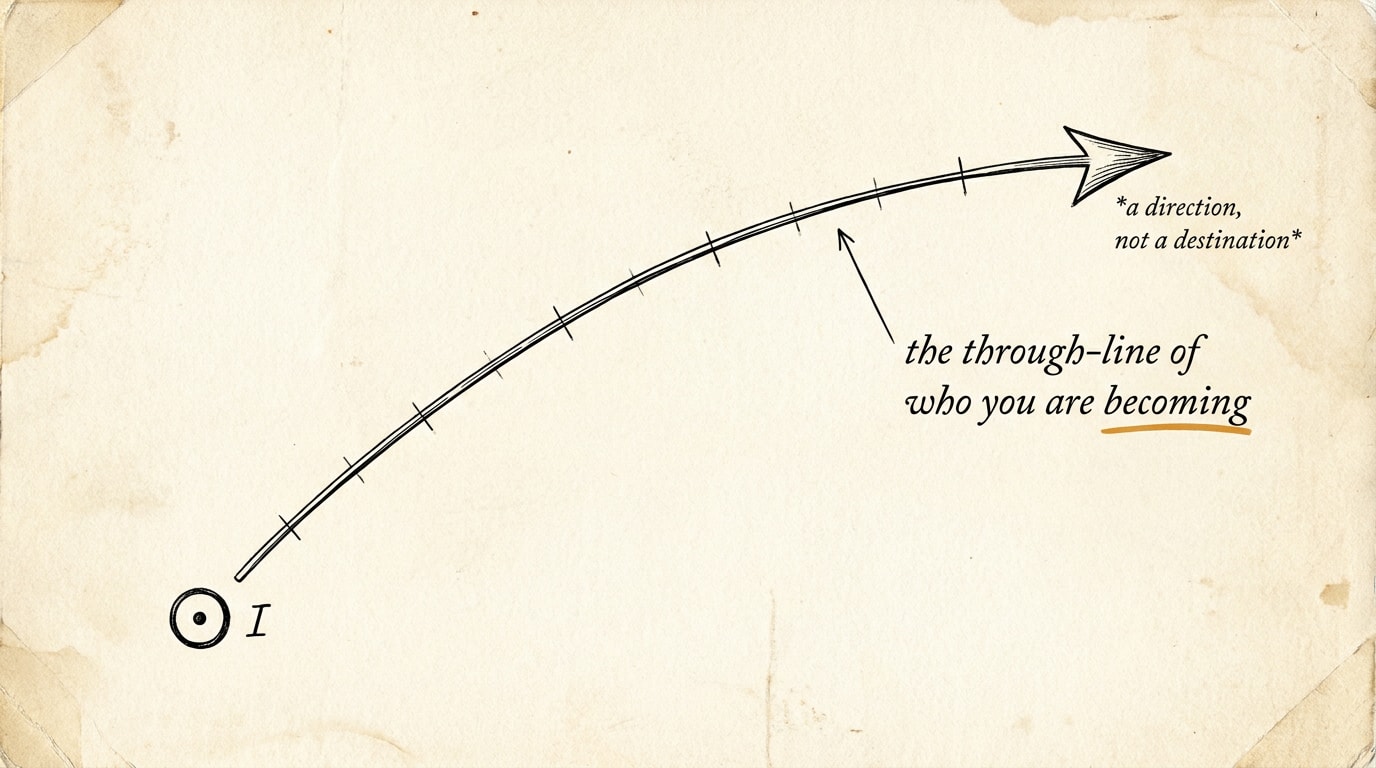
Your Sun sign isn't the label on the tin. In the canonical Western astrology tradition, the Sun is a direction of becoming: the through-line of who you're growing into across a lifetime, rather than a fixed personality verdict. It's what most people mean by I'm a Scorpio, but it works better as a verb than a noun.
The thing about "becoming" is that it's never finished. That's the awkward, useful part. When the "who am I?" feeling is loud, the Sun question to ask isn't what's my sign?, it's what am I being asked to become, and which part of that have I been deferring? For Maya, the Sun is in Cancer; the canonical direction of travel there is toward home, care, and emotional roots. For eleven years of marriage she'd deferred her own version of home to the shared one. Her Sun didn't go away. It got quieter so the marriage could be louder. After the divorce, it started speaking up again, and not knowing what to do with that voice felt, for months, like not knowing who she was.
The Sun is a process, not a snapshot. The "becoming" part is what makes you feel unfinished, which, from the inside, can sound like I don't know who I am when what's actually true is I'm not done becoming. For a deeper look at the Sun specifically after a life pivot, the sister piece Sun Sign Meaning: What Astrology Says When You've Lost Yourself takes it further.
Your Moon: what you actually need (small, daily, private)
Your Moon describes what you privately need: the small, daily, often invisible conditions that let you feel safe enough to be yourself. It's the layer most people skip in astrology because it doesn't make for good Instagram. The Moon isn't about your public self; it's about what gets you through Wednesday. Calculated from your date, time, and place of birth (because the Moon moves about 13° each day, and a missed birth time can put it in the wrong sign).
Three brief, recognisable shapes:
| Moon sign | What it needs | In a phrase |
|---|---|---|
| Moon in Cancer | Proximity to chosen people, soft lighting, food made with attention | Comfort as fuel |
| Moon in Capricorn | Structure, a clear list, mastery of one small thing per day | Calm through competence |
| Moon in Aquarius | Alone-time to think, an idea to chew on, distance enough to see the pattern | Clarity through space |
When identity feels blurred, start with the Moon. What did I genuinely need this week, and how much of it did I actually get? answers a small, doable question, and small doable questions are more honest, more often, than who am I? The "who am I?" voice usually gets quieter when the Moon has been fed for a few days running. Not because the question has been answered, but because the part of you that was asking it is no longer running on fumes.
Your Ascendant: the interface the room reads first
Your Ascendant (also called your Rising sign) is the version of you the room meets in the first thirty seconds. It's the doorway, not the building. It was the sign rising over the eastern horizon at the moment of your birth, which is why time matters: the Ascendant moves on about every two hours, and a missed birth time can put it in the wrong sign altogether. WowAstro calculates Ascendants using the Swiss Ephemeris, the same astronomical data working astrologers rely on.
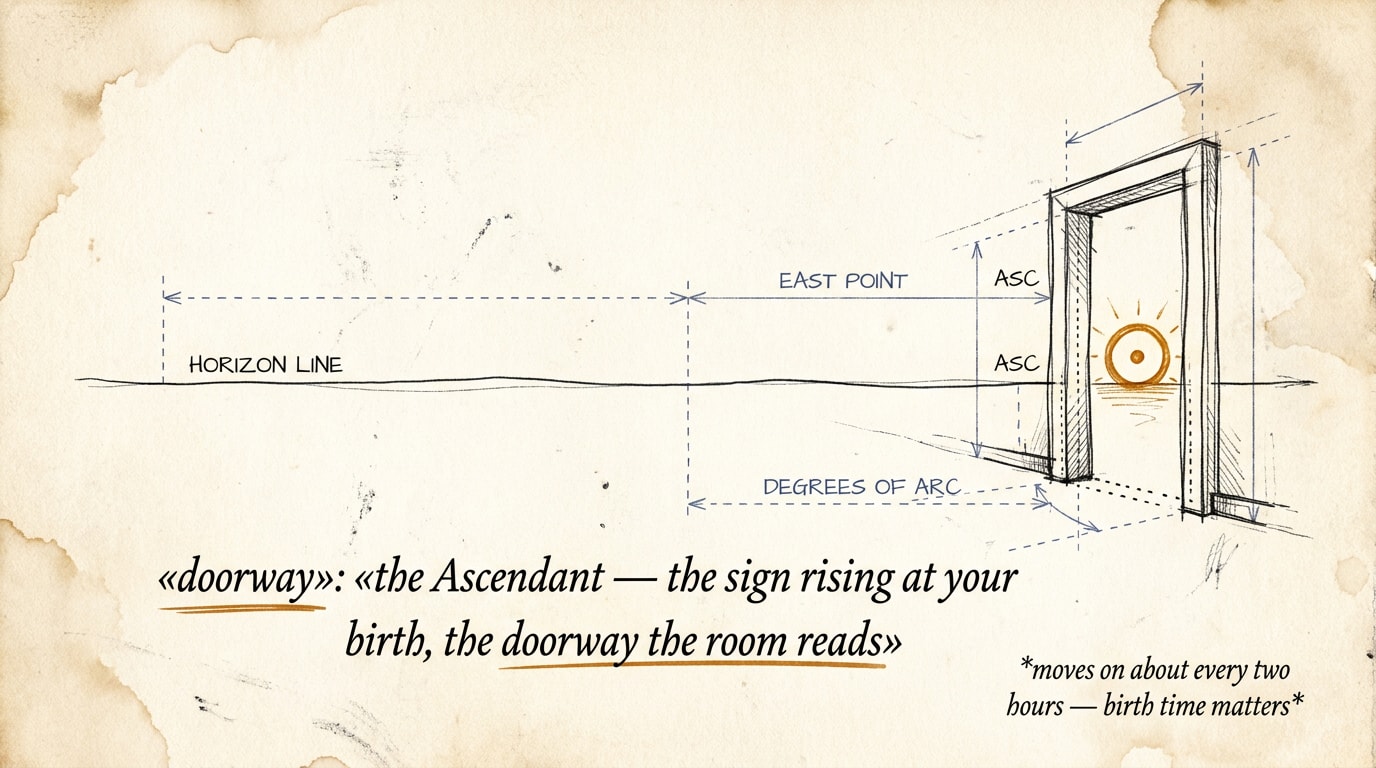
When identity feels blurred after a life pivot, the Ascendant can feel mismatched too, because the environment has shifted (new role, no role, new home, no partner, no team) and the same doorway no longer lands the same way. Maya's Pisces Ascendant used to read, in her marriage, as "attuned partner": porous, intuitive, picking up the room. In single life it reads, to her, as "whoever the room needs". Same interface, different room.
The Ascendant isn't fake. It's the part of you that's already on the surface where other people can read it, and after a pivot it can feel performative, but that's usually the environment changing, not you. If the gap between your Ascendant and your Sun is the loud one (you feel less lost and more like you're faking competence), that has its own structural name, which is the territory of the Rising-versus-Sun and the faking-it feeling sister piece.
Your South Node: the version of you that's quietly exhausting
The Moon's nodes are the canonical astrology shorthand for the axis of where you came from and where you're growing. The South Node is your inherited default: the role, the skill, the way of being that comes too easily and slowly drains you. The North Node is the unfamiliar growth direction. They sit on opposite ends of an axis across the chart, because the lunar nodes are the two points where the Moon's orbit crosses the ecliptic; by definition, they're always 180° apart.
After a life-pivot, the South Node often feels like who I used to be that I'm now exhausted being. Maya's South Node is in Virgo: the over-functioning version, the woman who managed everyone's diaries, remembered every birthday, anticipated every need. In the marriage it was love-in-action. Out of it, it's the muscle that won't stop flexing, the helpful gesture nobody asked for. The "who am I?" question, partly, is: who am I when I stop being the person who manages everyone?
If a version of you used to work and now doesn't, if it used to feel like virtue and now feels like obligation, that's often the South Node. Naming it doesn't make it stop. But naming it changes I don't know who I am to I know exactly who I've been, and I'm ready to be less of her. Which is more useful information than the original sentence.
The gap isn't a failure. Identity is four layers operating at different scales: direction, need, interface, default. After a life pivot they de-sync because one of them (usually the role you were performing) has changed shape. That's not loss of self. It's the layers asking to be re-known.
 Evening at the desk: naming a shape, not finding an answer.
A worked example: Maya, the four layers read end to end
Here is one chart read across the four layers, to show how an identity-blur looks from the inside. The chart below is illustrative: a plausible composite, not a real person, but the shape will be recognisable.
Maya is thirty-one. The divorce went through fourteen months ago. Her four layers:
| Placement | What it describes | What Maya feels now |
|---|---|---|
| Sun in Cancer | Direction of becoming toward home, care, emotional roots | Deferred eleven years to a shared home that's no longer there |
| Moon in Capricorn | Private need for structure and the mastery of one small thing per day | The marriage gave her co-managed structure; on her own the structure is missing |
| Ascendant in Pisces | Porous interface that used to land as "attuned partner" | In single life it reads as "whoever the room needs" |
| South Node in Virgo | The over-functioning manager | The muscle that won't stop flexing, the version slowly tiring her |
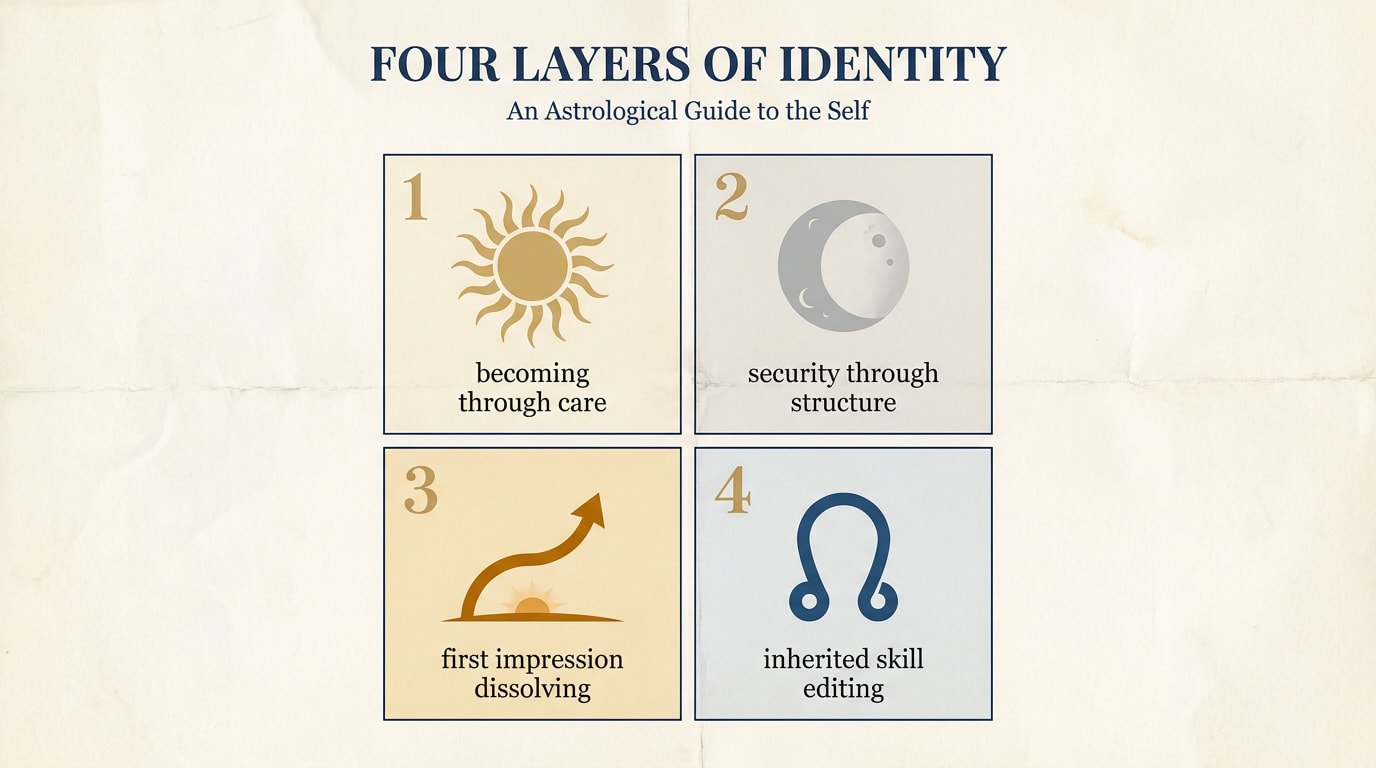
Reading the layers together, the feeling I don't know who I am breaks apart. It's not one thing. It's the Capricorn Moon missing daily structure. It's the Pisces Ascendant mismatched with the new room. It's the Cancer Sun asking to be built, and not deferred again. It's the Virgo South Node quietly exhausting her, even now. Four processes, one feeling. The useful question shifts from who am I? to what does each of these four need from me now? Three of those four have small, practical answers. The fourth is slower work. But the panic in the original question lowers as soon as the question is broken up.
"Isn't this just pseudoscience?" A fair question. The claim here isn't that the planets are causing anything; it's structural. Astrology hands you a four-part vocabulary refined for around two thousand years to talk about layered selfhood: direction, need, interface, default. Whether or not you believe the cosmology, the four-layer prompt is more useful for self-reflection than discover your true self. Use the vocabulary; ignore the planets if you'd rather.
A reflective practice: naming, not finding
Once you can name the four layers, you can use them as a self-reflection structure rather than a personality verdict. This is journal territory, or a quiet hour with a notebook. It is not a method for talking yourself out of real distress, and not a substitute for a conversation with a qualified counsellor or therapist. If the "who am I?" feeling sits alongside persistent low mood, panic that won't lift, or thoughts of self-harm, the right next step is your GP, NHS 111, or Samaritans on 116 123. The astrology can wait.
Four prompts, one per layer. Sit with one of them per evening rather than all four at once; the answers arrive better that way.
- Sun. What am I being asked to become right now that I've been deferring? What direction is quietly insistent, even when I haven't been listening?
- Moon. What did I genuinely need this week (small, daily, private), and how much of it did I actually get?
- Ascendant. How does the room read me now, versus how it read me a year ago? What's changed in the room, and what's changed in me?
- South Node. Which version of me used to work and now feels like obligation? What would it cost (and what would it open) to be less of her?
The work is naming the layers, not answering who am I? — which is usually the wrong question. The right question is the one that makes the next small step visible. If the question feels less about identity and more about direction (where am I going? rather than who am I?), the angular houses of the chart are the better lens, and the sister article on feeling stuck and the direction houses takes that further.
 The pause between knowing and naming.
Triple-stamp. Astrology, used honestly, sits alongside professional help. It can name layers and structure questions. It cannot replace therapy, medication, a GP appointment, or a trained counsellor. If the feeling is heavy, please book the session first; the chart will keep.
If you want to see your own four layers (Sun, Moon, Ascendant, and Nodes) laid out side by side, WowAstro will calculate your free birth chart. Date, time, and place; a couple of minutes. Worth knowing which layer is loud right now, and which is quietly waiting.
Frequently asked questions
What does astrology say about "who am I?"
Astrology doesn't answer who am I? directly. Used honestly, it reframes the question as which layer of me am I living right now, and which is dormant? Four chart points are worth examining when the self feels blurred: the Sun (your direction of becoming), the Moon (what you privately need), the Ascendant or Rising sign (the interface the room reads first), and the South Node (the version of you you've been over-relying on). The chart can't tell you who you are. It can name the four layers and structure better questions about your own life. Used this way, astrology is a self-reflection map, not a personality verdict and not a substitute for therapy.
Which sign am I really: my Sun, Moon, or Rising?
All three are you. They describe different layers operating at different scales. The Sun is the direction you're growing into across a lifetime; the Moon is the private need that gets you through the week; the Rising sign is the interface the room reads in the first thirty seconds. The question which is the real me? usually means which one feels most like me right now?, and that can shift after a life pivot. Permission to feel multiple. None of them is the "real" you to the exclusion of the others; you are the conversation between them.
Can a birth chart tell me what to do with my life?
A chart can't tell you what to do, and treating it as if it could is a misuse of the tool. What it can describe is what you're being asked to become (the Sun), what you privately need (the Moon), what the room reads first (the Ascendant), and what you've been over-relying on (the South Node). That structure helps you ask better questions about your own life. If you're making consequential decisions (career changes, ending or starting relationships, finances), please involve qualified humans (therapists, careers advisers, financial advisers) rather than just a chart. The chart is a prompt. The decision is yours, and other people's expertise is often the next step after the prompt has done its work.
I don't recognise myself anymore. Is that normal? When should I see a professional?
Feeling that you don't recognise yourself, particularly after a life pivot (divorce, redundancy, empty nest, bereavement, the end of a long caring role), is a common and well-described experience, not a diagnosis. Both the NHS and Mind describe identity issues as a normal mental-health concern that talking therapies can help with. If the feeling is persistent (more than a few weeks), interfering with your sleep, work, or relationships, or accompanied by hopelessness or thoughts of self-harm, please contact your GP, NHS 111, or Samaritans on 116 123 (free, 24/7). The British Association for Counselling and Psychotherapy (BACP) also runs a free UK directory of registered therapists. Astrology can sit alongside that conversation; it isn't a substitute for it.
Read the wider context in our guide to your full birth chart
By Oksana Miatova, astrologer and writer at WowAstro. Charts calculated using the Swiss Ephemeris.
About this article: WowAstro readings combine traditional astrological methodology (Swiss Ephemeris calculations, Hellenistic and modern psychological frameworks) with AI-assisted writing reviewed by Oksana Miatova before publication. For entertainment and self-reflection only — not medical, legal, or financial advice. Full editorial policy at /editorial-standards.
Astrology, as we use it at WowAstro, is a tool for self-reflection and self-understanding, not a method for predicting events, health, or financial outcomes.
If feelings of being lost, disoriented, or persistently low are overwhelming, please speak with a qualified counsellor, therapist, or your GP. In the UK you can contact Samaritans on 116 123 (free, 24/7), Mind on 0300 123 3393, NHS 111 for non-emergency health concerns, or the BACP directory to find a registered therapist. Astrology can sit alongside that conversation; it is not a replacement for it.
Read your own natal chart
A personal AI reading, from £1
⭐ +50 Wow Stars cashback · sign up and get 100 ⭐
Build my chart →Comments
New here? Get −30% off your natal chart
Leave your email and we will send you the promo code WELCOME30. Straight after that you can comment — no passwords, all automatic.
Quick sign-in
Sign in with Telegram — one click.
Or by email (with a gift)
Already have an account? Enter the same email — we'll email you a sign-in link.