
You looked at your birth chart, saw twelve numbered wedges around the wheel, and someone told you those were the houses. You opened a guide to find out what they meant, and were handed twelve paragraphs in a row, each one describing a different house as though it had a personality of its own. By the fourth or fifth, you'd lost the thread.
Here's the move worth making early. The astrology houses meaning isn't twelve separate characters — it's twelve areas of life. Where each planet falls tells you where that part of you lives most actively. That single shift makes the whole layer easier to read, and the rest of this guide is what it looks like in practice.
In short. The astrology houses meaning describes twelve areas of life, marked out around the birth chart wheel and counted from the Ascendant. Each house is a domain (self, money, communication, home, creativity, work, partnership, depth, meaning, career, community, the inner), and the planet that falls in a house tells you where that part of you most visibly lives. Houses aren't characters; they're locations.
 A closer look at the wheel, without the jargon wall.
What the astrology houses actually are
The astrology houses are twelve areas of life mapped onto the chart wheel, not twelve personality types. They are counted anti-clockwise from your Ascendant (your Rising sign) and re-drawn for every chart based on date, time and place of birth. The concept is Hellenistic in origin, formalised in Ptolemy's Tetrabiblos in the second century CE, and used continuously in Western astrology since. Read each house as "where in your life this part of you shows up", not as a verdict on character.
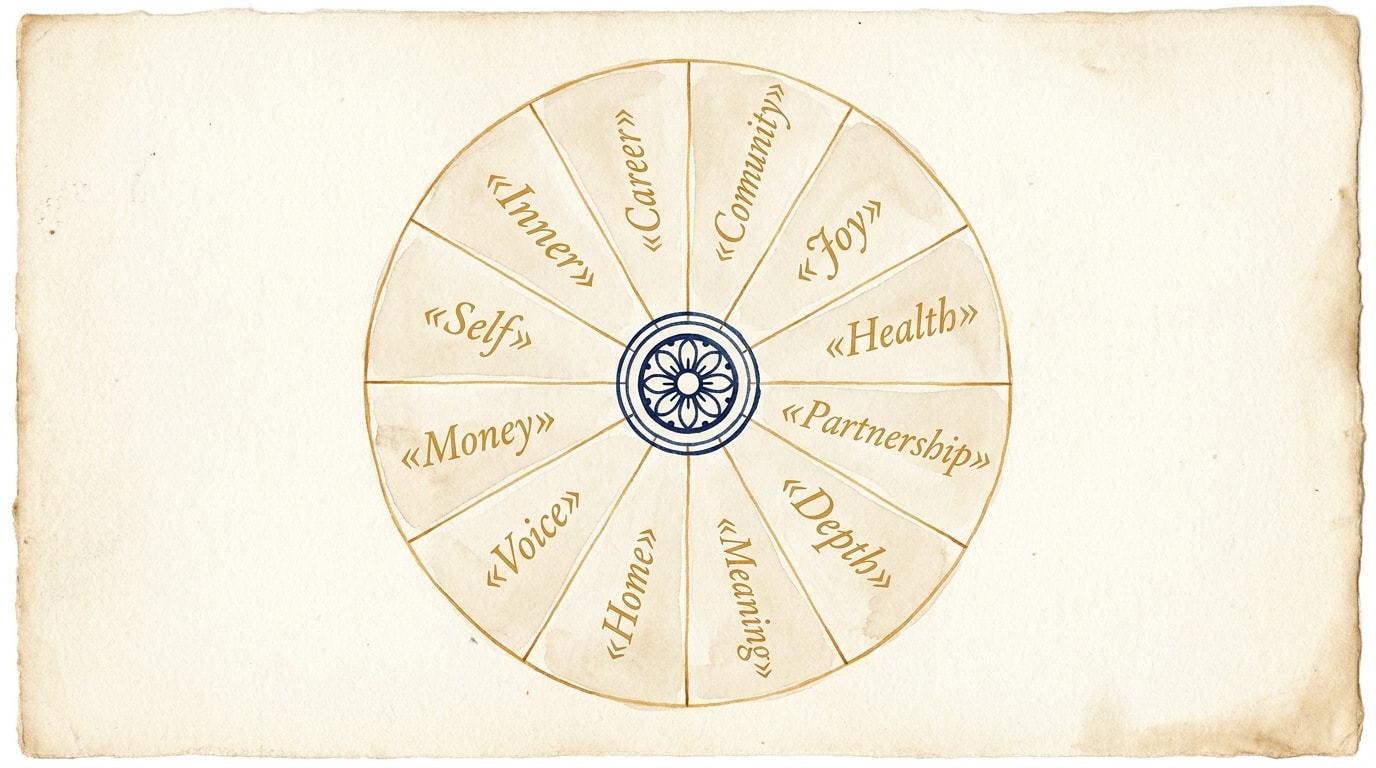
This is the move most beginner guides skip, and it's the one that makes everything else easier. A sign tells you how a planet expresses itself; Mercury in Gemini is one kind of mind, Mercury in Capricorn another. A house tells you where that mind shows up in your life. Mercury in Gemini in the 3rd house lives in your everyday conversations. The same Mercury in Gemini in the 10th house lives in your public role and the words you're known for. The area of life changed, and so did the person.
If the Rising sign or Ascendant is unfamiliar territory, it's worth a brief detour first; the houses count off from that point, so the Ascendant is effectively your starting line.
Reading the houses in groups, not one by one
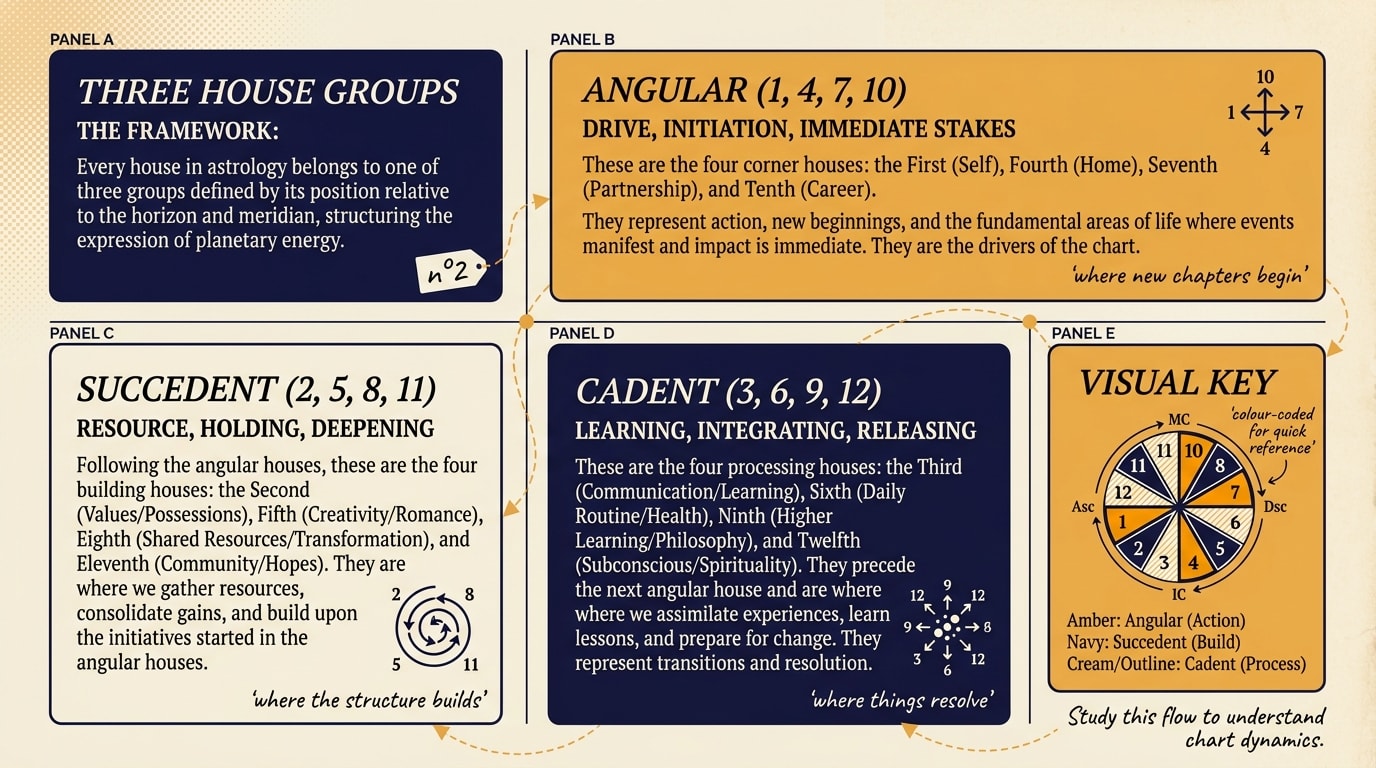
The twelve houses sit naturally in three groups of four (angular, succedent and cadent), and reading by group is faster than memorising twelve isolated descriptions. The classification is structural, based on each house's angular position from the four chart angles, and Hellenistic in origin. In a sentence: angular houses are where action starts; succedent houses are where you build and hold; cadent houses are where you learn and integrate. Start with the group, then the specific house.
Angular: where life starts (1, 4, 7, 10)
The angular houses sit on the four structural axes of the chart wheel: the Ascendant (1st), the Imum Coeli (4th, the bottom of the chart), the Descendant (7th) and the Midheaven (10th, the top). The 1st is the self and how you come across in the first thirty seconds. The 4th is home, family, and the inward roots you grew from. The 7th is the significant other, the partner or close colleague you build a one-to-one with. The 10th is your public role, career and reputation. Planets in angular houses tend to be visible: they show up in how you act, where you live, who you're with, and what you do for a living.
Succedent: where you build and hold (2, 5, 8, 11)
The succedent houses come immediately after the angular ones, and they are about consolidation rather than initiation. The 2nd is money, values, self-worth and the resources you own outright. The 5th is creativity, play, pleasure, children, and the things you make for the joy of making them. The 8th is shared resources, depth, intimacy and the transformations that happen when two lives are properly entangled. The 11th is friends, groups, future hopes and the communities you join. Where the angular houses are about taking up your position, the succedent ones are about what you do with it once you're in it.
Cadent: where you learn and integrate (3, 6, 9, 12)
The cadent houses come last in each angular sequence and have a mobile, transitional quality. The 3rd is communication, siblings, neighbours and the texture of everyday exchange. The 6th is work, daily routine and the small repeated acts that make up most of your week. The 9th is meaning, philosophy, long journeys and the worldview you're slowly building. The 12th is the inner life, retreat, and what happens behind the scenes of your visible self. If your chart concentrates planets here, it usually marks a life that runs on learning, processing and quiet inner work, even when the outer signs read as ordinary.
In short. Twelve houses, three groups: angular (action), succedent (building), cadent (learning). Read the group first, then the house. The grouping is doing most of the work; the labels just fill in the details.
Planet in house in sign: how the three layers fit together
Every placement in a chart is read as three layers (planet, sign and house), and the house is what makes the other two specific to a part of your life. Take Mercury in Gemini in the 3rd house: a quick, curious mind, lived in everyday conversation. The same Mercury in Gemini moved into the 10th house reads differently — a quick, curious mind lived in your public role, the words you're known for in your work. Same planet. Same sign. The area of life has changed, and so has the person.
| Layer | Question it answers | Example |
|---|---|---|
| Planet | What function? | Mercury: thinking and speaking |
| Sign | How, in what style? | Gemini: quick, curious, restless |
| House | Where, in what area of life? | 3rd: everyday communication |
This three-layer reading is the thing to remember every time you look at a placement. Without the house, you have a description of a mind in the abstract; with the house, you have a description of a mind that lives somewhere specific. The same logic applies to the twelve zodiac signs themselves: a sign is only half the picture until you know which house it's sitting in.
A worked example: one chart's planets across the houses
Most guides explain the houses one by one and leave you to assemble them. Here is what the assembled version looks like, with a single illustrative chart (not a real person, just a plausible set of placements that lets us run the method end to end).
The placements: Sun in the 10th house, Moon in the 4th, Mercury in the 3rd, Venus in the 7th, Mars in the 1st.
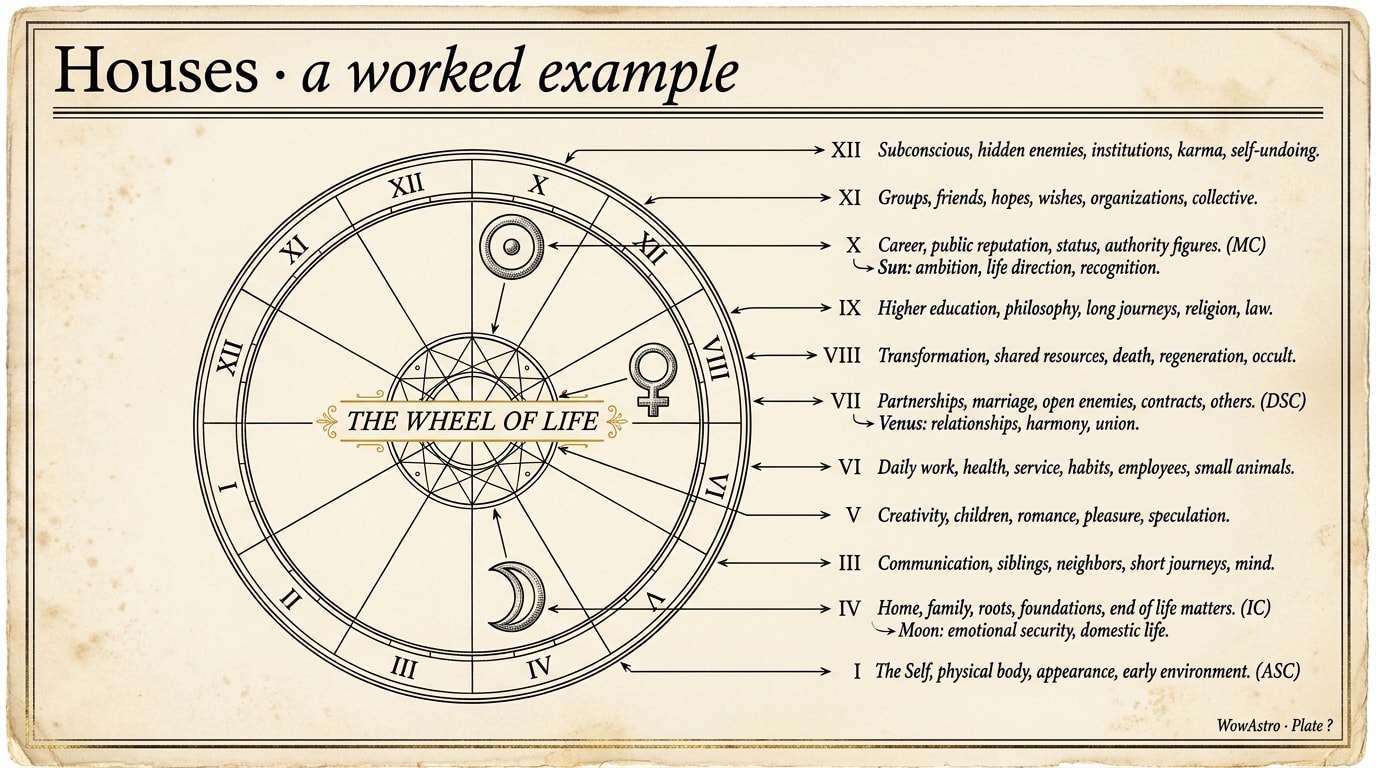
Notice where the planets are. Four of the five sit in angular houses: the Sun in the 10th (career and public role), the Moon in the 4th (home and inner roots), Venus in the 7th (partnership), and Mars in the 1st (the self, the body, how you come across). The fifth, Mercury, sits in the 3rd, which is cadent but a chatty cadent, neatly placed in the house of everyday communication that suits Mercury particularly well.
What kind of person is this? Someone whose life is organised around the four cardinal points: who they are, where they come from, who they're with, what they do publicly. The Sun in the 10th pulls them toward public-facing work and a sense of identity built through what they're seen to do. The Moon in the 4th says home and family hold a disproportionate amount of their emotional weather. Venus in the 7th means love and connection are felt most clearly through one significant relationship rather than scattered across many. Mars in the 1st gives them a directness in how they show up. Mercury in the 3rd keeps the mind perpetually in motion through conversation and everyday exchange.
A recognisable person, then: visibly ambitious at work, anchored at home, partnered, direct in how they show up, and chatty in the everyday. Each placement is doing its part, but the reader doesn't have to know which is which to recognise the shape.
What the method did here was let the houses do their main job: tell you where each part of this person actually lives. Once you can see that, the chart stops being a list of placements and starts being a description of a life. The wider layer-cake model of how planets, signs, houses and aspects fit together is worth a longer look once this lands.
When houses get tricky: birth time, empty houses, and which house system
Three honest answers cover the practical worries that come up the moment people sit down to read their houses: what to do without a precise birth time, what an empty house means, and which house system to choose. None of these is a reason to abandon the houses; each has a clear workaround.
Without a precise birth time, the Ascendant and the house positions can't be calculated reliably; the Ascendant moves on roughly every two hours, and the houses follow from it. The rest of your chart still reads. The Sun, Mercury, Venus, Mars and the slower planets all change sign over days or longer, so they're stable without a precise time. If you find your birth time later, you can redraw the chart and recover the house layer.
An empty house is not a deficit. The area of life still exists; you still have a home, a job, friendships and partnerships, whether or not a planet happens to be parked in those houses. An empty house just means no planet is currently spotlighting that area; the sign on the cusp of the house and its ruler still describe the territory, more quietly. The 7th house empty doesn't mean "no partner"; it usually means partnership runs in the background of your life rather than being one of its loudest themes.
Which house system to pick is a question with no clean answer, and astrologers genuinely disagree. Placidus is the default in most Western software, including at WowAstro. Whole Sign is older — Hellenistic in origin — and has had a strong resurgence in the last twenty years. For a beginner read, the differences only matter for placements that sit very close to a house boundary; for the bulk of the chart, either system tells you the same story. Pick the default and don't worry until you have a reason to.
In short. No birth time: read the rest of your chart, redraw later. Empty house: the area of life still exists, just unaccented. House system: Placidus is fine to start; the differences only matter at the edges.
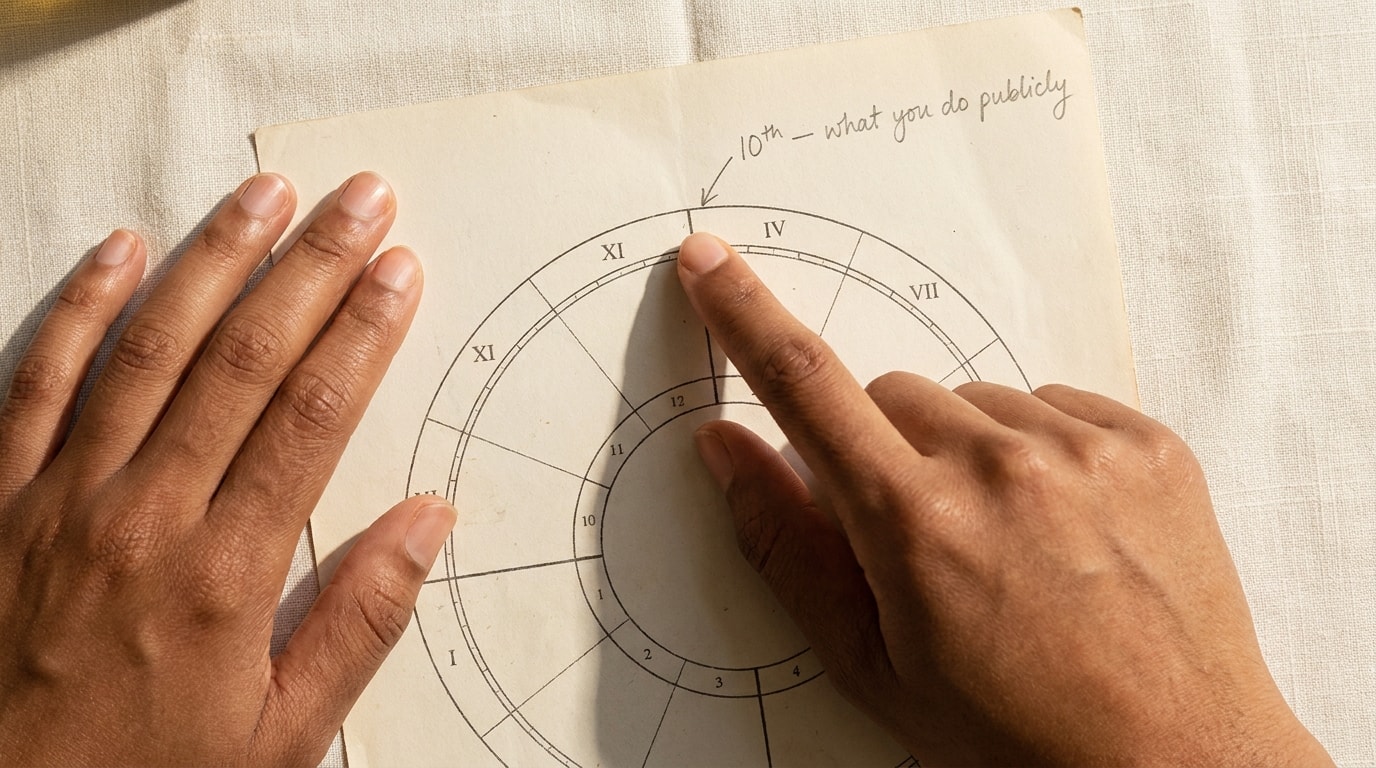 One area of life at a time, traced with a finger.
What knowing your houses is for
Knowing your houses is most useful as a way to ask "where does this part of me actually live?" rather than as a list of what each house decrees. The value isn't in memorising twelve labels; it's in spotting the two or three houses your chart concentrates planets in, and asking what they have in common in your actual life. Most people, on doing this, find a recognisable pattern. That pattern is the chart describing where you're spending your life energy, and what kinds of activity and attention you keep coming back to.
 The actual work happens after you put the chart down.
If you'd like to see this on your own chart rather than an illustrative one, WowAstro will calculate a free birth chart for you. Date, time and place; it takes a couple of minutes, and the houses are calculated using the Swiss Ephemeris.
Questions readers ask
What is the 1st house in astrology?
The 1st house in astrology is the house of the self: your body, the first impression you make on others, and the way you come across in the first thirty seconds of meeting someone. It begins at your Ascendant (your Rising sign) and is, structurally, the most angular of the angular houses. Planets in the 1st are usually visible in how you present: the Sun in the 1st often reads as someone with a recognisable sense of who they are; Mars in the 1st tends to be direct and a little forward. The 1st is the front door of the chart.
What does the 7th house mean?
The 7th house in astrology means partnership: your significant other, close colleagues, and one-to-one relationships in general. It sits directly opposite the 1st house, so where the 1st is the self, the 7th is the most important "other" in your life. It also classically covers open enemies (anyone you're locked in formal opposition with). Planets in the 7th show up in how you relate to a chosen partner: Venus in the 7th tends to make partnership a strong source of pleasure; Saturn in the 7th tends to make it serious and long-fought-for.
How many houses are in astrology?
There are twelve houses in astrology, counted anti-clockwise around the chart wheel from your Ascendant. They are divided into three structural groups of four: angular (1, 4, 7, 10), succedent (2, 5, 8, 11) and cadent (3, 6, 9, 12). Each of the twelve represents an area of life, from the self (1st) and money (2nd) through to community (11th) and the inner life (12th). The grouping into three is older and arguably more useful than memorising twelve separate descriptions.
What house is the most important?
No single house in astrology is "the most important" by default. The houses that matter most in any given chart are the ones with planets in them — those are the areas of life the chart is actively spotlighting. That said, the four angular houses (the 1st, 4th, 7th and 10th) tend to be the most visible in someone's life regardless of whether they hold planets, because they sit on the chart's structural axes. Read the angular houses first, then look at where any planets are concentrated.
A note on what this is. Astrology, as we use it at WowAstro, is a tool for self-reflection and self-understanding, not a method for predicting events, health, financial outcomes or the course of relationships. Read your chart as a description of patterns, take what's useful, leave the rest.
About this article: WowAstro readings combine traditional astrological methodology (Swiss Ephemeris calculations, Hellenistic and modern psychological frameworks) with AI-assisted writing reviewed by Oksana Miatova before publication. For entertainment and self-reflection only — not medical, legal, or financial advice. Full editorial policy at /editorial-standards.
Written by Oksana Miatova, astrologer and founder of WowAstro. Charts calculated using the Swiss Ephemeris, the same astronomical data working astrologers and serious astrology software use.
Read your own natal chart
A personal AI reading, from £1
⭐ +50 Wow Stars cashback · sign up and get 100 ⭐
Build my chart →Comments
New here? Get −30% off your natal chart
Leave your email and we will send you the promo code WELCOME30. Straight after that you can comment — no passwords, all automatic.
Quick sign-in
Sign in with Telegram — one click.
Or by email (with a gift)
Already have an account? Enter the same email — we'll email you a sign-in link.
