It is nine on a Wednesday in October. A 34-year-old woman in Manchester is sitting at her parents' kitchen table, three months after her divorce was finalised, in the slow logistical middle of finding her own flat. A mug of herbal tea has gone cold beside a notebook with two underlined words, what next — and no third line. Outside the kitchen window a wood pigeon. Inside, a quiet she can't quite name. Not depression, she's been depressed, and this is something quieter and stranger. Not grief, exactly. Just the feeling that the old shape of her life dropped away and the new one hasn't arrived yet.
If what you're feeling at your own table tonight is heavier than that, persistent low mood, panic that won't lift, thoughts of self-harm — please talk to your GP or contact Samaritans on 116 123 (free, 24/7). Astrology sits alongside that conversation; it can't replace it. What follows is for the slower kind of lost: the one where an old structure dropped away and the new one hasn't formed yet, and what you most want is a vocabulary for the in-between.
This article isn't a treatment, and astrology isn't therapy. What it offers, used honestly, is language for three parts of yourself worth re-naming when an old shape is gone.
In short. Feeling lost after a life pivot, divorce, redundancy, an empty nest, a bereavement, a finished degree — is often less a clinical state and more an identity-rewiring moment. Your old anchors dropped away and the new sense of purpose hasnt formed. Astrology can't fix this, but it can offer language for three parts of yourself worth re-naming: who you are becoming and where your purpose is pointing (your Sun), what you actually need (your Moon), and what you're willing to commit to (your Saturn). A chart is a structured prompt for self-reflection, not a verdict and not a treatment.
 The slower kind of lost: a notebook with two underlined words and no third line.
What "feeling lost" actually is — and what astrology won't claim
Feeling lost, in the sense most people mean it, is the experience of having no clear next move when something that used to organise your sense of self has fallen away. The marriage that quietly shaped your week. The job that gave the morning a rhythm. The role of parent-of-small-children when the youngest leaves for university. The degree you've been inside for four years. The country you've just moved away from. These don't have to be losses you're grieving in the clinical sense to leave you in the in-between.
Worth naming what this is not. Feeling lost is not, on its own, a diagnosis. The DSM (the manual psychiatrists use to define mental-health conditions) doesn't list "lost" as a disorder, and astrology shouldn't be treated as if it can diagnose you with anything else, either. A chart isn't a diagnosis and shouldn't be read like one.
A quick honest line about scope. This article uses astrology as a self-reflection lens, vocabulary for what the inside of the feeling looks like, and that is genuinely useful for the slower in-between. It is not, and shouldn't be sold as, a treatment plan. We are not treating symptoms here; we are noticing patterns. If the feeling has stopped you sleeping, working, or looking after yourself, that's the moment to talk to a qualified counsellor or therapist or your GP. Astrology can sit alongside that conversation; it can't replace it. The rest of this piece is for everyone else, the people in the slower kind of lost, the one that wants vocabulary more than rescue.
Why a chart is useful here — and why it isn't a fix
You don't have to believe the planets cause anything for a chart to be useful when you're lost.
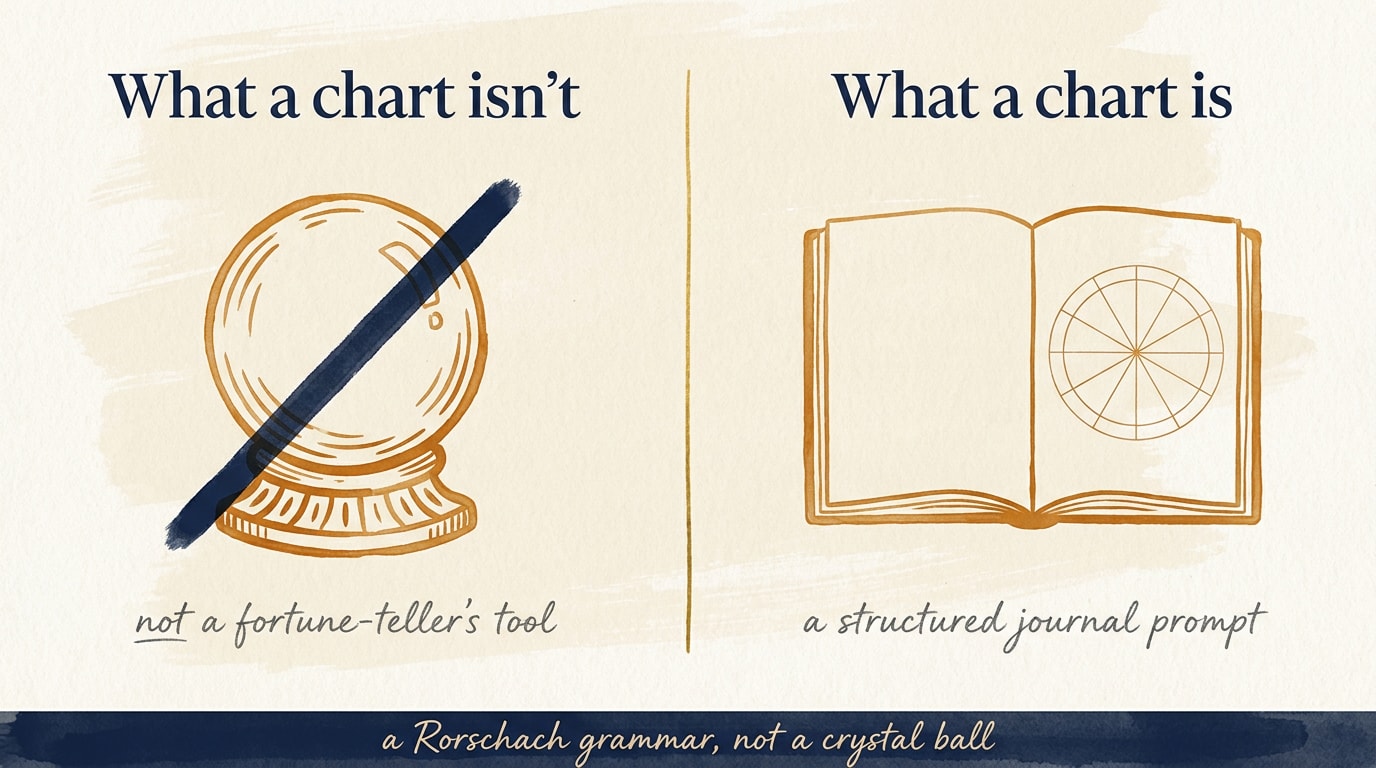
Think of a chart less as a horoscope and more as a Rorschach with structure. You're looking at it, you're making meaning from it, and the meaning you make tells you about you, not really about the planets. That isn't a claim that astrology is "science"; it's an honest description of what's happening when someone sits with their chart and feels something land. A chart is a structured prompt for self-reflection, the same family of tool as a journalling app, a personality framework, an Enneagram quiz, an attachment-style questionnaire, the prompts your therapist hands you at intake. None of those tools work because they're empirically "true" in a hard sense; they work because they hand you a stable vocabulary to look at yourself through.
What a chart does, mechanically, is hand you that vocabulary. Twelve signs, ten bodies, twelve houses, a structured vocabulary that has been used for centuries to describe parts of a self. When something has dropped out of your life, it can be useful to look at a stable map of your parts and ask: which of these went into the structure I just lost? Which of them are still here, waiting? Which of them never quite fitted the structure and might finally have space now?
The "does astrology work?" question is the wrong question to ask of this kind of tool. The right one is: "does this prompt help me notice something I'd otherwise miss?" Sometimes yes, sometimes no, same as any other reflective practice. Charts that don't land for you are charts you can put down.
A chart can name what's happening; it can't fix it on its own. The work, the actual shift in how you feel day to day, usually happens elsewhere: therapy, journalling, time, support, occasionally medication, the patient company of people who love you. The chart is the map. You still have to walk.
The three placements to read first when you've lost your shape
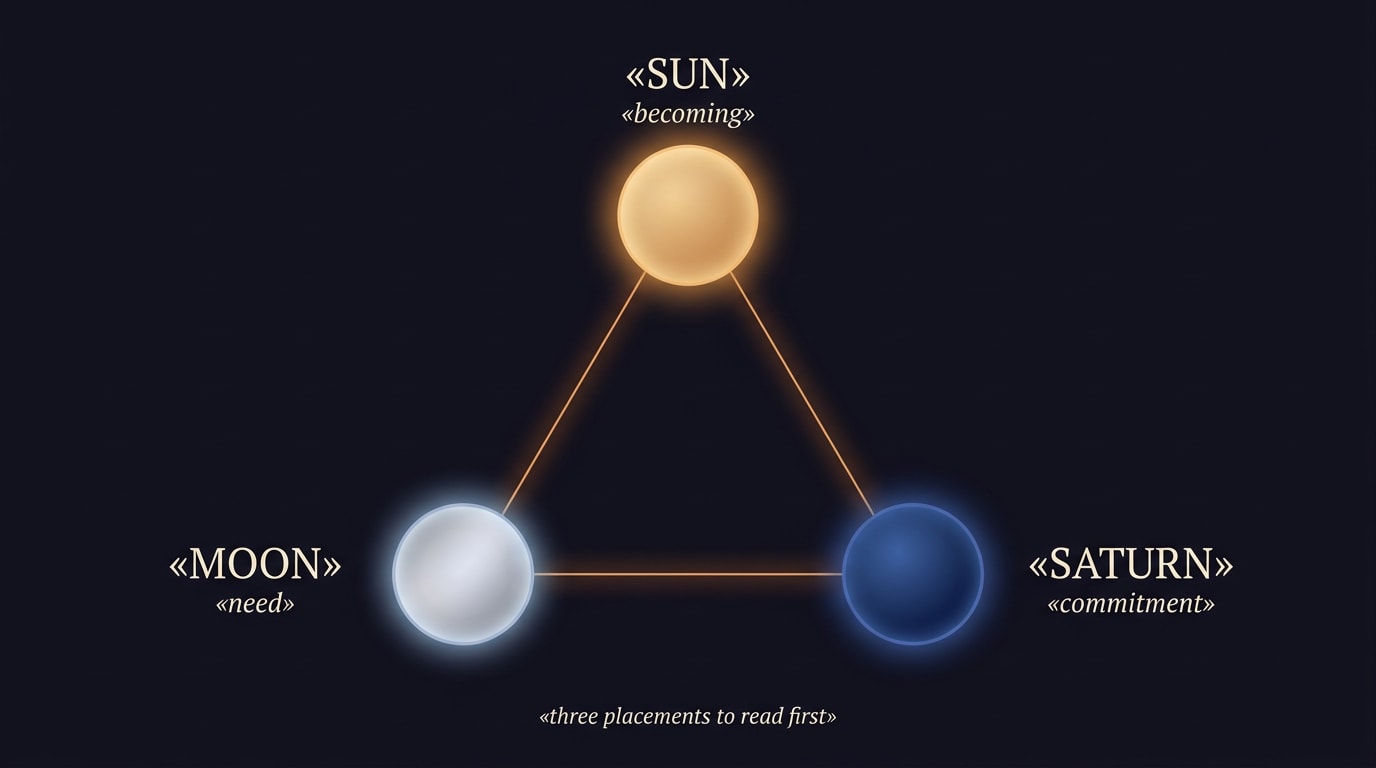
If you only ever read three things in your chart when you're feeling lost, read these: your Sun (who you are becoming), your Moon (what you actually need), and your Saturn (what you're willing to commit to). All three have been used as orientation anchors for centuries. When the old shape has gone and you're trying to read yourself afresh, these are the three questions worth re-asking.
Sun: who you are becoming
The Sun is the body most visible from Earth, and your Sun sign is determined by the date of your birth. Most people know it as the one-line answer to what are you at a dinner party (I'm a Pisces), but that flat horoscope use of the Sun is, traditionally, a real flattening of what it's there for.
The Sun isnt a label for a finished personality; its the direction your life is growing into - what older traditions called your sense of purpose, the through-line of who you are becoming. Some astrologers describe it as the part of you that's individuating, finding its own shape, separate from family, separate from social role, separate from job title, separate from any structure you happen to be inside at the moment. That word becoming is doing real work. Becoming hasn't finished yet, which means there's always some part of your Sun that isn't fully visible, not because you're hiding it, but because it isn't all the way here.
When you've just lost a structure, your Sun is often the part of you that's been waiting for the structure to step aside. Not always; sometimes the structure was the only thing holding the Sun together, and its loss is exactly the catastrophe it feels like. But often, surprisingly often, the lost feeling is partly the Sun stretching into space that just opened up, and not yet knowing what to do with it.
Moon: what you actually need
The Moon, astronomically, moves much faster than the Sun. About two and a half days per sign, completing the zodiac in roughly four weeks. Because it moves fast, calculating your Moon sign properly needs your date and your time of birth; a missed birth time can put it in the wrong sign.
The Moon in your chart isn't your "emotional self" as a flat label. It's the placement that describes what you need to feel held: physically, emotionally, the rhythms that quiet your nervous system, the kind of comfort that actually lands. Think: the right kind of dinner. The right amount of solitude. The right texture of company.
When a structure drops away, your Moon often reads back what that structure was quietly meeting. The marriage that did the cooking and the daily check-in. The job whose morning commute gave you forty minutes of audiobook solitude. The shared flat whose Sunday roast was the only meal you sat down for. The Moon-need didn't go away with the structure; it just lost its delivery mechanism. Half the slower kind of lost is the Moon being hungry and not yet knowing where the next meal is coming from. Three questions worth turning over: what did the old structure quietly feed in me; what is now unmet; what would enough look like, not ideal, just enough, for that need this week?
Saturn: what you're willing to commit to
Saturn takes about twenty-nine and a half years to complete the zodiac. Which means roughly every twenty-nine years, Saturn returns to the place it was at your birth, what astrologers call a Saturn return, the cultural shorthand for re-grounding around age 28-30 and then again around 56-60. Saturn has bad press in popular astrology (it's the "harsh" planet, the "punishment" planet) and that bad press is mostly nonsense.
What Saturn actually describes in your chart is the part of you that decides what's worth building around. What you're willing to put weight on. What you'll commit to even when the commitment becomes inconvenient. A Saturn placement, read kindly, is a question about purpose in life: what are you, on the inside, actually willing to build a life around?
When you've lost your shape, Saturn is the part you talk to about what to commit to next. Not the fast-decision Saturn of "just pick a thing"; the slow Saturn of "what could you live with thirty years from now". A useful one-line illustration: someone in the wake of a redundancy who keeps catching themselves thinking I'd quite like a small garden centre. That's a Saturn note. Quiet, slow, durable, builds-something-around-this-shape.
A worked example: a 32-year-old with Capricorn Sun, Sagittarius Moon, and a hard Saturn
Here's how the three-placement reading lands in one specific shape: an illustrative composite (a plausible combination, not a real person), to walk through the method.
 Six months after the redundancy, a Wednesday morning with no place to be.
Picture someone at thirty-two, six months after being made redundant from an engineering job he held for nine years. He has a Capricorn Sun, a Sagittarius Moon, and Saturn in hard angle to his Sun: what's called a square, an angle of about ninety degrees between two placements, considered traditionally to add friction.
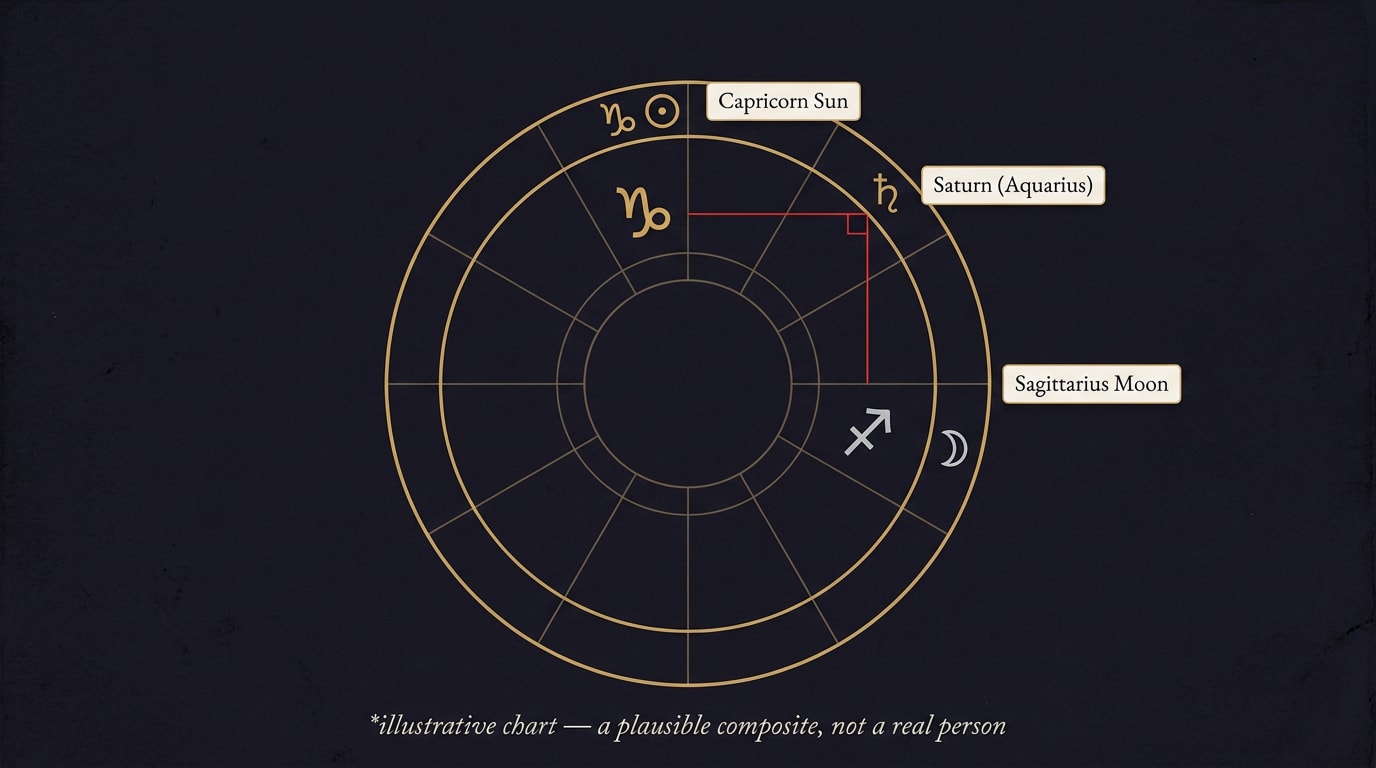
His Sun is in Capricorn. A temperament built to commit to long structures, slowly. Nine years at one company didn't just happen to him; his Sun chose it again, quietly, every morning. When the job ended he stopped doing the one thing his Capricorn Sun is fundamentally wired for: building. The lost feeling isn't the job; it's that the building-work paused, and the Capricorn part of him doesn't have a name for "not building" that doesn't feel like failing.
His Moon is in Sagittarius. Emotionally, he needs room, a sense of horizon, the ability to picture something bigger than the immediate week. The marriage and the job had between them quietly been meeting that need: the work conferences, the planning of weekends away, the sense that life had a shape larger than the kitchen-table week. Without them, the room shrinks. The Moon goes hungry, and a hungry Sagittarius Moon doesn't read "I'm depressed"; it reads "I'm getting irritable about absolutely nothing and starting arguments at lunch".
Then Saturn, square to his Sun. This is a temperament that argues with itself about what's worth committing to. The Capricorn Sun wants to build a long thing. The Saturn-square voice keeps asking but is this the right long thing? For nine years the job answered the question by default; the question wasn't on the table; the commitment was already made. At thirty-two, six months after redundancy, with the Saturn return having just passed at thirty, the argument is finally on the table properly, because the old commitment isn't holding it down any more.
He reads the three placements together. The lost feeling isn't a deficit. It's three real parts of him asking three different questions at once. Sun: what am I building next? Moon: what's actually feeding me? Saturn: what am I willing to put weight on, knowing I might be wrong? Each question has a slow answer, not a fast one. Six months on he hasn't found himself; that's the wrong language, the wrong shape. He's stopped looking for a single answer when his chart describes three.
'Isn't this just confirmation bias?' Partly, yes, and that's not the disqualifier some people think it is. Most self-reflection tools work partly through confirmation bias; you notice what the prompt invites you to notice. The question isn't whether the chart causes the noticing; it's whether the noticing is useful. For the person at thirty-two with three questions running at once, having three structured places to put them was useful. Whether you call that astrology or structured journalling is a vocabulary preference, not an empirical disagreement.
A reflective practice: three journal prompts you can use today
Once you can name the three placements you can turn them into a reflective practice, three journal prompts to sit with this week. No astrology degree required, no chart calculator required for the prompts themselves (although seeing your specific placements helps colour the answers). This is journal territory, or quiet thinking time with a mug of something warm: not a script for a session with a qualified professional, and not a method for talking yourself out of real distress.
 A morning prompt, not a finished answer.
The Sun prompt, direction of becoming. Sit with the question: what am I building, even quietly, that has nothing to do with what I just lost? Maybe it's a writing habit. Maybe it's the small daily walk that has nothing to do with anyone else's schedule. Maybe it's a thing you've been quietly curious about for a year and never had time for. Don't argue with whatever shows up; just write it down. Becoming, by definition, isn't finished, so the answer doesn't have to be finished either.
The Moon prompt, actual need. Sit with: what was the old structure quietly meeting for me, that I now have to meet some other way? Then: what would enough look like, not ideal, just enough, for that need this week? The trap with the Moon is wanting the perfect answer (the right relationship, the right routine, the right home). Resist that; just describe enough. Enough is what gets you through Wednesday without your nervous system filing a complaint.
The Saturn prompt, willingness to commit. Sit with: if I had to put my weight on one small thing in the next month, knowing I might be wrong, what would I be willing to commit to? What's the cost of getting it wrong, and is it bearable? The trick is to make the thing small enough that getting it wrong isn't catastrophic. Saturn likes small commitments, repeated. A weekly class. A monthly walk with one friend. A two-month writing project. The thing about commitments at a pivot is they don't have to be the new shape, they just have to be heavy enough to test your footing on.
Most of the work is noticing that the lost feeling has three voices in it, not one. Sit with the questions, not the answers. Don't try to write a closing line for any of them. The chart isn't a quiz with a result page.
A reminder: if sitting with these questions makes things feel heavier rather than clearer, if the journalling tips you into spiralling or self-blame, that's a Mind.org or GP conversation, not an astrology one. The two aren't competing; they answer different questions. The questions you can't answer in a notebook are usually the ones a person needs to hold with you.
When astrology is the wrong tool — signs you need a person, not a chart
There are specific times when reading your chart isn't the right next step. Knowing them is part of using astrology honestly.
The first is when the feeling is heavy enough to affect your sleep, your work, or your sense of safety. That's GP / Samaritans / Mind territory, not a chart. The first piece of work is talking to someone qualified, not reading a placement. If you're in the UK, the practical pointers are: Samaritans on 116 123 (free, 24/7) for anything that's frightening or urgent; Mind's infoline on 0300 123 3393 for advice on what kind of support exists and how to access it; the NHS, which usually lets you self-refer to talking therapies via your GP or directly online in most areas. Use them. The chart will still be there in three months.
The second is when what you actually want is for someone to tell you what to do. A chart is the wrong tool for that. It doesn't make decisions; it offers vocabulary. If what you need is decision-support, should I take the job, should I leave the relationship, should I move country — a friend who knows you, a coach with a method, a financial adviser with credentials, or a therapist who'll sit with the ambivalence will serve you better than a placement read at the kitchen table.
The third is when you are in active crisis or grief. The first weeks after a loss aren't usually the time for self-reflection prompts. The first work is being held, by people, not by maps. Anything that asks you to look hard at yourself in the acute middle of a grief is asking too much. The chart will still be there in three months. Read it then, if you want to.
The fourth is when the question is medical or psychiatric. A chart can't diagnose ADHD, depression, anxiety, an eating disorder, addiction, trauma, or anything else that lives in a clinician's notes, and it shouldn't be used as if it can. If a description in any astrology article seems to match something that's affecting your life in a serious or persistent way, the next step isn't more astrology; it's a conversation with a qualified clinician. A chart can describe patterns. A clinician can name a condition. Different vocabularies, different jobs.
Astrology, used honestly, sits alongside professional help. It doesn't compete with your GP or your therapist. If you're hesitating between booking a session and reading your chart — book the session first.
What an astrology lens does here. It gives you a name for three parts of yourself when an old structure has dropped away. Not a verdict, not a treatment, not a plan — vocabulary that lets the lost feeling become less personal and more describable, while the actual rebuilding happens slowly in the rest of your life.
If you'd like to see your own Sun, Moon and Saturn side by side, WowAstro will calculate a free birth chart for you. Date, time and place — a couple of minutes. A starting point for the journal prompts above, not a verdict.
Frequently asked questions
Can my birth chart really tell me who I am?
A birth chart can describe parts of you in a structured vocabulary; it doesn't tell you who you are. The difference matters. A description hands you words for noticing, that's my Sagittarius Moon arguing with my Capricorn Sun about the weekend — and the noticing can be useful. A verdict tells you what to be, which a chart can't and shouldn't do. Reading your chart for self-understanding is closer to using a thoughtful personality framework than to taking a personality test with a result page.
How is reading a chart for self-understanding different from a horoscope?
A daily horoscope makes a prediction about your day, expect tension at work, avoid important conversations. Reading your chart for self-understanding offers vocabulary about your patterns — here is the part of you that asks what to commit to, here is the part that gets hungry for room. Different intent: prediction tries to tell you events ahead of time; reflection tries to give you language for what's happening. This article is about the second. We're not predicting your week.
Where should I start if I want to use astrology for self-reflection?
Start with the three placements in this article, Sun, Moon, Saturn — and resist the urge to look up every other body and house at once. Calculate your chart (a free natal-chart calculator like the one on WowAstro does this in a couple of minutes), find your three placements, read one of them and sit with it for a week before moving to the next. The Sun first, because it's the easiest to find. Then the Moon. Then Saturn. Use the three journal prompts above. Don't try to learn everything in a week. A chart isn't a fact-sheet to memorise; it's a vocabulary to live with.
Should I see a therapist instead of looking at my chart?
If you're struggling enough that it's affecting work, sleep, or relationships, yes, please. Mind.org has a free directory of UK therapists, and the NHS offers talking therapies via self-referral in most areas. A chart can give you language for what you feel; a therapist gives you tools to work with it. They aren't substitutes for each other. Many of the people who get the most out of a chart are people who also have, or have had, a good therapist — astrology gives them a way to think about patterns between sessions, and therapy gives them a way to actually shift the patterns. The two sit alongside each other.
Read the wider context in our guide to your full birth chart
By Oksana Miatova, astrologer and writer at WowAstro. Charts calculated using the Swiss Ephemeris.
About this article: WowAstro readings combine traditional astrological methodology (Swiss Ephemeris calculations, Hellenistic and modern psychological frameworks) with AI-assisted writing reviewed by Oksana Miatova before publication. For entertainment and self-reflection only — not medical, legal, or financial advice. Full editorial policy at /editorial-standards.
Astrology, as we use it at WowAstro, is a tool for self-reflection and self-understanding — not a method for predicting events, health, or financial outcomes.
This article is for self-reflection and entertainment. If you're in crisis, please contact your GP, Samaritans on 116 123 (free, 24/7), or the Mind.org helpline on 0300 123 3393. Astrology sits alongside that conversation; it cannot replace it.
Read your own natal chart
A personal AI reading, from £1
⭐ +50 Wow Stars cashback · sign up and get 100 ⭐
Build my chart →Comments
New here? Get −30% off your natal chart
Leave your email and we will send you the promo code WELCOME30. Straight after that you can comment — no passwords, all automatic.
Quick sign-in
Sign in with Telegram — one click.
Or by email (with a gift)
Already have an account? Enter the same email — we'll email you a sign-in link.