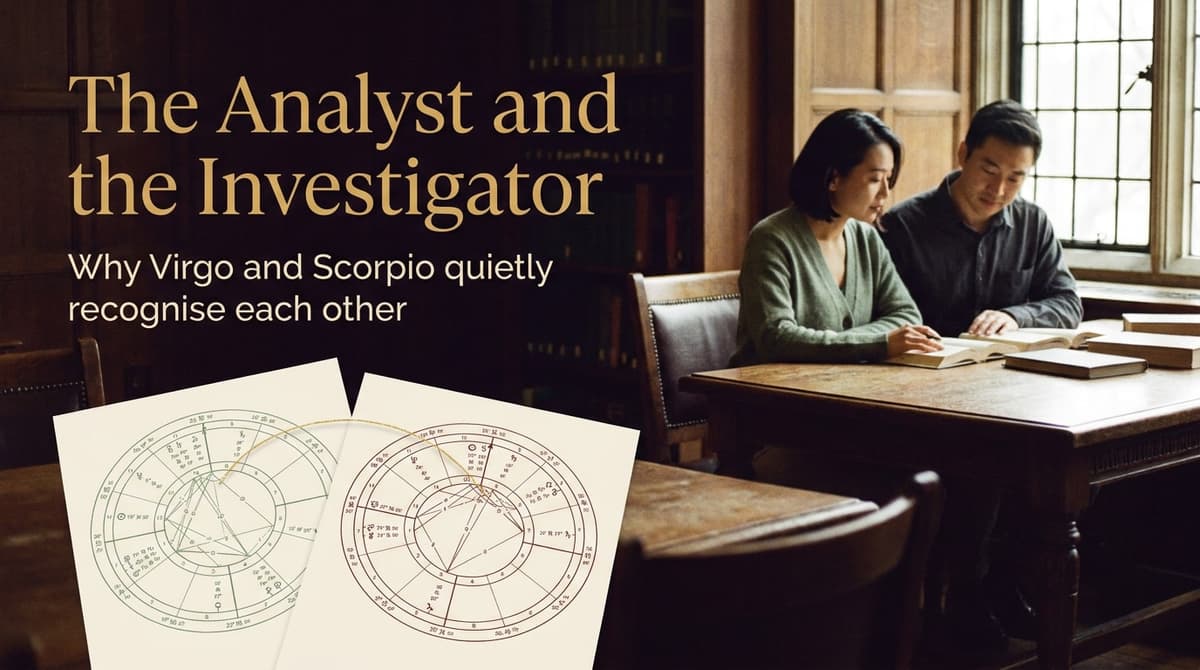
You've heard the word. A friend used it («we ran our synastry») and you nodded as if you knew exactly what they meant. Most people, asked to define synastry on the spot, say something about charts and compatibility and then trail off into «you know, like a couples thing».
Here's the short answer. Synastry is what astrologers do when they want to look at two people, properly. They take both birth charts, lay one over the other, and read how the planets of one of you sit in relation to the planets of the other. The output describes how you actually fit, not a verdict on whether you should.
The rest of this piece is the unhurried version of that paragraph.
In short. Synastry is the astrological technique of overlaying two complete birth charts to see how two people fit. It compares all ten planets in each chart, not just the two Sun signs. Where sun-sign compatibility reads one placement and calls it a relationship, synastry reads the whole conversation between two charts — what's easy, where there's friction, and what each person actually meets in the other.
 wiping hands on rag, looking out window.
What synastry actually is
Synastry, from the Greek syn-astron (literally «stars together»), is the technique of overlaying two birth charts to read the relationship between them as a third pattern.
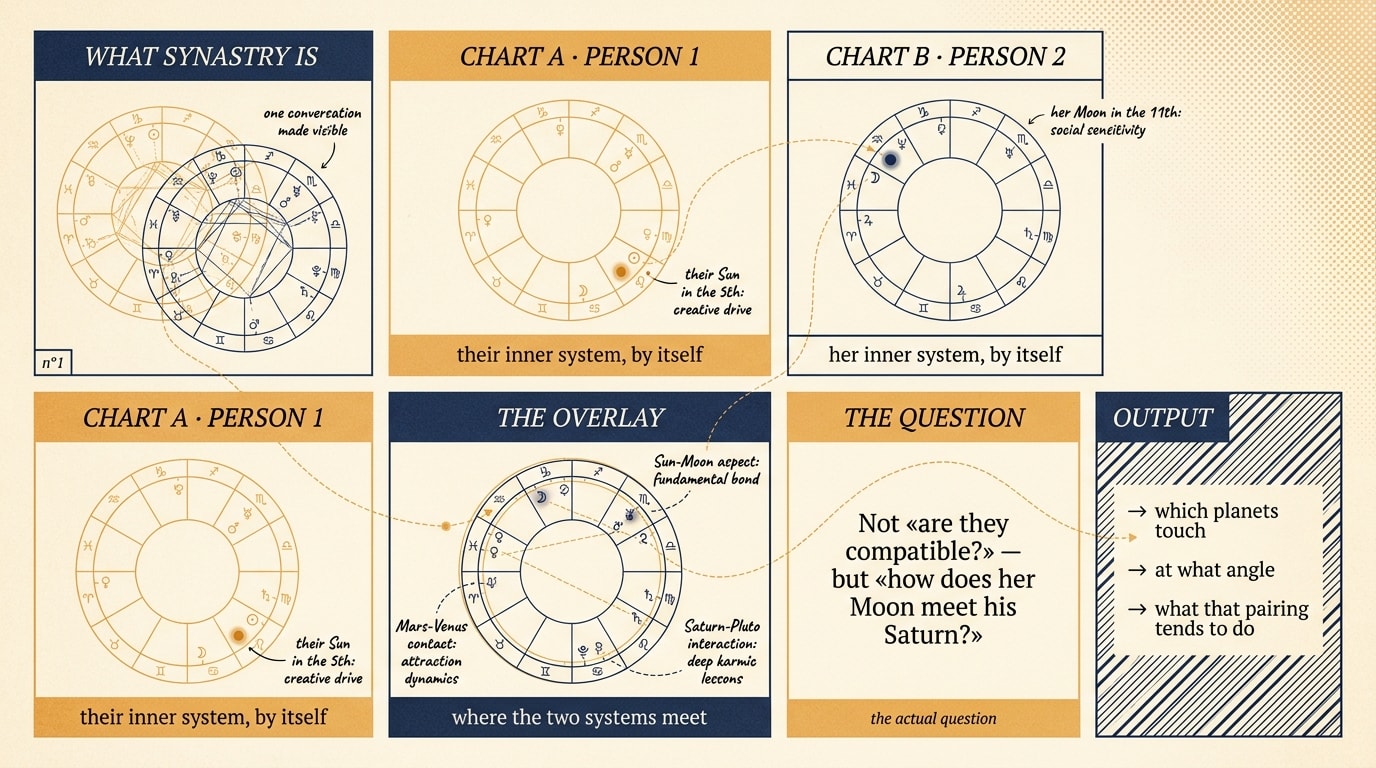
Each chart on its own is a complete map of where the planets sat in the sky at one specific moment of birth: the Sun, the Moon, Mercury, Venus, Mars and the slower planets out to Pluto, ten placements in all, plus the houses that divide the wheel into areas of life. Think of each chart as a small, complete operating system. Synastry is the conversation between two such systems when you lay them on the same desk.
The technique is used by working astrologers and documented in the canon of relationship astrology going back about fifty years. When an astrologer says «I ran your synastry», this is what they did: set one chart over the other on the same wheel and read how the planets in one angle toward the planets in the other.
If you haven't met your own chart yet, that's the starting point. Your natal chart explained walks through what one chart is doing on its own; synastry assumes you've done that bit first.
Synastry vs sun-sign compatibility
Synastry differs from sun-sign compatibility in scope: where a sun-sign table compares one placement in each chart, a synastry chart compares all twenty placements across both. Your Sun sign is one tenth of one chart. A real relationship runs on ten planets each, plus the angles between them, and any honest read needs at least the principal of those angles.
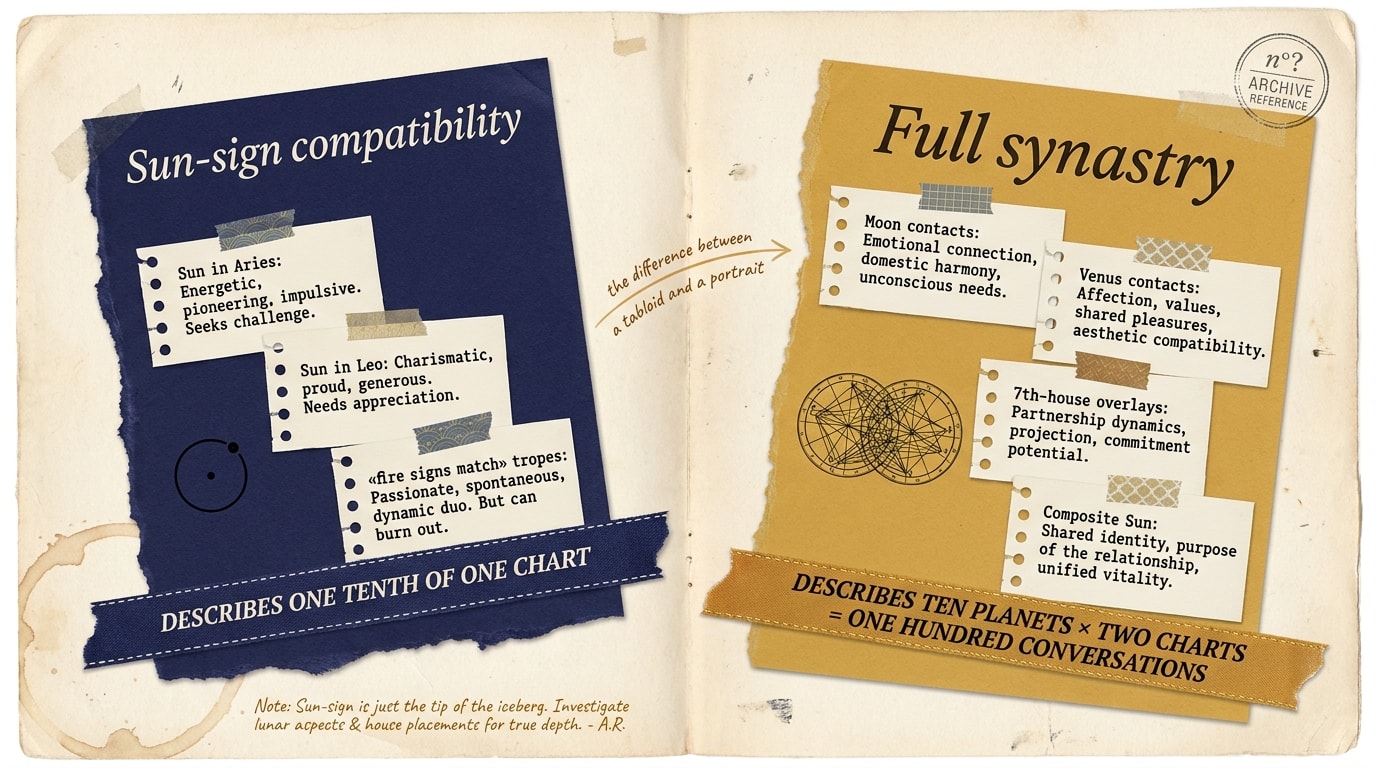
Three sun-sign sites can give you three opposite verdicts on Cancer-Scorpio precisely because each writer privileges a different angle on the same single data point. Nobody is exactly wrong; everybody is reading the same one-tenth of the chart and filling in the rest with mood. Synastry is what sun-sign tables would be if they did the rest of the maths.
| Sun-sign compatibility | Synastry | |
|---|---|---|
| What it compares | One Sun sign vs one Sun sign | All ten planets in chart A vs all ten in chart B |
| Data needed | Two dates of birth | Date, time and city of birth for both people |
| Possible results | 144 (one cell of a 12×12 grid) | Effectively unique for every pair |
| Houses (areas of life) | Not used | Used: where one person's planets land in the other's life |
That table isn't the deep dive, just the line between the two techniques. If you want the proper version of compatibility (which placements actually carry the weight, why so-called difficult aspects don't mean a bad relationship, and a worked example end-to-end), that lives in our honest guide to astrological compatibility. It's the longer cousin of this article.
What a synastry chart compares
A synastry chart compares two full birth charts by overlaying one on top of the other and reading the angles, called aspects, between the planets of one person and the planets of the other. An aspect is just a measurable angle between two planets — a trine is 120° apart, a square 90°, an opposition 180°, a conjunction 0°. Each angle has a different texture, which is why astrologers talk about Venus trine a partner's Mars rather than just naming the two planets in passing.
Ten planets in each chart means twenty placements in conversation. Some aspects feel easy and you barely notice them. Others rub, and the rubbing is information.
 looking out at the street, half-finished latte.
The whole technique is sometimes called chart overlay, which is exactly what it sounds like. Five placements carry most of the weight in a first read: Moon-to-Moon (your emotional language), Venus and Mars (the chemistry question), Sun-to-Moon (a quieter recognition layer), house overlays (where one person's planets land in the other's wheel), and the Ascendants (the first-impression surface). All five are explained, with worked examples, in our astrological compatibility guide; this article is the doorway, not the room.
What you'll notice in a synastry chart, once you know what to look for, is that it isn't a verdict at all. It's a paragraph of description. Two people sit in the same room and the chart describes what each of them is meeting in the other.
Synastry vs composite chart
Synastry and composite are two different techniques, and they often get confused. Synastry overlays your two separate charts to see the conversation between you. A composite chart is a single new chart, calculated from the midpoints of both, which describes the relationship as a third entity in its own right — separate from either of you, the relationship itself having something like a chart of its own.
Astrologers use them for different purposes. Synastry shows the dynamic between two people; the composite shows the character of the relationship those two create. For a first read of a couple, start with synastry. The composite is something you come to later, when you want to ask «what is this relationship doing?» rather than «what are we doing in it?».
A small worked illustration
Most explanations of synastry stop at the definitions. The two people below are not a real couple — just a plausible pair of charts, small enough to follow, that shows the moves.
Partner A: Sun in Capricorn, Moon in Pisces, Rising in Taurus. Partner B: Sun in Cancer, Moon in Taurus, Rising in Cancer.

Their Moons sit at a comfortable angle to each other. Pisces and Taurus form a sextile (about 60° apart), which is the friendly mid-range of aspects. Both Moons are receptive, both comfortable with slow time; Partner A, dreamier on the inside than the public face suggests, meets in Partner B someone who responds with grounded, sensory warmth.
Their Suns sit opposite each other. Capricorn and Cancer are opposite signs in the wheel, which makes a Sun-to-Sun opposition the classic complementary pairing — work and home, the long climb and the warm interior. Each carries the side the other isn't doing.
House overlays are where it gets specific. Partner A's Capricorn Sun, slotted into Partner B's wheel, falls into Partner B's seventh house, the house of committed partnership. From the first conversation, Partner B reads Partner A as relationship-shaped, not friend-shaped.
That is three of the five major signals. Soulmate astrology loves to skip straight to this kind of recognition, but the picture gets honest only when you add the other two (Venus-to-Mars and the Ascendants). For the synastry chart in full detail, with a complete worked example, our astrological compatibility guide is the article you want next.
Using a synastry read
A synastry chart is most useful as a description of a relationship's shape, not a verdict on whether it should continue. The chart describes how two people meet, attract, irritate and support each other; what each does with the description is, reassuringly, still up to them. Couples with «hard» synastries have built long marriages; couples with «easy» synastries have parted. The chart is information, not the decision.
What a synastry read does. It turns ten plus ten placements into a paragraph about one particular relationship: what comes easily, where you'll keep doing the work, what each of you offers the other that neither of you noticed needing. It doesn't tell you to stay or to leave. It describes the material you're working with.
Use it as a mirror. This is the pattern, what do we want to do with it? The parts that ring true are usually the work; the parts that don't are usually what the chart got right but the relationship has already grown past.
If you'd like to see your own synastry rather than an illustrative one, WowAstro will calculate it for both of you for £5: relationship astrology and birth chart compatibility from your two real charts, not two Sun signs.
Questions readers ask
What does a synastry chart show?
A synastry chart shows the angles between the planets of one person's birth chart and the planets of another's, laid one over the other. The angles, called aspects, describe the texture of the conversation between the two charts — what's easy, where there's friction, where one person sees themselves in the other. It isn't a verdict on whether the relationship will work; it's a description of what's being met when two people are in the same room.
Do I need exact birth times for synastry?
Ideally yes, but a partial read still tells you most of the picture. Without exact birth times you lose the Rising signs and the house overlays, which is two of the five big factors. The Moon, Venus, Mars and the Sun-to-Sun and Sun-to-Moon dynamics still read, with some loss of precision around the Moon if a partner was born close to midnight or noon and the Moon was changing signs that day. A partial synastry chart is still much more informative than any sun-sign table.
Is synastry better than sun-sign compatibility?
Synastry is considerably more informative than sun-sign compatibility for the simple reason that it uses ten planets across two charts instead of one. Sun-sign tables compare one tenth of one chart and call the result a relationship; synastry compares the whole thing, including the houses one person's planets land in for the other. Both can be enjoyable; only one has enough information to describe an actual couple.
What's the difference between synastry and composite?
Synastry overlays your two separate charts to see how you interact, planet by planet. A composite chart is a single new chart calculated from the midpoints of both, which describes the relationship as a third entity in its own right, separate from either of you. For a first read of a couple, synastry is the one to start with; the composite is useful later, when you want a sense of the relationship's own character.
 sitting on step with coffee cup.
A note on what this is. Astrology, as we use it at WowAstro, is a tool for self-reflection and self-understanding, not a method for predicting events, health, financial outcomes or whether a relationship will last. Read a synastry chart as a description of a dynamic, take what's useful, leave the rest.
Written by Oksana Miatova, astrologer and writer at WowAstro. Charts calculated using the Swiss Ephemeris, the same astronomical data working astrologers use.
See what your charts say about each other
A personal AI synastry reading — not a sun-sign table, but an analysis of both natal charts across 8 areas of the relationship
Comments
New here? Get −30% off your natal chart
Leave your email and we will send you the promo code WELCOME30. Straight after that you can comment — no passwords, all automatic.
Quick sign-in
Sign in with Telegram — one click.
Or by email (with a gift)
Already have an account? Enter the same email — we'll email you a sign-in link.