
You read your sun-sign description, didn't quite recognise yourself, and wondered what else there was. Or you keep seeing "sun in Scorpio, moon in Pisces, rising in Gemini" on someone's profile and want to know what on earth that's about. Or someone's just told you that a birth chart explains more than a horoscope, and you'd like to find out whether they're right.
This is the explainer — what a natal chart is, what each layer means, and why the four layers add up to a description rather than a verdict. If you want a hands-on, placement-by-placement guide to reading your own chart, that lives in How to read your birth chart: a step-by-step walkthrough. Start here for the concept, go there for the practice.
A birth chart, or natal chart, is the same idea each time: a map of where the planets sat in the sky at the exact minute you were born — drawn from your date, time and place of birth. That's the whole input. What it gives back is harder to put in a sentence, which is probably why most guides skip the explaining and reach for the jargon.
This one won't. The honest version is that your chart is one connected reading about a person, not a list of ten separate planets — and the rest of this guide is about what that means in practice.
In short. A natal chart, also called a birth chart, is a map of where the planets sat in the sky at the exact minute you were born, drawn from your date, time and place of birth. It describes patterns and tendencies, how you think, feel and act — rather than predicting events. The chart has four layers (planets, signs, houses, aspects) and is read as one connected description of a person, not ten separate placements. WowAstro calculates charts using the Swiss Ephemeris.
 looking at framed photo on shelf.
What a natal chart actually is (and what it isn't)
A natal chart is a snapshot of the sky at the exact minute you were born, used to describe patterns in your personality and life rather than to predict events. It takes three inputs, date, time and place of birth — because the sky changes by the minute, and the chart maps how the planets sat at that one specific point. The Rising sign in particular moves on every couple of hours, so the time you were born actually changes the chart. WowAstro calculates charts using the Swiss Ephemeris, the same astronomical data working astrologers and serious software rely on. Before you read anything, dig up your birth time as exactly as you can; a noted minute makes a different chart from a guessed one.
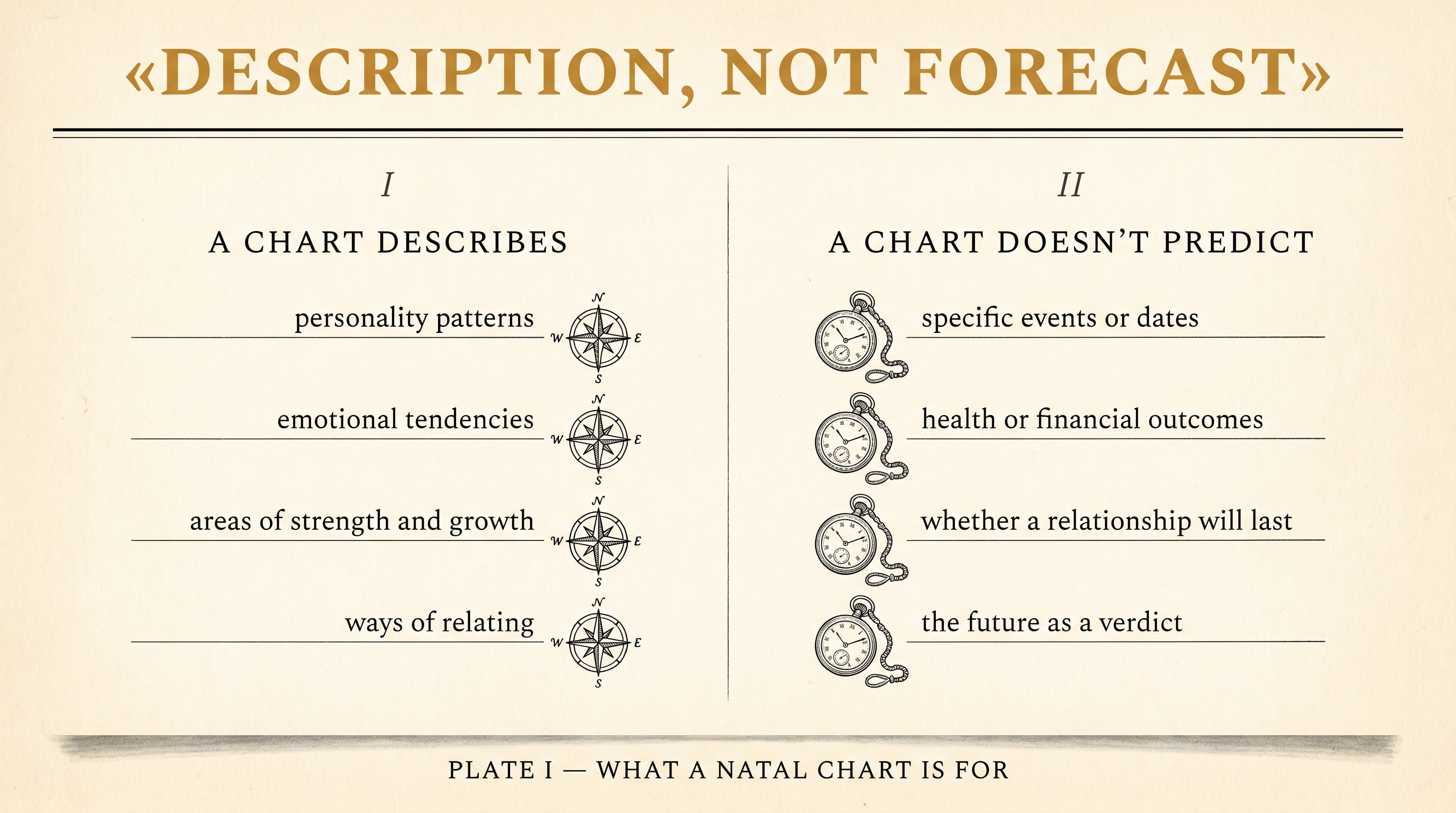
The most useful way to set expectations early is to spell out what a chart does and doesn't do. It describes the shape of you: the tendencies you bring, the reflexes you fall into under pressure, the directions you tend to grow towards. It doesn't tell you the date you'll meet someone, the year you'll change jobs, or whether the person you're dating is your soulmate. If a guide tells you yours will, the writer has wandered out of astrology and into entertainment-as-fortune-telling. We're staying with the first kind here.
One distinction worth making before we go further. A birth chart and a horoscope are not the same thing, though the words are often used interchangeably. A birth chart is calculated once, at your birth, from ten planets and the angles between them, and is unique to you. A horoscope column is a daily or weekly forecast written for everyone of a sun sign — twelve forecasts for the whole population. The first describes you specifically; the second describes nobody specifically. When this guide says "chart", it always means the first kind.
The four layers: planets, signs, houses and aspects
A natal chart is read as four layers stacked together: planets (the functions), signs (the styles), houses (the areas of life), and aspects (the conversations between planets). Most beginners try to read each placement on its own and stall — ten separate facts in a row don't add up to a person. The four-layer model is how working astrologers integrate the chart; once it clicks, the wheel stops looking like a puzzle of separate symbols and starts behaving like a sentence with grammar.

Planets: the functions
A chart has ten planets, by astrological convention this includes the Sun and Moon, which are technically luminaries. Each one stands for a function in you: the Sun for your sense of will and identity, the Moon for emotion and what makes you feel safe, Mercury for thinking and speaking, Venus for what you love and find beautiful, Mars for how you act and what you pursue. The slower outer planets carry broader themes: Jupiter for expansion and meaning, Saturn for structure and responsibility, Uranus for change and individuation, Neptune for imagination and dissolution, Pluto for depth and transformation. Read each planet first as a part of you, not as a fixed trait — Mercury is the part of you that thinks, not a verdict on whether you're clever.
Signs: the styles
Each planet sits in one of the twelve signs, and the sign describes the style in which that function operates. Mercury in Gemini is one kind of mind: quick, curious, restless, drawn to many things at once. Mercury in Capricorn is another: careful, methodical, weighty, prone to thinking things through twice before speaking. The function is the same, both are the part of you that thinks — but the style is different. This is the move that makes signs do real work. Reading "Mercury in Gemini" as a label tells you almost nothing; reading it as the way your thinking tends to move tells you something useful about how you'll experience a Monday morning meeting.
Houses: the areas of life
The wheel is divided into twelve houses, and each placement falls into one of them. A house is an area of life: the first house is the self you present, the seventh is partnership, the tenth is career and public reputation, the fourth is home and the people you let close. The full twelve cover everything from money and self-worth (second house) to learning and immediate environment (third house) to friendships and groups (eleventh house) to the more inward, harder-to-name material of the twelfth. For a first read, it helps to group them — broadly, the houses around 1, 4, 7 and 10 are the structural ones (self, home, others, public), and the rest sit between them, expanding what each axis is about. The houses are why a chart is so specific: the same Venus in Taurus reads quite differently in a 2nd house (you love what's beautiful and you build it into your life as wealth and possessions) than in an 11th (you express it in friendships and chosen community).
Aspects: the conversations
The planets sit at particular angles to each other on the wheel, and certain angles count as aspects — what astrologers call the conversations between planets. The main ones are conjunction (planets in the same place, working as one), sextile and trine (planets in supportive relationship, flowing easily), square and opposition (planets pulling against each other, friction). The function of aspects is to say where the parts of you cooperate and where they keep tripping over one another. A square between Saturn and Venus, for instance, describes a part of you that wants warmth and a part that defaults to caution, and the two have to negotiate. Aspects aren't verdicts. A chart full of trines often produces a person who finds life unusually easy and somehow flat; a chart with a few well-placed squares tends to produce the people who actually get things done.
In one line. Each placement reads as planet (what), sign (how), house (where), and the strongest aspects (what's in conversation with what). Mercury in Gemini in the 3rd house, for example, is a recognisable person: quick mind, thinks out loud, most visible in everyday conversation and short messages.
If you want a hands-on, placement-by-placement walkthrough of how to do this on your own chart, the step-by-step walkthrough of how to read your birth chart covers it from first wheel to first reading.
How a chart is calculated, and why birth time matters
A birth chart is calculated from your date, time and place of birth using an astronomical ephemeris that records planetary positions to the arc-second. The maths is centuries old in lineage and minutes old in execution; the same calculation that took an astrologer hours by hand in 1750 takes a chart calculator about half a second now. The Rising sign moves roughly every two hours, which is why even a half-hour error in your birth time changes the rising sign and shifts the entire house structure. The Swiss Ephemeris, the data standard used by serious astrology software including Solar Fire, Kerykeion and AstroSeek, is derived from NASA JPL data and gets you positions accurate to within a few arc-seconds.
A short historical note, since the calculation has a longer history than most people imagine. The recording of planetary positions for astrological use goes back to Babylonian astronomical diaries from around 700 BCE; Ptolemy's Almagest and Tetrabiblos in the second century formalised the maths and the interpretive framework that Western astrology still leans on; Renaissance ephemerides made charts available to a wider European audience; and the modern Swiss Ephemeris, first published in 1997 and continuously updated since, is the computational descendant of all of that. The interpretation is contested, in the way that interpretation always is; the underlying astronomy is not.
What if you don't know your birth time. This is the most common practical question, and the answer is that you can still get a useful chart, with caveats. Without a precise time, the Rising sign and the houses cannot be reliably calculated, the Rising shifts every two hours, and the houses follow from it. The Moon sign may be ambiguous if you were born within a few hours of a sign change, since the Moon moves about thirteen degrees per day and crosses sign boundaries often. Everything else — the Sun, Mercury, Venus, Mars, Jupiter, Saturn, and the outer planets, which change sign far more slowly, still reads cleanly. A partial read, in other words, surfaces most of who you are, even if it leaves out the first-impression layer and the houses. If you can find your birth time later, you can redraw the chart then; nothing about a partial reading is permanently lost.
How to read your chart as a whole, not as a list
To read your chart as a whole, you start with the big three (Sun, Moon, Rising), then add the other planets through their signs and houses, and finally look at the aspects to find where things are easy and where they push against each other. Beginners stall when they try to read every planet at once and come away with ten disconnected paragraphs — a chart-shaped wall of text that doesn't sound like anyone. The four-layer model handles this by giving you a reading order; you build the chart up rather than dump it out.
Four practical steps. First, the big three, your Sun (who you're becoming), Moon (what you need to feel safe), and Rising (how the world first reads you). These three carry most of the chart's grammar and give you the spine of a description; if you have only fifteen minutes, you read these. Second, add the personal planets, Mercury (thinking), Venus (love and values), Mars (action), each through its sign and house. These three, together with the big three, sketch most of what people mean when they describe a person. Third, add the social and outer planets — Jupiter and Saturn (the social planets, themes that shape a life-stage at a time) and Uranus, Neptune and Pluto (the outer planets, slower-moving generational themes). These add depth and context but are read last, because they're broader and don't define you as individually as the inner ones. Fourth, notice the strongest aspects, the tight ones, within a few degrees of exact, carry more weight than wider ones. Look especially at aspects involving the big three and the personal planets; these are where the chart's internal conversations are loudest.
 leaning on railing waiting.
If you'd like the same method in a hands-on walkthrough with a single chart worked from start to finish, the step-by-step walkthrough takes you through it.
A worked example: one chart, one paragraph
Most natal-chart guides explain the placements and leave you to assemble them. Here's what the assembled version looks like, with a single illustrative chart — not a real person, just a plausible set of placements that lets us run the method end to end.
The placements: Sun in Capricorn, Moon in Pisces, Rising in Taurus, Venus in Sagittarius, Mars in Aries.

The test of the four-layer reading is whether all that can be said as one paragraph about a person, not five separate lines. Here it is.
She comes across, on first meeting, as quietly competent, Taurus Rising, slow to warm, reserved, the sort of person other people quickly assume is dependable. The reserve is partly a misdirection. Her sense of self is genuinely serious (Capricorn Sun, drawn to long-form work, suspicious of shortcuts), but her inner weather is much softer and more porous than the outside suggests (Pisces Moon, easily moved, soothed by quiet rooms and water). What she loves runs in a different direction altogether — she's drawn to ideas, distances, plans, conversations that open up rather than close down (Sagittarius Venus, love expressed through movement of mind), which sometimes baffles colleagues who only see the Taurus surface. And under all of it, when she decides to do something, she moves quickly and without much warning (Aries Mars, action that arrives in a clean, fast burst rather than a long approach). A recognisable person: dependable on the outside, dreamy underneath, restless about ideas, decisive when it matters.
That paragraph is the chart. Each of the five placements is in there, doing its part, but the reader doesn't have to know which is which to recognise the person. That's what reading a chart as a whole looks like.
Notice what the method did. It put the layers in order, the Rising (first impression) opened, the Sun and Moon (will and emotion) built the spine, Venus and Mars (love and action) added two specific dimensions, and the integration happened in the prose rather than in a list. Notice also what it didn't do: it didn't predict that she will or won't marry, get rich, change jobs, or recover from anything. The chart is description, not forecast. What she does with the description — what she does with knowing that her surface and her interior point in different directions, is the part the chart doesn't write.
What a chart read does. It turns ten or more separate placements into one description of a particular person — not a verdict on who they should be, not a forecast of coming events, just a paragraph about the patterns and tendencies they bring.
Common misconceptions
Three things about a birth chart are widely misunderstood: it isn't the same as a horoscope, the sun sign isn't the whole chart, and the chart doesn't predict events. These confusions come mostly from horoscope columns that compressed astrology for newspaper readers in the 1930s and from social-media bios that compress everything into a single sun-sign sticker. A bit of clarification on each saves a lot of subsequent confusion.
A birth chart isn't a horoscope. A birth chart is calculated once, at your birth, from ten planets, and is specific to you. A horoscope column is a daily or weekly forecast written for everyone born under a particular sun sign — twelve forecasts for the whole population. They're related, in that the horoscope column is one rough use of one planet of your chart, but they answer very different questions. When you read "Aquarius season is bringing change", that's a horoscope column. When you read your chart, you're getting something considerably more specific.
The sun sign is one of ten. Knowing your sun sign tells you one tenth of the chart, and not always the most descriptive tenth. People whose sun sign descriptions don't quite fit are usually noticing something accurate — their Moon, Rising, or the bulk of their other planets are doing more of the descriptive work than their Sun. This is the most common reason a reader bounces off a sun-sign description and lands on a guide like this one.
The chart itself doesn't change. Your natal chart is fixed at the minute of your birth and stays that way for your whole life. What changes is the transit picture — where the planets are sitting now, compared with where they were when you were born. Transits are how astrologers talk about timing: a transit isn't a prediction of an event so much as a description of a current weather system passing over a particular point of your chart. That's a different article and a different scope; for now, the thing to hold is that the chart underneath is constant.
Finally, the chart doesn't predict events. It describes patterns, tendencies, and the shape of you over time. The line between description and prediction is where most of astrology's worse public reputation lives. A chart can say that you're inclined towards a particular kind of work; it can't say you'll get hired in October. A chart can say that you tend to fall hard and quietly; it can't say you'll meet someone at a party next month. If a chart reading promises any of that, the reader is doing the work that the chart isn't.
 holding the page close, carriage half-empty.
How to actually get your birth chart
To get your natal chart, you need your date, time and place of birth. Any reputable astrology calculator will draw the wheel for you in under a minute; the underlying astronomical data is the same across the major calculators (Swiss Ephemeris is the standard), and what differs is the interpretation layer on top. Some calculators give you a wheel and ten auto-generated paragraphs that don't talk to each other; some give you a wheel and a sales page for a longer reading; some give you a wheel and a thoughtful explanation in plain English. Choose by the kind of explanation you want to read.
If you'd like to see this on your own chart rather than an illustrative one, WowAstro will calculate a free birth chart for you. Date, time and place; takes a couple of minutes; the explanation that comes out is written for adults, not for fortune-telling. You can come back to this guide while you read what comes out, and use the four-layer method to put the placements together as a description of you.
If you're already thinking about how a chart works for two people together, partners, a parent and a child, a long friendship — that's its own technique, called synastry, and the honest guide to astrological compatibility walks through it.
A short, honest note. If you're reading this because you're at a difficult life pivot, a divorce, a redundancy, a bereavement, a milestone that's gone harder than expected, and someone has told you that looking at your chart might help, a chart is one such prompt and can be useful. If what you're carrying feels heavier than that, persistent low mood, panic that won't lift, thoughts of self-harm — please talk to your GP or contact Samaritans (116 123, free 24/7). Astrology can sit alongside professional support; it can't replace it.
What your chart is for
Your natal chart is most useful as a description of patterns you can use as a mirror — not as a forecast and not as a verdict on who you are or what you should do. The same chart can be read as a deterministic statement (which is what makes astrology feel mystical and untrustworthy) or as a structured prompt for self-reflection (which is what makes it useful). What changes is not the chart but what you do with the description.
The most useful way to read your own chart is to notice which parts of the description ring true and which parts don't. The parts that ring true are usually the patterns you can work with — the tendencies that are doing real work in your life, for better or worse. The parts that don't ring true are usually places the chart got right but you've already grown past. Either way, the chart is information, and what you make of it is the actual thing.
Questions readers ask
What is a birth chart?
A birth chart is a map of where the planets sat in the sky at the exact minute you were born, drawn from your date, time and place of birth. It describes patterns and tendencies in personality and life, how you think, feel, act, and relate — rather than predicting specific events. The chart has ten planets, twelve signs, twelve houses, and the angles between the planets (aspects), and is read as one connected description of a person, not as a list of separate placements.
Do I need my exact birth time?
Exact birth time matters for the Rising sign and the houses; without it you lose those parts of the chart, but the rest still reads. The Sun and the slower planets (Mercury, Venus, Mars, Jupiter, Saturn and the outer planets) all change sign over days or longer, so they're stable in a chart calculated without a precise time. The Moon can be ambiguous if you were born within a few hours of a sign change. If you can find your birth time later, you can redraw the chart at that point; nothing is permanently lost.
How do I calculate my birth chart?
You enter your date, time and place of birth into an astrology calculator; the calculator uses an astronomical ephemeris (the Swiss Ephemeris is the standard) to position the planets and draws the wheel. The calculation itself takes under a second. WowAstro will draw and explain your chart in plain English for free, with no sign-up; other calculators (AstroSeek, Astrodienst) will draw the wheel and leave you to read it. Either way, the underlying astronomy is the same.
What's the difference between a birth chart and a horoscope?
A birth chart is calculated once, at your birth, from ten planets, and is specific to you — every birth chart is effectively unique. A horoscope column is a daily or weekly forecast written for everyone born under a particular sun sign, so twelve forecasts cover the whole population. The two are related, in that the column uses one planet of your chart (the Sun), but they answer different questions: the chart describes you specifically, the column describes nobody specifically.
A note on what this is. Astrology, as we use it at WowAstro, is a tool for self-reflection and self-understanding, not a method for predicting events, health, financial outcomes or the course of relationships. Read your chart as a description of patterns, take what's useful, leave the rest.
Written by Oksana Miatova, astrologer and founder of WowAstro. Charts calculated using the Swiss Ephemeris, the same astronomical data working astrologers and serious astrology software use.
Read your own natal chart
A personal AI reading, from £1
⭐ +50 Wow Stars cashback · sign up and get 100 ⭐
Build my chart →Comments
New here? Get −30% off your natal chart
Leave your email and we will send you the promo code WELCOME30. Straight after that you can comment — no passwords, all automatic.
Quick sign-in
Sign in with Telegram — one click.
Or by email (with a gift)
Already have an account? Enter the same email — we'll email you a sign-in link.