Somewhere on your For You page, a 28-year-old is crying into the camera about how her Saturn return ruined her engagement, her career and her hair. The comments are unhinged. The duets are unhinged. By the third video you've started Googling whether you're about to be cosmically demolished too.
Here's the honest version. Your Saturn return is real, it's astronomical, and it's nothing like that. It's the slow window — once every twenty-nine and a half years — in which the planet Saturn comes back to the exact spot it sat in your birth chart. Most people who go through it don't lose their hair.
In short. A Saturn return is the moment the planet Saturn moves back to the exact spot in the zodiac where it sat at your birth, completing one full Saturn cycle of about twenty-nine and a half years. The first Saturn return hits around age 28-30, the second around 58-60. The window typically runs twelve to eighteen months because Saturn crosses the same point three times. It often correlates with structural growing-up (career, commitment, identity), but it isn't a guaranteed crisis.
 A scroll, not a sentence. Saturn return is a window, not a verdict.
What a Saturn return actually is
A Saturn return is the moment that transiting Saturn (the planet, moving today) returns to the exact zodiac position it occupied at the minute you were born. Saturn takes 29.46 Earth years to orbit the Sun, which means it comes back to the same point in the zodiac about once every twenty-nine and a half years. WowAstro calculates these positions using the Swiss Ephemeris, the same astronomical data working astrologers rely on. Before it's an astrological event, it's an astronomical one: the astronomy is true.
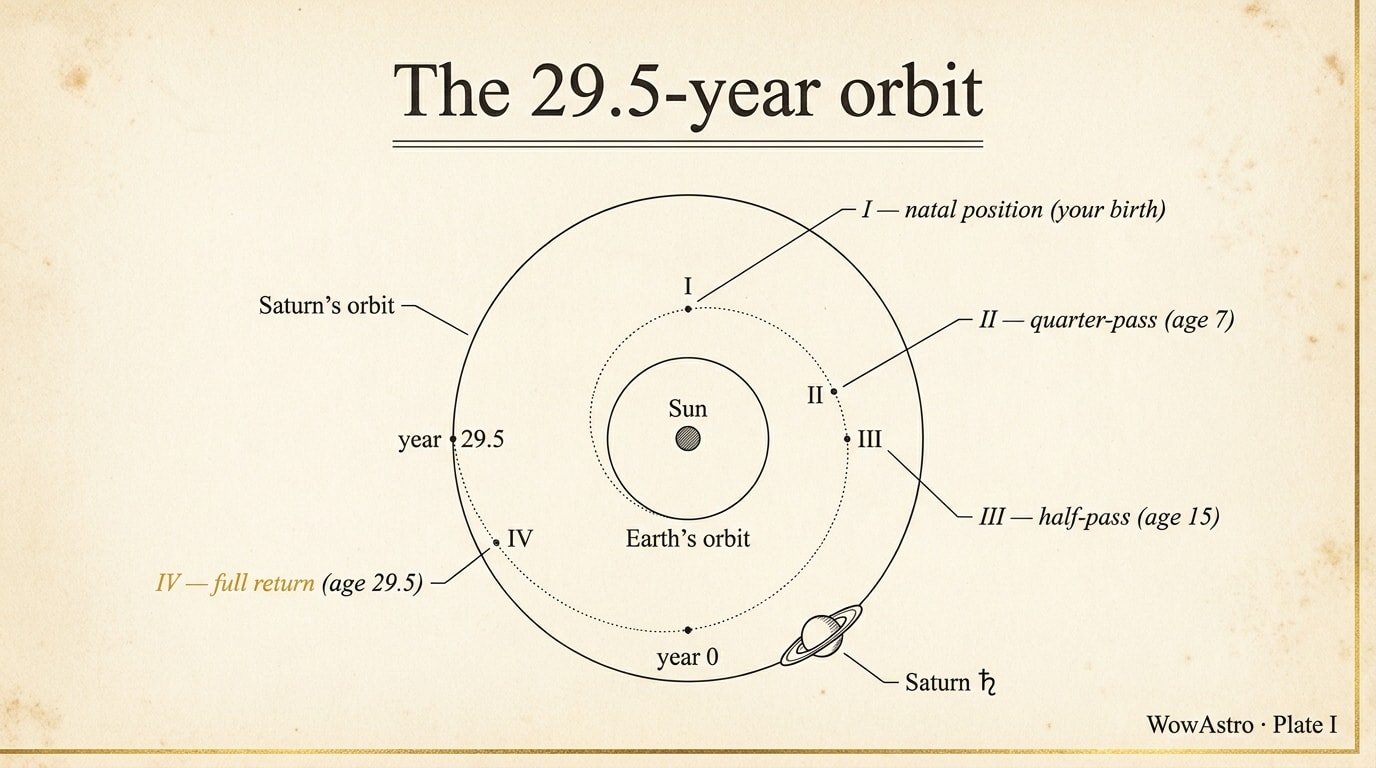
A useful image. Think of your natal Saturn as a pendulum someone let go of at the minute you were born. It has been swinging the whole time you've been alive. After about twenty-nine and a half years, it arrives back at exactly where it started — the pendulum is the same, and you are not.
That's all a Saturn return is, mechanically. Astrologers read it as a chapter-turn because Saturn's symbolic territory in the canon is structure, commitment, consequence and slow time, and a return of Saturn is, by definition, the moment those themes come back around for a second look. The general behaviour of transits, moving planets read against your birth chart, sits underneath everything that follows. A Saturn return is just one specific, long, transit.
So: when does yours arrive?
When your Saturn return arrives, the actual age window
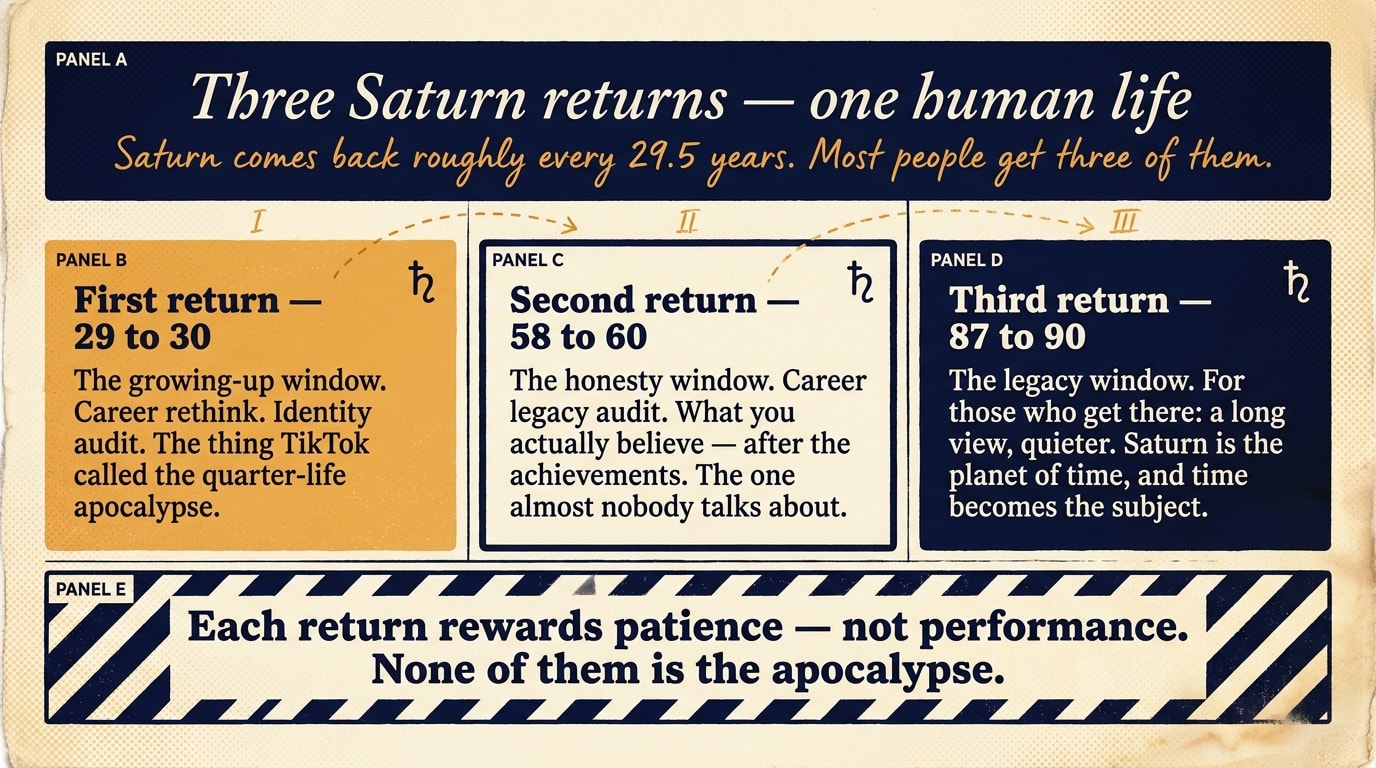
Your first Saturn return hits between the ages of 28 and 30. Your second arrives between 58 and 60. A rare third, if you live to it, lands around 87-89. The "at 29" shorthand isn't wrong, exactly — it's just less precise than it sounds. The exact month depends on where Saturn sat in your birth chart and on Saturn's retrograde motion within the window. To know yours within a month, you need a birth chart calculated with your date, time and place of birth.
A worked example to walk through the maths, illustrative, not a real person. Take someone born on the 15th of March 1995. Astrological software places their natal Saturn at, say, 12° Pisces (a plausible value, not a verified one for any actual person). Saturn next reached 12° Pisces around 2024-2026 in three passes across about fourteen months. That person's first Saturn return ran roughly from mid-2024 into the autumn of 2025. The "at 29" version of this is true to within a year. The precise version is true to within a month.
| Return | Age window | Window length |
|---|---|---|
| First | 28–30 | roughly 12–18 months |
| Second | 58–60 | roughly 12–18 months |
Find your exact window by calculating your birth chart, then locating when Saturn next returns to your natal Saturn position.
Two notes worth holding. If you don't know your birth time, the Saturn position is usually still accurate to within a degree. Saturn moves slowly, so a missing birth time hurts much less than it does for the Moon. And the "at 29" story isn't a bell ringing on the morning of your 29th birthday. The window opens about a year before the precise return and closes about a year after. The cultural shorthand is the middle of that window, not its edges.
Why the window lasts so long: the three-pass structure
A Saturn return isn't a single date. It's a twelve-to-eighteen-month window during which Saturn crosses its natal position three separate times. Saturn moves forward (direct), then appears to move backwards across the same degree (retrograde), then moves forward across that same degree once more. Three passes is the standard pattern for a Saturn return because Saturn spends about a hundred and forty days a year in apparent retrograde motion, the same astronomical illusion that produces Mercury, Venus and Mars retrogrades, only on a much slower scale. The "two years of chaos" mythology of the Saturn return is mostly the three-pass structure mistaken for one continuous emergency.
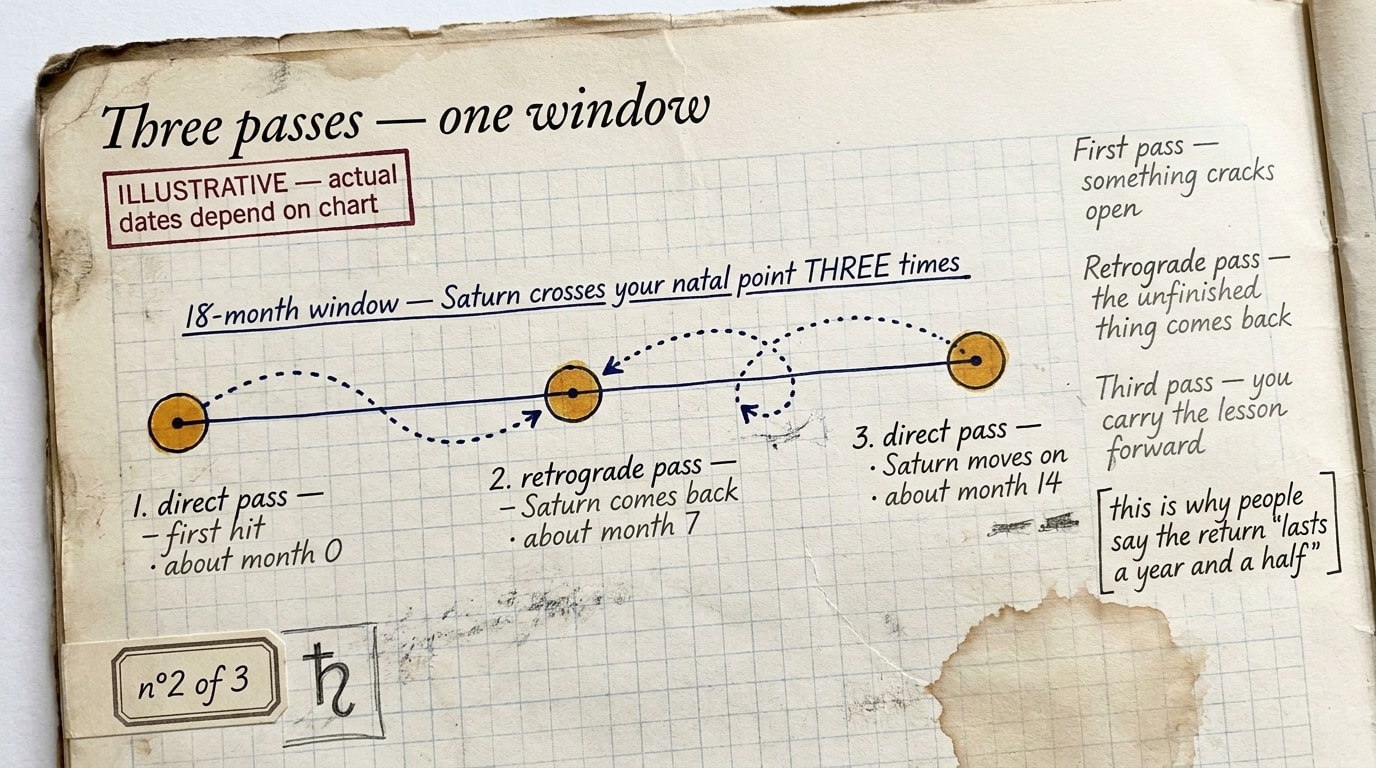
The first pass tends to feel like an overture. A theme arrives, often subtly: a tension at work, a question about a relationship, a thought you can't quite shake about where you live. Many people don't recognise it as Saturn at all until they're looking backwards from the second pass.
The second is the retrograde one. Saturn appears to move backwards across the same degree, and the material from the first pass returns for revision. The decisions that felt confident a few months earlier start asking to be reconsidered. This is usually the loudest pass of the three, because it's the one where the question has refused to be a passing question.
The third is direct again, and integration-shaped. Saturn passes over the same degree one last time. By this point the question has either been answered or has been allowed to dissolve. Many of the "defining" Saturn return stories people tell in retrospect were actually decided during the third pass, quietly, less dramatically than the second.
Don't try to date these yourself from a calendar. The passes don't fall on neat tri-monthly intervals; the exact timing depends on Saturn's position at your birth and on how its retrograde arc falls relative to that point. A transit report or a year-ahead reading will give you the three pass dates for your specific Saturn return.
What a Saturn return often correlates with (and what it doesn't)
Many people describe their Saturn return as a window in which structural choices got tested or rebuilt: career, relationship, identity, where they live, what they're willing to commit to. The correlation shows up reliably enough in the canonical astrological literature that it's been the topic of whole books. What we don't have is a rigorous empirical study supporting a causal link. So we have good descriptive language for what Saturn return windows tend to surface, and we don't have proof that Saturn causes anything in particular. The honest formulation is correlates with, not will.
What a Saturn return often correlates with, in many people's accounts: a career reconsideration, the end or formalisation of a long relationship, a move of city or country, a new and quieter sense of what you're actually willing to commit to, health habits being taken seriously for the first time. None of it is guaranteed; none of it arrives on a fixed schedule. A return often correlates with all of these in clusters; it also often correlates with a much quieter twelve months in which one of them is gently rebuilt and the others are barely touched.
 The slower kind of growing-up.
What a Saturn return isn't. It isn't a prophecy. It isn't a guarantee of things going wrong. It isn't even universal: some people pass through their late twenties without much Saturn drama, usually because they built the structure of their life carefully on the way in. The TikTok version makes it sound like a sentence handed down. It isn't.
The "correlates with" framing matters because the alternative (Saturn causes career upheaval, Saturn brings a breakup) is both bad astrology and bad reasoning. It's bad astrology because the canonical literature doesn't claim causation; it claims pattern recognition. It's bad reasoning because correlation between Saturn's position and the kinds of moments that happen to most people in their late twenties anyway is a low bar of evidence. What a Saturn return reliably gives you is a vocabulary for noticing what's already moving, not a script for what's about to happen. The peer pillar on astrology as self-understanding goes deeper into Saturn-as-commitment, if that's the part that lands for you.
The second Saturn return, the one almost nobody talks about
Your second Saturn return arrives around 58 to 60, and it tends to ask a different question from the first. Where the first Saturn return asks who am I becoming, the second often asks what was actually mine in all this. By that age the structures you built in your thirties and forties — career, marriage, home, identity — are mature enough to be honestly assessed. Some were yours all along. Some belonged to someone else's expectation and you carried them anyway. The second Saturn return is the pre-retirement re-grounding window: the one where the question of what's worth keeping gets a serious second look.
 Sixty looks different from twenty-nine. So does the return.
A brief note on a rare third. If you live past 87, Saturn meets its natal point a third time, around 88-89 years old. In practical terms most of us never plan for the third return. It's worth knowing it exists, because it answers the question some readers ask at the end of these pieces (is there anything after the second?): yes, but rarely.
Questions readers ask
When is my Saturn return?
Your first Saturn return hits between the ages of 28 and 30. Your second arrives between 58 and 60. The exact month depends on where Saturn sat in your birth chart, which depends on your date, time and place of birth. To know yours within a month, calculate your birth chart and look up when Saturn next returns to your natal Saturn position. Free transit calculators will give you the dates, or a year-ahead reading will pull the three pass dates and the window for your specific chart.
What actually happens during Saturn return?
Typically a 12-to-18-month window in which structural themes (career, commitment, identity, where you live, what you're willing to put weight on) get a serious second look. Many people describe career shifts, relationship turning points, identity questions, or a quieter and more honest sense of what they want to commit to. The window often correlates with growing-up moments, but it isn't a guaranteed crisis. Plenty of people pass through their first Saturn return without major external upheaval; the work is happening, but it's mostly internal.
Does everyone have a Saturn return crisis?
No. Not everyone has a crisis during their Saturn return. The mythology of a guaranteed quarter-life apocalypse is mostly TikTok-amplified survivorship bias: people who had dramatic Saturn return stories post about them, and people who had quiet ones don't. Many people coast through the window with relatively little drama, usually because they built the structure of their life carefully on the way in. The return is asking whether the structure holds, not promising that it won't.
What's a second Saturn return?
Your second Saturn return arrives around the age of 58 to 60, when transiting Saturn completes a second full Saturn cycle and returns to your natal Saturn position for the second time. It tends to ask what was actually mine in all this, rather than who am I becoming: a pre-retirement re-grounding window in many people's accounts. The mechanics are the same as the first (three passes, 12-18 months), but the themes are often quieter, more reflective, and more about honest assessment than about identity-formation.
A note on what this is. Astrology, as we use it at WowAstro, is a tool for self-reflection and self-understanding, not a method for predicting events, health, or financial outcomes. A Saturn return describes a structural growing-up window, not a fate. Read the descriptions as questions, take what's useful, leave the rest.
About this article: WowAstro readings combine traditional astrological methodology (Swiss Ephemeris calculations, Hellenistic and modern psychological frameworks) with AI-assisted writing reviewed by Oksana Miatova before publication. For entertainment and self-reflection only — not medical, legal, or financial advice. Full editorial policy at /editorial-standards.
Written by Oksana Miatova, astrologer and writer at WowAstro. Saturn return windows calculated using the Swiss Ephemeris, the same astronomical data working astrologers use.
Read your own natal chart
A personal AI reading, from £1
⭐ +50 Wow Stars cashback · sign up and get 100 ⭐
Build my chart →Comments
New here? Get −30% off your natal chart
Leave your email and we will send you the promo code WELCOME30. Straight after that you can comment — no passwords, all automatic.
Quick sign-in
Sign in with Telegram — one click.
Or by email (with a gift)
Already have an account? Enter the same email — we'll email you a sign-in link.