Half past four on a Thursday in a small café off Borough High Street. A 34-year-old woman tells her oldest friend, between sips of flat white, that the promotion has come through. The friend says the right warm things. Then, in the gap before the next question, the heroine looks down at her cup and says, quietly, but I still don't feel like a person who matters. The friend, confused, says but you just told me you're being promoted. Yes. That's not the bit I mean.
Self-worth and self-esteem sound interchangeable, but astrology gives them distinct chart anchors. Here's the difference, and why mixing them up keeps you stuck. Self-esteem is your felt sense of competence in specific bits of your life — work, looks, parenting, conversation, the things you can point at. Self-worth is something quieter underneath: your underlying conviction that you matter as a person, independent of any specific competency. The 2nd house describes worth-as-inherent-value; Saturn describes esteem-as-earned-standard. The two are related; they are not the same. They can move at different speeds. Sometimes, as in the café, they move in opposite directions.
→ Want to actively build it? See Building Self-Esteem with Astrology for the chart-informed practice protocol.
If what you are carrying right now feels heavier than a quiet café conversation, persistent low mood, panic that won't lift, thoughts of self-harm — please talk to your GP or contact Samaritans on 116 123 (free, 24/7). What follows isn't a treatment, and astrology isn't therapy. It can sit alongside that conversation; it can't replace it. The rest of this piece is a guide to the distinction between self-worth and self-esteem, with an astrology layer added on top for anyone who finds a structured vocabulary helpful for self-reflection.
In short. Self-worth and self-esteem aren't the same thing, although the two phrases are often used as if they are. Self-esteem is your felt sense of competence in specific domains, work, looks, social skills, parenting. Self-worth is your underlying conviction that you matter as a person, independent of any specific achievement. Esteem can be raised by a promotion, praise, or a new skill; worth usually can't. Astrology offers a structural vocabulary for both — different parts of your chart describe each, and they often move at different speeds.
 gazing at reflection in dark window.
What self-worth and self-esteem actually are — and why people confuse them
Self-worth is the underlying conviction that you matter as a person; self-esteem is your felt competence in specific domains. The two phrases get used interchangeably in everyday speech, in pop psychology, and sometimes in self-help writing. In modern therapy traditions, since foundational work on self-esteem as domain-specific competence and on worthiness as a separate unconditional sense of mattering, the distinction is consistent and useful.
A quick, concrete test. Does a promotion fix the feeling? Then what was wobbly was esteem in that domain. Does a kind word from a stranger on the bus shift something deeper that no recent achievement was touching? That was probably worth. Different muscle groups, different exercises.
You can have high esteem across many domains and still feel low worth — the "great CV, terrible about myself" pattern that brings a lot of competent people to therapy. The reverse exists too, although it gets less airtime: wobbly esteem in many specific areas alongside a quiet, steady sense of mattering. The two systems operate independently.
This article uses astrology as a self-reflection lens — vocabulary for what each feeling looks like inside a chart. Not a treatment, not a substitute for therapy or your GP. Astrology can sit alongside professional help; it can't replace it.
The everyday test: how to tell which one you're feeling
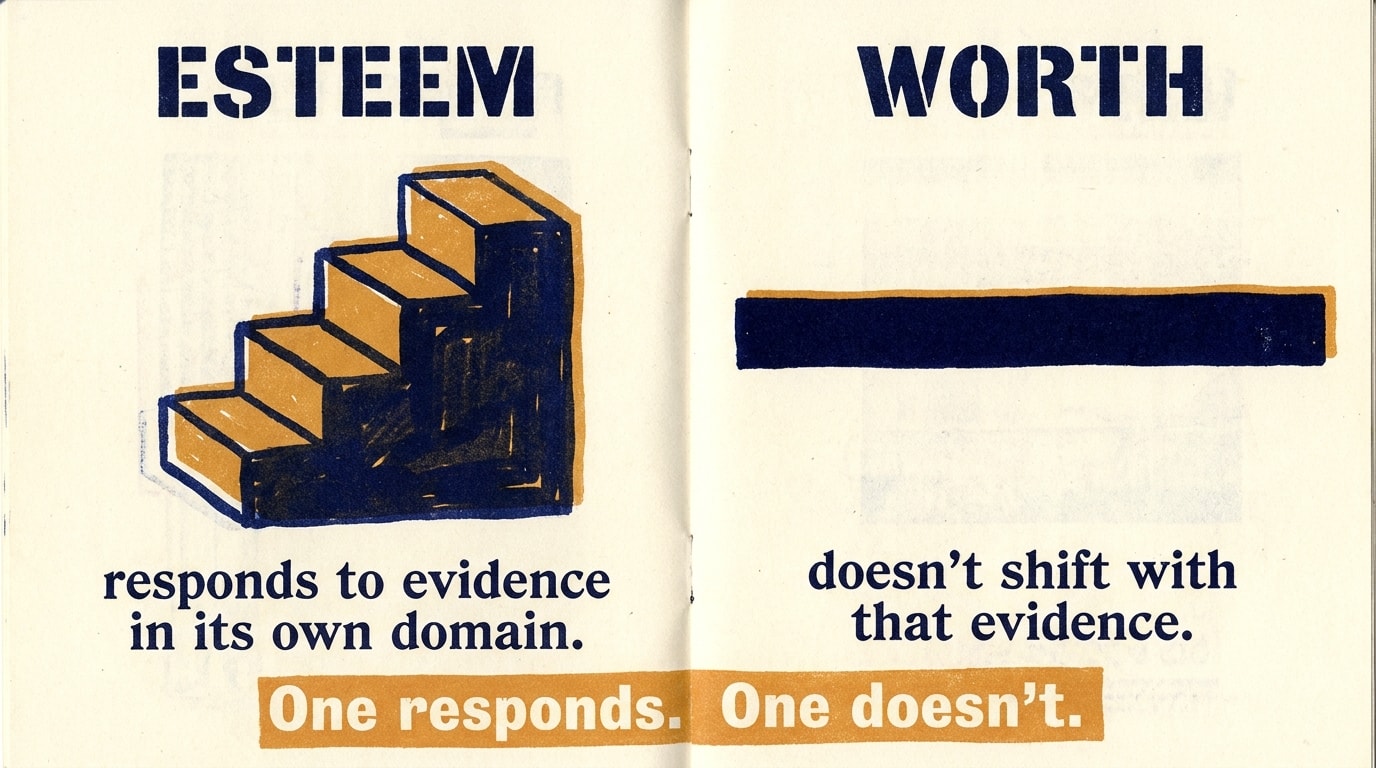
The clearest way to tell esteem from worth is to ask what changes the feeling. Esteem responds to evidence in its own specific domain. Worth doesn't change with evidence in any specific domain; it tends to need slower, often relational work — a long therapeutic relationship, a sustained friendship that holds it.
A few illustrative shapes, drawn from the kinds of things people say when they sit down to think about it.
"I aced the presentation, and I still feel small." High task esteem with low worth, talking past itself. The task evidence is there; the feeling underneath isn't moving with it.
"I'm objectively bad at maths, but I still like myself." Low esteem in one specific domain, with intact worth holding up the rest of the structure. Unimpressive on paper, functional in life.
"I got the promotion and feel more competent than I did last week, but I'm still not sure I deserve nice things." Esteem moved up; worth stayed flat. The two-track movement visible inside a single sentence.
"I just sort of like myself. It's a bit weird because I haven't done anything to deserve it." High worth without esteem proxies — sounds vain in a culture that confuses the two, but actually one of the kinder outcomes a developmental childhood can produce.
"I keep building the CV and the feeling underneath doesn't move." The most common shape, frankly. Esteem inflation without worth lift.
Which voice gets quieter when you do well, and which voice stays put? That, in practice, is the diagnostic.
Why this distinction matters (for the things that don't work)
Most self-help advice targets esteem and gets sold as a fix for worth. That is the single biggest reason so much of it doesn't land.
Affirmations, lists of wins, fake-it-till-you-make-it, "just love yourself" as an instruction, these techniques aim at specific-domain esteem. They can work, modestly, for raising felt competence in the targeted area. They tend to misfire on worth. The worth question isn't, fundamentally, about evidence; more evidence in any specific domain doesn't shift it. It's about whether you, at the level of being-a-person, are someone who matters — and no promotion answers that question. The feeling resets quickly because the input wasn't matched to the system being asked.
What does shift worth tends to be slower and more relational. Therapy modalities aimed at the worth-track, compassion-focused approaches, schema-based work, attachment-aware therapy — usually move at a different pace than CBT for specific symptom relief. Coaching and CBT-style workbooks (the well-known Overcoming Low Self-Esteem CBT tradition is the obvious example) can be very effective for domain-specific esteem; they aren't always the right tool, on their own, for a worth wound. The British Association for Counselling and Psychotherapy (BACP) maintains a directory of practitioners with different specialisms, worth knowing if you're matching the tool to the actual problem.
Where astrology comes in: a vocabulary for both
Astrology offers a structural vocabulary for both worth and esteem — different parts of a chart describe each. This is not a claim astrology causes either feeling, and it isn't a claim a chart diagnoses what's actually happening for you. It's a description of how, in practitioners' reading, certain placements consistently map onto worth-territory and others onto esteem-territory. WowAstro calculates charts using the Swiss Ephemeris, the same astronomical data working astrologers rely on.
The placement map, in plain terms.
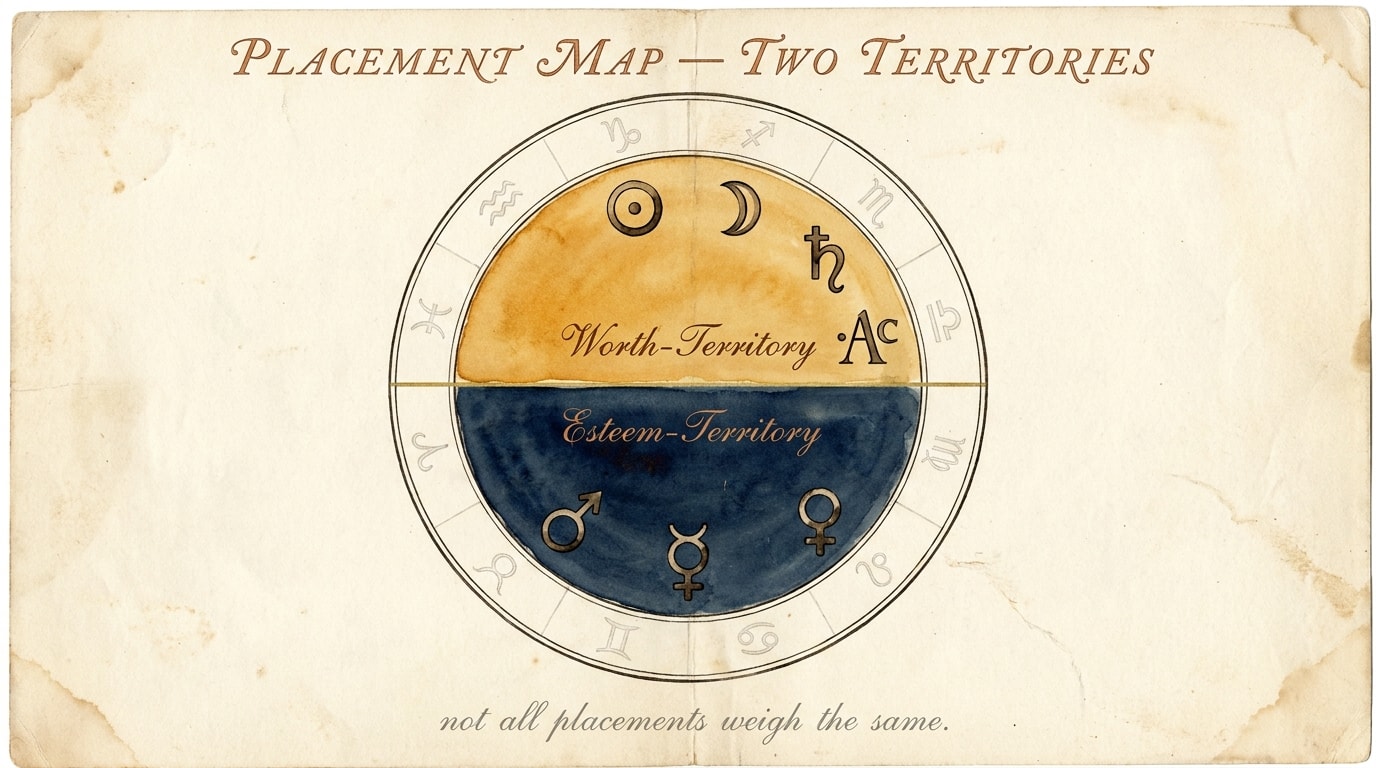
Worth-territory is mainly carried by the Sun (the developing core identity, the part you are becoming), the Moon (the part of you that needs to feel held), and the Saturn aspects to either of them (the inherited model of "enough"). Taken together, these three describe the bedrock layer where the "do I matter" question lives. When the layer is steady, worth tends to feel steady-by-default; when it is wounded, the worth voice runs loud, and the loudness can outlast any specific success.
Esteem-territory is mainly carried by Mars (your felt right to act, to take up space), Mercury (your voice and intellectual confidence), and Venus (your relational and aesthetic sense of being likeable, attractive, easy to be with), broken down further by which house each sits in. The 2nd house describes esteem around resources and self-as-asset; the 6th house describes esteem around daily work. A chart can show which domains will be easy and which will need patient practice to feel competent in.
A chart describes where each lives. It doesn't fix either; that's not what charts do. Astrology sits alongside professional help; it isn't a substitute for therapy, coaching, or your GP.
Self-worth in the chart: Sun, Moon, and the Saturn that inherits the standard
Self-worth, in most astrological readings, lives mainly in the Sun and Moon — and the Saturn dynamic that decides what counts as "enough" for both. These three are the first place to look when the worth question is loud.
The Sun, in canon astrology, is the developing core of who you are becoming. Worth read through the Sun is the felt entitlement to take up space as that becoming-person. When the Sun is harmoniously aspected, worth tends to feel steady-by-default. When it receives hard angles from Saturn or Pluto, the worth question runs louder; the sense of being entitled to one's own life feels conditional rather than given.
The Moon describes the part of you that needs to feel held, the rhythms that quiet your nervous system. Worth and the Moon are linked because the felt sense of mattering is, at root, about whether your needs were treated as legitimate when you were small. Moon-Saturn aspects often correlate with a felt sense that emotional needs were inconvenient — too much, too soft, too needy. That voice carries forward as a quiet conviction that asking to be held is somehow a failure, and it lands later as low worth, not low esteem.
Saturn-to-Sun and Saturn-to-Moon aspects describe the inherited standard — what the people around you said counted as "enough" as a person, rather than as a doer of specific things. When that standard was tight, the inner voice enforcing it runs harsh, and that voice lives close to worth. Our article on Saturn aspects and the inner critic covers the structural layer in detail. For the related "I feel like a fraud at what I've achieved" wound, Rising vs Sun and impostor syndrome covers it from a different angle.
If the worth question is loud in your life, the Sun-Moon-Saturn triangle is usually the first place to look.
Going deeper. Worth-track placements describe inherited architecture, not current personal failure. A loud worth voice describes a tight inherited standard — it isn't a verdict on whether you deserve the life you're in. The architecture is workable. The work isn't fast.
Self-esteem in the chart: Mars, Mercury, Venus, and house position
Self-esteem, broken down by domain, lives mostly in Mars, Mercury, Venus — and the houses that show which domains matter most. These placements describe where the "am I good at this specific thing" voice is fluent and where it has to work harder.
| Planet / placement | Esteem type | Common pattern |
|---|---|---|
| Mars | Agency-esteem — the felt right to act, assert, take up space | Hard-aspected Mars often correlates with hesitancy to act in your own interest |
| Mercury | Voice-esteem — verbal and intellectual confidence | Mercury–Saturn aspects often correlate with the "I sound stupid when I talk" voice |
| Venus | Relational and aesthetic esteem — felt sense of being likeable, attractive, easy to be with | Venus–Saturn aspects often correlate with feeling unlovable or aesthetically inadequate |
| House positions | Domain-specific esteem tied to area of life | 2nd house: resources and value-as-asset; 6th house: work-and-service esteem |
Esteem is domain-specific in a way worth isn't. A chart can show which domains you'll find easy and which you'll have to keep working at — without diagnosing you as defective in any.
 turning page of large hardback.
A worked example: the gap between high esteem and low worth
Here is one combination, end to end, showing how a chart can describe high esteem and low worth in the same person. The chart below is illustrative, a plausible composite, not a real person — to walk through the method.
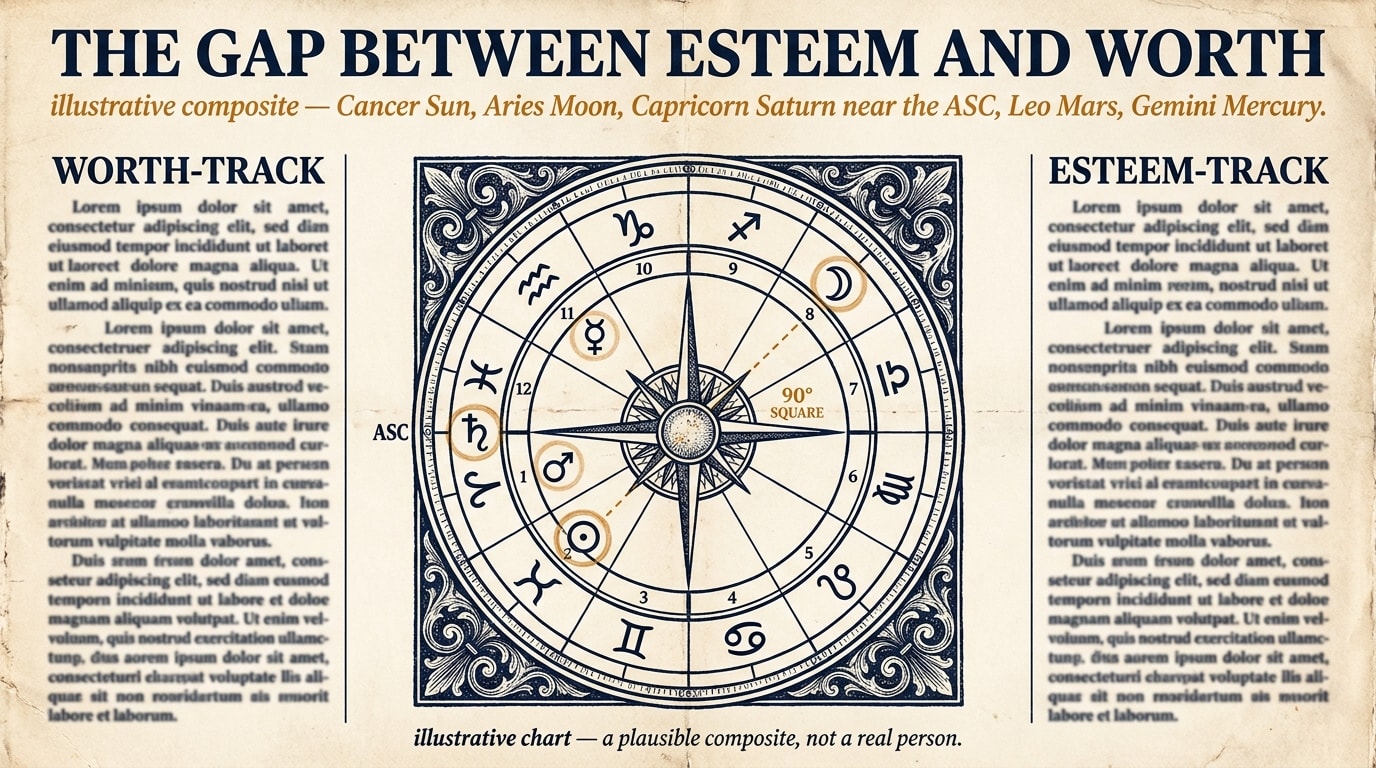
Picture someone at thirty-four. Cancer Sun. Aries Moon, with a tight square from Saturn. Capricorn Rising. Mars in Leo. Mercury in Gemini.
First the room. The Capricorn Rising signals composed, careful, capable; first impressions read as grown-up and in charge.
Then the fluent track, which is esteem. Her Mars in Leo gives her an easy, almost unconscious confidence in showing up. She holds the floor when she needs to and takes the project lead without much hesitation. Her Mercury in Gemini gives her quick, articulate voice; she explains complicated things well, knows it, and others respond. By any honest measure her esteem-track is well-built and fluent.
Then the wounded track, which is worth. Cancer Sun is a developing core that is, by temperament, relational and emotionally attuned, felt mattering built around being-with-others rather than independent achievement. Combined with a Moon in Aries taking the Saturn square, the architecture describes a worth-track that learned early that emotional needs were inconvenient. The Aries Moon wants to assert needs immediately; the Saturn square says, not now, not so loudly. Thirty years on, the result is a quiet conviction that her needs are too much, and the underlying question, am I actually a person who deserves love unconditionally?, never gets a fully clean "yes".
So the day-to-day shape. The promotion shifts her esteem up. The worth question stays exactly where it was. Friends who only see esteem-evidence are confused by her I'm fine, I'm just a bit down on myself moments. People who can see worth-track architecture aren't confused; they know they are looking at two systems on different clocks inside the same person.
Esteem-track and worth-track operating at different speeds. The chart describes both; it doesn't blend them.
'Isn't this just confirmation bias?' A fair question, and partly yes — which isn't the disqualifier some people think it is. Most self-reflection tools work partly through confirmation bias; you notice what the prompt invites you to notice. The question isn't whether the chart causes the noticing; it's whether the noticing is useful. Whether you call that astrology or structured journalling is a vocabulary preference, not an empirical disagreement.
 writing in a journal, lamp on.
A reflective practice: three prompts for each track
Once you can name the worth-track and the esteem-track separately, you can use them as two distinct reflective prompts. Journal territory, or quiet thinking time with a mug of something warm — not a script for a session with a qualified professional, and not a method for talking yourself out of real distress.
Three worth prompts — slower, deeper, often returned to over weeks rather than answered in one sitting.
Which moments in my week made me feel like I mattered as a person, independent of anything I did? The honest answers are usually small — being remembered by a colleague, a long pause from a friend that said I see you. The worth-track is fed by unconditional acknowledgement more than by big domain wins. Notice what fed it.
Where did I notice the voice that says I shouldn't take up space — and what was it actually responding to? The worth voice often comes online specifically when you try to ask for something for yourself. Notice the trigger and whether the volume matches the actual stakes.
If nothing on my CV changed for a year, what would I still know about my value to the people who love me? The CV-stripping question. The honest answer is usually quieter and more confident than the version that lives in your head when you're stressed.
Three esteem prompts — more domain-specific, often answerable in a sitting if you're being honest.
Which domain of my life carries the most felt competence, and which the least? Map them. You don't have to fix the low ones; just name them.
Where would small, repeated practice meaningfully shift one of the low-competence areas? Esteem moves with repetition and feedback. What is the smallest weekly practice that would feed a wobbly domain that matters to you?
Which esteem-wound is actually about that domain, and which is leaking from low worth into wherever it can find purchase? If the felt failure in a specific domain doesn't match the actual evidence about your competence there, what you're calling "low esteem at maths" or "low esteem at parties" is often worth-leakage looking for a place to express itself. Worth-leakage doesn't get fixed by maths classes or party-skills practice; it gets addressed by working with worth directly.
Sit with the questions, not the answers. Most of the work is noticing that the two tracks ask different questions. Don't try to write closing lines.
A quick reminder: if these prompts make things heavier rather than clearer, if the journalling tips you into spiralling or self-blame — that's a Mind.org or GP conversation, not an astrology one. Mind's information line is 0300 123 3393 (Mon-Fri 9am-6pm).
When astrology is the wrong tool — and what to use instead
There are specific times when reading your chart isn't the right next step for low self-worth or low self-esteem. Knowing them is part of using astrology honestly.
The first is when the feeling is heavy enough to affect your sleep, your work, or your sense of safety. That is GP / Samaritans / Mind territory, not a chart. UK practical pointers: Samaritans 116 123 (free, 24/7) for anything frightening or urgent; Mind 0300 123 3393 (Mon-Fri 9am-6pm) for advice on what support exists and how to access it; NHS 111 for urgent non-emergency advice; your GP as first stop for talking-therapy referrals, available via self-referral in most areas. Use them. The chart will still be there in three months.
The second is when what you actually want is for someone to tell you what to do. A chart doesn't make decisions; it offers vocabulary. If you need decision-support, a friend who knows you, a coach with a method, or a therapist who'll sit with the ambivalence will serve you better than a placement read at the kitchen table.
The third is when you are in active crisis or grief. The first weeks after a loss aren't the time for self-reflection prompts. The first work is being held, by people, not by maps. The chart will still be there in three months.
The fourth is when the question is medical or psychiatric. A chart can't diagnose depression, anxiety, an eating disorder, addiction, trauma, ADHD, or anything else that lives in a clinician's notes, and shouldn't be used as if it can. If a description here seems to match something affecting your life seriously or persistently, the next step isn't more astrology; it's a conversation with a qualified clinician. A chart can describe patterns. A clinician can name a condition.
Astrology, used honestly, sits alongside professional help. It doesn't compete with your GP or your therapist. If you're hesitating between booking a session and reading your chart — book the session first.
What an astrology lens does here. It gives you a name for two parts of yourself, worth and esteem — that often get confused for each other. Not a verdict, not a treatment. A vocabulary that lets the feeling become less personal and more describable, while the actual rebuilding happens slowly in the rest of your life, mostly with the help of people.
If you'd like to see your own Sun, Moon, Saturn, Mars, Mercury and Venus side by side, WowAstro will calculate a free birth chart for you. Date, time and place — a couple of minutes. A starting point for the prompts above, not a verdict. For wider context on how a chart can sit alongside the slower work of self-understanding generally, astrology for self-understanding covers the three-placement model.
Frequently asked questions
What is the difference between self-worth and self-esteem?
Self-worth is your underlying sense that you matter as a person, independent of any specific achievement; self-esteem is your felt competence in specific domains — work, looks, social skills, parenting. A promotion can lift self-esteem in the work domain; it usually doesn't shift self-worth, because self-worth isn't about evidence in any single domain. A kind word from a stranger, or a long conversation with someone who genuinely listens, sometimes shifts self-worth a little, because worth responds to unconditional acknowledgement rather than to domain-specific evidence. In astrology, Sun, Moon, and Saturn aspects describe worth-territory; Mars, Mercury, and Venus describe esteem-territory.
Can low self-esteem and low self-worth happen at the same time?
Yes, often, and they can also happen independently of each other. Some people have very low self-worth alongside high self-esteem in many specific domains: the "great CV, terrible about myself" pattern. Others have wobbly self-esteem in many areas alongside intact self-worth, unimpressive on paper, functional in life. Many people have both low simultaneously, and distinguishing the two layers is part of figuring out which kind of help, coaching, CBT-style esteem work, compassion-focused therapy, slower relational therapy — actually fits. If both together are affecting your daily life, please speak with your GP or contact Mind on 0300 123 3393.
Does astrology help with low self-esteem and low self-worth?
Astrology does not treat low self-esteem or low self-worth and isn't a substitute for therapy, counselling, or your GP. What it can do is offer a structural vocabulary — language for which part of the chart describes worth-territory and which describes esteem-territory, which can make the feeling feel less personal and easier to sit with as something inherited rather than something true about your value as a person. A self-reflection lens, not a treatment. If your self-esteem or self-worth feels persistently low, the right next step is your GP, BACP-registered counselling, or Mind on 0300 123 3393. A chart can sit alongside that work; never instead of it.
Which planets describe self-worth in astrology?
In most readings, self-worth is described mainly by the Sun, the Moon, and the Saturn aspects that decide what counts as "enough" for both. The Sun is your developing core. The Moon is the part of you that needs to feel held; when its needs were treated as inconvenient in childhood, the worth-track tends to inherit that voice. Saturn aspects to either of them describe the inherited standard — what the people around you when you were small said counted as "enough" as a person. None of this is a diagnosis; it's structural vocabulary. For a deeper read on the Saturn layer specifically, see Saturn aspects in astrology and the inner critic.
Read the wider context in our guide to your full birth chart
By Oksana Miatova, astrologer and writer at WowAstro. Charts calculated using the Swiss Ephemeris.
About this article: WowAstro readings combine traditional astrological methodology (Swiss Ephemeris calculations, Hellenistic and modern psychological frameworks) with AI-assisted writing reviewed by Oksana Miatova before publication. For entertainment and self-reflection only — not medical, legal, or financial advice. Full editorial policy at /editorial-standards.
Astrology, as we use it at WowAstro, is a tool for self-reflection and self-understanding — not a method for predicting events, health, or financial outcomes.
This article is for self-reflection and entertainment. If feelings of worthlessness, self-criticism, or low mood are overwhelming or persistent, please speak with a qualified counsellor, therapist, or your GP. In the UK you can also contact Samaritans on 116 123 (free, 24/7), Mind on 0300 123 3393 (Mon-Fri 9am-6pm), or NHS 111 for urgent non-emergency advice. The British Association for Counselling and Psychotherapy (BACP) maintains a directory of UK-registered counsellors. Astrology can sit alongside that conversation; it is not a replacement for it.
Read your own natal chart
A personal AI reading, from £1
⭐ +50 Wow Stars cashback · sign up and get 100 ⭐
Build my chart →Comments
New here? Get −30% off your natal chart
Leave your email and we will send you the promo code WELCOME30. Straight after that you can comment — no passwords, all automatic.
Quick sign-in
Sign in with Telegram — one click.
Or by email (with a gift)
Already have an account? Enter the same email — we'll email you a sign-in link.