Self-esteem in astrology is read through three placements working together: the Sun (your sense of who you are), Saturn (your inner critic, standards of worth, and capacity to take yourself seriously), and the second house (what you value, including yourself). A chart with Sun–Saturn in a hard aspect (square, opposition, conjunction in some interpretations) often produces a person who under-rates their own competence even after objective achievement. The work isn't fixing the chart — it's recognising the pattern early enough to interrupt it. This article walks through the three placements with practical journaling prompts for each.
Four o'clock on a Friday in October. Your manager rang to say you're being put forward for senior consultant — that you've earned it, that the directors agreed it was overdue. You thanked him. You hung up. You made dinner, watched something undemanding, brushed your teeth. The whole time, running just under the surface like a tap left on in another room, the same small steady voice you've heard for years: they've made a mistake; I've been faking it; the next project will be the one where they finally see it. You knew, on paper, that the promotion was fair. You felt, on the inside, like you'd just got away with something.
If that voice is heavier than that, if you are noticing persistent low mood, panic that won't lift, or thoughts of self-harm, please talk to your GP or contact Samaritans on 116 123 (free, 24/7). Astrology can sit alongside that conversation; it can't replace it. What follows is for the slower kind of low self-esteem: the one where, by every external measure, you're fine, and on the inside, the verdict still won't quite settle.
If you've understood what self-esteem is and want to do something about it, here's a chart-informed practice protocol — Saturn rituals for the inherited standard, Moon-care for unmet need, 2nd-house work for worth-channels, Ascendant-honest presentation. Self-esteem doesn't always track what's actually true about you. It tracks an inherited internal standard you didn't choose — and astrology has had a centuries-old vocabulary for that standard for a very long time. This article isn't a treatment, and astrology isn't therapy. What it offers is language for the structure behind a low self-esteem pattern, four chart-informed practices you can try alongside professional support, and an honest pointer to where to find help that can actually shift the pattern itself.
→ First need to understand the difference from self-worth? See Self-Worth vs Self-Esteem: An Astrology-Informed UK Guide for the definitional distinction.
In short. Low self-esteem isn't a character defect, it's a structural pattern with an inherited internal standard at the bottom of it. Astrology, used honestly, can name the structure across four parts of your chart: Saturn (the model of "enough" you absorbed before you could vote), the Moon (what you actually need to feel held), the 2nd house (your sense of inherent worth), and the Ascendant (the surface version you present to a room). A chart can't build self-esteem; therapy, time, and support do. What it can do is make the scaffolding visible — and naming a structural shape often loosens it.
The three placements astrology uses to read self-esteem
| Placement | What it reads | Hard-aspect pattern (Sun–Saturn square, etc.) |
|---|---|---|
| Sun | Core sense of self — who you are without performing | When suppressed: hard to claim achievements out loud |
| Saturn | Inner critic, standards, capacity to take yourself seriously | When strict: chronic feeling of "not enough yet" |
| Second house | What you value, including yourself; what you believe you're worth | When sparse: under-charging, under-asking, over-giving |
| Combined reading | The structural shape of self-worth | The work: noticing the pattern before it loops |
 phone face-down beside him, watching pigeons.
What self-esteem actually is — and what astrology won't claim
Self-esteem, in the sense most people mean it, is the relationship you have with your own worth — how much you experience yourself as fundamentally fine, regardless of what you've achieved this week. The phrase entered modern psychology through William James in his 1890 Principles of Psychology, was formalised into a research instrument by Morris Rosenberg in 1965, and is defined today by the American Psychological Association as the degree to which the qualities and characteristics in one's self-concept are perceived to be positive.
The clinical literature draws a useful distinction. Contingent self-esteem rises and falls with external feedback, a good review at work lifts it; a critical email lowers it. Non-contingent self-esteem sits relatively still regardless of what arrives in the inbox. Most people who struggle are over-reliant on the contingent kind, which is exhausting, because the feedback keeps moving and the worth-feeling has to keep moving with it. Estimates of UK adults who carry persistently low self-esteem range, depending on the definition used, from roughly eleven to thirty-four per cent. Either way: this is common, well-described, and a psychological phenomenon — not an astrological one.
This article uses astrology as a self-reflection lens, a vocabulary for what the pattern looks like inside the chart. Not a treatment. Not a substitute for talking with a qualified counsellor or your GP if this feeling is persistent or overwhelming. Astrology and professional support answer different questions; use them together if you need both. If your self-esteem feels persistently low and is affecting your work, sleep, or relationships, a BACP-registered counsellor or your GP is the right first conversation. NHS talking therapies are available via self-referral in most UK areas and are free at the point of access.
What astrology can do, used honestly, is offer language for the structure behind the pattern. The inner standard you measure yourself against didn't come from nowhere. Something handed it to you before you were old enough to argue with it — and your self-esteem has been quietly answering to that standard ever since. Astrology has a vocabulary for that handed-down structure, distributed across four parts of your chart.
Why a chart is useful here — and why it isn't a fix
You don't have to believe the planets cause anything for a chart to be useful when your self-esteem has gone quiet on you.
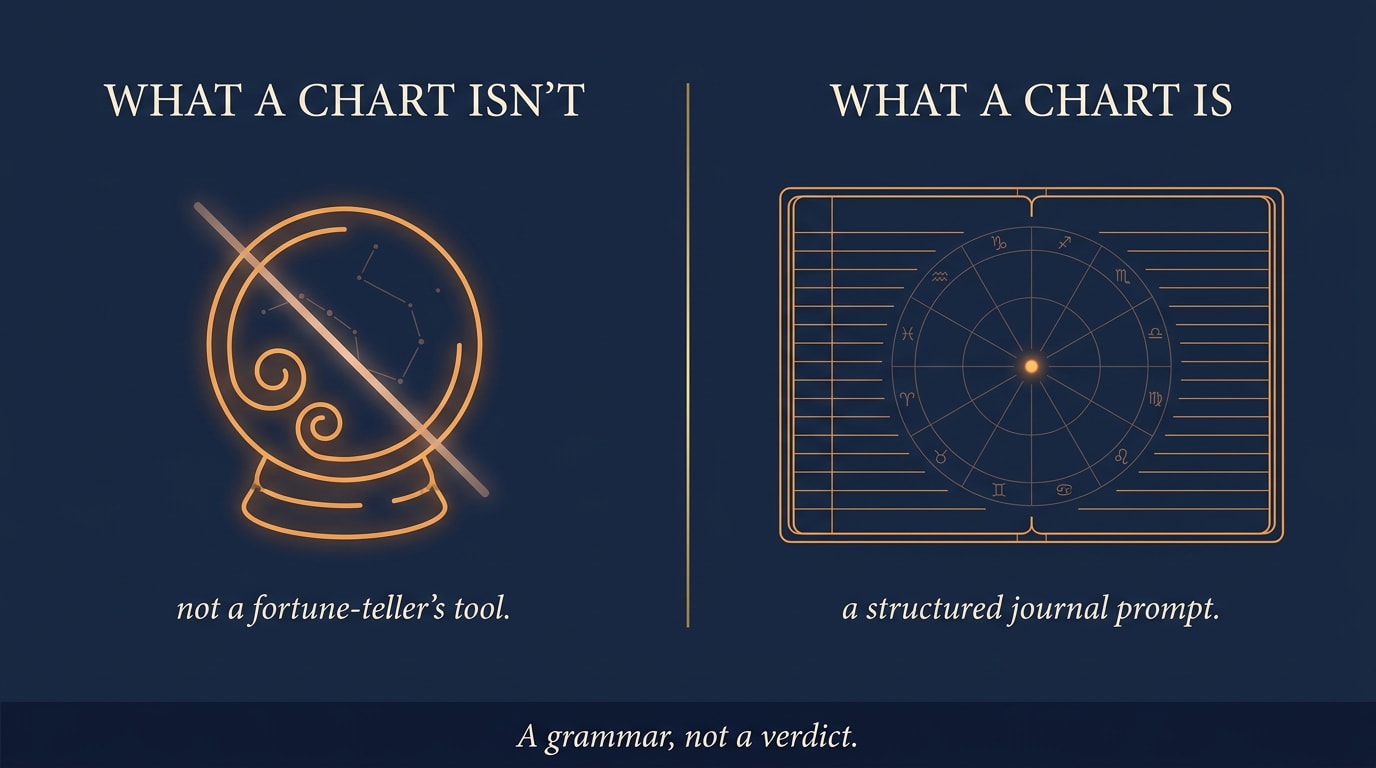
Think of a chart less as a horoscope and more as a Rorschach with structure. You're looking at it, you're making meaning, and the meaning you make tells you about you — not really about the planets. That isn't a claim that astrology is empirically "true" in a hard sense; it's an honest description of what's happening when someone sits down with their chart and feels something land. A chart is in the same family of tool as a journalling app, an Enneagram quiz, an attachment-style questionnaire, or the prompts your therapist hands you at intake. None of those tools work because the underlying model is provable in physics; they work because each one gives you a stable vocabulary to look at yourself through.
What a chart does, mechanically, is hand you that vocabulary. Twelve signs, ten bodies, twelve houses — a structured language that has been used for centuries to describe parts of a self. When self-esteem is the thing not quite working, it can be useful to look at a stable map of your parts and ask which of them is being measured against what.
The "does astrology work?" question is the wrong one to ask of this kind of tool. The right question is, "does this prompt help me notice something I'd otherwise miss?" Sometimes yes, sometimes no, same as any other reflective practice. Charts that don't land for you are charts you can put down.
A chart can name what's happening; it can't fix it on its own. The work, the actual shift in how your self-esteem operates day to day, usually happens elsewhere: therapy, journalling, time, support, occasionally medication, the patient company of people who love you. The chart is the map. You still have to walk.
The four placements that describe the self-esteem story
Four parts of your birth chart describe four different layers of the self-esteem pattern: Saturn (the inherited standard), the Moon (what you actually need), the 2nd house (your sense of inherent worth), and the Ascendant (the surface version of you the room reads first). They aren't the only placements that matter, but in practice they're the four that show up most often when readers describe a self-worth wound they can't quite outrun.
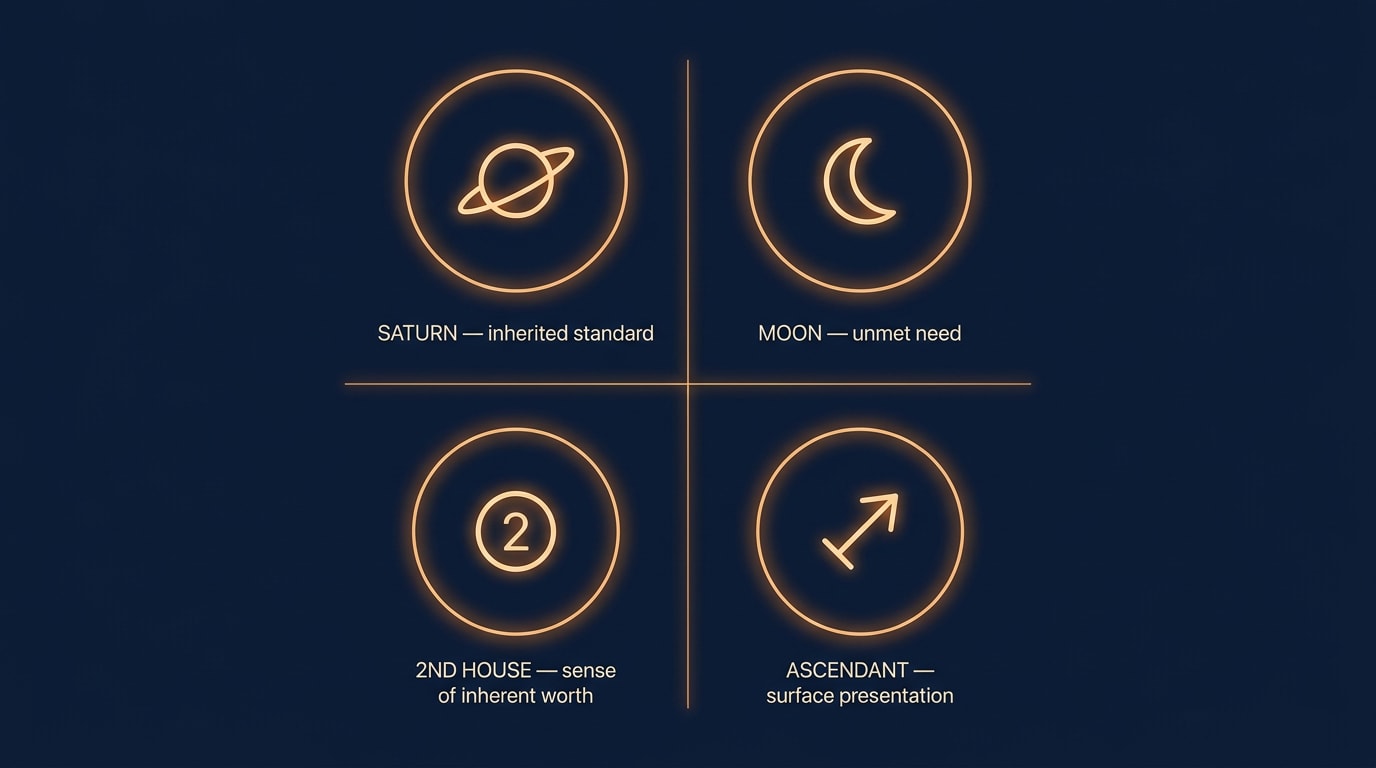
Reading the four together, rather than any one in isolation, gives you a structural map of where the pattern lives in your particular chart. One of them will usually feel louder than the others, but the story is rarely about just one.
Saturn: the inherited model of "enough"
Your Saturn placement describes the model of "enough" you absorbed before you started choosing your own standards. Saturn moves slowly, about twenty-nine and a half years for one orbit of the Sun — which is one of the reasons what Saturn describes tends to feel slow and weighty, like a voice that's been around a long time. WowAstro calculates these positions using the Swiss Ephemeris, the same astronomical data working astrologers rely on.
The old astrology shorthand, Saturn is the strict teacher, is half right and half misleading. The strict teacher you didn't choose. The standards weren't your idea originally. They came from family, from school, from the era you grew up in, from whichever adults in your life happened to be loudest about what counted as "enough". Saturn just names the part of you that absorbed all that and now enforces those standards from the inside.
When Saturn forms tense angles to other parts of your chart (aspects, the astrological word for geometric angles between two placements), the standard plays through that part of you with more volume than average. Saturn in tense angle to the Sun: the standard hits identity; whoever you are, the voice asks if you're enough of it. Saturn in tense angle to the Moon: the standard hits feelings; what you allow yourself to feel is constantly auditioning for the right size. Saturn in tense angle to the Ascendant: the standard hits surface presentation; first impressions get edited before they land.
None of these is a diagnosis. They're descriptions. If one of them sounds like the standard in your head, that's because Saturn's structural language is recognisable when you finally hear it named. If you want to read more about that voice specifically, Saturn aspects and the inner critic covers it as a deeper dive.
The Moon: what you actually need to feel held
Your Moon describes the rhythms, comforts, and forms of holding that genuinely settle your nervous system — and self-esteem suffers, quietly and persistently, when those needs go unmet for long enough.
The Moon moves fast, about one sign every two and a half days, completing the zodiac in roughly four weeks. Because it moves fast, calculating your Moon sign properly needs your date and your time of birth; a missed birth time can put it in the wrong sign. The Moon in your chart isn't your "emotional self" as a flat label. It's the placement describing what you need to feel held — physically, emotionally, the rhythms that quiet you, the kind of comfort that actually lands.
Different Moon signs need different things. A Cancer Moon needs time at home and familiar people. An Aquarius Moon needs intellectual exchange and freedom of movement. A Taurus Moon needs slow rhythms and tangible comfort: good bread, warm rooms, predictable weeks. The list goes on, sign by sign, and none of them is better than another; they're descriptions of what specifically lands as "held".
When the Moon-need goes unmet over time, self-esteem reads it as "something is wrong with me for needing this much". It's often misdiagnosed, internally, as I'm too needy, when what's actually true is just that this particular Moon has no delivery mechanism in this particular life-shape. The Moon-self isn't a defect. It's a request. When the request is repeatedly ignored, self-esteem leaks.
The 2nd house: your sense of inherent worth
Your 2nd house describes how you experience your own resources — including, in canon astrology, your sense of inherent worth.
The 2nd house is the section of your chart immediately following the Ascendant. Traditionally it covers material resources, possessions, money — and, by close extension, the inner experience of what I have, including what I am. Whatever sign sits on the cusp of the 2nd house, and whatever planets are placed inside it, colour the way worth is experienced from the inside.
A 2nd house with Neptune in it often reads as a person whose sense of worth feels diffuse: hard to locate, hard to defend, easy to dissolve into someone else's reading of you. A 2nd house with Saturn in it often reads as someone who experiences worth only when something has been measurably earned; the standard for "owning" the worth is set high and stays there. An empty 2nd house (no planets placed inside it) is common and isn't a problem; in that case, the ruler of the sign on the cusp tells the rest of the story.
The 2nd house is the inner-worth layer of self-esteem — separate from achievement, separate from self-esteem-as-feeling, closer to what I sense I am, before evidence. When that layer is muffled or hard to access, the rest of the structure has nothing solid to rest on, and external validation has to do all the heavy lifting. Which it can't, for long.
The Ascendant: the surface version you present
Your Ascendant, also called your Rising sign, is how you arrive in a room. When the surface version diverges from the inside, self-esteem often reads the gap as evidence you're faking it.
The Ascendant is the sign that was rising over the eastern horizon at the moment of your birth, which is why your birth time matters. The Ascendant moves on roughly every two hours; a missed birth time can put it in the wrong sign. The first impression you didn't choose, the social-greeting version of you, the part the room can scan in the time it takes to shake a hand.
The Ascendant doesn't cause low self-esteem on its own, but it often amplifies the felt-gap when other placements are doing self-esteem work. A composed-reading Capricorn Rising paired with a softer-than-expected Pisces Sun can produce a chronic they think I'm more capable than I am mismatch. A warm Cancer Rising paired with an internally austere Saturnian inside can produce a chronic they think I'm easier to be around than I actually am. For the impostor-syndrome version of this specifically, Rising versus Sun in astrology covers it from the gap angle.
The room reads your Ascendant first. Self-esteem is what happens between that first reading and the longer story underneath it — and the wider that gap, the louder the inside voice tends to get.
The four-layer reading. Saturn names the inherited standard. The Moon names the unmet need. The 2nd house names the sense of inherent worth. The Ascendant names the surface mismatch. Reading them together gives you a structural map of the self-esteem story — not a verdict, not a treatment, just a vocabulary that lets the feeling become more describable.
 half-pint of ale, reading paper menu.
A worked example: a 29-year-old with Saturn square Sun and Moon in Virgo
Here is one combination read end to end, in an illustrative composite — a plausible chart, not a real person. The point isn't whether this chart belongs to anybody in particular; the point is to walk through the method.
Picture someone at twenty-nine, two months into a senior-management promotion she objectively earned. Sun at three degrees of Taurus. Saturn at three degrees of Aquarius, roughly ninety degrees away, which astrologers call a square. Moon at twenty-five degrees of Virgo. Cancer rising. Her 2nd house, by the whole-sign convention, sits in Leo; the ruler of Leo is the Sun, which puts the 2nd-house ruler back on the same planet doing identity work in Taurus.
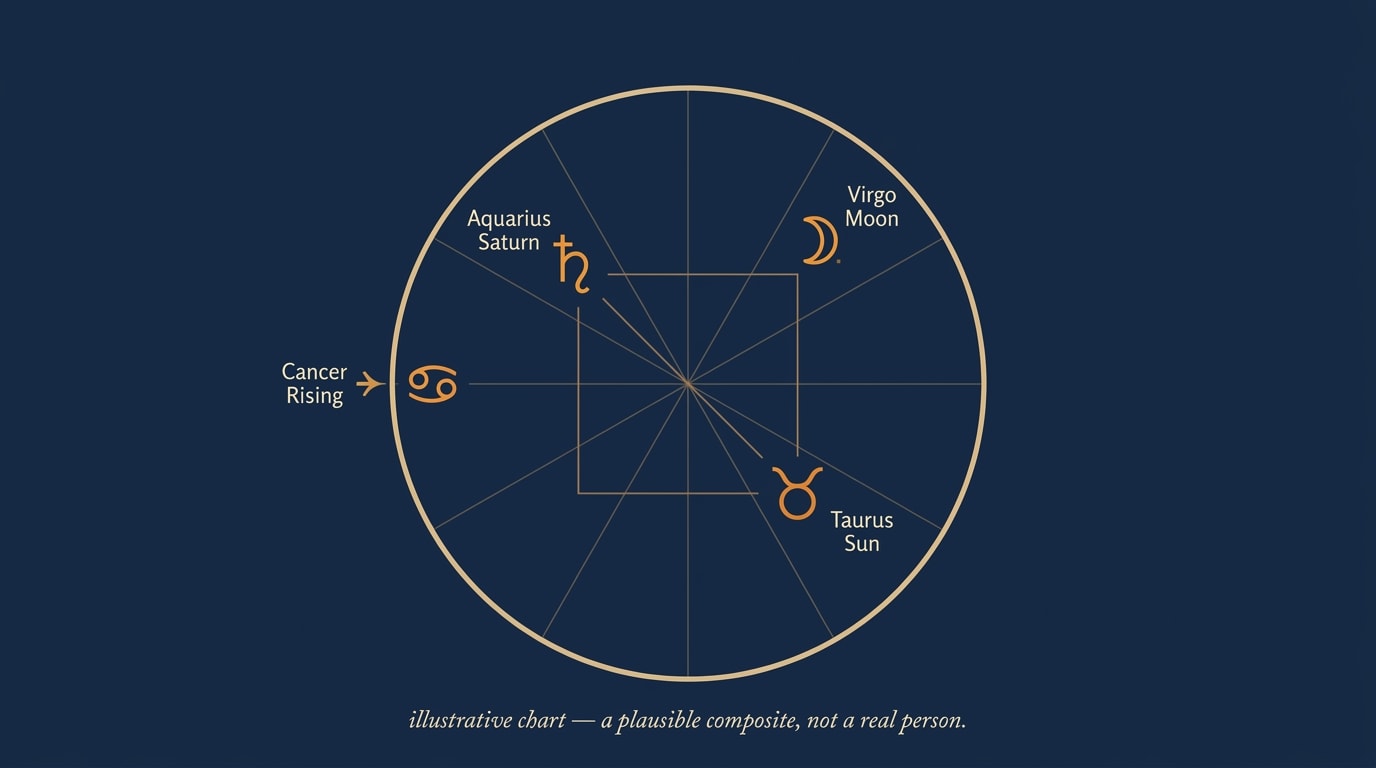
What that looks like in plain English, placement by placement.
The Sun in early Taurus is a slow-builder identity: the part of her that gets satisfaction from making things that last. Taurus is happy to make a beautiful thing because it's a beautiful thing; it doesn't need the thing to be clever or original to feel like it counts.
The Saturn in late Aquarius is the inherited standard. In Aquarius, the standard is about contribution to the collective: is this clever enough, useful enough, original enough to matter to people beyond yourself. The standard isn't her standard. It's the one she absorbed somewhere along the way before she got to vote on it.
The square between them, that clean ninety-degree angle, means the standard plays through her identity directly. The Taurus part finishes a beautiful piece of work. Within about thirty seconds, the Saturn-in-Aquarius voice produces three reasons it isn't clever enough. Every win is real for twenty minutes and then the bar moves. Not self-sabotage. The inherited standard recalibrating, because nothing finished ever quite matches the version that was promised.
The Moon in late Virgo is the need-baseline: order, modest competence, useful tasks, quiet usefulness. When that need is met, she feels grounded. The trouble is that she has been performing-confident for weeks (for the interview, for the promotion announcement, for the team meetings since), and Virgo-Moon doesn't get fed by performance. It gets fed by ordinary unwitnessed competence, by quiet evenings of finishing small useful things at her own pace. While the Moon goes unfed, the inner-critic voice gets louder, and self-esteem leaks at the seams.
The 2nd house in Leo, ruled by the Sun. And the Sun is the same planet currently being squared by Saturn. Which means the channel through which she experiences her own worth runs through the same place the inherited standard is hitting hardest. The worth-feeling and the identity-feeling aren't separate problems; they're the same problem felt twice. A muddled email shakes the worth itself, briefly, because the worth-channel and the "am I clever enough" channel share a wire.
The Cancer rising reads as warm and approachable in the first thirty seconds of any meeting — senior people defer because the surface is welcoming. The Moon-in-Virgo inside, fed or unfed, is silently auditing whether she actually deserves the warmth she's being handed.
The four placements aren't competing. They're four real things happening at once. The promotion is genuinely earned. The inner-critic voice is genuinely loud. The Moon-need is genuinely starving. The worth-channel is genuinely wired through the same planet that's getting squared. All four are true. Naming the shape doesn't fix the pattern, but it changes the relationship to it. Less I'm faking it. More oh — this is a known shape, and the shape has four parts.
'Isn't this just pseudoscience?' A fair question. The claim here isn't that planets cause low self-esteem. It's that birth charts give you a structured vocabulary (Saturn, Moon, 2nd house, Ascendant), and the vocabulary lines up, often surprisingly well, with the shapes a self-esteem wound tends to take. Whether that's because of the planets or because the vocabulary is good doesn't actually matter for our purposes. The right question isn't is this true in physics?; it's does this prompt help me notice something I'd otherwise miss?
A reflective practice: naming, not fixing
Once you can name the four-placement structure, you can use it as a self-reflection prompt rather than evidence against yourself. This is journal territory, or quiet thinking time over a cup of tea — not a script for a session with a professional, and not a method for talking yourself out of real distress.
 rolling up mat.
Four questions worth turning over slowly, one per placement.
The Saturn prompt. What was the inherited standard of "enough" in the house I grew up in — and whose voice is it actually, when I hear the inner critic now? Sometimes the voice is your mother's, sometimes your father's, sometimes an older sibling's, sometimes a teacher's, sometimes a whole era's. Naming the original speaker is often more useful than arguing with the standard directly. You can't outvote the standard from inside the standard's own logic. You can sometimes set it down once you can see who handed it to you.
The Moon prompt. What does my Moon-need look like, in concrete terms, this week, and what would enough of it look like? Not ideal, just enough. Half the slow work of self-esteem is feeding the Moon. A Cancer-Moon week with one full evening at home; an Aquarius-Moon week with one good intellectually substantial conversation; a Taurus-Moon week with one slow proper meal at a table. The Moon-need doesn't have to be glamorous. It has to be met.
The 2nd-house prompt. What do I experience as inherently mine — before evidence, before validation? What does it feel like when that question is met with silence? If the answer is a long pause, that's a 2nd-house signal worth sitting with; it doesn't mean you don't have inherent worth, only that the inner experience of it is muffled. Therapy is good at this layer in a way that articles aren't.
The Ascendant prompt. When others read me in the first thirty seconds, what do they tend to assume — and which of those assumptions matches the inside, and which doesn't? The mismatches are where the "I'm faking it" voice lives. Naming them moves them from evidence of fraud to known features of how my chart broadcasts.
Sit with the questions, not the answers. Most of the work is noticing that the pattern has a shape and the shape has four parts. If the feeling stays loud or interferes with your sleep, your work, or your sense of safety, that's the moment to talk to a qualified counsellor or your GP — or, if it's more immediate than that, Mind on 0300 123 3393 (Mon-Fri 9am-6pm) or Samaritans on 116 123 (free, 24/7). Astrology can sit alongside that conversation; it cannot replace it.
What an astrology lens does here. It gives you a name for something already inside the chart — not a verdict, not a treatment, just a vocabulary that lets the self-esteem story become less personal and more describable. The work itself happens elsewhere.
When self-esteem work needs a person, not a chart
There is a line between my self-esteem is low sometimes and low self-esteem is running my life, and on the other side of that line, this article isn't the right tool. Astrology, used honestly, sits alongside professional help. It doesn't compete with your GP or your therapist. If you're hesitating between booking a session and reading your chart, please book the session first.
Concrete markers worth noticing: persistent low mood lasting more than two weeks; sleep disrupted by self-critical thoughts; withdrawal from people who actually matter to you; self-criticism that has shaded into self-loathing or into thoughts of self-harm. Any of these is a Mind, NHS, or GP conversation, not an astrology one.
In the UK, there are several free routes in. Your GP is the first stop and can refer you for NHS talking therapies, available via self-referral in most areas. Mind runs an information line on 0300 123 3393 (Mon-Fri 9am-6pm) and a free directory of UK therapists at mind.org.uk. Samaritans takes calls on 116 123 (free, 24/7), and you don't have to be in crisis-enough to deserve the call. The BACP holds a register of accredited counsellors if you'd like to find a therapist directly. NHS 111 is the right route for urgent but non-emergency mental-health support.
If you'd like to see where your Saturn, Moon, 2nd house and Ascendant sit in your own chart — WowAstro will calculate a free birth chart for you. Date, time and place; a couple of minutes. Worth knowing whether the inherited standard you've been carrying is loose, average, or tight, and which of the four placements is doing the most work in your particular self-esteem story. The chart is the start of the audit, not the end of it. If you'd like to keep reading, astrology for self-understanding sits alongside this piece on what a chart can name when you've lost your shape entirely.
Frequently asked questions
What does astrology say about self-esteem?
Astrology offers a structural vocabulary for the pattern of low self-esteem, not a treatment for it. In canon astrology, four placements describe four different layers of the self-esteem story: Saturn (the inherited standard against which you measure yourself), the Moon (what you actually need to feel held), the 2nd house (your sense of inherent worth), and the Ascendant (the surface version of you the room reads first). Reading them together gives you a structural map of where the pattern lives in your particular chart. Reading any one of them in isolation usually misses most of the story. Astrology, used honestly, names the shape; it doesn't fix it. If your self-esteem is genuinely struggling, the right next step is your GP, a BACP-registered counsellor, or in immediate distress, Samaritans on 116 123.
Can astrology help build self-esteem?
Astrology doesn't build self-esteem, therapy, time, and supportive relationships do. What astrology can do is name the structural pattern behind the feeling. Some readers find that naming the structure makes the pattern feel less personal and easier to sit with as something inherited rather than something true. That's a self-reflection function, not a treatment. The actual shift in how your self-esteem operates day to day — the slow change in what you allow yourself to feel about yourself when nobody's watching, usually happens elsewhere: talking therapies, journalling, time, supportive relationships, occasionally medication. A chart can be useful alongside that work; it isn't a substitute for it. If your self-esteem feels persistently low, NHS talking therapies are available via self-referral in most UK areas, and Mind has a free UK therapist directory at mind.org.uk.
Which planet rules self-esteem?
No single planet "rules" self-esteem; it's a layered pattern across at least four placements in canon astrology. Reducing it to one planet (Saturn for the standard, the Moon for need, Venus for worth, the Sun for identity) misses the point: self-esteem is what happens when those layers either align or pull against each other. The most common single-planet framing in mainstream astrology is Saturn, because Saturn most directly names the inherited standard you measure yourself against. But Saturn on its own doesn't tell you whether your Moon-need is being met, whether your 2nd-house worth-channel is clear, or whether your Ascendant is amplifying a mismatch between surface and inside. Saturn aspects and the inner critic goes deeper on Saturn specifically.
Is reading my chart better than therapy for low self-esteem?
No. Therapy and a chart do different things. Therapy gives you tools, cognitive work for thinking patterns, trauma-informed work for older wounds, talking therapies for general distress. A chart gives you vocabulary — names for the shape of what you're feeling. They aren't competing. If you can only access one, choose therapy: it does the actual changing. If you have both, use them together, the chart helps you name the shape, the therapist helps you work with it. In the UK, NHS talking therapies are available via self-referral in most areas, and the BACP register lists accredited counsellors. Astrology can sit alongside that conversation; it cannot replace it.
Read the wider context in our guide to your full birth chart
By Oksana Miatova, astrologer and writer at WowAstro. Charts calculated using the Swiss Ephemeris.
About this article: WowAstro readings combine traditional astrological methodology (Swiss Ephemeris calculations, Hellenistic and modern psychological frameworks) with AI-assisted writing reviewed by Oksana Miatova before publication. For entertainment and self-reflection only — not medical, legal, or financial advice. Full editorial policy at /editorial-standards.
Astrology, as we use it at WowAstro, is a tool for self-reflection and self-understanding, not a method for predicting events, health, or financial outcomes.
If feelings of worthlessness, self-criticism, or low mood are overwhelming or persistent, please speak with a qualified counsellor, therapist, or your GP. In the UK you can also contact Samaritans on 116 123 (free, 24/7) or Mind on 0300 123 3393 (Mon-Fri 9am-6pm). Astrology can sit alongside that conversation; it is not a replacement for it.
Read your own natal chart
A personal AI reading, from £1
⭐ +50 Wow Stars cashback · sign up and get 100 ⭐
Build my chart →Comments
New here? Get −30% off your natal chart
Leave your email and we will send you the promo code WELCOME30. Straight after that you can comment — no passwords, all automatic.
Quick sign-in
Sign in with Telegram — one click.
Or by email (with a gift)
Already have an account? Enter the same email — we'll email you a sign-in link.