It's the sixth Friday of a relationship that, by every honest measure, is going well. He's kind, available, turned up on time, and last week he remembered something you mentioned in passing. You should be pleased. Instead, in the half-hour before he arrives to collect you for a weekend away, you find yourself picking a small steady fight about something that, in the morning, won't have mattered. He goes home. You sit at the kitchen window with a mug you don't drink, and the old quiet voice says exactly what it always says: I'm not really meant to have this. Better now than in six months.
If you've sat at that window, you've met what most people, sensibly, call self-sabotage — the recurring pattern of undoing the thing you actually want. Most internet writing on it is solution-shaped: notice the trigger, journal it, replace it. None of which is wrong; a fair amount is the right tool. But self-sabotage is rarely random, and the shape behind it is rarely solved by another step-by-step. Astrology has a structural vocabulary for the shape — Saturn-Venus aspects, Pluto-Sun aspects, the 12th house, Moon afflictions. Not a diagnosis. A mirror.
If self-sabotage has tipped from "I do this sometimes" into "this is running my life", please talk to your GP or contact Samaritans on 116 123 (free, 24/7). Astrology can sit alongside professional support; it can't replace it.
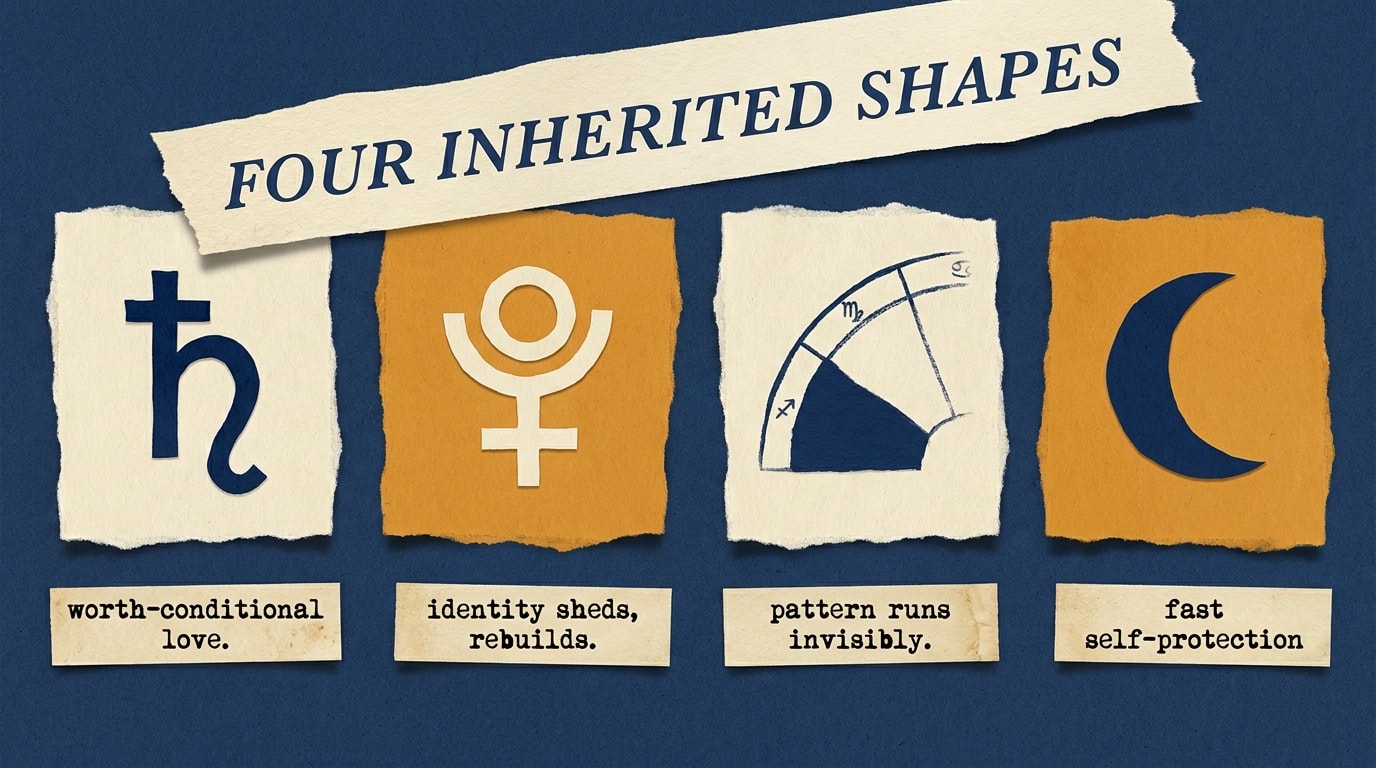
In short. Self-sabotage — the recurring pattern of undoing the thing you actually want — often runs on inherited structures you didn't choose. Astrology has a structural vocabulary for the shape behind it: Saturn-Venus aspects (worth-conditional love), Pluto-Sun aspects (identity-level breakdown before rebuild), 12th-house placements (patterns that work invisibly), and Moon afflictions (pre-emptive emotional protection). A chart can't stop the pattern. It can name its shape, which sometimes loosens it enough to see.
 putting on coat to leave.
What self-sabotage actually is, and what astrology won't claim
Self-sabotage is the recurring pattern of undermining the goals, relationships, or outcomes you actually want — the missed deadline, the diet you keep ending in the same dessert, the relationship you leave at the first sign of stability, the application you finished but never sent. The shared feature is the gap between conscious want and recurring action. The phrase "self-sabotage behavior" appears across psychology as a description of pattern, not a diagnosis: it isn't a DSM-listed disorder. It's a phenomenon, well-described and common.
Self-sabotage isn't laziness or weakness — it's typically a learned protective strategy that once made sense, often in childhood, and now operates against the life you're currently trying to build. The voice that explains it afterwards ("I just couldn't go through with it", "something wasn't right") is the strategy's narrator. The strategy itself is older than the narrator.
This article uses astrology as a structural mirror — vocabulary for the shape of the pattern, not a treatment. This isn't a substitute for therapy; astrology and professional support answer different questions. If the pattern is heavy enough to affect your sleep, work, relationships, or sense of safety, that's a Mind.org (0300 123 3393, Mon-Fri 9am-6pm) or GP conversation, not an astrology one.
What astrology offers, used honestly, is language for the structure behind the recurring action. Something handed you a set of defaults long before you were old enough to argue with them, and self-sabotage is what one of those defaults looks like when it runs against your current wants. The names don't fix anything. They make the defaults visible.
Why an astrology lens makes sense here
An astrology lens works for self-sabotage because the patterns we call self-sabotage usually have a structural shape — and astrology has spent centuries developing vocabulary for inherited shapes. Self-sabotage tends to follow a personal grammar: it shows up in the same situations, with the same timing, dressed in the same after-the-fact explanations. WowAstro calculates charts using the Swiss Ephemeris, the same astronomical data working astrologers rely on, so the placements in your chart are real points with real birth-date positions, not a vibe.
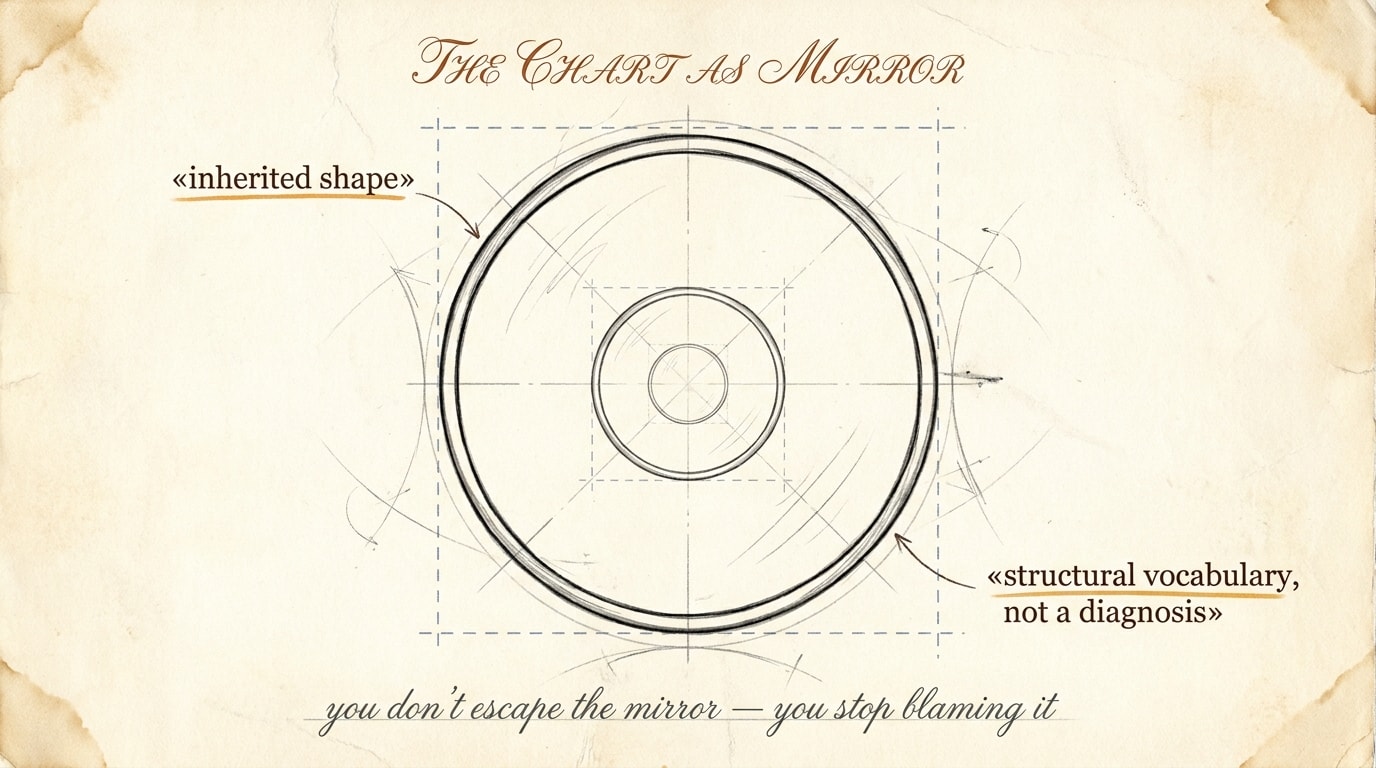
None of what follows is a diagnosis. These are descriptions of structural shape — useful exactly because, once you can name a shape, you can stop arguing with yourself about whether it's there.
Four placement patterns behind common self-sabotage shapes
Four configurations show up most often when readers describe self-sabotage they can't quite shake. They aren't the only placements that matter, but in practice they describe most of the recurring patterns. Each names a different inherited shape — either an aspect (a geometric angle between planets) or a house position.
Saturn-Venus aspects — when love is something you have to earn
A square, opposition, or conjunction between Saturn and Venus tends to install a model in which love is something earned, kept by being useful enough, and removed when you stop performing. Not stated as a belief. Lived as a default. The result is a recognisable shape: love that arrives unconditionally feels suspicious. The pattern can show as deflecting closeness when it gets too easy, ending things before someone else can leave, or quietly choosing people who can't quite love you (which proves the model right). The self-sabotage is the pre-emptive ending. The voice behind it sounds reasonable: I'm sparing us both. Reframed: the model of love was learned. It isn't permanently true about you.
Pluto-Sun aspects — when identity sheds before it rebuilds
Pluto's pattern in canon astrology is breakdown-before-rebuild — total transformation at the identity level. When Pluto aspects the Sun (the becoming-self), the pattern can show as self-undermining right before something would mean visible change. The promotion you don't quite say yes to. The move you postpone past the deadline. The version of yourself you start to become, and then quietly undo — not because you don't want it, but because the version of you that has to die for it to happen is loud about not dying. The self-sabotage is the chart's negotiation with identity-level change. It feels less like "I don't want this" and more like "something in me refuses, and I can't quite locate what".
12th-house tenants — when the pattern runs you before you see it
The 12th house describes what works in you below conscious awareness — old conditioning, inherited stories, blind spots. A planet sitting there operates through that channel: invisibly, often automatically. Self-sabotage from a 12th-house placement feels least like a choice — you find yourself derailing the email, the relationship, the booked appointment, before your conscious mind has caught up. With Mars there, the action runs ahead of thought. With Venus there, the relational self-undermining happens, and the explanation arrives afterwards. With Moon there, the feeling "something's wrong with this" arrives without an argument attached. The shape: hidden-running.
Moon afflictions — when feeling unsafe arrives faster than thinking
The Moon describes your emotional default — what you reach for when tired, scared, or unsure. When it carries a heavy aspect (Moon square Saturn, Moon opposite Pluto, Moon conjunct an outer planet), the default sets toward self-protection: contract, withdraw, end it, pre-empt it. Self-sabotage from a Moon affliction feels emotional rather than strategic — the I just couldn't go through with it that surfaces after you've cancelled the thing, not before. The body said no, and the mind tidied up after. The shape: a fast no, defended by reasonable-sounding reasons.
A note on what these aren't. A Saturn-Venus square doesn't mean low self-worth as a fact about you. A 12th-house Mars doesn't mean unconscious aggression. These are inherited shapes — louder than average for these placements, but not destiny. The pattern is describable. Whether and how you work with it is up to you and, when the pattern is heavy, a qualified counsellor.
 closing laptop, looking out window.
A worked example: Saturn square Venus with Venus in the 12th
Here is one combination read end to end — Saturn squaring Venus, with Venus sitting in the 12th house. The chart is illustrative (a plausible composite, not a real person) so we can walk through how the placements describe a recognisable self-sabotage pattern in love.
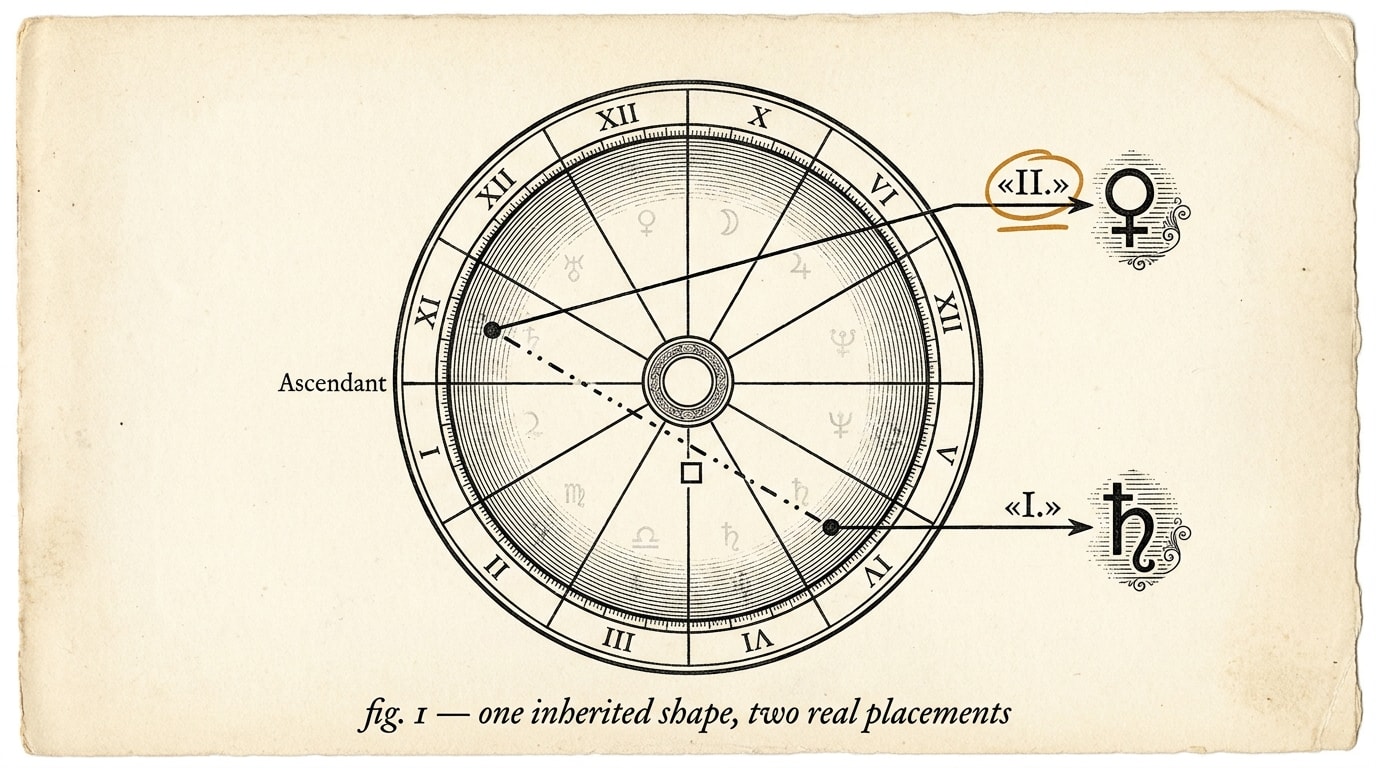
Saturn squares Venus. Venus sits in the 12th.
The inherited model (Saturn-Venus square): love is something earned, kept by being useful enough. Not stated as a belief; lived as a default. The hidden channel (Venus in the 12th): the pattern operates below conscious awareness. She doesn't think I'll sabotage this; she finds herself doing it before she's thought it through, and the explanation arrives afterwards in language that sounds practical.
The shape, week by week. A healthy relationship starts. For about six weeks she's present. Then small things start landing as larger things. A missed call read as rejection. A quiet evening read as withdrawal. He says something neutral; she hears a sentence he didn't say. By week ten she's started a row she half-doesn't mean. By week twelve she's drafted the message in her head, and some version of it gets sent.
The structural read: the Venus-in-the-12th doesn't let her see the pattern until afterwards. The Saturn-Venus square supplies the inherited rule ("love that's easy must be wrong") without ever stating it out loud. Together they describe a recognisable shape — a person who can stay through difficulty but can't stay through ease.
That pattern isn't a moral failing, and it isn't random. It's two real placements describing one inherited shape. Once you can name it, the pattern doesn't vanish; it becomes available to consciousness, where it can be worked with. The working-with is usually a therapist's territory. The naming is what astrology contributes.
'Isn't this just pseudoscience?' A fair question. The claim here is structural, not magical. You don't have to believe Saturn or Venus cause anything for this to be useful. What a chart does, mechanically, is hand you a structured prompt for self-reflection — the same kind of thing journalling apps, attachment-style frameworks, or therapy intake forms do. The right question isn't does it work?; it's does this prompt help me notice something I'd otherwise miss?
 looking at framed photo on shelf.
A reflective practice: naming, not fixing
Once you can name the structural shape of your self-sabotage pattern, you can use it as a self-reflection prompt rather than as evidence you're broken. This is journal territory, or quiet thinking time over a cup of tea — not a script for a session with a professional, and not a method for talking yourself out of recurring distress.
Three questions worth turning over when you've just done the thing again. What was about to happen, just before you did it? What were the conditions for the version of you that wanted the outcome — and what changed in the half-hour before the undoing? If this pattern were protecting you from something, what would it be protecting you from? Whose voice is the rule you're following — did you write it, or did someone write it for you before you had a say?
Sit with the questions, not the answers. Naming a structural shape often loosens it slightly. The shape doesn't vanish, and the heat around it doesn't drop all the way — that's not what a single article does. But the pattern stops being personal and starts being describable, which is different from how it usually feels at eleven on a Tuesday night when you've just ruined another thing you actually wanted.
A chart can name what's happening; it can't fix it on its own. The work — the actual shift in how the pattern operates day to day — usually happens elsewhere. Therapy. Journalling. Slow practice. Time. Support. The chart is the map. You still have to walk.
A quick reminder: if the patterns described here feel less like I get in my own way sometimes and more like I can't stop, that's a Mind.org or GP conversation, not an astrology one. The two aren't competing; they answer different questions.
When the pattern needs a person, not a chart
There is a line between self-sabotage I can journal about and self-sabotage that's running my life, and on the other side of that line this article isn't the right tool. Astrology, used honestly, sits alongside professional help. It doesn't compete with your GP or your therapist. If you're hesitating between booking a session and reading your chart, please book the session first.
Concrete markers worth noticing: persistent low mood lasting more than two weeks; panic that doesn't lift between events; self-destructive behaviour that's escalating in frequency or stakes; withdrawal from people who matter to you; self-criticism that has shaded into self-loathing or thoughts of self-harm. Any of these is a Mind, NHS, BACP, or GP conversation — not an astrology one.
In the UK, four free routes in. Your GP is the first stop and can refer you for NHS talking therapies (also accessible via self-referral in most areas). Samaritans takes calls on 116 123 (free, 24/7, all year), and you don't have to be in crisis enough to deserve the call. Mind runs an information line on 0300 123 3393 (Mon-Fri 9am-6pm) and a free directory of UK therapists at mind.org.uk. The British Association for Counselling and Psychotherapy (BACP) lists qualified UK counsellors at bacp.co.uk if you'd rather go privately. For urgent (non-emergency) mental-health support, NHS 111 is available 24/7.
If you want to see whether your chart carries Saturn-Venus, Pluto-Sun, 12th-house, or heavy Moon-aspect placements, WowAstro will calculate a free birth chart for you. Date, time and place; a couple of minutes. The chart is the start of the audit, not the end of it. If you'd like to keep reading, Saturn aspects and the inner critic covers the structural-Saturn voice in more detail, rising sign versus sun sign and impostor syndrome covers a related self-worth wound from a different angle, and feeling stuck and unsure of direction covers the houses-based view of being unable to move forward.
Frequently asked questions
What is self-sabotage in plain terms?
Self-sabotage is the recurring pattern of undermining the goals, relationships, or outcomes you actually want — the deadline you couldn't quite meet, the relationship you end at the first sign of stability, the application you finished but never sent. It's a description of behaviour, not a clinical diagnosis. Self-sabotage isn't laziness or weakness; it's typically a learned protective strategy that once made sense and now operates against the life you're trying to build. Psychology describes it as "self-sabotage behavior"; astrology, used as a complementary lens, can offer structural vocabulary for the shape it tends to take in a particular person.
Can astrology really explain self-sabotage behaviour?
Astrology doesn't explain self-sabotage causally — but it does offer structural vocabulary that often describes the shape of recurring patterns better than "self-sabotage" as a flat label. A chart can name the inherited grammar a behaviour seems to be following: worth-conditional love (Saturn-Venus), identity-level breakdown before change (Pluto-Sun), pattern running invisibly (12th-house tenants), or fast emotional protection (Moon afflictions). That's a self-reflection lens, not a causal claim. It doesn't tell you why you do the thing; it gives you a different way to look at the shape of it.
Which astrological placements show self-sabotage most clearly?
Four placement-frames recur most often. Saturn-Venus aspects — square, opposition, or conjunction — describe worth-conditional love and tend to show as deflecting closeness or ending things before they can stabilise. Pluto-Sun aspects describe identity-level breakdown-before-rebuild and tend to show as undoing the thing right before it would mean visible change. The 12th-house tenants — Sun, Venus, Mars, or Moon in the 12th — describe patterns running below conscious awareness, where the action happens before the explanation. Moon afflictions — Moon square Saturn, opposite Pluto, conjunct outer planets — describe an emotional default set toward pre-emptive self-protection. None of these is exhaustive, and none is diagnostic.
How do I stop self-sabotage if astrology can't fix it?
Astrology can't stop the pattern — but the pattern can shift, usually with professional support. A chart can help you name the inherited shape behind a recurring self-sabotage behaviour, and naming a shape often makes it slightly less personal and easier to sit with as something you can work on rather than something you secretly are. The actual work — the shift in what you do at the moment the impulse to undo arrives — usually happens in therapy, in slow practice, in time, with support. In the UK, your GP is the first stop and can refer for NHS talking therapies. Mind (0300 123 3393, Mon-Fri 9am-6pm) lists therapists at mind.org.uk. BACP (bacp.co.uk) lists qualified UK counsellors. Samaritans (116 123, free 24/7) is available if you're struggling and want to talk. NHS 111 covers urgent non-emergency mental-health support. Astrology can sit alongside that conversation; it is not a replacement for it.
Read the wider context in our guide to your full birth chart
By Oksana Miatova, astrologer and writer at WowAstro. Charts calculated using the Swiss Ephemeris.
About this article: WowAstro readings combine traditional astrological methodology (Swiss Ephemeris calculations, Hellenistic and modern psychological frameworks) with AI-assisted writing reviewed by Oksana Miatova before publication. For entertainment and self-reflection only — not medical, legal, or financial advice. Full editorial policy at /editorial-standards.
Astrology, as we use it at WowAstro, is a tool for self-reflection and self-understanding, not a method for predicting events, health, or financial outcomes.
If self-sabotage, low mood, or self-destructive patterns are overwhelming or affecting daily life, please speak with your GP, or contact Samaritans on 116 123 (free, 24/7), Mind on 0300 123 3393 (Mon-Fri 9am-6pm), or the BACP directory of qualified UK therapists. For urgent (non-emergency) mental-health support, NHS 111 is available 24/7. Astrology can sit alongside that conversation; it is not a replacement for it.
Read your own natal chart
A personal AI reading, from £1
⭐ +50 Wow Stars cashback · sign up and get 100 ⭐
Build my chart →Comments
New here? Get −30% off your natal chart
Leave your email and we will send you the promo code WELCOME30. Straight after that you can comment — no passwords, all automatic.
Quick sign-in
Sign in with Telegram — one click.
Or by email (with a gift)
Already have an account? Enter the same email — we'll email you a sign-in link.