Eight o'clock on a Tuesday evening. You're finishing an email to a client. You read it a sixth time, because a small steady voice inside your head says it isn't quite right yet — not really, not enough. You change one word. You send it. You feel less like you sent a good piece of work and more like you got away with one. Astrology has a specific name for that voice, and it lives in your chart as a set of geometric angles between Saturn and the rest of you.
Saturn aspects in astrology — Saturn square Sun, Saturn square Moon, Saturn conjunct Ascendant — are the configurations astrologers have used for centuries to describe exactly this experience. Not the punishing Saturn of bad horoscope columns, but the structural Saturn: the inherited model of "enough" that someone built into you before you started choosing what "enough" meant. Read structurally rather than as fate, these aspects name the voice and explain why it sounds the way it does.
If that voice has stopped being background noise and started affecting your sleep, your work, or your sense of safety, please talk to your GP or Samaritans on 116 123 (free, 24/7). Astrology can sit alongside that conversation; it can't replace it.
In short. The chronic "not good enough" voice in your head is what psychology calls the inner critic — and what astrology has been calling Saturn for centuries. Read structurally rather than as punishment, Saturn names the inherited model of adequacy you were built on, long before you got to vote on it. Self worth work, in this frame, becomes less about fixing yourself and more about looking at the scaffolding you didn't choose.
 The minute after sending — not relieved, exactly, just lighter by a notch.
What the inner critic actually is, and what astrology won't claim
The inner critic is the persistent internal voice that judges you, sets standards you can't quite reach, and treats every shortfall as evidence you aren't enough. The phrase has roots in twentieth-century psychology, Freud's superego, the "critical parent" in transactional analysis, the shadow voices in Jung — and the through-line is the same: most people have one, it's not a diagnosis, and the volume varies enormously between individuals.
This article uses astrology as a self-reflection lens — vocabulary for what the voice looks like in your chart. Not a treatment. Not a substitute for therapy or medical advice. Astrology and professional support answer different questions; use them together if you need both.
If the voice has tipped into something heavier, persistent low mood, panic that won't lift, intrusive thoughts you can't quiet — please contact your GP or Mind on 0300 123 3393 (Mon-Fri 9am-6pm). Astrology isn't the right tool for that level of weight.
What astrology can do, used honestly — is offer language for the structure behind the voice. The voice doesn't come from nowhere. Something handed you a set of standards before you were old enough to argue with them, and your inner critic has been enforcing those standards ever since. Astrology has a name for that handed-down structure. It calls it Saturn.
Why Saturn is the kindest explanation
Saturn isn't the punishing planet bad horoscopes make it out to be. Read structurally, it's the part of your chart describing what you were taught counts as "enough" — and the inner voice that keeps enforcing that standard now that the teaching is done.
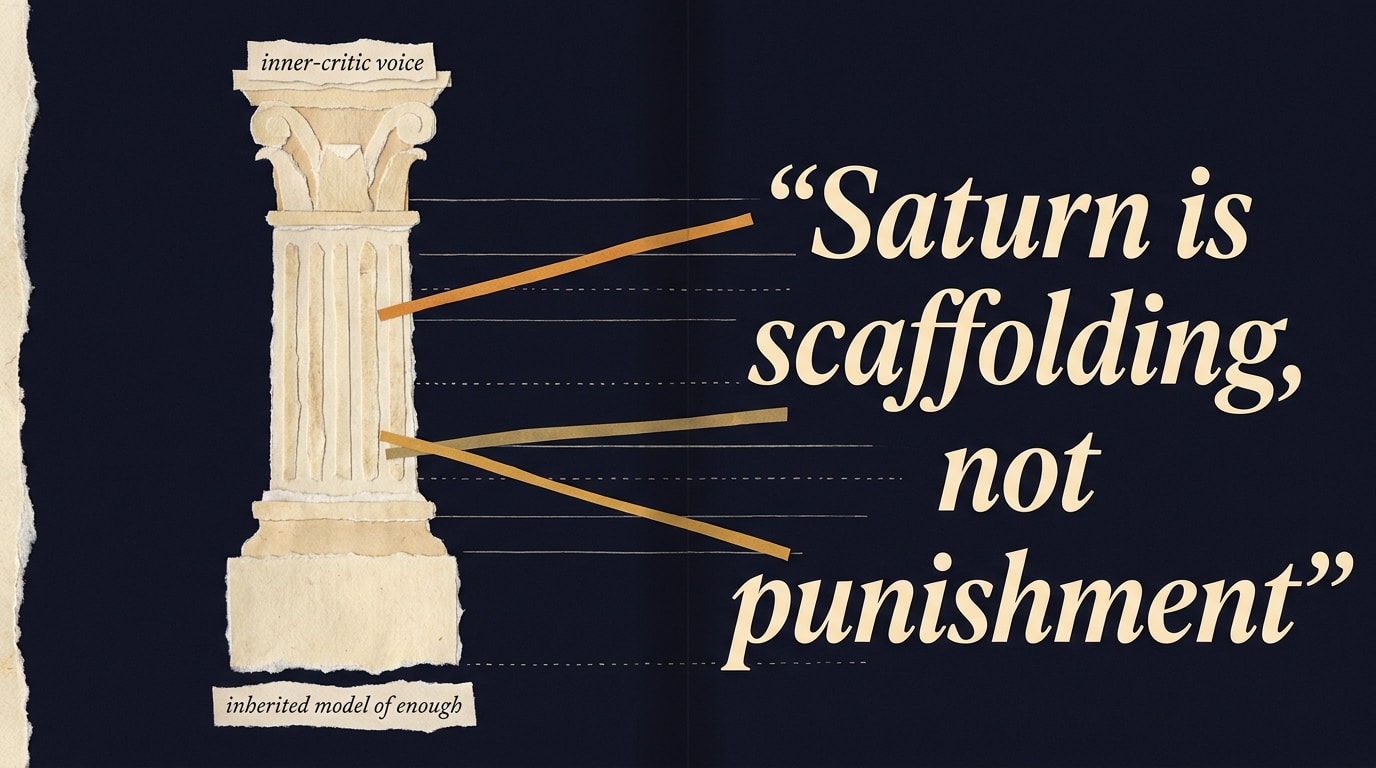
Saturn, in canon astrology, represents structure, time, limits, authority, commitment. It moves slowly, about twenty-nine and a half years for one orbit of the Sun — which is one of the reasons what Saturn describes tends to feel slow and weighty, like a voice that's been around a long time. WowAstro calculates these positions using the Swiss Ephemeris, the same astronomical data working astrologers rely on, so the Saturn in your chart is a real astronomical point with a real birth-date position, not a vibe.
The old astrology shorthand, Saturn is the strict teacher — is half right and half misleading. The strict teacher you didn't choose. The standards weren't your idea originally. They came from family, from school, from the era you grew up in, from whichever adults in your life happened to be loudest about what mattered. Saturn just names the part of you that absorbed all that and now speaks with its voice when you're alone at eight in the evening rewriting a perfectly fine email.
The reframe is small but it changes everything: not Saturn is punishing me, but Saturn is the scaffolding I was built on, and the inner critic is its voice. Different verb. Different ambition. You can't delete a scaffolding, but you can walk around it in daylight and decide which bits of it you actually want to keep.
Three Saturn placements that hit hardest
Three configurations between Saturn and other parts of your chart tend to make the inner-critic voice louder than average. They aren't the only ones that matter, but in practice they're the three that show up most often when readers describe a self-worth wound they can't quite outrun.
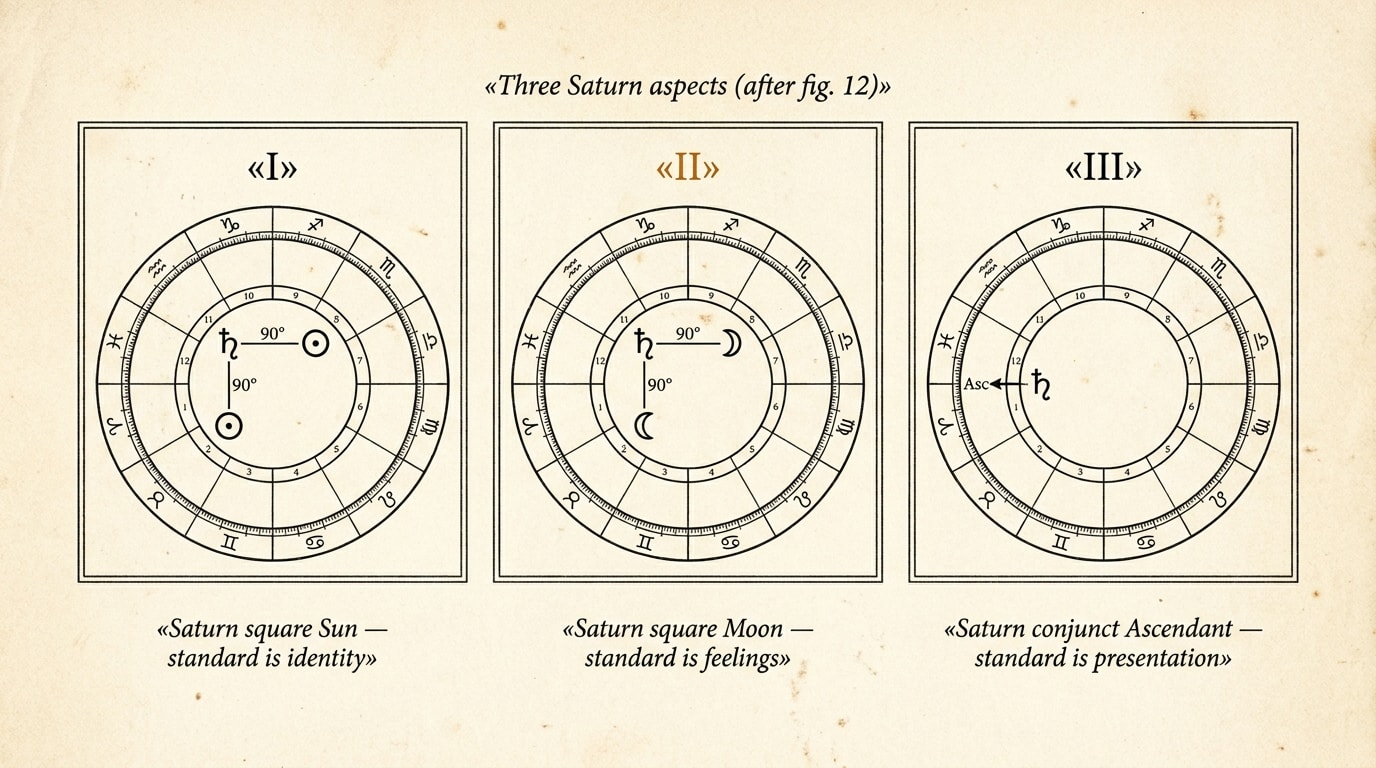
These are aspects, the astrological word for geometric angles between two planets. When Saturn forms a tense angle (a square — ninety degrees apart) or sits very close (a conjunction) to your Sun, your Moon, or your Ascendant, structural-Saturn plays through that part of you with more volume than usual.
Saturn square Sun. The standard the inner critic enforces is about identity. Whoever you are, the voice asks if you're enough of it. Achievements don't quiet it; they reset the bar. Every win is real for about twenty minutes and then the standard moves. It isn't self-sabotage. It's the inherited model recalibrating, because nothing finished ever quite matches the version that was promised.
With Saturn square Moon, the standard the inner critic enforces is about feelings. The voice comments on what you allow yourself to feel: too much, too soft, too needy, too sensitive. The inherited model said feelings should be smaller than yours actually are. People with this placement often grew up around adults whose own feelings were unsteady, and learned early to manage the room. The self-esteem cost is real: emotional needs treated as embarrassments don't disappear; they go underground.
When Saturn forms a square or conjunction with the Ascendant, the standard shifts to how you present in the world. The voice edits your first impressions before you've made them. Composed posture, careful speech, the right kind of laugh, never quite right, never quite enough. People with this placement often look, from the outside, like the most put-together person in the room, and feel, on the inside, like the one most likely to be found out.
None of these is a diagnosis. They're descriptions. If one of them sounds like the voice in your head, that's because Saturn's structural language is recognisable when you finally hear it named.
The placement isn't the problem. A Saturn aspect doesn't mean low self worth as a defect. It means the model of "enough" you inherited was tighter than average, and the inner critic enforcing it is louder than average. That's a shape, not a flaw.

A worked example: Saturn squaring the Sun
Here is one combination read end to end, in an illustrative composite — a plausible chart, not a real person.
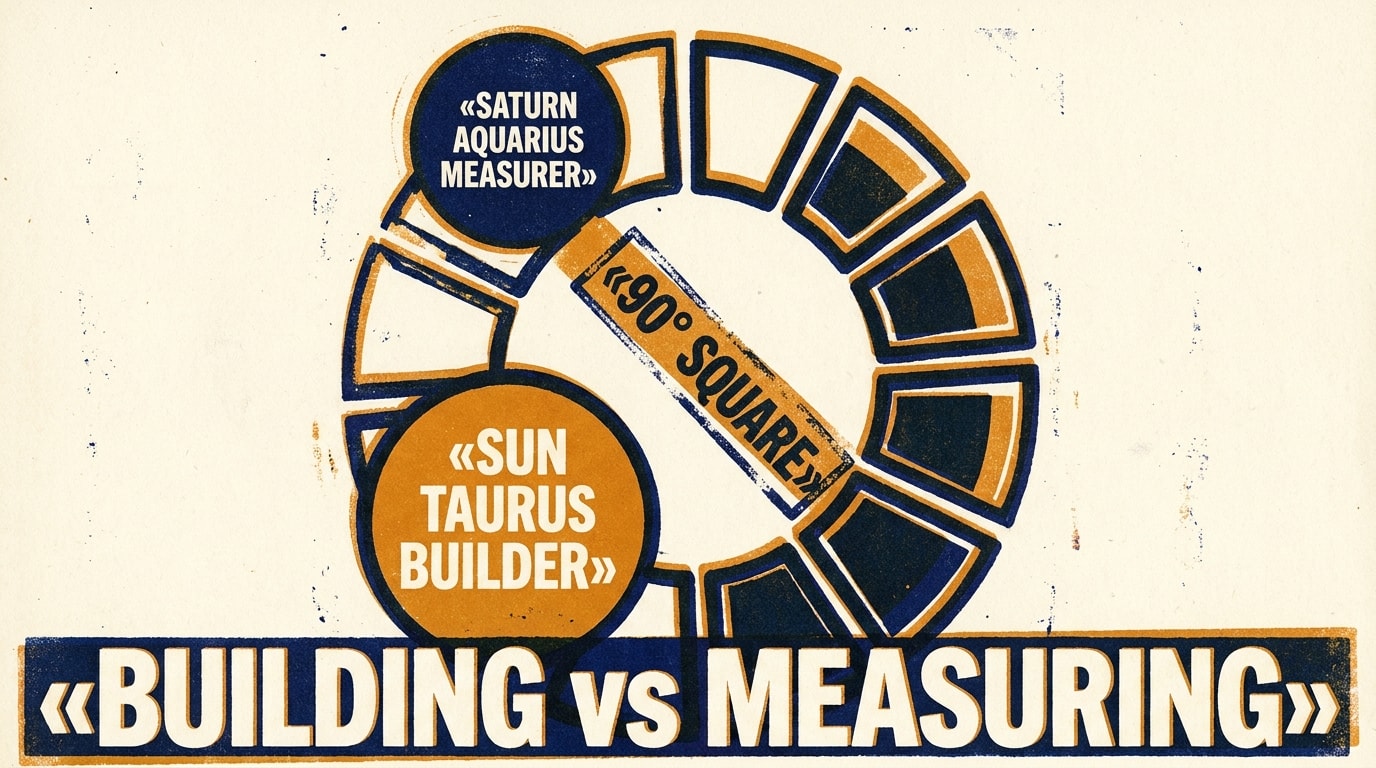
Sun in early Taurus. Saturn in late Aquarius. Roughly ninety degrees between them — a square.
What that means in plain English: the identity-self (Sun in Taurus) wants to build something solid and personal. Taurus is the slow builder of the zodiac — the part of someone that gets satisfaction from making things that last. The structural voice (Saturn in Aquarius) measures everything Taurus makes against an inherited intellectual or communal standard: is this clever enough, useful enough, original enough. Taurus is happy to make a beautiful thing because it's a beautiful thing. Saturn in Aquarius wants to know what it contributes.
In a single day this plays out about ten times. She finishes a piece of work that is, by any honest measure, actually good. The Sun-self knows it's good. Within about thirty seconds, the Saturn-voice produces three reasons it isn't clever enough. She redrafts. She emails it at midnight feeling she's just about pulled it off, when what she's actually done is produce one of the best things she's made this month.
The square isn't a malfunction. It's two real placements doing two real jobs — building, and measuring. Both are necessary. The work isn't to remove the measurer; it's to notice that the measurer was inherited (not invented by you) and the standard it uses is older than your actual values. Once you can name that, the heat around its daily verdict drops a little. Not all the way. But noticeably.
'Isn't this just pseudoscience?' A fair question. The claim here is structural, not magical. You don't have to believe Saturn causes anything for this to be useful. What a chart does, mechanically, is hand you a structured prompt for self-reflection — the same kind of thing a journalling app, a personality framework, or a therapy intake form does. The right question isn't does it work?; it's does this prompt help me notice something I'd otherwise miss?
What Saturn actually wants (and isn't)
If you read Saturn as the inherited model of enough, the question changes: what's the model actually for?
In canon astrology, Saturn matures over a lifetime. The same Saturn that runs harsh inner-critic voice in your twenties tends to relax, slightly — by your fifties. The voice doesn't disappear; the relationship to it changes. People often describe their first Saturn return, around age twenty-eight to thirty, as the first time the structure becomes visible to them, as if Saturn has finally come into the room and asked what you actually want from all this.
Three things Saturn does well when it's working with you rather than at you.
Structure that holds you up. The discipline to finish things, to stay with hard work, to build slowly. Without some Saturn in your makeup, nothing survives the boring middle of any project. The same machinery that runs the inner-critic voice is what gets you through the second week of a difficult task. You can't have one without the other; the question is who's setting the standard.
Standards that mean something. The ability to know what you actually value, instead of inheriting other people's metrics wholesale. Mature Saturn audits the standard — keeps the parts that match what you actually want to build, lets go of the parts that don't. The audit takes years. It's worth it.
Limits that protect you. Saying no. Leaving room. Not collapsing into every demand. Saturn-as-boundary, rather than Saturn-as-punishment, looks like a quiet ability to know your own edges and stay inside them. The inner critic, when it matures, stops being a punishing voice and starts being something more like a discerning one.
A chart can name what's happening; it can't fix it on its own. The work, the actual shift in how the inner critic operates day to day, the slow change in how your self-esteem actually feels — usually happens elsewhere. Therapy. Journalling. Time. Support. The chart is the map. You still have to walk.
The reframe. The inner critic isn't a glitch in you that needs fixing. It's Saturn, inherited structure — running on an old setting. You can't delete the structure, but you can audit it. The audit is the work, and most of it happens outside any single article.
 Morning at the table — naming a shape, not fixing one.
When the critic needs a person, not a chart
There is a line between my inner critic is loud sometimes and my inner critic is running my life, and on the other side of that line, this article isn't the right tool. Astrology, used honestly, sits alongside professional help. It doesn't compete with your GP or your therapist. If you're hesitating between booking a session and reading your chart, please book the session first.
Concrete markers worth noticing: persistent low mood lasting more than two weeks; panic that doesn't lift between events; sleep disrupted by intrusive thoughts; withdrawal from people who actually matter to you; self-criticism that has shaded into self-loathing or into thoughts of self-harm. Any of these is a Mind, NHS, or GP conversation — not an astrology one.
In the UK, three free routes in. Your GP is the first stop and can refer you for NHS talking therapies, available via self-referral in most areas. Mind runs an information line on 0300 123 3393 (Mon-Fri 9am-6pm) and a free directory of UK therapists. Samaritans takes calls on 116 123 (free, 24/7, all year), and you don't have to be in crisis enough to deserve the call.
If you want to see where your Saturn sits, and which placements it's in conversation with — WowAstro will calculate a free birth chart for you. Date, time and place; a couple of minutes. Worth knowing whether the structure you inherited is loose, average, or tight. The chart is the start of the audit, not the end of it. If you'd like to keep reading, astrology for self-understanding covers how a chart can sit alongside that wider work, and rising sign versus sun sign and impostor syndrome covers the surface-level version of the same wound from a different angle.
Frequently asked questions
What is the astrological "inner critic"?
The astrological "inner critic" is what most traditions call Saturn read structurally — the part of your chart describing the model of "enough" you absorbed from your environment before you started choosing your own standards. It isn't a punishing planet; it's a scaffolding voice. Psychology describes the same phenomenon as superego, critical parent, or internalised shame voice. Astrology describes it as Saturn placement and Saturn aspects. The two domains aren't competing; they name the same thing in different vocabularies, and reading one against the other often makes both more legible.
Why is Saturn the planet of self worth?
Saturn isn't strictly the planet of self worth, it's the planet of the standard against which you measure self worth. That's a subtle but important difference. Self-worth itself isn't located in any one planet. But the inner voice that decides whether you've cleared the bar has Saturn's vocabulary in canon astrology. A tightly aspected Saturn often correlates with a tighter standard — harder to meet, more punishing when missed. A loosely aspected Saturn correlates with a more flexible one. Neither makes someone's worth any greater or smaller; just the inherited measuring stick different.
Can astrology help with low self-esteem?
Astrology does not treat low self-esteem and isn't a substitute for support with self-esteem or self-confidence concerns. It can describe the structural model behind the inner-critic voice, what it sounds like, where it came from, what it's measuring against — and some readers find that naming the structure makes the voice feel less personal and easier to sit with as something inherited rather than something true. That's a self-reflection lens, not a treatment. If your self-esteem feels persistently low or your inner critic is affecting your daily life, the right next step is your GP or Mind on 0300 123 3393. A chart can be useful alongside that, never instead of it.
Is therapy better than reading my chart?
For changing how the inner critic actually operates day to day, therapy is the right tool. A chart is something else. Therapy gives you tools, cognitive work for patterns, trauma-informed work for older wounds, talking therapies for general distress. A chart gives you vocabulary — names for the shape of what you're feeling. They aren't competing. If you can only access one, choose therapy: it does the actual changing. If you have both, use them together, the chart helps you name the shape, the therapist helps you work with it. Mind has a free UK therapist directory at mind.org.uk, and the NHS offers talking therapies via self-referral in most areas. Astrology can sit alongside that conversation; it cannot replace it.
Read the wider context in our guide to your full birth chart
By Oksana Miatova, astrologer and writer at WowAstro. Charts calculated using the Swiss Ephemeris.
About this article: WowAstro readings combine traditional astrological methodology (Swiss Ephemeris calculations, Hellenistic and modern psychological frameworks) with AI-assisted writing reviewed by Oksana Miatova before publication. For entertainment and self-reflection only — not medical, legal, or financial advice. Full editorial policy at /editorial-standards.
Astrology, as we use it at WowAstro, is a tool for self-reflection and self-understanding, not a method for predicting events, health, or financial outcomes.
If feelings of worthlessness, self-criticism, or low mood are overwhelming or persistent, please speak with a qualified counsellor, therapist, or your GP. In the UK you can also contact Samaritans on 116 123 (free, 24/7) or Mind on 0300 123 3393 (Mon-Fri 9am-6pm). Astrology can sit alongside that conversation; it is not a replacement for it.
Read your own natal chart
A personal AI reading, from £1
⭐ +50 Wow Stars cashback · sign up and get 100 ⭐
Build my chart →Comments
New here? Get −30% off your natal chart
Leave your email and we will send you the promo code WELCOME30. Straight after that you can comment — no passwords, all automatic.
Quick sign-in
Sign in with Telegram — one click.
Or by email (with a gift)
Already have an account? Enter the same email — we'll email you a sign-in link.