The podcast is two minutes old by the time the Jubilee line pulls out of Canary Wharf. Someone you've never met is telling the host how, at thirty-six, she quit twelve years of marketing and trained as a midwife. You've heard the story before, in different costumes — the lawyer who runs a bakery, the banker who teaches secondary maths. You stare past your own reflection in the carriage window and the familiar thought arrives on cue: that could be me. But how do I know if it's now, or if I'm just bored?
A career change is rarely a single decision. More often it's a question that's been getting louder for months, sometimes years, and you can't tell whether to act on it or wait it out. Astrology won't pick your next job, that's a conversation for a CV, a financial planner, and, ideally, a regulated career advisor. What astrology can do is name the shape of the question and show you that the moment it's getting loud is structural, not personal failure. You don't have to believe the planets cause anything for this to be useful; a chart, mechanically, is just a structured prompt for paying attention. If the question is making you genuinely unwell, or you're between jobs and the money is tight, the right next stops are Citizens Advice, your GP, and Samaritans (116 123, free 24/7) — not a chart reading.
In short. A career change is usually a structural recalibration of your public direction, the part of a chart astrology calls the MC (Midheaven) and the 10th house. The question gets loud at specific recurring windows: around your first Saturn return (about ages 28-30), the mid-life Uranus opposition (around 40-43), and the second Saturn return (about 56-60). A chart won't pick your new job. It will name what kind of question this restless feeling is asking — and the answer rarely lives in your LinkedIn search bar.
 looking out at the street, half-finished latte.
What a 'career change' actually is — and what astrology won't claim
A career change in the structural sense isn't picking a different job title. It's a recalibration of the kind of public-direction question your life is asking. The phrase "change career" covers everything from a sideways move within the same industry to a full second-act pivot, and the UK Office for National Statistics tracks job tenure carefully but doesn't have a code for "career change", because the category lives in the person's own framing, not in HMRC records. That's part of why it's such a slippery thing to think about: nobody can show you a number that tells you whether you're having one.
Astrology, used honestly, sits at a particular angle to this question. What it is: a structural map for where the public-direction question lives in a chart, and a sense of when it tends to get loud. What it isn't: a method for choosing your next role, a financial-planning tool, or a substitute for career coaching or therapy. Astrology and professional support answer different questions; use them together if you need both.
If you're feeling stuck in life in a broader way, the peer article on the four direction-houses is the longer pillar this one sits underneath. If you're between jobs, in financial distress, or the question is genuinely affecting your sleep, the practical first stops are Citizens Advice for benefits and career guidance, your GP for the wellbeing piece, and a regulated career advisor or therapist — not a chart. This article is for the version of the question that's restless but functional. The version that follows you onto the tube on a Thursday morning.
Your MC and 10th house — the visible-direction marker
In astrology, the visible direction of your life, the part of you that has a job title and a LinkedIn headline — lives in the 10th house, and on its starting line, the Midheaven (often shortened to MC). The MC is calculated from your birth time and place, it moves through all twelve signs in roughly twenty-four hours, which is why a missed birth time can put it in the wrong sign entirely. A sun-sign listicle can't read your MC for you; a properly drawn chart can.
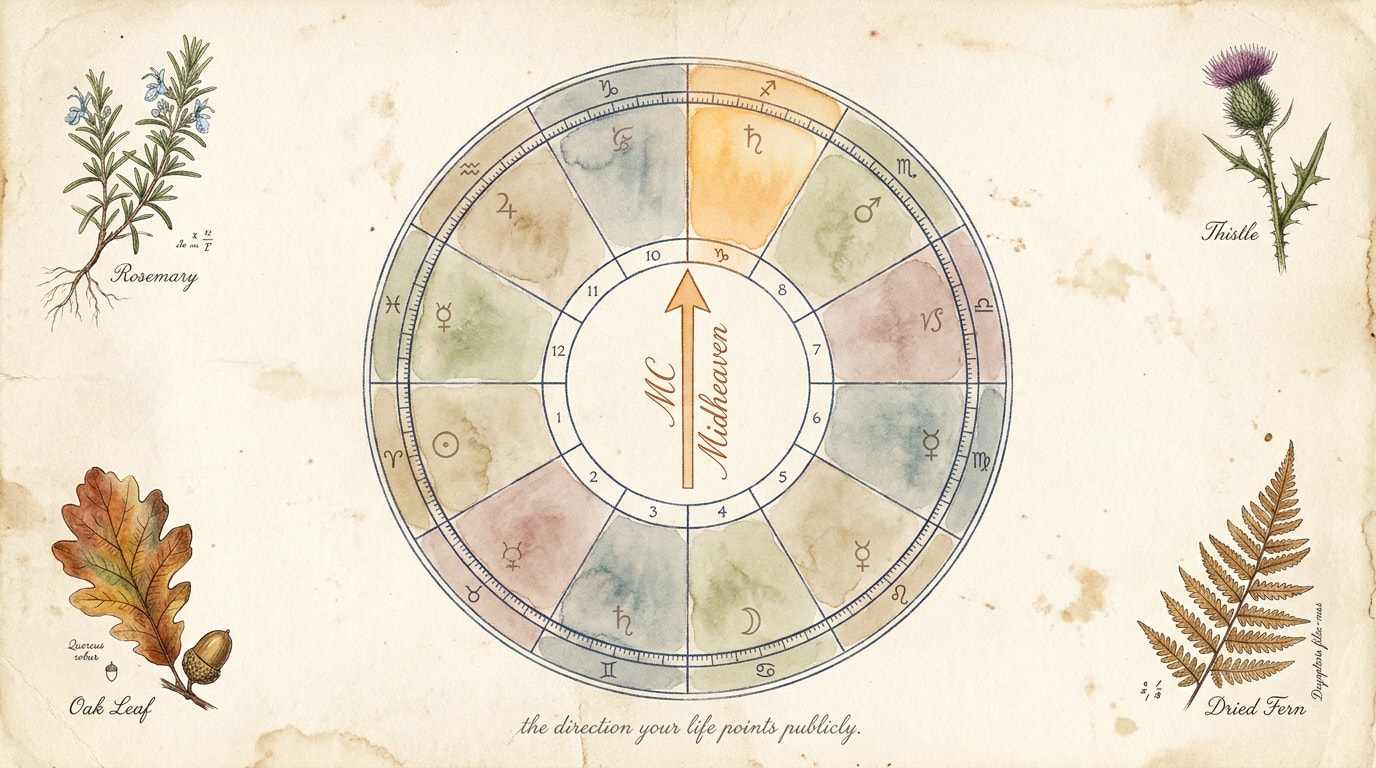
The sign on your MC doesn't predict your career. It describes the flavour of the public-direction question you keep asking. The same person, working the same job, with two different MCs would be asking two different things underneath the surface of the work:
| MC sign | The underlying question |
|---|---|
| Aries MC | Am I doing something that's actually mine, or am I in someone else's queue? |
| Cancer MC | Is what I do for the people I'm responsible for, in a way I can feel? |
| Sagittarius MC | What's the bigger meaning of what I'm doing? |
| Capricorn MC | What's the structure I'm building, and is it load-bearing? |
| Pisces MC | Whose suffering or beauty am I serving? |
There are twelve of these and each is a slightly different question. If you recognise the question your MC is asking, that's the lens working — the next step is reading the rest of the chart for context, not changing jobs that afternoon. If you don't recognise it, the chart you're working with probably has the wrong MC, and the fix is birth-time accuracy, not more interpretation.
The recurring windows — Saturn return, mid-life opposition, second Saturn return
Career-pivot questions don't arrive randomly. They cluster around three recurring astrological windows that line up, observably, not predictively — with peak demographic ages for career change. The windows are real-time astronomy: Saturn takes about 29.5 years to orbit the Sun, Uranus takes about 84. These cycles aren't doing anything to you; they're a calendar that happens to keep showing up around the same ages people independently decide their work isn't fitting any more.
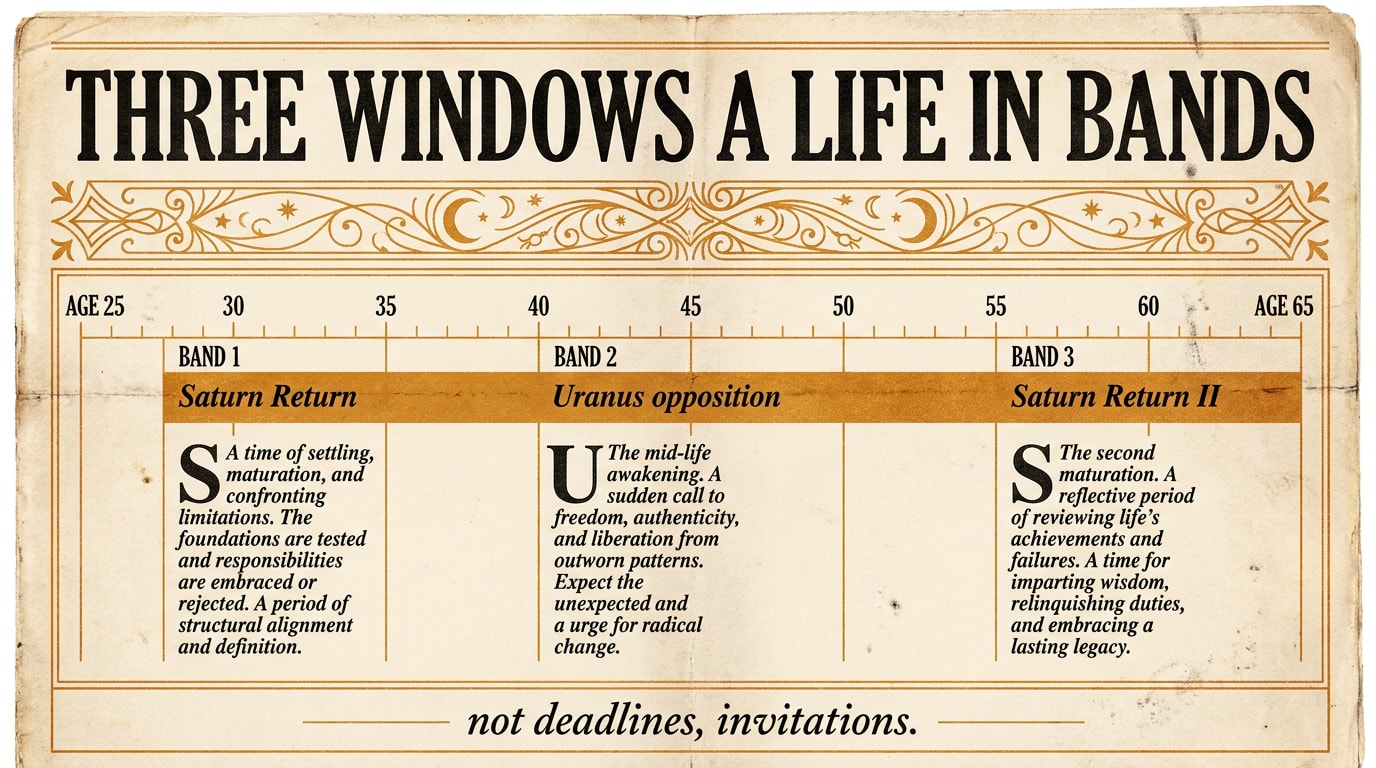
The first Saturn return lands around ages 28-30, when Saturn returns to its birth position for the first time. Practitioners observe a recurring pattern: a stretch of two-to-three years in which the structures you built in your twenties get asked, fairly bluntly, whether they're load-bearing for the person you're becoming. The career-question version of that is do I want to keep building inside this structure, or do I need to dismantle and start again? If you'd like the full Saturn-cycle context, the peer article on the Saturn return explains the full mechanism; here it's enough to say that the first time round it tends to land hardest on whichever angular house has the most weight in your chart, and for many people that's the 10th.
The mid-life Uranus opposition lands around ages 40-43, when transiting Uranus reaches the point exactly opposite its birth position (half an orbit of an eighty-four-year cycle). Uranus is the planet of structural surprise; opposition to itself tends to register as a if I'm not doing this for me, who's it for? question. The pop-psychology label "mid-life crisis", Elliott Jaques coined it in a 1965 paper — is mostly this in less flattering dress. It doesn't have to be a crisis. Quietly handled, it's often the cleanest career pivot most people make.
The second Saturn return lands around ages 56-60, the second full Saturn cycle. The question shifts: what do I want the final professional chapter to be? This one often coincides with redundancy, retirement runway, or empty-nest restructuring, practical events that sharpen an underlying question that was already arriving. If your career-change question is loud and you're in one of these three windows, you're in good company. A chart can name what's happening; it can't fix it on its own. The work — the actual decisions about CV, retraining, the conversation with your manager or your partner or your bank, happens elsewhere.
Jupiter transits — when the door tends to feel open
Where Saturn returns describe the question, Jupiter transits describe the opportunity-noticing. Jupiter takes about twelve years to orbit the Sun, so it spends about a year in each house in turn. Three Jupiter-transits often show up in career-pivot stories:
| Jupiter transit | What it tends to bring |
|---|---|
| Jupiter through the 10th house | The public-direction year. People often report a stretch when recognition, promotion, or visibility-boosting offers seem unusually accessible. |
| Jupiter through the 2nd house | The resources year. Salary jumps, freelance income spikes, or a deepening of financial confidence. |
| Jupiter through the 6th house | The daily-work-life year. A change in the texture of how you spend your working hours, sometimes a health re-set that unlocks the rest. |
These are noticing windows, not instruction manuals. Astrology doesn't say take the offer; it says the door tends to be visible during this stretch. The decision is still yours — and a regulated career advisor or financial planner is the right second opinion, especially if the offer involves a pay change or a different employment status.
'But this isn't a science.' Fair. You don't have to believe Jupiter causes anything for this to be useful. What a chart does, mechanically, is hand you a structured prompt for paying attention — the same kind of thing a calendar of personal cycles, a quarterly review, or a journalling app does. The question "does astrology work?" is the wrong question; the right one is "does this prompt help me notice something I'd otherwise miss?"
 sitting on step with coffee cup.
A worked example — MC in Sagittarius, first Saturn return, Jupiter in the 6th
Here's how the structural map reads in one composite chart. The chart is illustrative, a plausible composite, not a real person — and the point is the shape of the reading, not the recommendation.
She's twenty-nine, three years into a senior associate role at a London consultancy. The work is interesting on paper and the pay is the best she's ever earned. She's been restless for eight months and can't quite name what for.
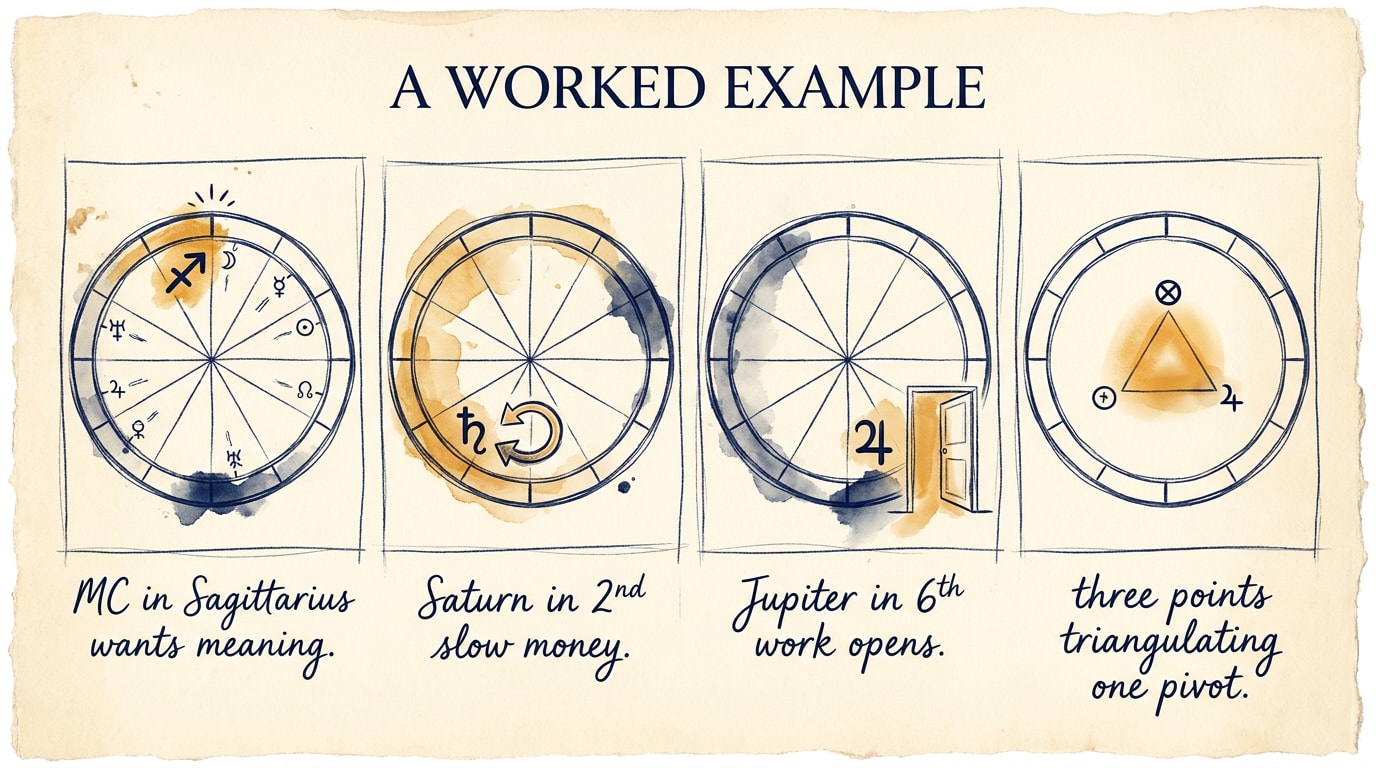
Her MC is in Sagittarius. The visible-direction question keeps asking what's the bigger meaning of what I'm doing? The consultancy role pays well and reads correctly from outside; the inner question doesn't translate. The Sagittarius MC has been asking the meaning question for years — quietly through her twenties, more loudly now.
Her current window is the first Saturn return, about three months in. Saturn is asking, in the way it tends to, whether the structure she built in her twenties is load-bearing for the woman she's becoming.
Her Jupiter is transiting her 6th house, daily work, the texture of the working day. A door she'd dismissed three months ago — a part-time NHS communications brief, has been re-offered. It pays roughly forty per cent less than her current package and looks lateral on a CV.
What that reads as from the inside: I can't tell if I want this part-time NHS thing because it's genuinely meaningful, or because I'm tired and it's a way out. I keep waiting for a sign.
What the chart actually says is more useful than a sign. The Sagittarius MC has been asking the meaning question for a long time. The first Saturn return is asking whether the current structure can hold meaning, or whether it's becoming a costume. Jupiter through the 6th is showing her a door whose shape matches the meaning question. Whether to walk through it is still her decision, but the structural shape of the moment is unusually coherent. Naming the shape doesn't make the decision. It does let her stop interrogating whether she's even allowed to find the question loud. The next stops are a career advisor and an honest financial conversation about a forty per cent pay cut — not more astrology.
A reflective practice — noticing what the question is asking
Once you can name the MC question and the window you're in, you can use the combination as a structured journal prompt rather than a decision-making tool. This is journal territory, or quiet thinking time over a cup of tea — not a script for a session with a coach or therapist, and not a substitute for the financial spreadsheet you eventually have to make.
 putting on coat to leave.
Three questions worth turning over when the career-change voice is loud. If I could remove all financial constraints for six months, which version of the work would I actually want to test? This one cuts under sunk-cost paralysis: the answer often points at the shape of what you want, even if the version that gets paid for looks different. What's the question my MC has been asking, and how long have I been hearing it? This one separates the structural question from the operational one — the underlying restlessness from this specific job. Is this restlessness asking for a new job, or a new relationship with the work I already do? Sometimes a career change is a job change; sometimes it's a renegotiation with the existing employer, or a sideways move that frees the structure to breathe.
Sit with the questions, not the answers. If the question is shading into financial panic, persistent low mood, or thoughts of self-harm, the next call is Citizens Advice, your GP, Samaritans, or Mind — not more journalling. Astrology can sit alongside that conversation; it cannot replace it.
What an astrology lens does here. It gives you a structural name for a feeling already inside the chart — and a sense of when the feeling tends to recur across a lifetime. It doesn't pick your next role, and it isn't a substitute for proper career advice, financial planning, or therapy.
If you want to see which window your chart is in right now, and which transit, if any, is making the question loud — WowAstro's annual forecast walks through the year's transits to your 10th house, your MC, and the major outer-planet windows. Date, time and place; a couple of minutes to set up.
Frequently asked questions
Does astrology predict when to change career?
No. Astrology, used honestly, describes when career-direction questions tend to get structurally loud — most commonly around the first Saturn return (about ages 28-30), the mid-life Uranus opposition (around 40-43), and the second Saturn return (about 56-60). It doesn't predict the decision or guarantee an outcome. Timing windows are observational, not deterministic; people change careers outside of them all the time, and many people pass through all three without changing careers at all. Real career decisions need a financial plan, an updated CV, an honest conversation with the people the change affects, and ideally a regulated career advisor.
What does my 10th house say about my career?
Your 10th house describes the flavour of your public-direction question, what kind of meaning your career keeps trying to answer — not a literal job title. The sign on the 10th house cusp (the MC) sets the tone; planets inside the 10th turn up the volume; transits through the 10th describe phases when public-direction questions are loud. Encyclopedic "10th house means career in such-and-such industry" listings are reductive: the same MC produces very different career shapes depending on the rest of the chart, the life history it sits inside, and the practical constraints of the person reading it.
I'm in my 40s and want to change career — is it too late?
Astrologically, no, the mid-life Uranus opposition (around 40-43) is one of the three structural windows when career-pivot questions are most common, not least. The "too late" story is cultural, not structural. UK Office for National Statistics data on job moves shows mid-40s career-changers across sectors; ONS doesn't track "career change" as a category, but it does track significant occupational shifts, and they happen at every age band. Practically, mid-life pivots take longer to engineer financially — there's usually more to rearrange. A career advisor and a financial planner are the right pair for the operational side; a chart can name the question the window is asking, which sometimes makes the operational work less paralysed.
Does astrology actually help with career change?
Astrology doesn't pick a career or substitute for proper career advice — it can offer a structural vocabulary for the question your restlessness is asking, and a sense of which recurring window you're currently in. That naming sometimes lowers the temperature of the question enough to make the operational work (CV, conversations, financial calculations) more bearable. If the question is shading into financial panic, persistent low mood, or thoughts of self-harm, the right next step is Citizens Advice, your GP, Samaritans (116 123, free 24/7), or Mind (0300 123 3393). Astrology can sit alongside that conversation; it is not a replacement for it.
Read the wider context in our guide to your full birth chart
By Oksana Miatova, astrologer and writer at WowAstro. Charts calculated using the Swiss Ephemeris.
About this article: WowAstro readings combine traditional astrological methodology (Swiss Ephemeris calculations, Hellenistic and modern psychological frameworks) with AI-assisted writing reviewed by Oksana Miatova before publication. For entertainment and self-reflection only — not medical, legal, or financial advice. Full editorial policy at /editorial-standards.
Astrology, as we use it at WowAstro, is a tool for self-reflection and self-understanding. It is not career advice, financial advice, medical advice, or a method for predicting events or guaranteeing outcomes.
If feelings of restlessness or fear about your career are shading into persistent low mood, panic, financial distress, or thoughts of self-harm, please contact Samaritans on 116 123 (free, 24/7), Mind on 0300 123 3393, NHS 111, or your GP. For practical career-and-money guidance, Citizens Advice is the right UK first stop. Astrology can sit alongside that conversation; it is not a replacement for it.
Read your own natal chart
A personal AI reading, from £1
⭐ +50 Wow Stars cashback · sign up and get 100 ⭐
Build my chart →Comments
New here? Get −30% off your natal chart
Leave your email and we will send you the promo code WELCOME30. Straight after that you can comment — no passwords, all automatic.
Quick sign-in
Sign in with Telegram — one click.
Or by email (with a gift)
Already have an account? Enter the same email — we'll email you a sign-in link.