You opened your weather app on a Monday morning and noticed it: a thin sliver next to "Waxing Crescent, 14%". Or you scrolled past your astrology app and it told you the moon was full, in a tone faintly implying you ought to do something about that. You'd quite like to know what the phrase means, without the lecture on orbital geometry from one side and without the call to set seven intentions on cardstock from the other.
This is the explainer. If you want today's actual phase in the sky, any astronomy site or moon-tracking app will give you the answer in a second. The Royal Observatory Greenwich moon calendar is the cleanest UK source. What this guide does is tell you what the moon phase of today actually means once you've found it, in plain English, with the astronomy honest and the astrology kept on a short lead.
In short. The moon phase of today is the moon's position in its 29.5-day cycle of light, defined by the angle between the Moon, Earth and Sun. There are eight named phases (new, waxing crescent, first quarter, waxing gibbous, full, waning gibbous, last quarter, waning crescent). Astronomically, the phase tells you how much of the Moon is lit and where it sits in the monthly cycle. Astrologically, it's read as a rhythm marker: useful for pacing, not for predicting events. It is not the same thing as your moon sign.
 Tonight's moon — a small, quiet fact before it's anything else.
What "moon phase of today" actually means
The moon phase of today refers to the Moon's position in its monthly 29.5-day cycle of light, as seen from Earth at this point in time. The cycle itself is called a lunation, and it runs from one new moon to the next. Whatever phase your app shows you, moon current phase, tonight's moon phase, moon phase today, phase of the moon today — they are all asking the same question and pointing at the same answer: where is the Moon, right now, in that monthly arc from dark to full and back?
The mechanic is straightforward. The Moon orbits the Earth roughly once a month. As it does, the angle between Moon, Earth and Sun changes, and so does the amount of the Moon's lit side that we can see from down here. The Moon itself isn't producing any of that light. The Sun is. The phase is just how much of the lit half is currently facing us.
Worth knowing. A full cycle takes 29.53 days on average, so the phase shifts a small amount each night, roughly 12.2 degrees of arc, or about one-twelfth of the way through the cycle every two and a half days. The Moon never quite repeats the same phase on the same calendar date twice in a row, which is why the calendar in your app changes month to month.
That's the astronomy. Now the part most calendars skip.
The eight phases, in plain English
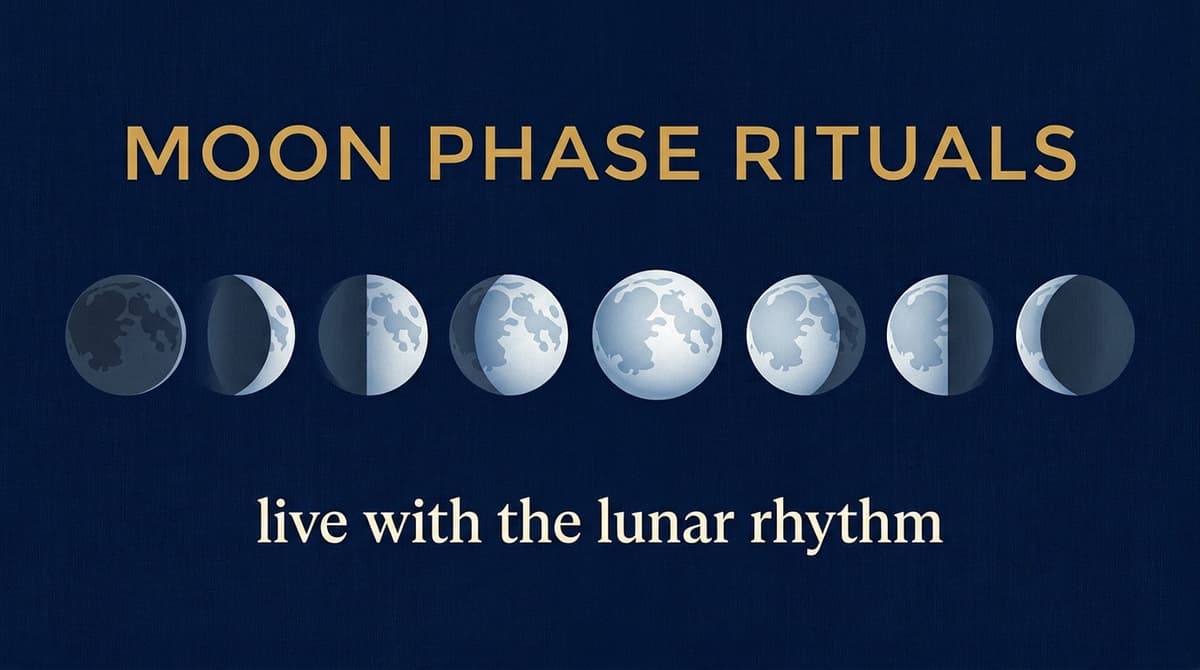
The eight phases of the moon are conventionally named new, waxing crescent, first quarter, waxing gibbous, full, waning gibbous, last quarter and waning crescent. "Waxing" means growing toward full; "waning" means shrinking back toward dark. The four quarter points (new, first quarter, full, last quarter) are the structural markers of the lunation. The four between them (the crescents and gibbouses) are the in-betweens, and statistically this is where you'll find the Moon on most nights, because they each last about three and a half days, while the quarter points themselves are momentary.

Read this list the way a skim-reader actually reads it: find your current phase, read that block, ignore the rest until tomorrow.
New moon
The Moon sits between Earth and Sun, so the side facing us is unlit. Functionally invisible from the ground; the sky is at its darkest. In the lunation rhythm, the new moon is the starting line: a quiet point, low on visible information. Astrologically it's traditionally read as a beginning marker: a moment for noticing what you'd like to set in motion, before anything has yet been set.
Waxing crescent
A thin curve of light on the right edge of the disc (Northern Hemisphere). Days one to roughly seven. Things you noticed at the new moon take on a first visible shape, but are still small enough to abandon without much cost. Often the most useful phase for low-stakes experiments.
First quarter
Half the disc is lit, the right side bright, the left still in shadow. Roughly day seven. Traditionally a phase of friction: the bit of any new project where the initial momentum runs into the first real obstacle, and you decide whether to push through or quietly drop it. Read in the moment, not as a prediction.
Waxing gibbous
More than half lit, growing toward full. Days eight to thirteen. A phase of refining and adjusting; whatever was begun is now visible enough to assess but not yet at its most exposed.
 Checking tonight's phase — a small ritual that doesn't have to mean anything more.
Full moon
The Moon sits opposite the Sun from Earth's point of view, so the side facing us is fully lit. Day fourteen or fifteen. The full moon gets more attention than the other phases combined, partly because it's visually arresting and partly because the cultural noise around it is loud. Traditionally read as a moment of visibility and culmination: whatever you've been building or thinking about tends to be at its most obvious now, including the parts you might have preferred to keep quiet. Not a moment of action so much as a moment of seeing clearly.
Waning gibbous
Past full, still more than half lit. Days fifteen to twenty-one. A phase of integration; whatever the full moon showed you wants to be made sense of rather than acted on.
Last quarter
Half-lit again, left side bright, right in shadow. Day twenty-one or thereabouts. Traditionally a release phase: a moment for letting something go cleanly, often something you'd been holding for longer than was useful.
Waning crescent
A thin sliver of light on the left. Days twenty-two to twenty-nine. The Moon is shrinking back toward invisibility; the reading is one of rest, quiet, and clearing space before the next new moon. Genuinely a low-energy phase, and treating it that way makes the next cycle start better.
Moon phase vs moon sign: not the same thing
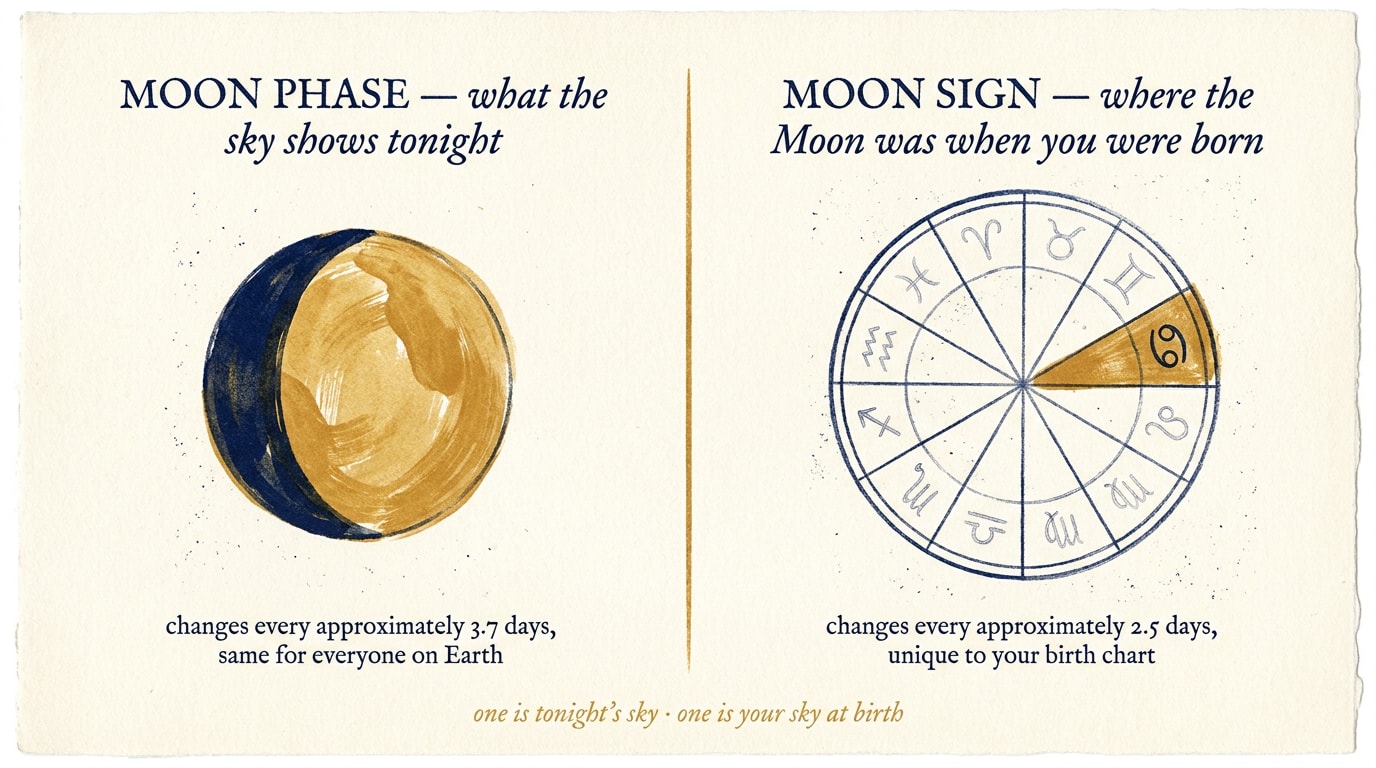
The moon phase and the moon sign are two different pieces of information about the same Moon, and they're often shown side by side in apps without explanation. The phase tells you where the Moon is in its monthly cycle of light. The sign tells you which of the twelve zodiac signs the Moon is currently sitting in, a piece of information that changes every two and a half days, regardless of phase.
| Layer | What it tracks | Cycle length | Where it lives on the chart |
|---|---|---|---|
| Moon phase | Position in the monthly light cycle | 29.5 days | Calculated from Moon-Sun angle |
| Moon sign | Which zodiac sign the Moon is in | About two and a half days per sign | Calculated from the Moon's ecliptic position |
A worked example. Suppose your app tells you "Moon in Pisces, Waxing Gibbous". Two pieces of information, read independently. The waxing gibbous is the phase: refining, growing toward visibility, late in the build-up to full. The Pisces is the sign, telling you the Moon today is moving through the part of the zodiac associated with softness and dreaminess. Read them together and the texture comes through: this month's build-up to full is happening in a quieter, more inward register than it would in, say, a Sagittarius gibbous.
Your natal moon sign — the sign your personal Moon was in when you were born — is yet another thing, and one of the most useful placements in your own chart. If you'd like the longer version, your natal chart explained: a complete beginner's guide walks through it.
What today's phase can (and can't) tell you
A moon phase describes a position in a cycle of light, not a forecast for your week. It can usefully describe the kind of moment we're in collectively, a building phase, a culmination, a release, a quiet period — but it can't tell you the specific outcomes of your week. The Moon does not cause your decisions, your mood or your sleep, and any source telling you otherwise has wandered past what the astronomy or the astrology actually supports.
The full moon and sleep is the cleanest example. There is a long-standing folk claim that people sleep worse around full moons. A 2013 Swiss study by Christian Cajochen found a small effect in a small dataset of 33 volunteers; larger replication studies in the years since have failed to confirm the effect, and the original researchers themselves have published methodological caveats. Researchers are still debating the methodology. The honest position is that the effect is unproven, the cause is unknown if any effect exists, and any blog telling you the full moon "makes" you sleepless is reaching past the evidence.
Phases are usefully read as:
- Rhythm markers — they describe the pacing of the month and let you notice cycles in your own attention, energy and follow-through.
- Reflective prompts — at the new moon you might ask what you'd like to start; at the last quarter, what you'd like to release. The prompt does the work, not the Moon.
- Cultural punctuation — humans have ordered time around lunar cycles for at least five thousand years. There is something to that, even if the something is mostly about us.
They are not:
- Causal forces acting on your life, mood, sleep, fortune or relationships.
- Predictions of specific events.
- Instructions about what you must do on which day.
The difference between a description and a verdict is the whole game.
What to do with tonight's phase
The most useful thing to do with the moon phase of today is to notice it, place it in the broader month, and then carry on. You don't need to do a ritual. You don't need to set seven intentions on cardstock. The reflective use of the cycle is small and quiet, and it gets stronger the less performance you put around it.
A simple pattern, if you'd like one:
- Note the phase when you remember (an app, a weather widget, a glance out the window).
- Ask a one-line question that matches the phase — "what would I begin?" near the new moon, "what's becoming visible?" near the full moon, "what could I let go?" near the last quarter.
- Carry on with your day. Notice, by the next cycle, whether the question keeps showing you the same thing.
If you'd like the longer version, what it looks like to live with the moon as a weekly rhythm, with the full lunation broken into a practice — living by the moon as a weekly rhythm is the companion piece.

What today's phase is for. It's a small marker in a long natural cycle, useful as a prompt, harmless as a curiosity, and dishonest as a forecast. Read it as a small fact about where you are in the month, not a verdict on where you're going.
 One line in a notebook, once a month — often enough.
Questions readers ask
How is the moon phase of today calculated?
The phase is calculated from the angle between the Moon and the Sun as seen from Earth, expressed as a percentage of the Moon's visible disc that is currently lit. A phase calculator uses an astronomical ephemeris (the Swiss Ephemeris is the data standard most professional astrology software relies on) to position the Moon and the Sun to arc-second accuracy, then computes the angle and the illumination. The maths is centuries old; modern software does it in milliseconds. Any reputable moon-phase tool will give you the same answer to within a fraction of a percent.
Does the moon phase change every day?
Yes, slightly. The Moon moves through its full 29.5-day cycle continuously, so the percentage of the disc that is lit shifts every night. The named phases are conventional markers along that continuous cycle, not discrete states. The four quarter points (new, first quarter, full, last quarter) are precise astronomical moments; the four in-between phases (the crescents and gibbouses) each cover about three and a half days. So if your app tells you it's "waxing gibbous" today and tomorrow, it isn't a mistake; the phase name covers a stretch of the cycle.
What's the moon phase tonight?
The fastest UK source is the Royal Observatory Greenwich moon calendar, which gives current phase, percentage of illumination, and the next four quarter dates. Any modern weather app will also show it. If you want a single number for tonight, the percentage of illumination is the simplest. Anything between roughly 45 and 55 per cent is a quarter, near 100 is full, near 0 is new.
Why does the moon phase matter astrologically?
Astrologers read the phase as a marker of pacing within the month, not as a force acting on your week. A new moon is read as a moment of beginning, a full moon as a moment of visibility, the quarters as turning points; the crescents and gibbouses as the slower build and decline between them. The reading is descriptive, not predictive: the phase suggests the kind of moment we're in collectively, not the specific events of your week. It also isn't the same as your moon sign, which is the zodiac sign your Moon sits in (a different and usually more personal piece of information).
A note on what this is. Astrology, as we use it at WowAstro, is a tool for self-reflection and self-understanding, not a method for predicting events, health, financial outcomes, or the course of relationships. The Moon doesn't cause your decisions. Read tonight's phase as a small piece of context about the month, take what's useful, and leave the rest.
If you'd like to see how the moon you were born under fits into your own chart, WowAstro will calculate a free birth chart for you. Date, time and place; takes a couple of minutes. And if you want to apply the chart from there, the step-by-step walkthrough of reading your birth chart takes it forward.
About this article: WowAstro readings combine traditional astrological methodology (Swiss Ephemeris calculations, Hellenistic and modern psychological frameworks) with AI-assisted writing reviewed by Oksana Miatova before publication. For entertainment and self-reflection only — not medical, legal, or financial advice. Full editorial policy at /editorial-standards.
Written by Oksana Miatova, astrologer and writer at WowAstro. Charts and phase calculations use the Swiss Ephemeris, the same astronomical data standard working astrologers and professional software rely on.
Read your own natal chart
A personal AI reading, from £1
⭐ +50 Wow Stars cashback · sign up and get 100 ⭐
Build my chart →Comments
New here? Get −30% off your natal chart
Leave your email and we will send you the promo code WELCOME30. Straight after that you can comment — no passwords, all automatic.
Quick sign-in
Sign in with Telegram — one click.
Or by email (with a gift)
Already have an account? Enter the same email — we'll email you a sign-in link.