The full moon is rising over your kitchen window in Camden. You've just made tea, the light has turned that particular silver, and you've found yourself reaching for your phone — is this why I can't sleep? The first three search results disagree completely. One is from NASA and is about orbital geometry. The other two are selling moon phase rituals that come with a starter pack of crystals.
If you've ever wanted a third answer, somewhere between the physics lecture and the crystal seller, this is that. Moon phase rituals — in the honest sense — are simply the everyday practices people build around the Moon's monthly rhythm of growing and releasing light. No manifestation magic, no causation claims, no abundance attracted on a Tuesday. A moon phase is, plainly, where the Moon sits in its journey around the Earth, measured by how much of its lit face we can see from down here. That's the whole astronomy. What you sensibly do with the observation is the rest of the article.
In short. A moon phase is the shape of the Moon's lit face as we see it from Earth, changing across roughly 29.5 days as the Moon orbits us. The four main phases (new, first quarter, full, last quarter) describe a cycle of light: invisible, half-lit growing, fully lit, half-lit shrinking. Phases are about visibility, not influence. The lunar calendar tracks these phases. A moon sign, which is a different thing entirely, is where the Moon stood when you were born.
What a moon phase actually is
A moon phase is the shape of the Moon's lit half as we see it from Earth, and the shape changes because the Earth, Moon and Sun keep moving relative to each other over the month.
Here's the bit most explainers skip. The Moon doesn't make its own light. The Sun is always lighting one half of it, the same way the Sun lights one half of the Earth; there's no "dark side" that goes dark, just a far side that we, standing on this side, mostly can't see. What does change is the angle from which we watch the lit half. When the Moon sits roughly between us and the Sun, the lit half is pointing away from us, and we get a new moon — invisible. When the Moon sits on the far side of us from the Sun, the lit half is facing us straight on, and we get a full moon, fully visible. In between, the lit half is at an angle, and we get the crescents and the quarters.
One full cycle, from new moon to next new moon, takes about 29.5 days. Astronomers call this a synodic month, which is just shorthand for "one complete round-trip of the Moon's phases as seen from Earth". The number isn't tidy because the Earth is itself moving around the Sun while the Moon is going around us; the Moon has to catch up a little to come back to the same lit-half angle. Hence 29.5, not 28, and hence the slow drift of full-moon dates across the calendar year. If you'd like a more precise version, NASA keeps a thorough plain-English explainer at moon.nasa.gov; the same numbers turn up wherever astronomers do the actual maths.
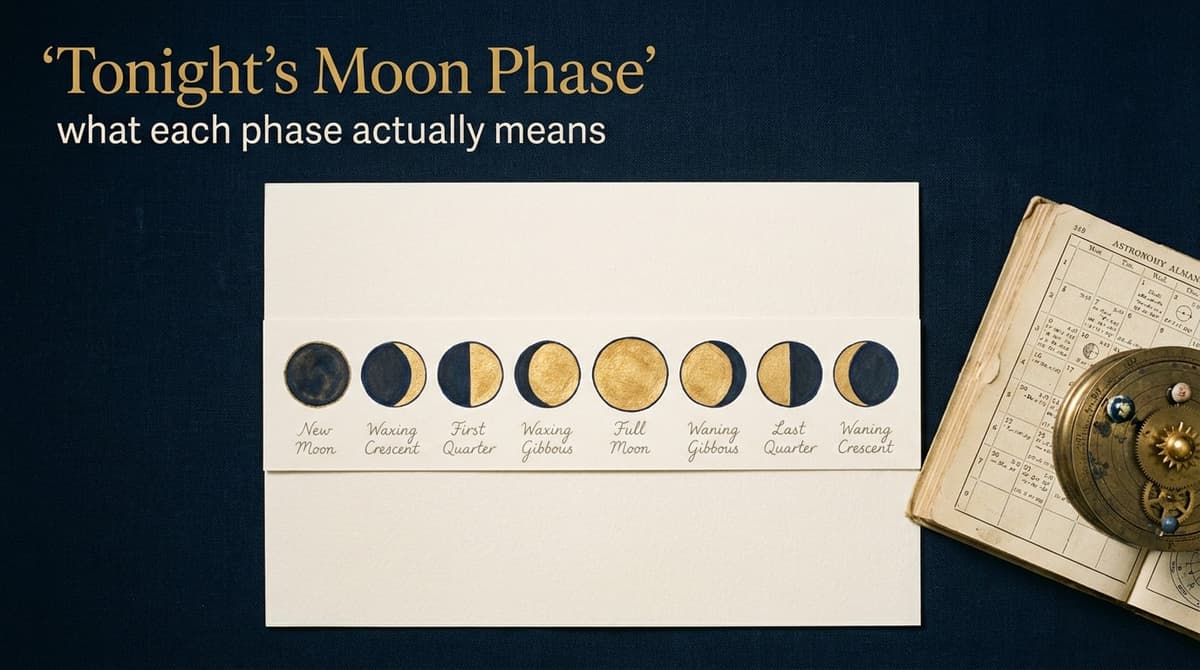
So far this is all geometry. What the Moon's phases describe is visibility — how much of the lit half we can see from where we stand, not anything the Moon is doing to us. The familiar names map onto percentages: 0% lit at the new moon, 50% at the quarters, 100% at the full moon, back to 0%. That's the whole astronomy. The rest of this guide is about what people sensibly do with the observation.
The four big phases as a rhythm
The four main moon phases describe a rhythm of growing and releasing light, and people who pay attention to them tend to use that rhythm as a pacing tool rather than as a forecast.
You might have seen the eight-phase list before: new, waxing crescent, first quarter, waxing gibbous, full, waning gibbous, last quarter, waning crescent. It's technically correct and most professional almanacs include it. For a daily reader it's also a lot to hold in your head. The four major phases (new, first quarter, full, last quarter) give a much cleaner weekly beat, with roughly seven days between each one. The intermediate phases are real but they're transitions, not separate stages. Four is what the old farmer's almanacs tracked for centuries. Eight is mostly a 19th-century astronomical refinement for people who needed more precise observational vocabulary.
The pattern across the four, simplified almost to the point of nursery rhyme, runs: start, push, peak, release. It's a description of a cycle of light, and it works as a description of a cycle of attention because attention also runs in arcs.
New moon: the invisible start
At new moon, the Moon sits between Earth and Sun. Its lit half is pointing away from us, so from down here it's invisible — you'll find it on a phase chart but not in the sky. Traditional lunar calendars across cultures, from the Hebrew and Islamic months to the older agricultural calendars of East Asia, start their month at the new moon. The visible cycle is just beginning.
A practical reading, the one that doesn't promise anything: a new moon is a reasonable place to put a small, regular pause. Ten minutes with a notebook works as well as anything more elaborate. Notice what you'd like to give attention to for the next few weeks, write it down in plain language. This is a journaling prompt, not an instruction to the universe. The intention is for your own attention; whether or not the Moon is interested is genuinely not the point.
First quarter: the half-lit push
About seven days after the new moon, the Moon reaches first quarter — at 90 degrees to the Sun from Earth's point of view, half-lit, visible from mid-afternoon until midnight. The light has been visibly growing for a week. The first quarter is sometimes called the "crisis of action" in older almanacs, which sounds more dramatic than it usually feels; it's the point where whatever you put your attention on at the new moon meets the actual diary. Things that were vague become specific, and resistance shows up where it was going to show up anyway.
A practical reading: check whether the small intention has stayed with you. If it has, good. If it hasn't, that's information about how much room your week actually had, or about whether the intention was the right one. Either way, the half-lit Moon is a reasonable cue to look at it.
Full moon: the visible peak
At full moon, the Earth sits between Moon and Sun. The Moon's lit half is facing us directly, so it appears as a complete disc, and it rises around sunset and stays visible all night. This is the most photographed phase, the one in poems and harvest scenes, the one that people swear keeps them awake.
On that last point, there is a small body of research worth being honest about. A 2013 study from a Swiss sleep lab reported a slight decrease, roughly 20 minutes less sleep duration around the full moon, in a small group of adults sleeping under controlled conditions. Subsequent attempts to replicate the finding produced mixed results: some studies saw a similar small effect, others didn't see it at all. The body of evidence is small and contested. If you sleep worse around full moon, you're not imagining the experience; researchers just haven't been able to pin down a reliable cause. The honest answer is we don't really know. The honest framing is if you notice, notice; if you don't, you haven't missed anything.
A practical reading: a full moon is a reasonable end-of-week check-in. The intention from the new moon, if there was one, has had two weeks to live in the world. What did the world do with it.
Last quarter: the releasing half
About three weeks into the cycle, the Moon reaches last quarter — 270 degrees from the Sun, half-lit on the other side, visible from midnight to mid-morning. The light is now visibly shrinking. Traditional almanacs called this the "release" phase, the natural counterpart to the building first quarter, the point in the cycle where what's not working can be quietly put down.
A practical reading: notice what you'd like to take off the list before the next cycle starts. Not as a vow, more as a sentence in a notebook. The cycle is closing; the next one is a week away.
In short. Four phases, four practical functions: new (notice and set an attention), first quarter (push and check resistance), full (review what's been going on), last quarter (release what isn't working). The eight-phase version of all this is for astronomers and detailed almanacs — you don't need it to live a month.
Moon signs and moon phases: the bit most people conflate
A moon sign and a moon phase are not the same thing, and confusing them is the most common mistake new readers make.
A moon sign is the zodiac sign the Moon was passing through at the exact moment you were born. It's part of your birth chart, calculated from your date, time and place of birth, and it doesn't change. A moon phase is the visible shape of the Moon today, calculated from the calendar date alone, and it changes constantly. The two come from different questions: one is who you are, the other is when you are.
Here's the difference in a single table.
| Moon sign | Moon phase | |
|---|---|---|
| What it describes | The zodiac sign the Moon was in when you were born | The shape of the Moon's lit face today |
| Data needed | Date, time and place of your birth | Today's date |
| How often it changes | Never; it's fixed for life | Continuously; the Moon changes phase visibly day to day, and sign every two to three days |
| What it's for | Reading a part of your inner life | Tracking a cycle in the sky |
A worked example, in case it helps. If your birth chart has the Moon in Pisces and today is a full moon in Cancer, those are two separate facts about two different things. You always have a Pisces Moon, that's where the Moon stood the day you arrived. Everyone is currently watching a Cancer full moon, that's where the Moon stands tonight. The two have nothing to do with each other except that the same astronomical object is involved.
If you don't know your moon sign, you can work it out for free in a minute or two from a chart calculator; most need only your date, time and city of birth. WowAstro's free birth chart is one option among several.
Your natal Moon sign: what it actually says
Your natal Moon sign describes your emotional reflex: how you recover from a hard day, what you need around you to feel at home, what comes out when you've stopped performing.
In Western astrology, the Moon is the inner, less public part of the chart. It pairs with the Sun (your conscious sense of self, the thing you'd describe in a job interview) and the Ascendant (the surface you present to people in the first few minutes). The three together are the standard "start here" trio. Reading the rest of your chart — Sun, Moon, Rising and the planets together — is a longer business; we've written a step-by-step walkthrough on how to read your birth chart if the Moon sign is just one piece you want in context.
The 12 Moon signs sort, at a high level, by element. Water Moons (Cancer, Scorpio, Pisces) tend to recover by going inward: quiet rooms, slow time, water nearby helps. Fire Moons (Aries, Leo, Sagittarius) recover by going outward: movement, a walk, a project, talking to someone bracing. Earth Moons (Taurus, Virgo, Capricorn) recover through the body and the senses: food cooked properly, a tidy room, a long bath, the same dog walked at the same time. Air Moons (Gemini, Libra, Aquarius) recover by thinking it through out loud: conversation, ideally with someone who'll let them finish.
That's a high-level sketch, not a horoscope. The specific notes of a Pisces Moon vs a Scorpio Moon (both water, both private, both not what you'd guess from the outside) are the kind of thing a full birth-chart read fills in. What matters here is the principle: your moon sign is part of the permanent furniture of you, and knowing it is more useful in the long run than memorising tonight's phase, because the moon sign doesn't change while the phase resets every four weeks.
A practical lunar week, in real time
To make the four-phase rhythm less abstract, here's one cycle as it might actually look. Imagine the new moon falls on a Monday evening in late October, say, the Monday after the clocks change. By the following Tuesday, the Moon will be one week along: a waxing crescent growing toward first quarter. Across the week in between, this is what you'd see and what someone using the moon as a rhythm cue might do with it.
On the Monday evening of the new moon, the Moon is invisible — sitting between us and the Sun with its lit half pointing away. Nothing to see in the sky, which is the point. The cycle is starting under the skin, not over your head. The practice, if you want one, is ten minutes with a notebook and a pen. Write down one thing you'd like to give attention to in the next month. Plain language, no grand vow. Close the notebook.
Tuesday and Wednesday belong to the waxing crescent. A sliver of Moon appears just after sunset, low in the western sky, the rest of the disc still dark. Worth stepping outside to see if you're somewhere it's visible. Nothing else is required of you. If the intention from Monday wandered off in the first 48 hours, that's data about how busy your week is, not a failure of intention.
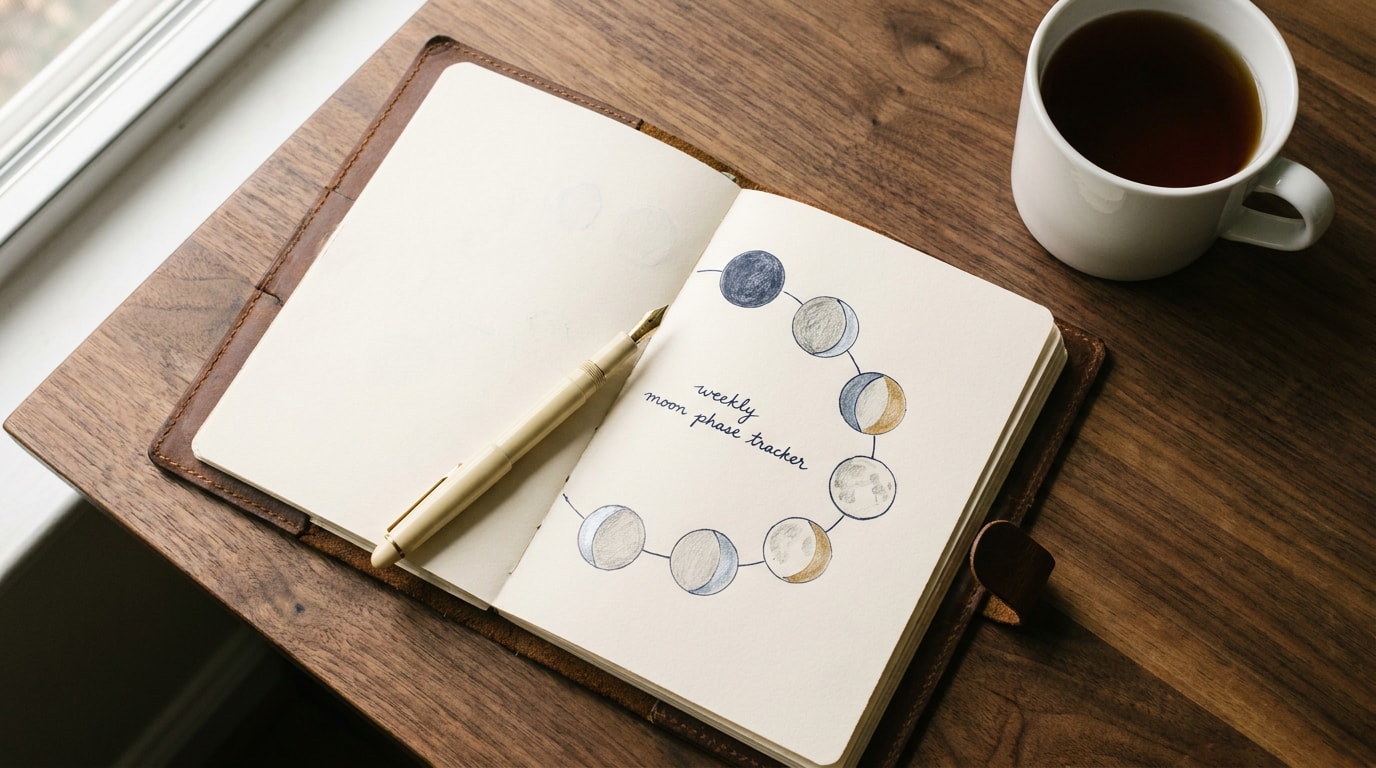 A week's worth of phases, drawn in the margin.
By Thursday, the Moon is approaching first quarter and is now visibly half-lit, sitting up in the evening sky from about teatime onward. This is the cycle's friction point — the place where whatever you wrote down on Monday meets the reality of the actual week. The old almanacs called it a "crisis of action", which is overstated for most weeks. Mostly it's the day you notice you haven't done the thing.
Friday and Saturday hold the waxing gibbous. The Moon is brighter, fuller, visible most of the night. The light is now obviously approaching peak. A small mid-week check works here: what's been working since Monday, what hasn't. Two sentences in a notebook is fine.
Sunday brings the Moon nearly complete, rising at sunset, dominating the sky from dusk onward. The week behind you is visible the way the Moon is visible: most of it lit, easy to take in at a glance. If you want to sit with it for ten minutes, this is the night.
You'll have noticed the practice doesn't ask the Moon for anything. It uses the Moon's reliable cycle as a pacing cue — a way of marking time that runs at a different speed from the working week. If none of this maps to your week, the Moon is doing nothing wrong and neither are you; lunar attention is a tool that suits some weeks and not others.
If keeping an eye on the lunar week without doing the maths yourself is the point, our free daily lunar forecast tells you which phase the Moon is in today and which zodiac sign it's currently passing through. It's a glance, not a reading.
The honest take: what the Moon doesn't do
The Moon is a rhythm marker, not a cause. It doesn't make things happen to you, attract outcomes to you, or determine your week.
Most popular lunar-living advice is built on causation claims of one kind or another: set intentions at the new moon and the universe responds, ride the full moon for the relationship, harness Mercury for the promotion. Some of it sounds like metaphor that's been stretched until it broke; some of it sounds like marketing. None of it has stood up well to anyone who's looked for evidence. Studies on the Moon's behavioural effects (sleep, mood, hospital admission rates, accident rates, even the famous "more babies are born at full moon" claim) have come back mixed at best and mostly null. The 2013 Swiss sleep paper mentioned earlier is one of the few small positive results; subsequent attempts to replicate it produced as many no-effect results as confirmations. Larger reviews of the lunar/behaviour literature describe the evidence as "limited and inconsistent". That's a fair summary.
If a website tells you the new moon will reliably deliver your pay rise, the safest question is what they're selling. The honest version of lunar attention is more modest, and more interesting. The cycle is real, the phases are reliable, the practice of pausing four times a month is genuinely useful as a piece of self-noticing. The bit that's reliably valuable is the attention you bring to the pause, not what the Moon is doing in response. The Moon doesn't need to be doing anything for the pause to count.
There's a small relief in this version, which is why people end up here. The Moon doesn't have plans for you. It isn't taking notes. It's a large reliable scenery that loops past your window every month, and you can use it as a clock, a journal prompt or a slow piece of weather. The value of the practice is the practice. The Moon, kindly, is just there.
Questions readers ask
What does each moon phase mean?
Each of the four main moon phases describes a different stage of lit visibility from Earth. The new moon is invisible (0% lit, the Moon's lit half is pointing away from us). The first quarter is half-lit and growing. The full moon is fully lit (100%, the Moon's lit half is facing us straight on). The last quarter is half-lit and shrinking. In traditional almanacs the four were grouped, loosely, into start, push, peak and release: a description of a cycle of light that some people find useful as a description of a cycle of attention. The phases describe how the Moon looks from where we stand, not what the Moon is doing to us.
What's my moon sign?
Your moon sign is the zodiac sign the Moon was passing through at the exact moment you were born. It's calculated from your date, time and place of birth, and it stays the same for life. Unlike a sun sign, you can't work it out from your birthday alone, because the Moon changes signs every two or three days. If you were born close to when the Moon was changing signs, even an hour's difference can matter. A free chart calculator that asks for date, time and city will tell you which sign you fell into.
What's a void-of-course moon?
The Moon is called void-of-course in the period between its last major aspect to another planet and its entry into a new zodiac sign. It happens roughly once every two or three days and can last anywhere from a few minutes to most of a day. Traditional Western astrology treats void-of-course periods as not ideal for starting new things, on the grounds that initiatives begun then tend to fizzle. As with most lunar advice, the safest reading is: notice the dip in momentum if it happens to you; don't reorganise your life around it. A good daily lunar tracker will mark void-of-course hours so you don't have to calculate them.
Can I really plan by the moon?
You can use the moon as a rhythm cue, in the same way you might use the seasons or the working week, and many people find that genuinely useful. What you can't reasonably do is rely on the moon to make plans work. The astronomy is real, the four-phase cycle is reliable, and the practice of pausing four times a month is good for the kind of self-noticing that gets lost in a busy diary. The cause-and-effect claim, that the Moon delivers outcomes if you address it correctly, isn't supported by the evidence and isn't what working astrologers tend to say either. Treat the lunar calendar like a calendar, not a vending machine, and you'll get the use out of it that it actually has.
The lunar calendar's quietest function, if it has one, is to make you look up. Four times a month it offers a reliable cue to lift your attention from the diary to the sky for ten minutes. That's worth doing. Whether or not anything in your week shifts as a result is a separate question, and an honest answer to it is probably not in any way you can measure. The looking up is the part that pays.
Read the wider context in our guide to your full birth chart
A note on what this is. Astrology, as we use it at WowAstro, is a tool for self-reflection and self-understanding, not a method for predicting events, health, financial outcomes or weather. The astronomy in this piece (phase percentages, the 29.5-day synodic month, illumination geometry) is verifiable in any current reference, and has been cross-checked against NASA and the Swiss Ephemeris. The framing of phases as rhythm rather than cause is an editorial position, taken because it's the version of lunar practice that we think holds up.
About this article: WowAstro readings combine traditional astrological methodology (Swiss Ephemeris calculations, Hellenistic and modern psychological frameworks) with AI-assisted writing reviewed by Oksana Miatova before publication. For entertainment and self-reflection only — not medical, legal, or financial advice. Full editorial policy at /editorial-standards.
Written by Oksana Miatova, astrologer and writer at WowAstro. Charts calculated using the Swiss Ephemeris.
Read your own natal chart
A personal AI reading, from £1
⭐ +50 Wow Stars cashback · sign up and get 100 ⭐
Build my chart →Comments
New here? Get −30% off your natal chart
Leave your email and we will send you the promo code WELCOME30. Straight after that you can comment — no passwords, all automatic.
Quick sign-in
Sign in with Telegram — one click.
Or by email (with a gift)
Already have an account? Enter the same email — we'll email you a sign-in link.