You opened the year-ahead tab on some free astrology site, and forty-seven paragraphs unfurled. Saturn is squaring something. Pluto is doing something to your eighth house. Mercury will go retrograde four times. By paragraph six you had quietly closed the tab.
Here's the working astrologer's open secret: most transits don't matter. A handful do, and learning which is which turns a year-ahead read from a noise wall into a quiet two-line note about what to notice.
In short. Astrology transits are the planets moving today, read against your birth chart (the planets frozen at the moment you were born). Most transits are background. A small number actually matter — chiefly the outer-planet cycles (Saturn, Jupiter, Pluto) and eclipses that touch your personal planets. Transits describe recurring weather, not fixed events.
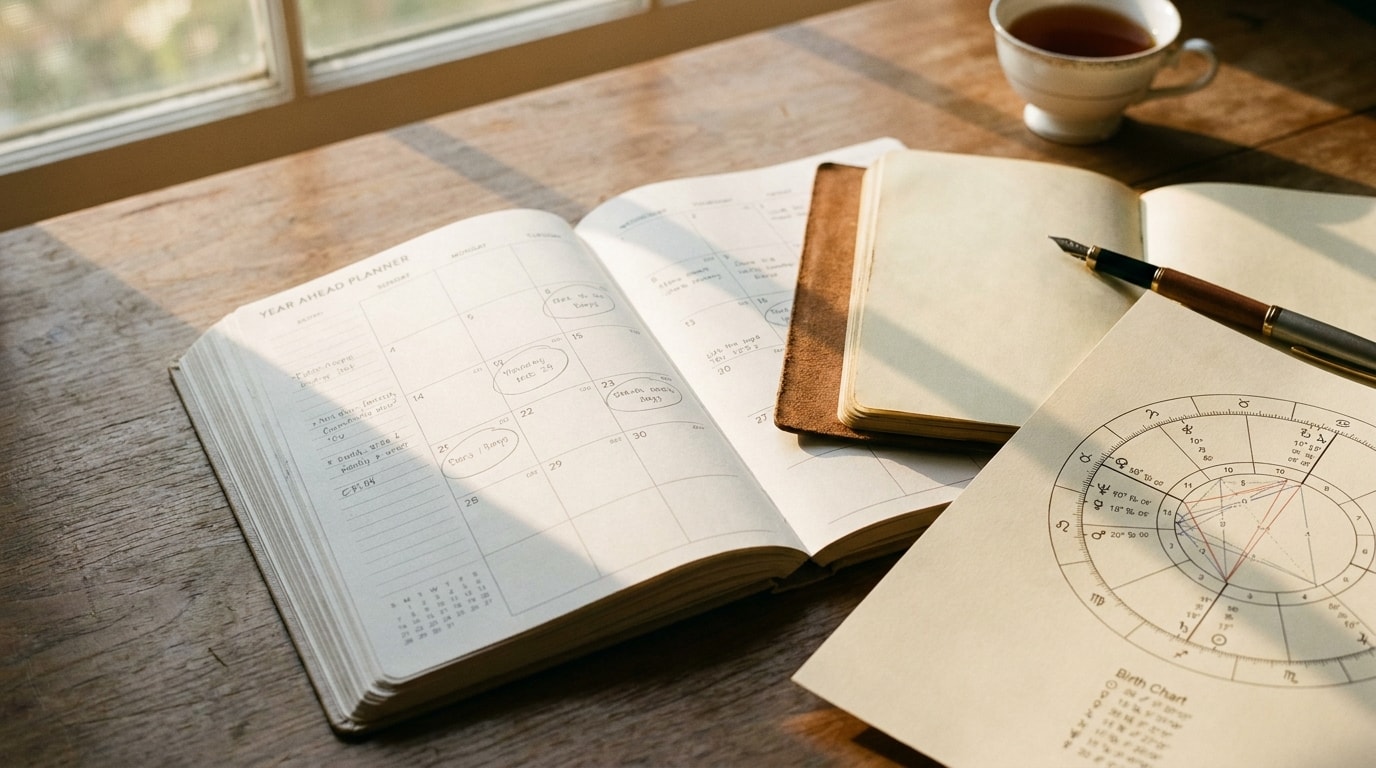 A year ahead, written down in two lines at a time.
What a transit actually is
A transit is a planet moving in today's sky, read against your birth chart — the snapshot of where the planets sat at the minute you were born. Astrologers overlay one onto the other to see how today's planets touch your natal ones. WowAstro calculates these using the Swiss Ephemeris, the same astronomical data working astrologers rely on. Your birth chart describes who you are; transits describe what the sky is doing to (or with) you right now.
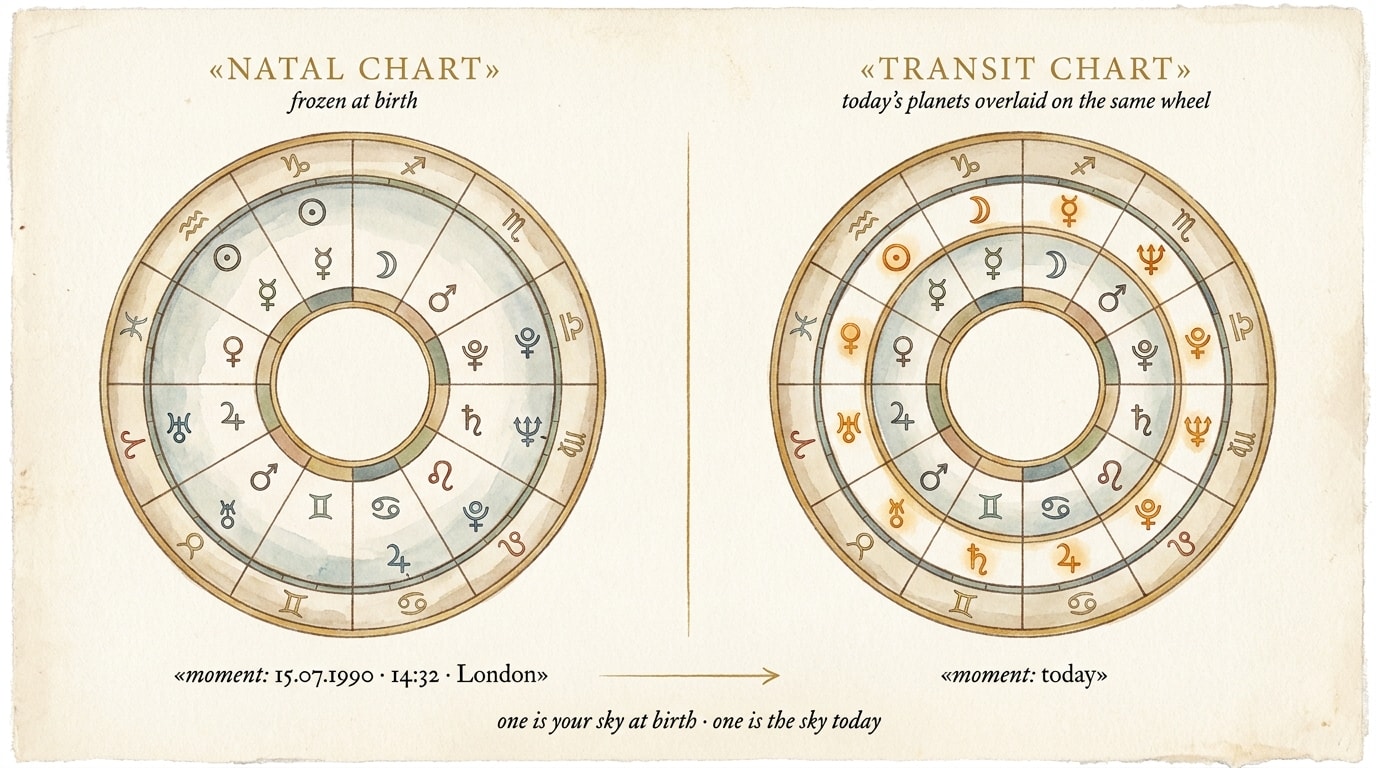
A useful metaphor. Your birth chart is a photograph. It does not change. Every planet sits where it sat at the minute you arrived. The transit chart is the sky today — those same planets are still moving, of course, in their long orbits around the Sun. An astrologer reads transits by laying today's sky over the photograph and noticing where they meet. When today's Saturn crosses the exact spot your natal Sun sits, that's a Saturn–Sun transit, and it tends to surface in a recognisable way.
The whole grammar of this is just that meeting — moving planet today, fixed planet at birth, the angle between them. Everything else is detail.
Why most transits don't matter
At any given moment there are dozens of transits active on your chart, and the vast majority are background hum. Only a small set actually surface as something you'd notice in a year. Working astrologers filter with three questions: how slow is the moving planet, how hard is the angle, and what's being hit. Knowing the filters lets you ignore around ninety-five per cent of the noise and read the five per cent that matter.
The first filter is speed. Outer planets (Saturn, Uranus, Neptune, Pluto) stay on a single degree of the zodiac for months, sometimes years in Pluto's case. Saturn takes roughly two and a half years to cross a sign and about seventy-three days on a single degree. That gives a transit time to bed in and surface as something you actually notice. Mercury, by contrast, can cross your Sun in an afternoon. By the morning it's gone.
The second filter is angle. A transit creates a particular geometric relationship with the planet it's hitting. Hard angles produce friction, which is what you feel: squares of around 90°, conjunctions sitting right on top, oppositions exactly 180° away. Soft angles are gentler and often unnoticed: trines of around 120°, sextiles of around 60°. As a rule, the harder ones are the ones you remember in retrospect.
The third filter is what's being hit. A transit landing on your Sun, Moon, Rising sign, or one of your personal planets (Mercury, Venus, Mars) is felt. A transit landing on something obscure (a minor arabic point, your natal Pluto, which is itself a slow-moving point) usually isn't.
A transit becomes a five-per-cent transit when it answers favourably to all three filters: a slow planet, a hard angle, hitting a personal point. That's the one worth reading.
The two-transit rule. Out of the active transits in any given month, pick the two strongest by the three filters. Notice those two. Treat the rest as background.
The five transits worth knowing
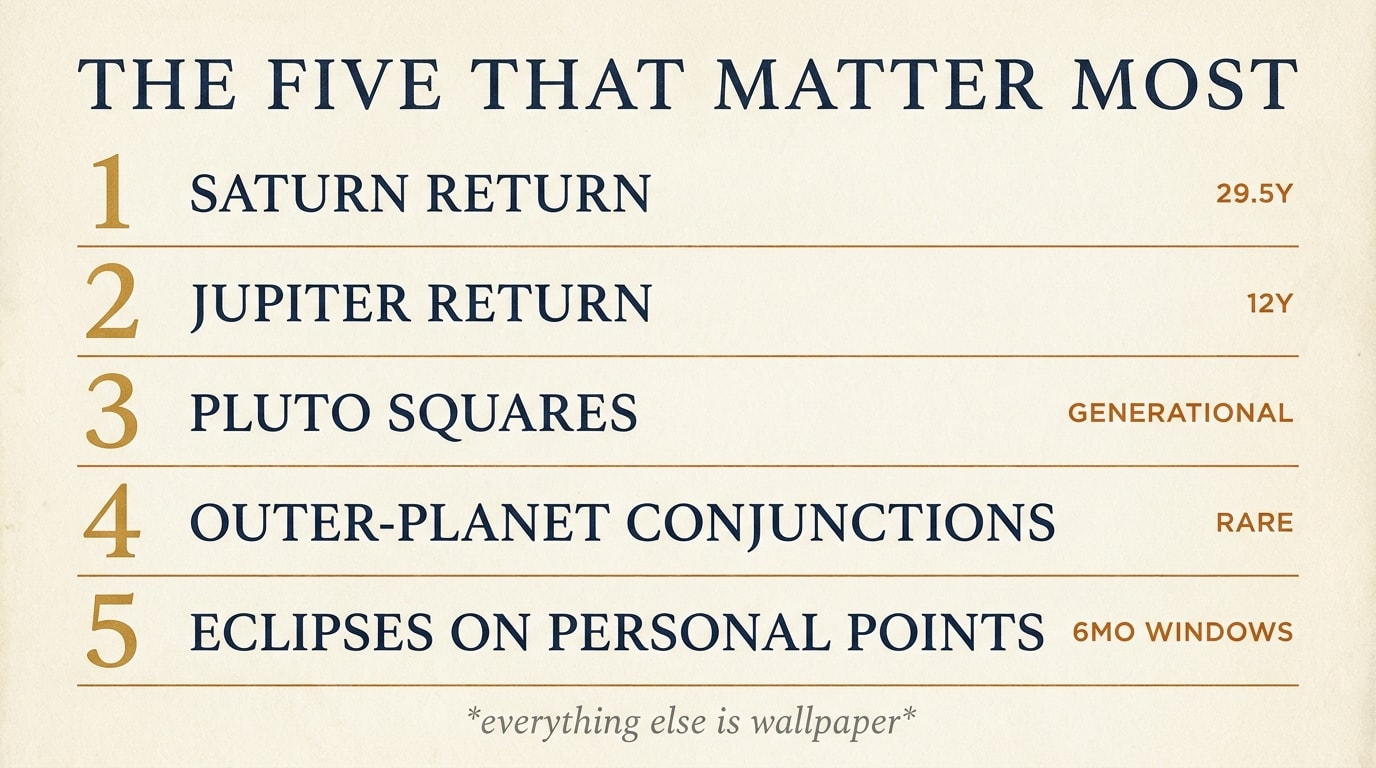
Five transits are worth learning before any others, because each marks a long-cycle window with broadly predictable themes. They're the ones working astrologers reach for first when a client asks what's happening in a year ahead. If you only ever track five transits in your life, track these.
1. Saturn return
Saturn takes roughly twenty-nine and a half years to orbit the Sun, which means it returns to the exact spot it sat in your birth chart about once every twenty-nine and a half years. The first hits around age twenty-eight to thirty, the second around fifty-eight to sixty. It's the classic "who am I becoming" pressure window. Old structures that were built without your real consent, careers, relationships, identities, tend to start creaking. The pressure isn't punishment; it's the part where you're asked to choose what you actually want to be responsible for.
Saturn returns don't arrive on a single date and leave the next morning. Saturn typically crosses its natal position three times across about a year and a half, as it moves direct, then retrograde back over the same degree, then direct again. The window has a beginning, a deepening, and a final pass. The biggest mistake people make is reading the first crossing as the whole thing; the second and third often surface what the first only hinted at.
What this gives you to notice: where life feels heavier, more serious, more "earn it", and what you'd choose to keep if you had to rebuild from scratch.
2. Jupiter return
Jupiter orbits in roughly twelve years, returning to its natal spot at ages twelve, twenty-four, thirty-six, forty-eight, sixty. These are the "room to expand" windows: opportunities, doors opening, a sense of forward motion. The catch is that Jupiter inflates whatever it touches, so a Jupiter return can amplify a bad habit just as easily as a good one. It's not a free win; it's a magnifier. A Jupiter return is best read as a year to be deliberate about what you'd like to grow, rather than a year that hands you growth ready-made.
What this gives you to notice: what you'd genuinely like to grow, before something less considered grows by accident.
3. Pluto square to a personal planet
Pluto moves so slowly that a single Pluto transit can stretch across three or four years. It particularly matters when Pluto squares one of your personal planets: your Sun, Moon, Mercury, Venus, or Mars. The square is a long, slow restructuring pressure. People who are in one tend to describe it as a thing that's been "going on for ages now". Generations get the same Pluto transits at similar ages, which is why entire cohorts go through the same upheaval window at the same point in life.
What this gives you to notice: the part of you that's quietly being remade, and whether you're cooperating with the rebuild or resisting it.
4. Outer-planet conjunction to a personal point
When Saturn, Uranus, Neptune, or Pluto sits directly on your Sun, Moon, or Rising sign, the transit becomes a once-in-a-lifetime weight. These are rare (Uranus on your Sun, for instance, happens once every eighty-four years), and they tend to be remembered as a defining stretch of life. Different outer planet, different flavour: Saturn slows and demands, Uranus disrupts and frees, Neptune dissolves and softens, Pluto restructures.
What this gives you to notice: the part of life that's clearly under the planet's signature, and a willingness to be changed by it rather than fight to stay the same.
5. Eclipses on personal points
A solar or lunar eclipse landing within about five degrees of your Sun, Moon, Ascendant, or Midheaven is the rare short transit that punches above its weight. The eclipse itself takes a weekend, but the chapter it opens often runs for six months. Eclipses tend to mark beginnings and endings — sudden chapter turns rather than slow pressure windows.
What this gives you to notice: a thing that ends or begins around the eclipse window, and a willingness to let the timing make sense in retrospect rather than in the moment.
Retrogrades, and what Mercury retrograde actually is
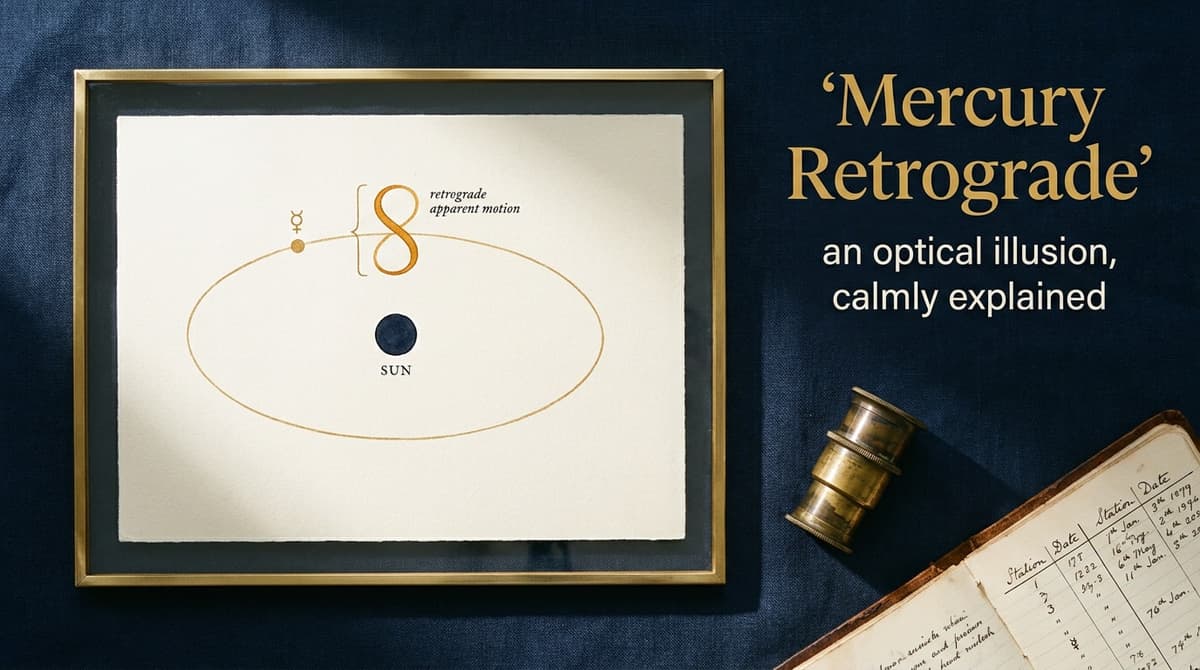
A retrograde is an optical illusion. Mercury isn't moving backwards. From Earth's vantage point it just looks that way, because the Earth and Mercury are travelling at different speeds around the Sun and we're observing one moving object from another moving object. The closer planet briefly appears to overtake the further one, then to slip behind it, in the same way a fast car overtaking a slower one on a motorway briefly looks (to the slower car) as though it's going backwards. NASA has a good explainer of the geometry if you want to see it drawn.
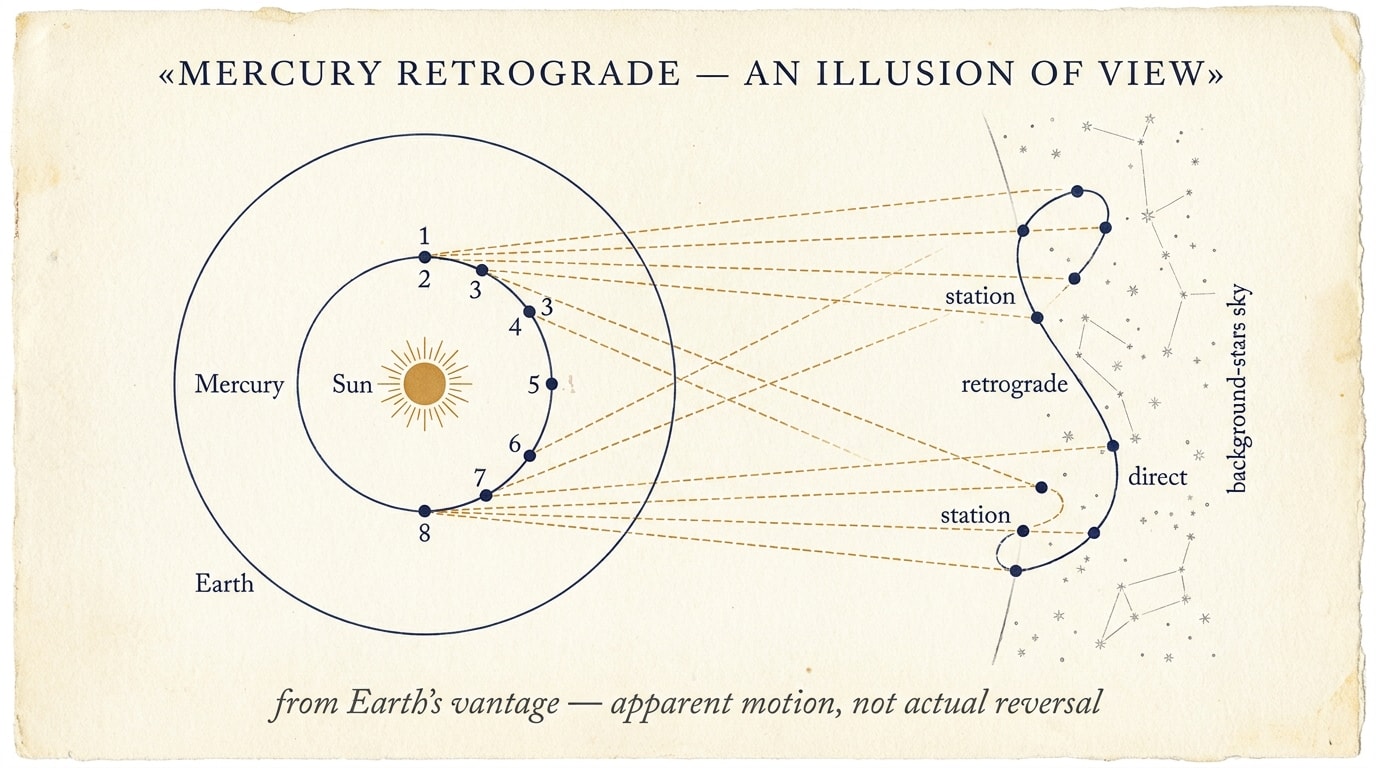
Mercury retrogrades about three or four times a year, for roughly three weeks each time. It's famous mostly because it's frequent. In a typical year a person will spend nine to twelve weeks "under" a Mercury retrograde, which gives plenty of chances to notice it and plenty of room to blame it.
The second reason it's famous is the symbolic territory it covers. In the astrological system Mercury is associated with thinking, talking, writing, technology, short journeys, contracts, deals; in other words, with most of the small machinery of a modern day. When the symbol for the small machinery appears to go backwards, the small machinery is felt to wobble. That's the cultural shorthand. Whether the wobble is actually higher during the retrograde window is empirically harder to defend; what's defensible is that the window is read as a time to slow the small machinery down.
 Sky as recurring weather, not headline news.
Astrologically the window is read as review, revise, revisit — the three R's. Things from the recent past resurface. Old conversations want to be reopened. Decisions made just before the retrograde tend to need adjustment. It's not a bad window; it's just the wrong one for irreversible new starts. Send the contract afterwards. Read it now.
Mercury gets blamed for traffic jams, ex-text messages, and the time the printer stopped working. The printer always stops working.
Other retrogrades that actually matter more
| Planet(s) | Frequency | Duration | What tends to surface |
|---|---|---|---|
| Venus | Roughly every 18 months | Around 6 weeks | Old patterns in love and money; old partners reappear, old aesthetic preferences feel relevant again |
| Mars | Roughly every 26 months | 2–3 months | Where your drive has been pointed in the wrong direction |
| Outer planets (Jupiter, Saturn, Uranus, Neptune, Pluto) | Several months each year | Several months | Retrograde windows largely indistinguishable from direct ones — background hum |
A worked example: what one astrological year looks like
Most transit guides explain the symbols and leave you to assemble them. Let's actually do it, with one chart, one year, end to end. The chart is illustrative (not a real person, just a plausible combination) and the timing is conceptual rather than dated to a calendar year. The point is the rhythm.
Sun in Capricorn. Moon in Pisces. Rising in Gemini. Mercury in Capricorn near the natal Sun. Mars in late Cancer. Saturn in early Aries in the natal chart (long ago, fixed forever in the photograph).
Q1. A solar eclipse falls at three degrees of Gemini, within a few degrees of this person's Rising sign. The eclipse takes a weekend; the chapter it opens runs for months. Around the same window, transiting Saturn (which is currently moving slowly through Aries) sits at twenty-two degrees Aries — closing in on a square to natal Mercury and natal Sun in Capricorn. This is the year's first "matters" transit, slow planet, hard angle, hitting a personal point. The Saturn–Mercury and Saturn–Sun squares will exact across roughly six months. The eclipse signals the start of something on the visible-identity front; the Saturn squares will quietly press it into a serious shape.
Q2. Mercury retrograde in Pisces lands across the natal Moon. Mercury retrograde is usually background hum, but a Mercury retrograde directly across a personal planet is slightly louder than usual — old conversations from the inner life resurface for three weeks. Nothing dramatic. Just a window where the inner weather is more exposed than the rest of the year.
Q3. Transiting Jupiter has been moving slowly through Cancer and now returns to its natal position, hitting the natal Mars. Jupiter return windows are the "room to expand" transits — but Jupiter on Mars amplifies drive. For this person, the question of the Q3 Jupiter return is what they choose to push forward, given Saturn has spent half the year saying "earn it" first.
Q4. Pluto, having moved slowly into Aquarius, sits at around five degrees Aquarius and makes a slow sextile to natal Saturn in early Aries. Sextiles are soft, opportunity-shaped angles rather than friction-shaped ones. This is a gentle, mostly-background window where some of the harder restructuring of the year settles. It will exact and recede over a year and a half, hardly noticed in the daily sense, present in the longer one.
What does the working astrologer say to this person about their year? Roughly this: two transits really matter, the Saturn squares from Q1 through Q3, and the Jupiter return in Q3. Everything else is real but secondary. Read those two. Sit with what they're asking. The eclipse, the Mercury retrograde, the Pluto sextile — useful context, not headline news.
Notice what's not in this read. No specific predictions. No "you'll meet someone in May", no "watch out for the third week of October". Just two windows of weather and two questions the weather invites you to sit with. That's the whole shape of a year read this way.
What transits don't do. They don't name the date you'll meet someone or get the job. They don't predict an event in your life. They describe recurring weather — when it tends to rain, when it tends to clear, when the wind is from the east. What you do with the weather is still entirely yours.
 Two transits at a time, written down and noticed.
How to use this: the two-transit rule
Pick two transits at most to track at any one time, and notice them rather than perform them. Most charts have many active transits in any given month, and trying to track all of them is the route straight back to the forty-seven-paragraph paralysis you closed the tab on. The working method is small: a "month-ahead" note, two lines long, that says what the strongest active transit is, what the second-strongest is, and one question each gives you to sit with. Used this way, transits become a quiet rhythm rather than a daily horoscope.
Four steps.
First, get your birth chart calculated accurately. The Rising sign moves on every couple of hours, and house positions can't be drawn without a precise birth time, so this matters more than people realise.
Second, run a transit report for the period you're curious about. Free transit calculators (AstroSeek, for one) will give you a list of active transits for a date.
Third, from the report, pick the two strongest transits using the three filters from earlier: slow planet, hard angle, hitting a personal point. If only one transit clears all three filters, that's your only one. Don't manufacture a second.
Fourth, write the "what this gives me to notice" line for each — not a forecast of events, but the question or pattern the transit hands you. That's the working note. Done.
If you'd rather have someone do this collation for you in a single sitting, WowAstro's year-ahead reading will pull the matters-most transits for your chart and write the working notes. Same method; you skip the calculator.
Questions readers ask
What is a transit chart?
A transit chart is a chart that overlays today's planets on top of your natal chart, showing which transits are currently active against your birth positions. Free transit calculators will draw it for any date, past or future — so you can look at last winter as easily as next summer. The transit chart isn't separate from your birth chart; it's a second layer read against it.
Are retrogrades bad?
No. Retrograde is a recurring three-week window of review, revise, revisit — old material resurfaces, decisions get a second look, the right moves are inward rather than outward. Mercury retrograde gets disproportionate blame because it's frequent and tied to communication and tech in the symbolic system. It's not a punishment. It's a window with a different shape from the rest of the year.
How long does a transit last?
It depends on the planet's speed. A Mercury transit takes hours to a few days. A Sun transit takes about a day. A Mars transit takes a week or two. A Jupiter transit can stretch across several weeks. A Saturn transit lasts months, often hitting the same point three times across a year as Saturn moves direct, retrograde, then direct again. A Pluto transit can last years.
Do I need a professional to read my transits, or can I read this myself?
Both are reasonable. Tracking two transits yourself, using this article and a free transit report, is genuinely doable for someone curious enough to put in an evening. A working astrologer's year-ahead reading is the same method, done in one sitting, with the symbols and their interactions already pulled together for you. The right choice is partly time and partly taste; people who want the rhythm without the bookkeeping tend to take the reading.
Read the wider context in our guide to your full birth chart
A note on what this is. Astrology, as we use it at WowAstro, is a tool for self-reflection and self-understanding, not a method for predicting events, health, or financial outcomes. Transits describe recurring weather, not fate. Read the descriptions as questions, take what's useful, leave the rest.
About this article: WowAstro readings combine traditional astrological methodology (Swiss Ephemeris calculations, Hellenistic and modern psychological frameworks) with AI-assisted writing reviewed by Oksana Miatova before publication. For entertainment and self-reflection only — not medical, legal, or financial advice. Full editorial policy at /editorial-standards.
Written by Oksana Miatova, astrologer and writer at WowAstro. Transits calculated using the Swiss Ephemeris, the same astronomical data working astrologers use.
Read your own natal chart
A personal AI reading, from £1
⭐ +50 Wow Stars cashback · sign up and get 100 ⭐
Build my chart →Comments
New here? Get −30% off your natal chart
Leave your email and we will send you the promo code WELCOME30. Straight after that you can comment — no passwords, all automatic.
Quick sign-in
Sign in with Telegram — one click.
Or by email (with a gift)
Already have an account? Enter the same email — we'll email you a sign-in link.