Maya wants to book the bigger gallery space for her opening. Sam has run the numbers and wants to stay with the smaller one. The disagreement isn't loud. It isn't even, strictly, about the gallery — it's about the print run, who gets named first on the marketing copy, whether the studio rent should go up to take a better unit. She's a Leo. He's a Taurus. The conversation always settles in the same place: neither of them is wrong, and neither of them is moving.
The first thing the internet says about this is that they're "two stubborn signs and good luck to you". The second site gives the pair a 42% match score with no source. The third calls it "the lion and the bull" and lets the metaphor do the work. Every one of those paragraphs looked at a single placement — your Sun sign — and made a relationship out of it. A real chart has ten planets in it, and asking whether leo and taurus compatible the way the sun-sign tables ask it is like grading a holiday by the colour of the airport carpet. Some signal, yes. Not enough to build on.
This guide explains the part the listicles never name: why the Leo-Taurus Sun pair is a square, what it means that both signs are fixed, and what the rest of the chart usually does with the hold-pattern.
In short. Leo Sun and Taurus Sun describe one tenth of one chart each — a temperament pair, not a relationship verdict. The hold-pattern is structural, because Leo and Taurus are both fixed signs sitting 90° apart on the wheel — an aspect astrologers call a square. The Sun (Leo's ruler) and Venus (Taurus's ruler) give the pair a less famous polarity than Venus-Mars: one wants recognition for what they express, the other for what they value. The same mechanism that makes compromise slow makes the relationship unusually durable when it works. The Moon, Venus, Mars and Rising placements do most of the rest.
 The conversation that keeps coming back in a different costume.
Why the Leo-Taurus listicles can't agree
Three different sites can give you opposite verdicts on the same Sun pair because each one is reading one planet out of ten and calling the result a relationship.
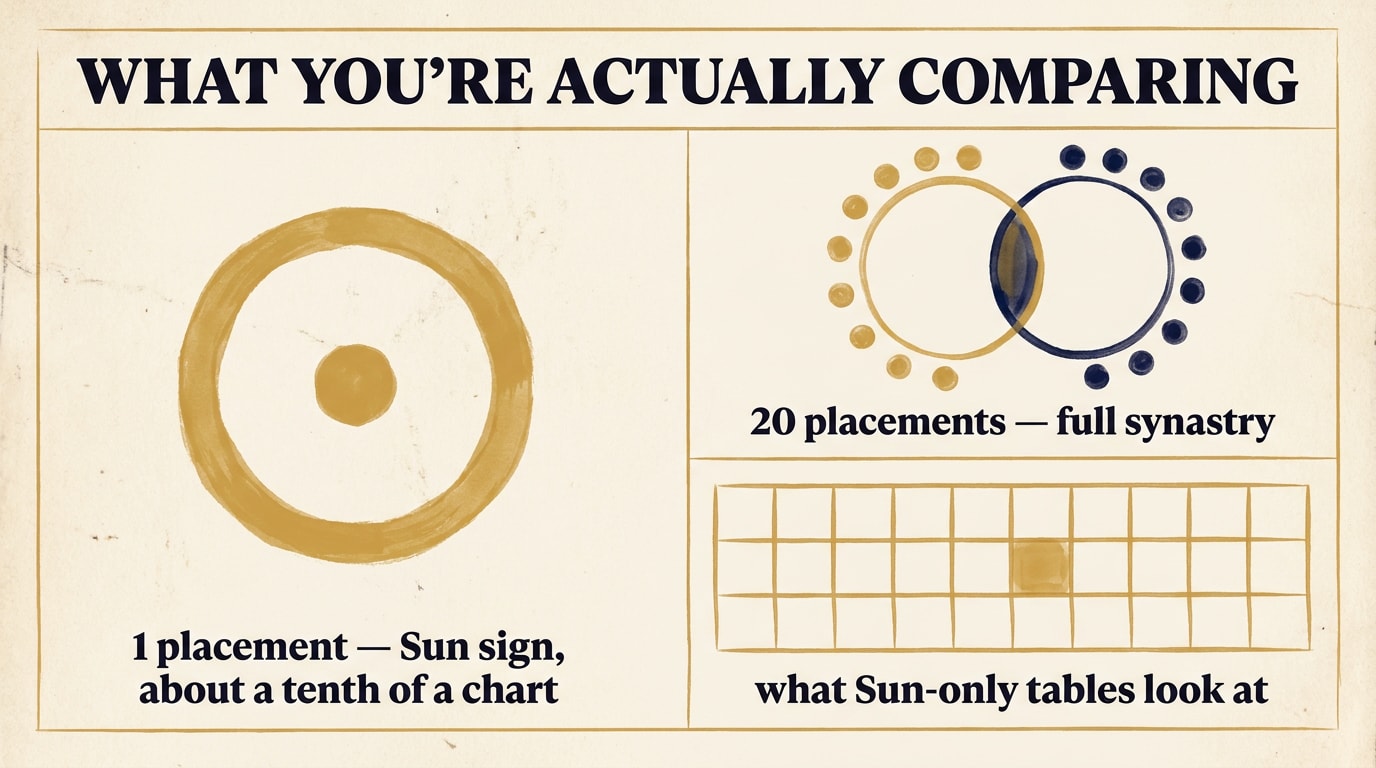
Your Sun sign covers roughly one tenth of one chart. Compatibility actually runs across ten planets in your chart and ten in your partner's, plus the angles between them. When one site calls Leo-Taurus "fixed-loyal love" and another "two stubborn signs and good luck", each writer is internally consistent — they're reading the same single data point and filling in the rest with mood.
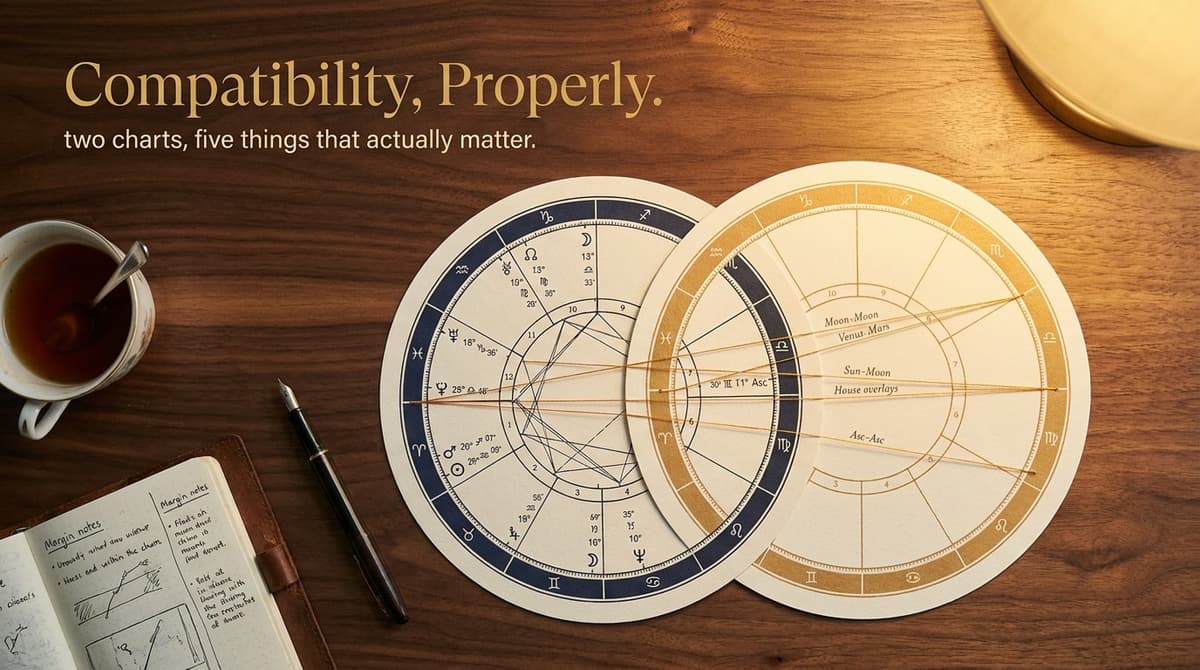
Synastry, the proper word for astrological compatibility, which we cover in the full guide, works differently. It overlays both birth charts and looks at how each planet in one chart relates to each planet in the other. Same two people, twenty placements of information, instead of one cell of a 12×12 grid.
| Sun-sign verdict | Synastry | |
|---|---|---|
| What it compares | One Sun sign vs one Sun sign | Ten planets in each chart, plus angles |
| Data needed | Two dates of birth | Date, time and city of birth for both |
| Houses (areas of life) | Not used | Used: where one person's planets land in the other's life |
So when this guide talks about whether leo and taurus compatibility holds up in practice, the Sun pair is the entry point, not the conclusion.
What the Sun pair actually describes
The Leo-Taurus Sun pair describes a particular temperament friction around recognition and value, not a relationship outcome.
Leo is a Sun-ruled, fixed-fire sign: warm, expressive, oriented toward being seen, holds the centre of a room without especially meaning to. The Leo Sun tends to want recognition for what they create, and reads quiet acknowledgement as quiet dismissal. Call it the Stage — the placement that wants to be seen.
Taurus is a Venus-ruled, fixed-earth sign: steady, sensual, oriented toward worth, holds onto what they value with the patient grip of someone who knows how long the thing took to build. The Taurus Sun tends to want recognition for what they keep, and protects what they've worked to put together. Call it the Vault — the placement that wants to keep.
What this pair shares is less obvious than the difference. Both placements want recognition. Both hold their ground. Both are wired for the long game rather than the quick win. Where they part company is on what kind of recognition counts. Leo wants it to come from the room — the audience, the public eye, the warm acknowledgement of being seen. Taurus wants it to come from the work itself — the thing built, kept, valued in its own right, regardless of who happens to be watching.
That single placement reliably predicts a particular rhythm of disagreement — the spending conversation, the credit conversation, the bigger-or-smaller-gallery conversation — and a particular mutual respect once both stop trying to convert the other. It doesn't predict whether you're compatible. That sits in the rest of the chart.
The fixed-square (90°): what two-fixed-signs actually does
Leo and Taurus sit 90° apart on the zodiac wheel, which means the Sun pair forms an aspect astrologers call a square. Both signs are fixed, which is the bit the listicles miss.
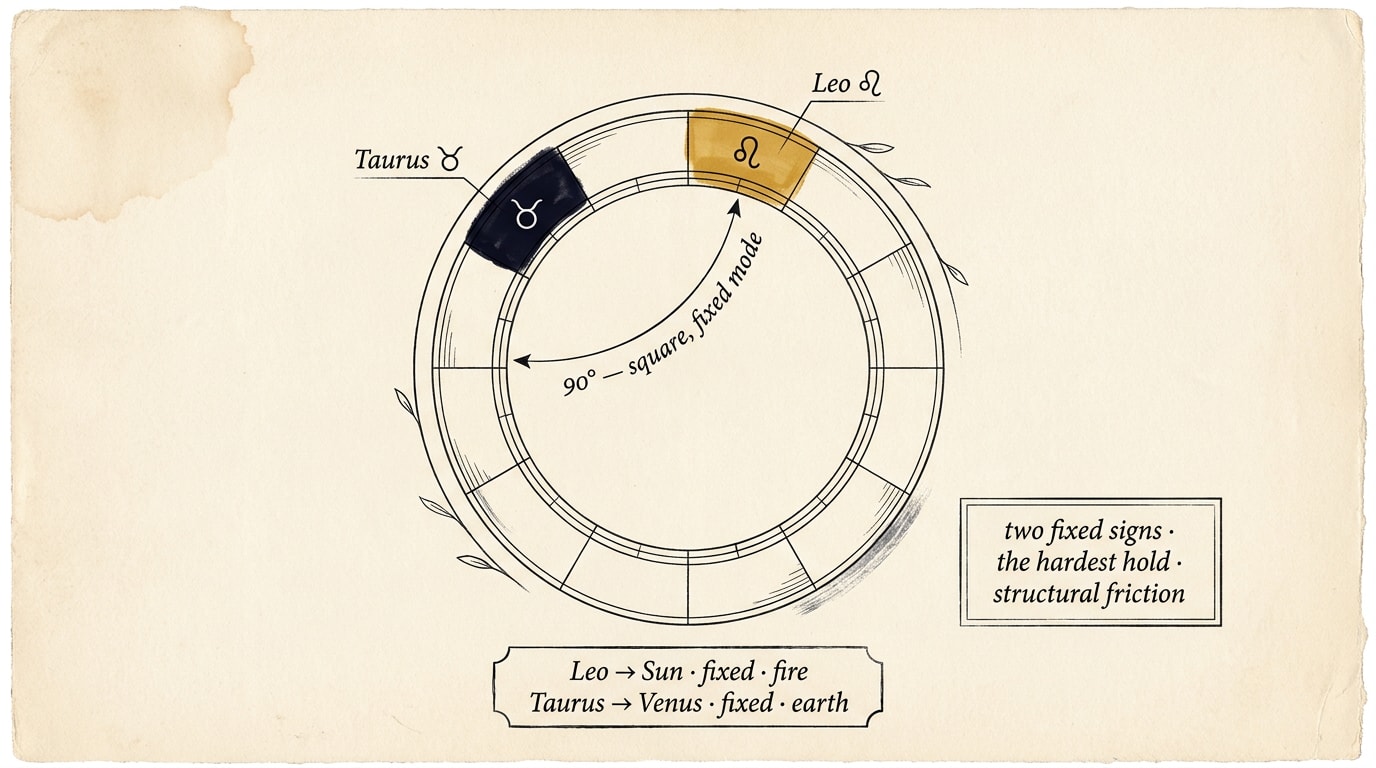
A square is an angle of around 90° between two placements — what you get when two signs share modality but oppose elements. Leo-Taurus is the fixed-fire-versus-fixed-earth case. It's the friction aspect, traditionally: the place where two energies meet at the kind of angle that resists easy resolution. In synastry it usually describes where the couple keeps meeting structural disagreement — but worked through, it's also where the relationship gets its spine. (For comparison, the Leo-Aquarius pair is a 180° opposition, not a 90° square, which is a different shape of difficulty.)
Fixed-square is the hardest version of square, because both partners are wired to hold rather than adjust. In astrology, the twelve signs divide into three modes — cardinal (initiators), fixed (holders), and mutable (adjusters). Leo holds. Taurus holds. Neither one is built to be the first to move; both wait for the other to step back, and both are willing to wait a long time. The work isn't to be less stubborn — fixed-mode astrology means you're not going to be. The work is to recognise that whoever moves first is moving on principle, not weakness.
 The quiet hour after a small disagreement.
If neither of you ever picks up the phone first, by the way, you're doing fixed-square astrology correctly. Now please someone start a conversation. The shift that helps Leo-Taurus couples in practice is small and unromantic: whoever picks up the phone first isn't losing. It's not a concession; it's a skill that fixed-mode people have to learn deliberately because nothing about their wiring teaches it for free.
Worked through, the fixed-square is also the engineering reason this pair tends to last. Once both have stopped expecting the other to fold, they discover that two people who refuse to drift can build something neither would build alone. None of this is in the sun-sign tables, because the sun-sign tables don't measure modes at all.
Where the listicles are right, and where they're wrong
The Leo-Taurus clichés are a mix of accurate temperament reading and recycled stereotype. Here's the honest sorting, one cliché at a time.
| Cliché | Status | What's actually going on |
|---|---|---|
| "Two stubborn signs" | ✅ Mostly true | Fixed-mode mechanism. Both signs are wired to hold rather than adjust. |
| "Lion and Bull, big drama" | ❌ Zoomorphic filler | Sign archetypes aren't animal personalities; the metaphor is decoration. |
| "Both love luxury" | ⚠️ Partly | Taurus loves the worth of a thing (Venus rulership). Leo loves recognition for it (Sun rulership). Different appetites for the same surface. |
| "Taurus calms Leo down" | ❌ Sometimes | Calming-influence is a Moon-Moon question, not a Sun trait. Plenty of Taurus Suns are more agitated than the Leo opposite them. |
| "Leo brings the fun, Taurus brings the security" | ⚠️ Listicle-friendly half-truth | The structural reality is more interesting — both bring stability; the fight is over which kind. |
| "42% match" (or any percentage) | ❌ Made up | No real chart math produces a single compatibility percentage. The number is decoration. |
| "Doomed because both fixed" | ❌ Wrong direction | The same mechanism that makes compromise slow makes the relationship durable when it works. |
The rule: when a listicle promises a verdict or a number, it's reading one placement and dressing it up. When it describes a quality without promising an outcome, it's closer to honest.
A worked example: Maya and Sam
Two people, made up for the sake of explanation, both with the famous Sun pair. The rest of the chart is what makes them recognisable as a couple.
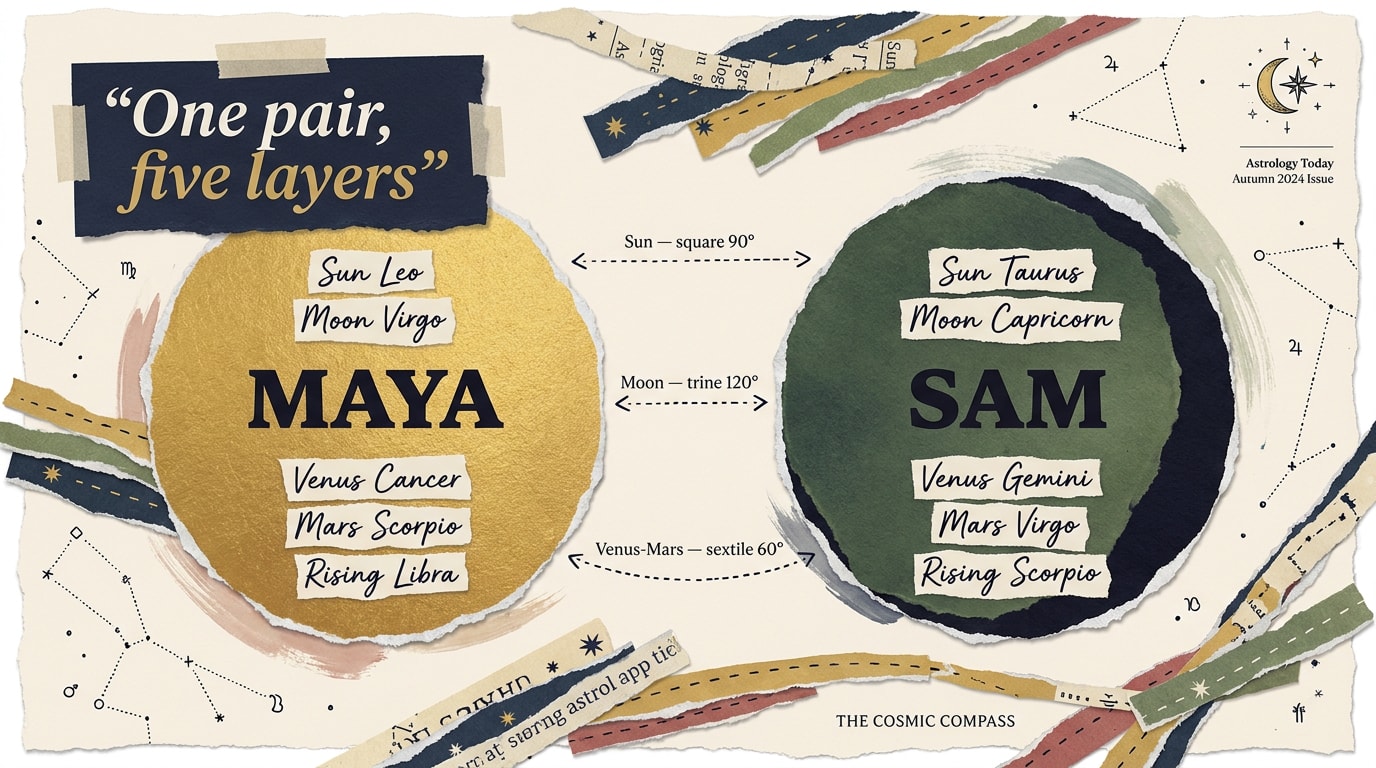
Maya the Leo: Sun in Leo, Moon in Virgo, Venus in Cancer, Mars in Scorpio, Rising in Libra. Sam the Taurus: Sun in Taurus, Moon in Capricorn, Venus in Gemini, Mars in Virgo, Rising in Scorpio.
Start with the Suns. Leo square Taurus is the fixed-square the rest of this guide has been about: two holders, neither moving, the recognition-and-value polarity. Each one carries a side the other isn't doing. The risk is the easy projection of "you'll be the one who keeps the books, so I won't have to" or "you'll be the one who runs the room, so I won't have to". The reward, when both stay responsible for their own end of the axis, is a relationship with unusual range.
Now the Moons. Virgo Moon meeting Capricorn Moon by trine is a quieter, daily-life harmony point that does a lot of the work the headline Sun-Sun square can't. Both Moons are earth, both are practical, both like a plan that does what it said it would do. On a Tuesday evening when the Sun-square is irritating both of them, the Moon-trine is the bit that lets them sit at the same table and read in silence without it being a problem. This is the placement that lets the harder aspects cool down rather than escalate.
Venus to Mars, more reassuringly. Maya's Cancer Venus meeting Sam's Virgo Mars is a soft, useful chemistry: sextile by sign, water-earth, both signs interested in care that gets shown rather than declared. She expresses affection through warmth and remembered detail; he expresses it through quietly fixing the thing she mentioned twice she'd been meaning to. The attraction expresses itself through usefulness rather than dramatics — exactly the kind of chemistry that survives into year five.
House overlays do the rest. Maya's Leo Sun falls in Sam's tenth house, the house of public role and career. Being with her has changed how he shows up professionally — he's more visible, takes more credit for the work he's quietly been doing for years. Sam's Taurus Sun falls in Maya's eighth house, the house of shared resources and financial intimacy. Being with him has changed how she relates to money — she's slower, more careful, more interested in what's worth keeping. Ascendants: Libra Rising meeting Scorpio Rising sit semisextile, which is to say their first-impression speeds don't match. She reads graceful and warm; he reads private and watchful. Recognition is not instant. Familiarity has to earn it, and once earned, it's both surprised and pleased to be there.
What this read tells us. A Leo-Taurus pair with this synastry has a real engine. The Sun-Sun square gives them the shared friction to negotiate. The Moon-Moon trine gives them the daily harmony that lets them keep negotiating. The Venus-Mars sextile gives them a steady chemistry that means they actually want to stay in the room together. The house overlays — tenth for him reading her as career-shaper, eighth for her finding herself changed financially — give the relationship two clear purposes. None of this is "compatible" or "incompatible". It's the shape of a particular relationship.
How to know if your Leo-Taurus is working
The difference between a healthy Leo-Taurus pairing and a splintering one isn't the square itself — it's whether both partners can name what each one is fighting for. Splintering tends to happen when each insists that their own version of recognition is the right one. The Leo partner reads Taurus's head-down focus on the work as a refusal to be impressed. The Taurus partner reads Leo's pull toward the audience as theatre rather than work. Both are missing the same point — they're both fighting for recognition for what they value, just from opposite ends.
Healing happens when both notice they're arguing about the same thing. The Leo partner stops reading "head down on the spreadsheet" as "doesn't care about my work", and starts reading it as "is doing the work that makes my work possible". The Taurus partner stops reading "wants the bigger gallery" as "vanity" and starts reading it as "knows what scale this work needs". Couples in the long form of this pair tend to say the same line in different words: we still annoy each other in exactly the way we did at the start, but we've stopped expecting that to mean we don't fit. The test isn't friction; it's whether the friction stays the question, or starts feeling like the answer.
If you'd like to see this on your own charts rather than an illustrative pair, WowAstro will run a full synastry for both of you using the Swiss Ephemeris, the same astronomical data working astrologers use. Five pounds, a few minutes, both sets of birth data.
 The calm of co-finished work.
Questions readers ask
Are Leo and Taurus compatible?
The Sun pair on its own can't answer that. What it tells you is that the pair carries a structural fixed-square (90°) that shows up as a recurring hold-pattern around what counts as recognition — Leo from the room, Taurus from the work. Whether two specific people are compatible depends on the rest of both charts: the Moons, the Venuses, the Mars placements, the house overlays. Plenty of Leo-Taurus couples build durable relationships precisely because both signs commit when they commit. Plenty of Leo-Leo couples don't.
Why are Leo and Taurus so stubborn?
Both signs are fixed, which in astrology is the mode built for holding ground rather than adjusting. Cardinal signs initiate; mutable signs adapt; fixed signs sit. A fixed-fixed pair shares the same mode and so the same tendency to wait for the other to move first. The signs sit 90° apart on the wheel — an aspect called a square. Two-fixed-signs-at-square is the hardest geometry for compromise in synastry, because neither end is wired to yield. It's not a personality flaw; it's the engineering.
Do Leo and Taurus argue a lot?
The arguments tend to be less frequent than in mixed-mode pairs, but longer. Fixed-mode partners are slow to escalate but also slow to step back, so a disagreement can keep returning in a different costume for weeks. The Leo-Taurus argument doesn't usually look like shouting; it looks like the same conversation surfacing every six weeks until both partners agree what they're actually fighting for. Worked through, the pattern becomes the relationship's spine rather than its weather.
Should I worry about the square between Leo and Taurus?
No, not on its own. A square in synastry describes a structural friction — somewhere the two partners' default operating systems pull against each other rather than along with each other. Worked through, squares often become the engine of a long partnership, because they keep both people honest about what each is bringing. The aspect to worry about isn't the square itself; it's a square both partners have stopped talking about, where the difference has hardened into a wall instead of a conversation.
A note on what this is. Astrology, as we use it at WowAstro, is a tool for self-reflection and self-understanding, not a method for predicting events, health, financial outcomes or whether a relationship will last. Read a synastry chart as a description of a dynamic — take what's useful, leave the rest.
Written by Oksana Miatova, astrologer and writer at WowAstro. Charts calculated using the Swiss Ephemeris, the same astronomical data working astrologers use.
See what your charts say about each other
A personal AI synastry reading — not a sun-sign table, but an analysis of both natal charts across 8 areas of the relationship
Comments
New here? Get −30% off your natal chart
Leave your email and we will send you the promo code WELCOME30. Straight after that you can comment — no passwords, all automatic.
Quick sign-in
Sign in with Telegram — one click.
Or by email (with a gift)
Already have an account? Enter the same email — we'll email you a sign-in link.