It's a Wednesday lunchtime, café near the office. Maya, queueing at the till, is texting a friend about Sam — fellow journalist, fellow byline on the long investigation they've been running for six weeks. Long meetings, late edits, the kind of working intimacy that creeps in without anyone naming it. The friend, who knows her, writes back: "isn't Scorpio terrible for Gemini?". Maya opens a tab while the queue shuffles. The first site calls it a hard match. The second says opposites attract. The third blames mind games. Two minutes, three verdicts, none of them useful.
Here's the honest version. The friction between Gemini and Scorpio is real, but the listicles are blaming personality for what's actually geometry. The two signs sit roughly a hundred and fifty degrees apart on the zodiac, an angle astrologers call a quincunx — an adjustment aspect, less famous than the square or the opposition and asking for a different kind of work from both signs. The pairing is structurally awkward for a reason that has nothing to do with either of you personally. What the awkwardness is asking of both of you is a particular kind of translation, and the rest of this piece is about what that translation looks like.
In short. Gemini and Scorpio sit 150° apart on the zodiac — an aspect called a quincunx, which describes an adjustment to make rather than a verdict to read. The friction the listicles blame on "opposites" is really a register-gap between Mercury (Gemini's wiring) and Pluto (Scorpio's). Whether the pairing grows depends, as always, on what sits lower in both charts.
 The question that came in by text.
What the compatibility sites get right (and what they leave out)
The hard-match framing is half-true. Gemini and Scorpio really do sit at an awkward angle: no shared element, no shared mode, no obvious bridge. What the framing leaves out is the aspect's name, the mechanism behind it, and the kind of relationships it tends to produce when both people stop treating it as a personality problem.
Your Sun sign is roughly one tenth of your chart. The Sun describes your basic sense of self, but the rest of the chart describes the rest of you: how you handle a long silence, what makes you feel safe, who you become when you stop performing for the room. Two people can have a difficult Sun-sign click on paper and an easy underlying climate in practice. The opposite happens too. Synastry — the proper word for compatibility, used by working astrologers, takes both whole charts, ten planets each, and reads the dynamic between them. It tells a far more useful story than any Sun-sign table.
If you want to know what each sign means as an individual, the twelve zodiac signs explained covers the personal traits side. This piece is about what happens between Gemini and Scorpio in particular.
The quincunx, named
Gemini and Scorpio sit roughly a hundred and fifty degrees apart on the zodiac. In astrology, the angular distance between two points is called an aspect, and an aspect of about 150 degrees is called a quincunx — sometimes inconjunct.
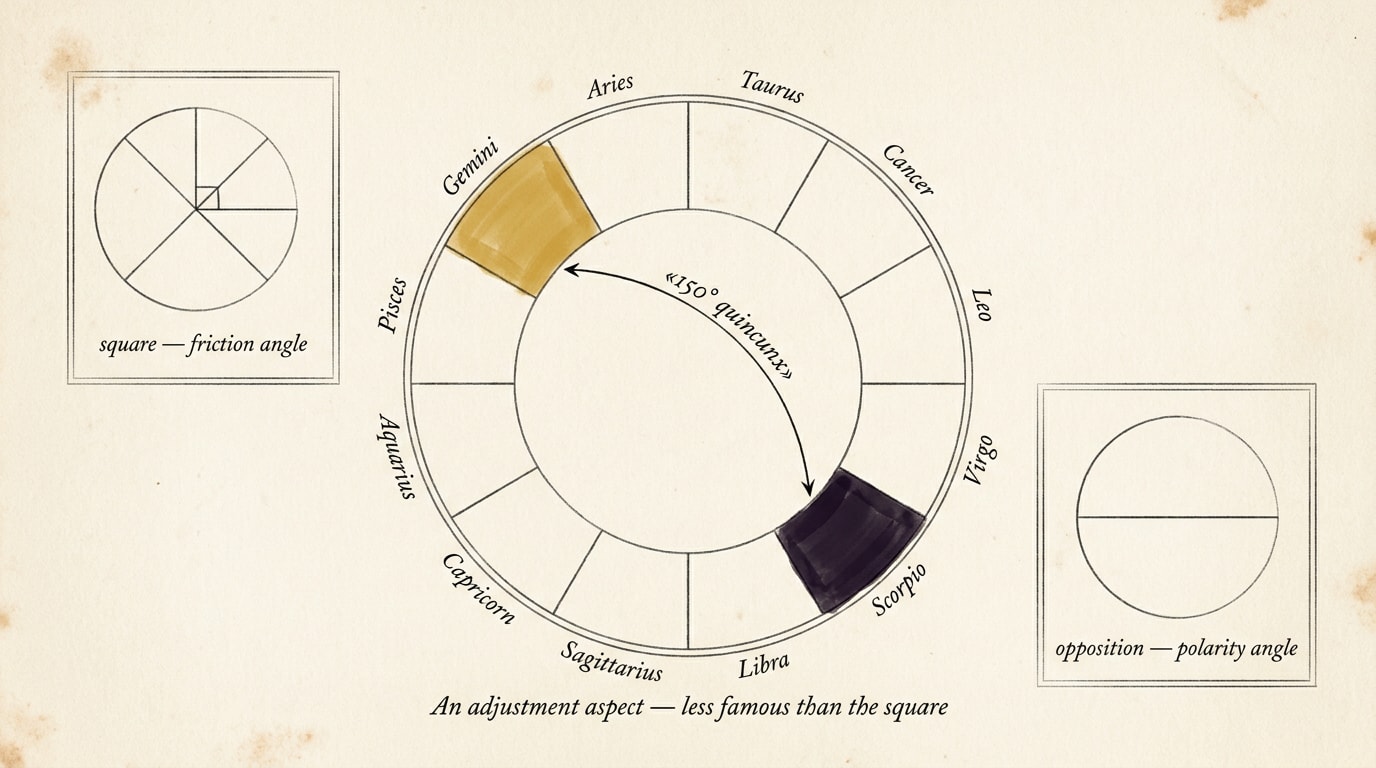
A quincunx isn't a square (90 degrees, the friction angle) and it isn't an opposition (180 degrees, two signs facing each other). It sits between, but with a different shape from either: close enough to feel constant, too far apart for a square's clean tension, too short for an opposition's mirroring polarity. The textbook description is "adjustment": two points with nothing in common, asked by their position on the wheel to coexist anyway. The work the pair does is less confrontation and less balance, more translation.
The thing nobody quite says is that this geometry is impersonal. The awkwardness in a Gemini-Scorpio pairing isn't because Gemini is too flighty or Scorpio too heavy. It's because two points 150 degrees apart in a circle produce a particular kind of mismatch wherever they appear. Quincunx pairings tend not to glide; they tend to learn each other through patient, ongoing adjustment.
Mercury and Pluto — two operating systems
Gemini is ruled by Mercury, the planet of language, mind and the moving parts of thought. Scorpio is ruled by Pluto, the planet of depth, focus and slow-burning intensity. Two operating systems for processing the same situation.
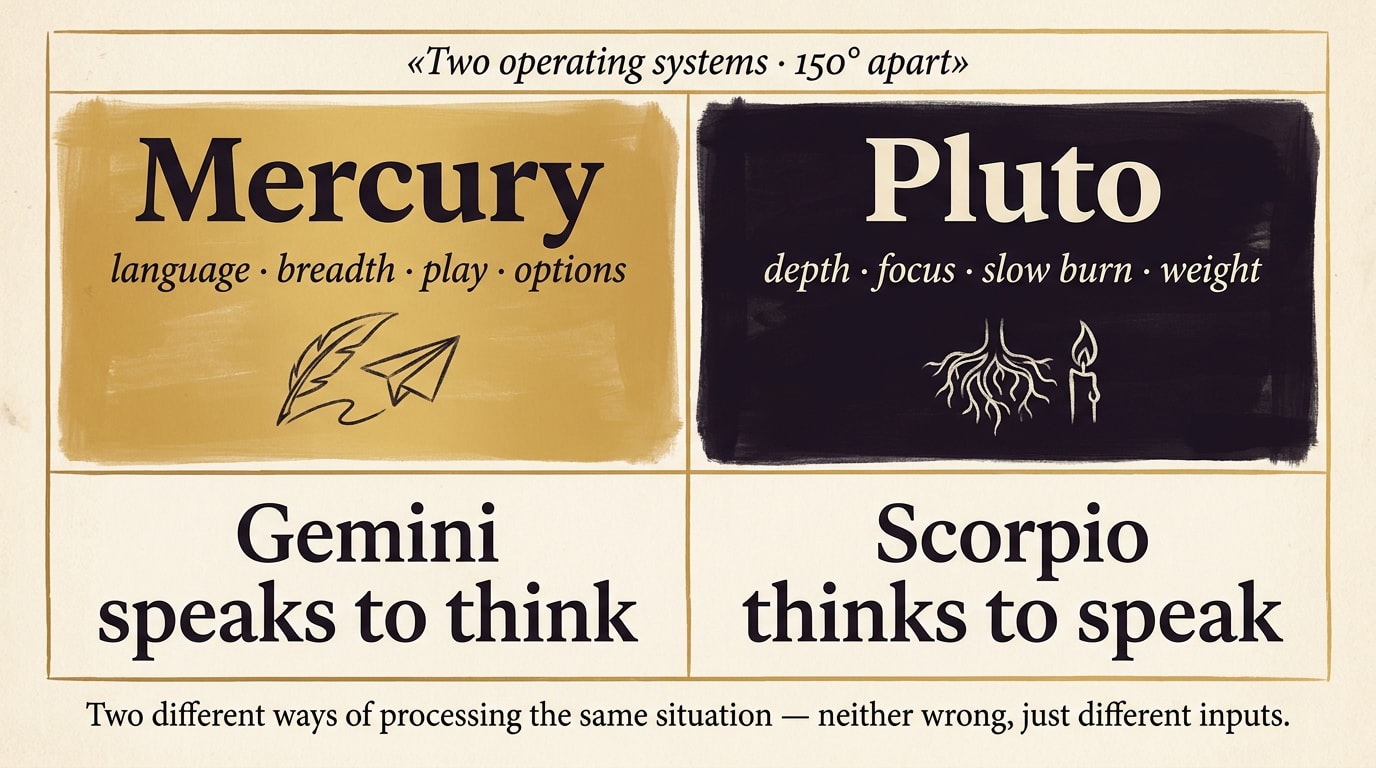
In practice this looks like one of you wanting to crack a joke when the room goes serious, the other wanting to sit with the seriousness until it gives up its meaning. Mercury runs on breadth, options, light play; it treats words as discovery rather than commitment. Pluto runs on weight, focus, slow time; it treats words as commitment, sometimes as exposure.
Neither is wrong. They're different inputs. The trouble starts when one of you assumes the other's lightness is deflection, or the other's weight is melodrama.
The work the quincunx asks of a Gemini-Scorpio pairing is, almost always, translation in two directions. The Gemini-side learns when to put the joke down and let a silence finish its sentence. The Scorpio-side learns when to let a serious thing be named lightly without losing its weight. Both are learning the other's first language. This is the bit no listicle gets to, because the listicles are reading personality where the chart is showing planetary register.
Also in short. Gemini's wiring is Mercury, language, breadth, play. Scorpio's is Pluto — depth, focus, slow burn. Two operating systems separated by 150 degrees of zodiac, asked by the geometry to learn each other's first language.
What synastry actually checks for Gemini and Scorpio
Whether a particular Gemini-Scorpio pairing grows or stalls is decided lower in the chart than the Sun. Five things do the work.
The Moons are the foundation, what each of you needs in order to feel safe. In this pair the Moons carry extra weight, because the Sun pair has no element bridge to fall back on; the underlying emotional climate has to come from somewhere, and the Moons are where it usually comes from. The Mercurys carry weight too, more than in most pairings, because Gemini is ruled by Mercury, so anything happening at the Mercury layer affects how Gemini-side feels itself being met. Venus and Mars are the chemistry, the contact that keeps two people in the same room across an awkward angle long enough to learn each other. Saturn, if it touches either chart's personal planets, gives the relationship the durability to keep doing the translation. And the Ascendants, what each of you looks like to the other at hello — often sit somewhere different from the underlying dynamic, which is why first impressions in this pairing rarely match what's actually going on between you.
The full synastry guide walks through all five layers in detail.
One real-feeling worked example
Two people, illustrative, not a real couple. Let's go back to Maya and Sam, the journalists from the café.
Maya, Sun in Gemini, Moon in Scorpio, Mercury in Cancer, Venus in Taurus, Mars in Pisces, Rising in Virgo. Sam — Sun in Scorpio, Moon in Gemini, Mercury in Scorpio, Venus in Sagittarius, Mars in Cancer, Rising in Pisces.
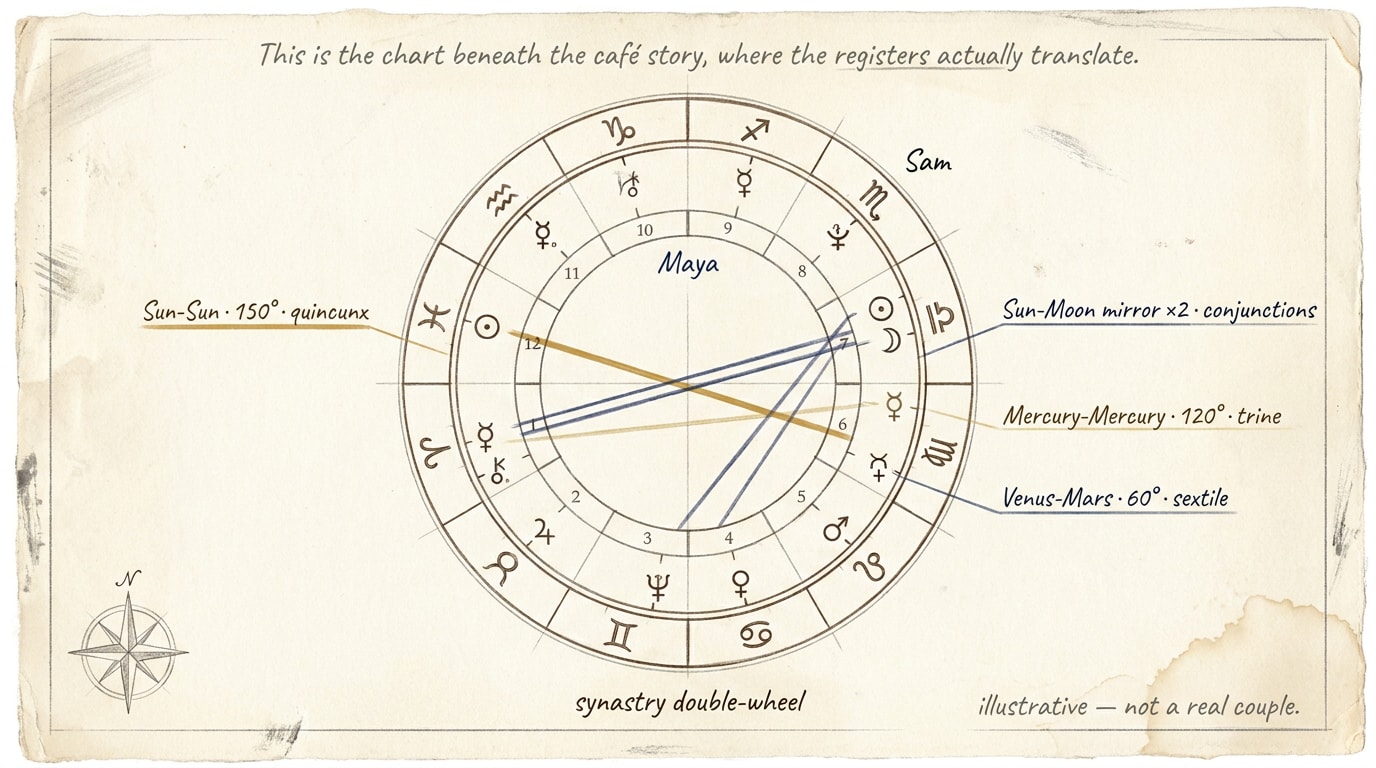
Start with the Suns. Maya's Gemini and Sam's Scorpio sit 150 degrees apart — the quincunx already described. That's the geometry the listicles get to and stop. Now read what's under it.
The Moons next, and this is where this synastry quietly comes alive. Maya's Moon sits in Scorpio, exactly where Sam's Sun lives. Sam's Moon sits in Gemini — exactly where Maya's Sun lives. Each person's emotional reflex is keyed to the other's basic identity. Two conjunctions, mirroring across the pair. It's a known classical synastry pattern of mutual recognition, and it's the mechanism the "opposites attract" framing keeps gesturing at without naming. Not destiny; geometry the Sun-sign table simply cannot see.
Mercury next, and Mercury carries extra weight in this pair. Maya's Mercury sits in Cancer, a water sign; Sam's Mercury sits in Scorpio, another water sign. Across the charts the two Mercurys sit 120 degrees apart, the easiest aspect in astrology — a trine, two water signs resting into each other. The translation the quincunx keeps demanding has, here, a built-in route: her words land in a register he can read.
Venus and Mars give them their chemistry. Maya's Venus in Taurus, sensual, grounded, slow — sits 60 degrees from Sam's Mars in Cancer, protective and feeling-led. A sextile. It's the steady pull that keeps both of them sitting at the same desk on the seventh week of a story they could have filed three weeks ago.
The house overlays show how each of them lands in the other's life. Maya's Rising is Virgo, so her chart begins at Virgo; counting forward from there, Sam's Scorpio Sun falls in her third house, the area astrologers associate with communication, daily mind, local connection. She reads him as someone she thinks alongside. Sam's Rising is Pisces, so his chart begins at Pisces; counting forward, Maya's Gemini Sun falls in his fourth house — the area astrologers associate with home, foundation, the inner ground. He reads her as something foundational, not decorative.
 Where the registers translate.
And the Ascendants, the first-impression layer, Virgo and Pisces sit a hundred and eighty degrees apart, an opposition. They look like awkward opposites on the surface, all neatness against all softness, and that's the part of the dynamic the listicles read and call "hard match". What's underneath — the double Sun-Moon mirror, the Mercury trine, the Venus-Mars sextile, does almost all the actual work of why they keep showing up to the same desk.
What you end up with isn't a destined pairing and isn't a doomed one. It's a workable adjustment with translation routes built in. The quincunx keeps asking for the work; the double Sun-Moon mirror is why both of them recognised each other in the first place; the Mercury trine and the Venus-Mars sextile are why both of them keep doing it.
What to actually check if you're in this pairing
Three things worth knowing, beyond your Sun signs.
First, find your Moon signs. The Moon takes a little more than two days to move through each sign, so depending on the time of day either of you was born, your Moon could fall in one of two signs. A free chart at astro.com gives the answer in a minute or two. In a Gemini-Scorpio pair the Moons matter more than usual, because the Sun pair has no element bridge of its own; the underlying climate has to come from somewhere.
Second, find both your Mercury signs. Mercury carries extra weight in this pairing because it rules Gemini. A Mercury in a water sign, or in a friendly aspect to the other's Sun or Moon, makes the translation noticeably easier.
Third, look at where Venus and Mars sit. A Venus-Mars contact across the awkward Sun-Sun angle is often what keeps two people in the same room long enough to learn each other's first language.
If you'd rather see the whole synastry for both of you on real charts, WowAstro will run it using the Swiss Ephemeris, the same astronomical data working astrologers use. The full synastry guide goes through the method end to end if you want the longer read. If you've also been reading about Scorpio with another sign, Aries and Scorpio compatibility sits next door to this one — another quincunx pairing, with a different mechanism underneath (shared Mars rulership rather than the Mercury-Pluto register-gap).
 The friction was geometry. The work is translation.
Questions readers ask
Are Gemini and Scorpio compatible?
The popular answer is "not really", that's what the top compatibility sites tend to say. The honest answer is that the pairing sits at a 150-degree quincunx, an adjustment aspect, and the discomfort isn't either sign's fault. Whether a particular Gemini-Scorpio pairing works depends on what sits below the Sun signs: the Moons, the Mercurys, the Venus-Mars contact, and where Saturn falls between you. The pairings that last tend to be the ones where the chart provides at least one easy contact lower down — a Mercury trine, a Moon sextile, a Venus-Mars aspect, that does the work of translation the Suns can't.
Why are Gemini and Scorpio attracted to each other?
The mechanism the "opposites attract" framing keeps gesturing at without naming. The pull often runs through the Moons — if one person's Moon falls in the other's Sun sign, that's a recognition contact no Sun-sign table can see, and it produces the "I felt like I knew you" reaction people sometimes attribute to mystery. The Mercurys can do the same, as can the Venus-Mars layer. The quincunx itself contributes too: 150-degree contacts often carry a particular pull precisely because there's no natural bridge between the two points, so the connection asks for ongoing attention.
Can Gemini and Scorpio be soulmates?
The soulmate frame doesn't apply usefully here. What this pairing can be is a long, useful translation — two people learning to read each other's first language. That tends to be steadier ground than the soulmate label, which often hides the work the relationship is actually doing.
What's the best aspect to look at first in a Gemini-Scorpio synastry?
The Mercurys. Mercury carries extra weight in this pairing because it rules Gemini, so anything that softens or sharpens the Mercury layer changes the whole dynamic. If one of your Mercurys sits in a water sign or makes a friendly aspect to the other's Sun or Moon, the translation gets considerably easier. After the Mercurys, look at the Moons — particularly whether either Moon falls in the other person's Sun sign, which is the recognition contact the Sun signs cannot show.
A note on what this is. Astrology, as we use it at WowAstro, is a tool for self-reflection and self-understanding, not a method for predicting events, health, financial outcomes or whether a relationship will last. Read a synastry chart as a description of a dynamic, take what's useful, leave the rest.
Written by Oksana Miatova, astrologer and writer at WowAstro. Charts calculated using the Swiss Ephemeris, the same astronomical data working astrologers use.
See what your charts say about each other
A personal AI synastry reading — not a sun-sign table, but an analysis of both natal charts across 8 areas of the relationship
Comments
New here? Get −30% off your natal chart
Leave your email and we will send you the promo code WELCOME30. Straight after that you can comment — no passwords, all automatic.
Quick sign-in
Sign in with Telegram — one click.
Or by email (with a gift)
Already have an account? Enter the same email — we'll email you a sign-in link.