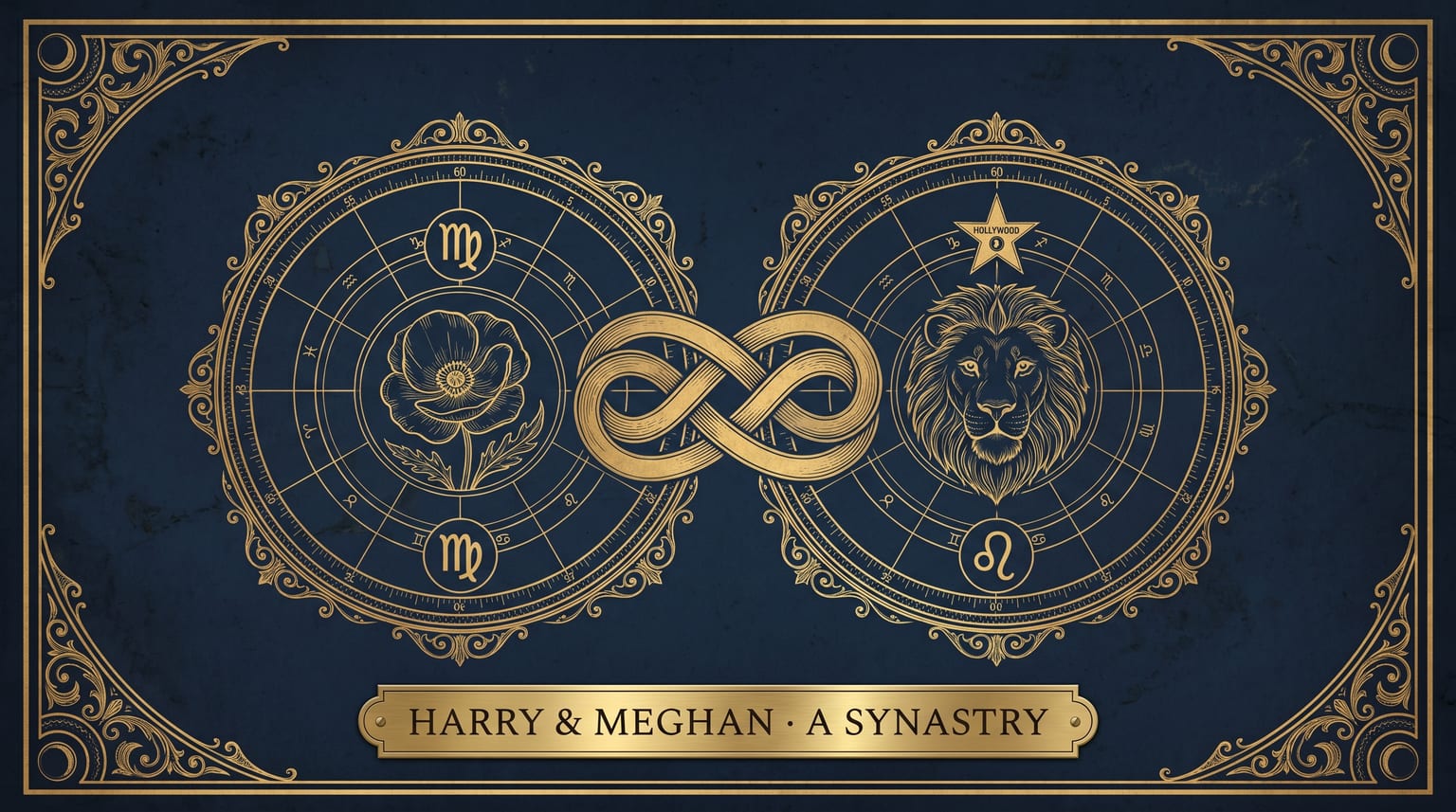

The score of 57 per cent might look unremarkable at first, but it describes something more alive than a smoother number would. This is not a quiet, friction-free connection. It is a bond with strong magnetic intersections and a few clear structural strains. Harry and Meghan pull each other into the exact areas where they are least indifferent. The charts show many significant inter-chart aspects, several of them extremely tight. That density matters more than the arithmetic. A relationship with this many crossings will never be boring. The two of them feel each other immediately.
Their elemental make-up explains part of it. Harry has three planets in fire, four in earth, one in air and two in water. Meghan has three in fire, one in earth, four in air and two in water. Harry's earth gives him a need for concrete, bodily, long-lasting things. His fire, through Mars, Uranus and Neptune in Sagittarius, wants movement and meaning. Meghan's air comes mainly through her Libra Moon, Jupiter, Saturn and Pluto, which makes conversation, comparison and ideas her natural habitat. Both have enough fire to start things and enough water to register hurt. The gap lies in earth and air. Harry can find Meghan's airiness abstract. Meghan can find Harry's earthiness slow. That gap is not fatal. It is useful, because it forces them to translate. Harry helps the relationship land. Meghan keeps it moving.
The natal house emphases matter before they even meet. Harry carries three personal planets in his eighth house: Sun, Mercury and Venus. The eighth house leans towards intensity, shared resources, crisis and transformation. He does not experience life mildly. Meghan carries four personal planets in her third house: Moon, Venus, Jupiter and Saturn. The third house is communication, immediate environment, news, siblings and the low-level hum of daily contact. She is wired to talk things through quickly, to gather impressions and to keep the conversation fresh. That third-house emphasis is restless, but in a relationship it means she will bring information, ideas and a need for novelty into the bond. Harry's eighth-house emphasis means he will bring depth, privacy and a stronger emotional charge. Together they keep moving between surface variety and underground intensity.
The projected houses sharpen the picture. Meghan's Ascendant falls in Harry's seventh house, the house of partnership. That is a classic placement for being seen as the partner almost from the first meeting. Her presence activates his language of union, fairness and open commitment. Harry's Ascendant falls in Meghan's sixth house, the house of work, daily duties and health. That is less glamorous but very real. He tends to activate the ordinary machinery of her life: who does what, how time is organised, what can be improved. So Meghan arrives in Harry's life as relationship. Harry arrives in Meghan's life as practical daily involvement. It is a good division, if they name it.
Three axes are accentuated. The 2/8 axis carries five planets. Money, shared resources, intimacy and emotional vulnerability are not side issues. They are one of the main stages. The 4/10 axis carries four planets. Home, family, status and public role are equally charged. The 5/11 axis carries four planets, bringing creativity, children, pleasure and friendship into the central weave. A couple with these three axes active will tend to define itself through resources, public-private balance and creative-social life. That is a lot of life compressed into one relationship.
The first impression is likely strong and slightly disorienting. Meghan's Mars sits exactly on Harry's Descendant, the angle of partnership. Harry feels her as direct, activating and impossible to ignore. She may not even be trying. Mars on the Descendant simply lands in his relationship field with force. At the same time Harry's Sun makes a harmonious aspect to Meghan's Ascendant and Descendant, so she receives his presence as warm and identity-confirming rather than merely intrusive. There is an immediate sense that each one has walked into the other's central relational field. The score of 57 means the relationship takes work, but the work is on material that is already charged.