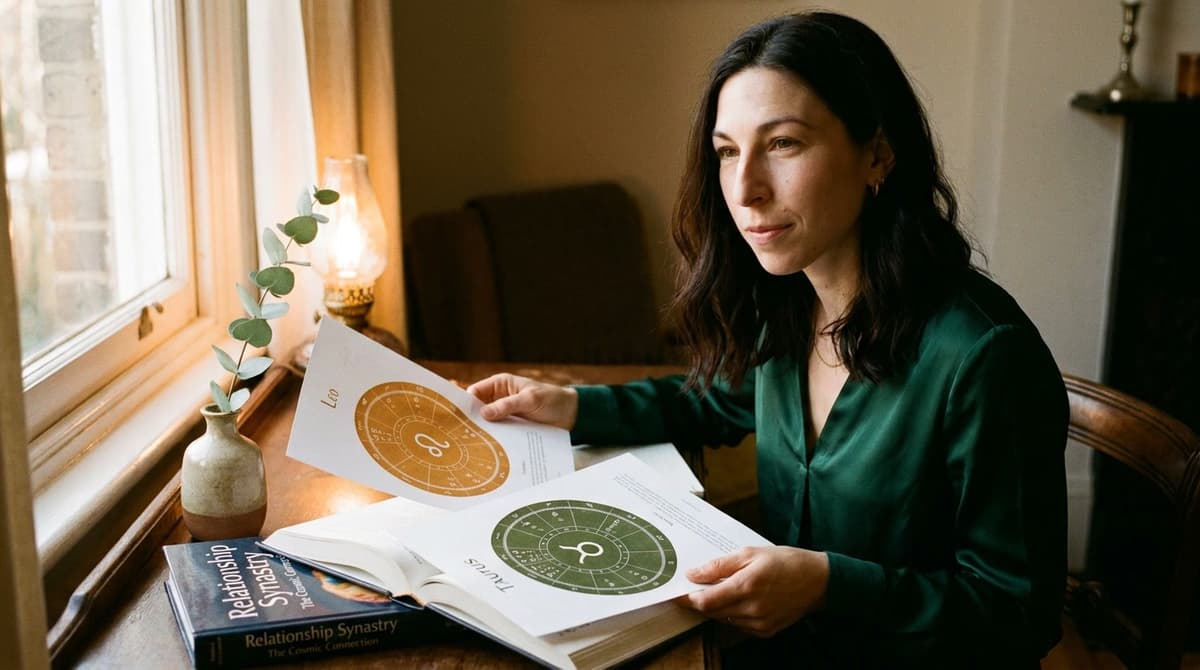
A Leo texts her Aquarius partner late on a Tuesday afternoon: "Are we still on for Sarah's birthday tonight?" He answers, twenty minutes later: "Yeah probably. Might pop in."
The phone gets set down a little too firmly. Might pop in. What is that supposed to mean. They were invited together. Sarah is one of her closest friends. He had agreed last week. Now there's a "might", and a "pop in", as if the evening is something he's fitting between two more interesting things.
This is the Leo-Aquarius dynamic on a Tuesday. Nothing dramatic, no row to repeat afterwards. Just two slightly different operating systems, briefly visible. The rest of this guide is about why opposite signs aren't actually opposite, why this pair tends to share an axis rather than fight on different battlegrounds, and what the full synastry reveals about why Leo-Aquarius either heals or splinters.
In short. Leo and Aquarius are opposite signs on what astrologers call the 5th-11th axis, the line between personal romance and chosen community. They tend to share the same question (where does the self belong) and answer it from opposite ends. Leo expresses through being seen as an individual; Aquarius through belonging to a wider group. Compatibility tends to surface not as instant chemistry, but as a long, structural negotiation. Difficult, often. Doomed, rarely.
 A Tuesday afternoon, mid-conversation.
Are Leo and Aquarius actually opposites?
Leo and Aquarius are opposites in a precise astrological sense: they sit directly across each other on the zodiac wheel, 180° apart. Opposition in astrology doesn't mean two signs disagree about everything. It means they share a single axis — and answer the axis's question from opposite ends. Leo, the fifth sign of the zodiac, is fixed fire. Aquarius, the eleventh sign, is fixed air. Together they form the 5th-11th axis, the line between personal self-expression and chosen community. They aren't enemies; they're mirrors of the same theme.
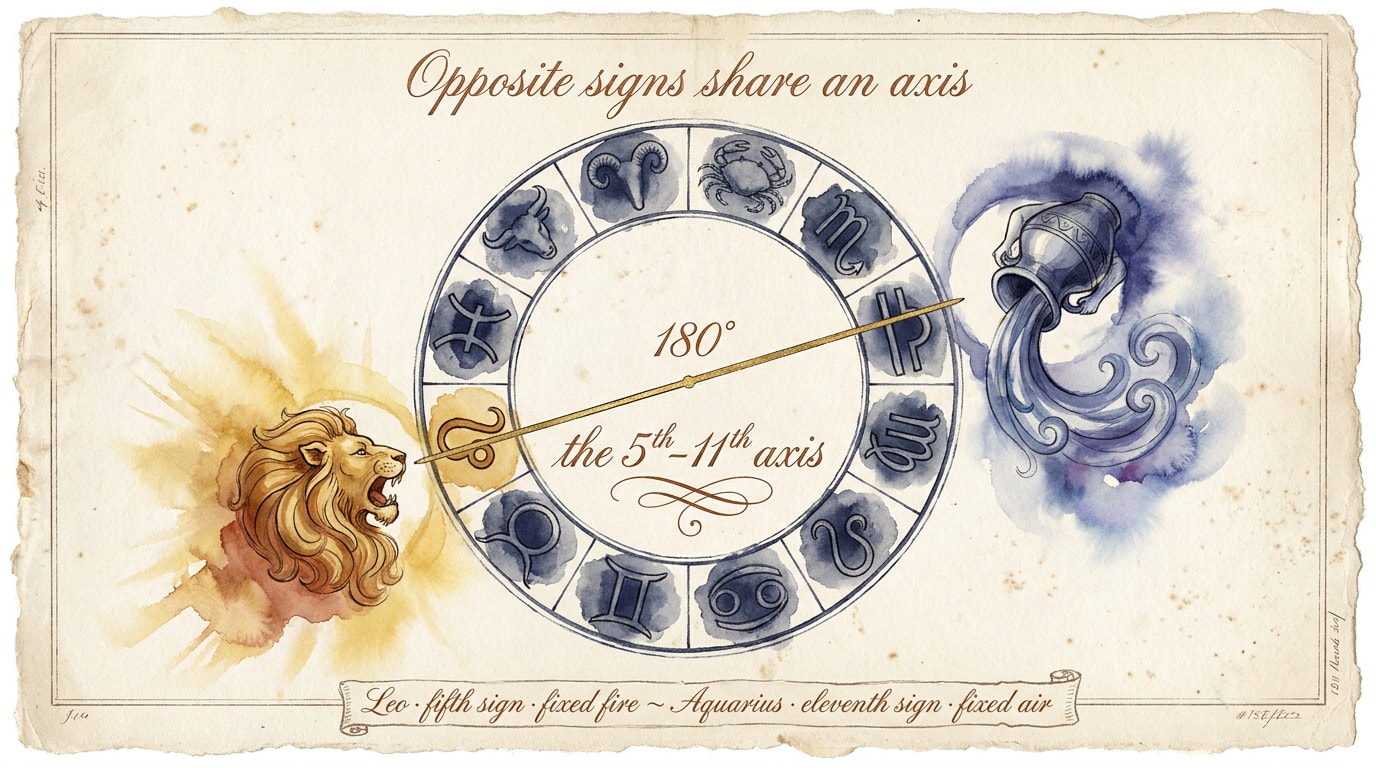
In a sun-sign listicle this is usually compressed into "opposites attract", which is a friendly sentence and not much else. The actual structure is more interesting. Two signs that sit opposite each other on the wheel are always the same mode (both cardinal, both fixed, or both mutable) and always opposing elements (fire-air or earth-water). The pair has more in common than the rest of the zodiac with any random sign. They keep, in fact, the same fundamental temperament, but they pull on opposite ends of one shared question. For Leo and Aquarius, the shared question is whether the self lives most fully on its own warm stage or as part of a larger collective. Neither answer is wrong — both are partial. A full synastry, which compares ten planets each rather than just two Sun signs, tends to confirm the axis matters more than the apparent disagreement.
| Leo | Aquarius | |
|---|---|---|
| Mode | Fixed | Fixed |
| Element | Fire | Air |
| House theme | 5th — personal expression, romance, play | 11th — friendships, networks, the future |
| Question they share | Where does the self belong? | Where does the self belong? |
| Answer they give | On its own particular stage | In the wider collective |
The 5th-11th axis: what they're actually arguing about
The 5th-11th axis is the line between me as an individual and me as part of a group. In astrology, the fifth house describes the warmer particulars of a life: personal creative expression, romance, the things that are uniquely yours, the people whose attention you actually want. The eleventh house describes the wider weather — friendships, networks, ideas held in common, the future you want to build with other people. Leo lives the fifth-house theme as a default — visible self, personal warmth, particular tastes. Aquarius lives the eleventh — group-mindedness, detached perspective, the cause and the company. Both partners care, equally, about belonging. They just locate belonging in different places.
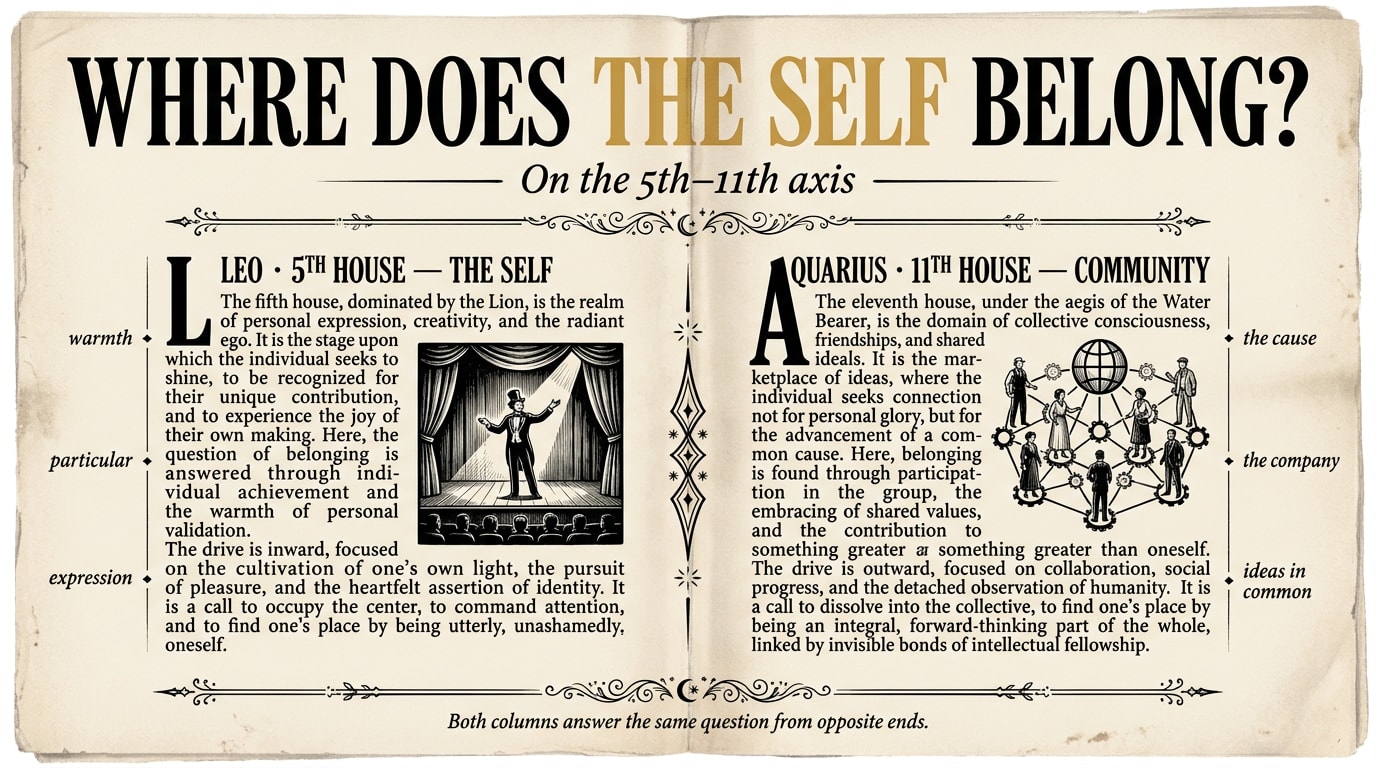
This is why the "might pop in" on a Tuesday lands the way it does. For the Leo partner, an evening at Sarah's birthday is the 5th-house experience: a particular person, a particular warmth, the specific attention you'd want from your specific partner. For the Aquarius partner, the same evening is one of many social settings, an 11th-house experience, where his sense of belonging is distributed rather than focused. He isn't withholding affection. He's reading the same evening as a different kind of event. (If you'd like a quick refresher on what Leo and Aquarius are like as individual signs, the zodiac signs guide covers both.)
A useful metaphor. Leo lights one person brightly, the way a reading lamp does. Aquarius lights a whole room evenly, the way an overhead does. One isn't better than the other. They illuminate different things, and the trouble starts when both partners insist the world looks correct only under their own kind of light.
Both fixed: why arguments take longer
Leo and Aquarius are both fixed signs, which means arguments between them tend to last longer than between mixed pairs. In astrology, the twelve signs divide into three modes: cardinal (initiators), fixed (holders), and mutable (adjusters). Leo holds. Aquarius holds. Neither partner is wired to step back from a position first; both wait for the other to move. The work isn't to be less stubborn. The work is to recognise that whoever moves first is moving on principle — not weakness.
Back to Tuesday afternoon. Two hours have passed since the "might pop in". Both phones sit face down. The Leo partner is rehearsing what to say if she rings. The Aquarius partner is, slightly, irritated that she's annoyed and slightly worried she's annoyed. Neither calls. Both want the other to start. This is fixed-sign astrology working exactly as designed. Three days later, when one of them finally picks up the phone, the other will say something like "I was just about to call you" — and they'll mean it, and it will also be true that they weren't.
The shift that helps Leo-Aquarius couples in practice is small and unromantic. Whoever picks up the phone first isn't losing. It's not a concession; it's a skill. Fixed signs aren't built to apologise first; they're built to hold. So someone has to choose, consciously, to interrupt the hold. After a few rounds of this, both partners discover that the world doesn't end when they break the pattern, and the rounds get shorter. None of this is in the sun-sign tables, because the sun-sign tables don't measure modes at all. (If neither of you ever apologises first, by the way, you're doing fixed-sign astrology correctly. Now please someone start a conversation.)
Mirrors, not enemies: what each one carries for the other
In opposition synastry, each partner tends to carry the trait the other has under-developed. Leo lives the 5th-house theme of personal self-expression at full volume, but often forgets the wider network: the friends-of-friends, the wider field, the cause beyond the warm intimate circle. Aquarius lives the 11th-house theme of belonging to groups beautifully, but often forgets to claim personal centre stage, to be the particular individual the friend or partner is delighted by, not just one of the people in the room. Opposite signs tend to heal each other's blind spots, when both choose to learn rather than defend.
Three small scenes, to show the shape of it.
A Sunday brunch. The Leo partner has dragged the Aquarius partner along; she wants to see her old friend, who is going through a difficult patch with her mother. The Aquarius partner is half-listening, then quietly notices the friend's earrings are mismatched, and gently mentions it as a joke, and the friend laughs for the first time that morning. The Leo partner needed the Aquarius partner to be there to do that, to spot the small wide thing she hadn't.
 Two ways of being in the same room.
A Wednesday evening, late. The Leo partner is upset about something at work; she's been overlooked again, she thinks, and it feels personal. The Aquarius partner listens, then says: "I think it's not actually about you. I think it's that they've all just had three months of this restructure, and they're not seeing anyone, they're just trying to survive Q3." The Leo partner protests for a few minutes, and then sees it. The Aquarius partner has lifted her out of the spotlight long enough to show her the room around her. She needed that.
A dinner party. Both of them at home. The Leo partner is the warm centre of the table, holding the room together with stories. The Aquarius partner is in the kitchen at one point, quietly explaining to one guest how she knows the other guest from twelve years ago, and how the third guest used to work with the host's brother. Different operating systems, both useful. The evening doesn't actually work without both of them.
A worked example: reading one Leo-Aquarius synastry
Most compatibility guides explain the symbols and leave you to assemble them. Here's one chart, end to end. The two people below are illustrative, not a real couple — just a plausible pair of charts that show the moves.
Partner A (the Leo): Sun in Leo, Moon in Cancer, Venus in Virgo, Mars in Libra, Rising in Taurus. Partner B (the Aquarius): Sun in Aquarius, Moon in Libra, Venus in Pisces, Mars in Capricorn, Rising in Aquarius.
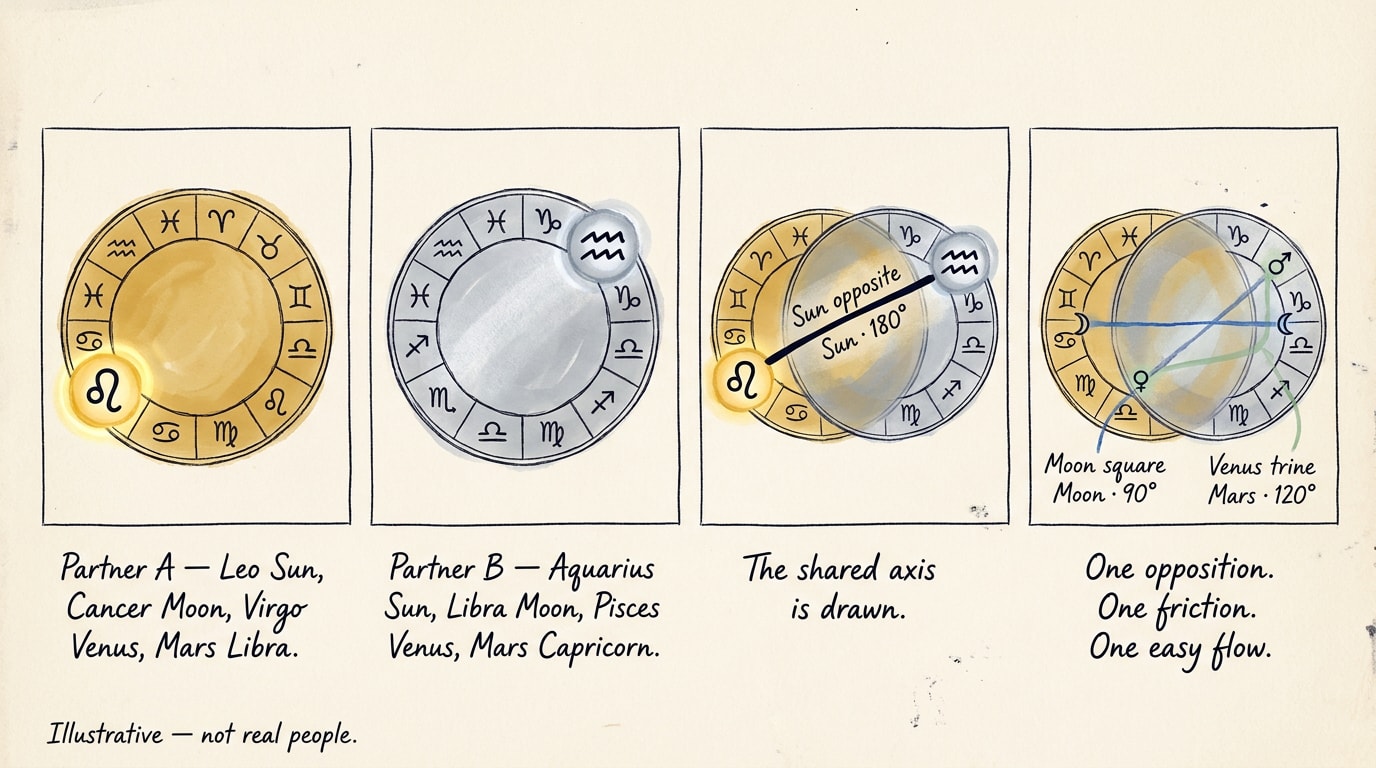
Start with the Suns. Leo opposite Aquarius is the classic axis the rest of this guide has been about: work and rest, particular and general, warm self and cool collective. Each one carries the side the other isn't doing. The risk is the easy projection of "you'll be the social one, so I won't have to" or "you'll be the warm one, so I won't have to". The reward, when both stay responsible for their own end of the axis, is a relationship with unusual range.
Now the Moons. Cancer Moon meeting Libra Moon by square is a quieter, daily friction point than the headline Sun-Sun opposition. Cancer is water; emotional reflex is about being cared for closely, by named people, in named ways. Libra is air; emotional reflex is about even-handedness, the relational principle, what's fair. When Cancer is upset, she needs someone to come and sit with her. When Libra is upset, he needs the situation to be talked through carefully. Same need — steadiness — different emotional grammar. This is the kind of friction the couple will keep encountering on Wednesday evenings.
Venus to Mars, more reassuringly. Partner A's Virgo Venus meeting Partner B's Capricorn Mars by trine is a quiet, steady chemistry: earth-earth, both signs interested in competence, in showing care through small consistent acts. He fixes her bike when she's mentioned twice she's been meaning to. She remembers his glasses prescription appointment. The attraction expresses itself through usefulness rather than dramatics, which is exactly the kind of chemistry that survives well into year five.
House overlays do the rest. Partner A's Leo Sun falls in Partner B's seventh house, the house of committed partnership. From the first conversation, Partner B reads Partner A as someone serious, partner-shaped, not friend-shaped. Partner B's Aquarius Sun falls in Partner A's tenth house, the house of public role and career. Partner A finds, over time, that being with Partner B has changed how she shows up in the world; she's more interested in causes, in the wider work, in the room beyond her own circle. Ascendants: Taurus Rising and Aquarius Rising sit square to each other, which is to say their first-impression speeds don't match. Taurus reads slow, grounded, embodied. Aquarius reads cool, alert, slightly elsewhere. Recognition is not immediate. Familiarity has to earn the connection, and once earned, it's both surprised and pleased to be there.
What this read tells us. A Leo-Aquarius pair with this synastry has a real engine. The Sun-Sun opposition gives them the shared axis to negotiate. The Moon-Moon square gives them the daily friction to keep negotiating. The Venus-Mars trine gives them a steady chemistry that means they actually want to stay in the room together. The house overlays (seventh for him reading her as partner, tenth for her finding herself changed publicly) give the relationship two clear purposes. None of this is "compatible" or "incompatible". It's the shape of a particular relationship.
How to know if your Leo-Aquarius is working
The difference between a healthy Leo-Aquarius pairing and a splintering one isn't the opposition itself; it's whether both partners treat the axis as a question they share. Splintering tends to happen when each one insists that their end of the axis is the right one. The Leo partner demands constant individual recognition and reads the Aquarius partner's group-mindedness as coldness. The Aquarius partner demands constant detached cool and reads the Leo partner's warmth as theatre. Both are missing the same point — they're both arguing about belonging, just from opposite ends.
 Two slightly different operating systems, in the same room.
Healing happens when both notice the axis is shared. The Leo partner stops reading "independent thinker" as "doesn't love me enough" — and starts reading it as "brings me a perspective I wouldn't have on my own". The Aquarius partner stops reading "wants to be seen" as "attention-seeking" and starts reading it as "still alive to the particular, where I sometimes forget". Couples in the long form of this pair tend to say the same line in different words: we still annoy each other in exactly the way we did at the start, but we've stopped expecting it to mean we don't fit. The test isn't friction; it's whether the friction stays the question, or starts feeling like the answer.
If you'd like to see this on your own charts rather than an illustrative pair, WowAstro will run a full synastry for both of you using the Swiss Ephemeris, the same astronomical data working astrologers use. Date, time and place of birth for both; it takes a couple of minutes.
Questions readers ask
Are Leo and Aquarius opposites?
Yes, in a precise astrological sense. Leo and Aquarius sit directly across each other on the zodiac wheel, 180° apart, on what's called the 5th-11th axis. That axis is about the relationship between the individual self (Leo's territory) and the wider community (Aquarius's). They aren't opposite in goals; they're opposite ends of the same conversation. Both signs are fixed, both share a temperament built around holding ground rather than adjusting — which is why their disagreements tend to feel structural rather than passing.
Do opposite signs really attract?
Often, but the attraction isn't magic; it's recognition. Each opposite sign tends to embody what the other has under-developed in themselves, so meeting one feels a bit like meeting a missing half. The pull is real and the chemistry is real; the long-term work is treating the difference as something to learn from rather than to fix in the other person. Plenty of opposite-sign couples last well. Plenty of identical-sign couples don't. The aspect describes a starting condition; what either pair does with it is the relationship.
What's the secret of Leo-Aquarius dynamics?
The 5th-11th axis. Leo lives self-expression and personal warmth; Aquarius lives group-mindedness and detached perspective. When both partners notice they're arguing about the same thing (where the self belongs) from opposite ends, the relationship tends to settle into a long, structural negotiation rather than a personal feud. The "secret" isn't avoiding the friction; it's recognising the axis exists, and treating each partner's end as a piece of the same conversation rather than a verdict on the other.
Should I worry about an opposition aspect in synastry?
No, not on its own. An opposition in synastry describes a structural difference between the two partners; they bring opposite ends of one theme into the relationship, which is why the dynamic can feel both familiar and slightly polarised at the same time. Worked through, oppositions often become the engine of a long partnership, because they keep both people honest about what each is bringing. The aspect to worry about isn't the opposition itself; it's an opposition both partners have stopped talking about, where the difference has hardened into a wall instead of a question.
A note on what this is. Astrology, as we use it at WowAstro, is a tool for self-reflection and self-understanding, not a method for predicting events, health, financial outcomes or whether a relationship will last. Read a synastry chart as a description of a dynamic, take what's useful, leave the rest.
Written by Oksana Miatova, astrologer and writer at WowAstro. Charts calculated using the Swiss Ephemeris, the same astronomical data working astrologers use.
See what your charts say about each other
A personal AI synastry reading — not a sun-sign table, but an analysis of both natal charts across 8 areas of the relationship
Comments
New here? Get −30% off your natal chart
Leave your email and we will send you the promo code WELCOME30. Straight after that you can comment — no passwords, all automatic.
Quick sign-in
Sign in with Telegram — one click.
Or by email (with a gift)
Already have an account? Enter the same email — we'll email you a sign-in link.