She heard the word for the first time in a Thursday-evening therapy session, and spent the Tube journey home reading six checklists on six different websites. She recognised herself in each one. By the time the train reached her station, she felt less informed than indicted, and the question waiting at the top of the escalator was the one nobody had answered: if this is what I am, who exactly does that make me?
If you've had a version of that train journey, this isn't another checklist. Codependency is a clinical pattern that psychologists describe and clinicians work with. It isn't an astrological one. But a natal chart can give you vocabulary for the inner shape behind the pattern, without diagnosing anything or pretending to fix it. If what you're recognising feels heavy — persistent low mood, panic that won't lift, or thoughts of self-harm — please talk to your GP or contact Samaritans on 116 123 (free, 24/7). Astrology can sit alongside professional support; it can't replace it.
In short. Codependency is the clinical name (Beattie, 1986; Cermak, 1986) for a pattern where one person's sense of self quietly dissolves into looking after another's needs. Astrology doesn't diagnose it and doesn't fix it. But certain chart placements (hard aspects between the Moon and Venus, the placement of the 7th house ruler, Saturn touching personal planets) often give vocabulary for the caretaking shape that sits behind the pattern. A chart is a mirror, not a verdict.
 The first walk home with a new word for an old shape.
What codependency actually is, and what astrology won't claim
Codependency is a pattern of relating in which a person's sense of self becomes organised around looking after, and being needed by, another person, often at quiet cost to themselves. The term was popularised by Melody Beattie in her 1986 book Codependent No More and developed clinically the same year by Timmen Cermak. It was first observed in families of people living with addiction; clinical use later broadened, and there is now professional debate about whether the term has been stretched too far. Several couples therapists publishing online argue that most people who self-diagnose as codependent aren't, in the clinical sense; they're simply caring in a relationship that isn't returning the care. A caveat worth carrying.
The pattern, when it is the pattern, tends to look like this: an emotional radar permanently tuned to another person's state; difficulty naming your own preferences when they're in the room; a felt sense that if I stop, everything falls. None of those, on its own, is a diagnosis. Taken together and persistent — costing you sleep or work or your sense of self — that's when the question stops being interesting and starts being one for a therapist.
A reminder while you're reading. If what's being described here sounds like daily life, the Mind information line (0300 123 3393, weekdays 9-6) is a good first call. This article uses astrology as a self-reflection lens: vocabulary for what the pattern looks like inside a chart. Not a diagnosis. Not a treatment. Astrology sits alongside professional help; it can't replace it.
Why a clinical word in an astrology article
Mixing a clinical term with astrology needs honest framing, not a chart-shaped diagnosis dressed up in soft language. Codependency is a relational pattern clinicians describe with criteria. Astrology describes structural defaults: the shapes of how a person tends to feel, want, relate, and arrive into a room. The two domains aren't doing the same job, and conflating them is the failure mode here.
This article offers vocabulary for the inner shape behind the pattern, with clear pointers to therapy if the pattern is interfering with daily life. It doesn't issue verdicts, predict outcomes, or substitute for professional support. A chart is a mirror with structure. It can name something you might recognise; it can't tell you what to do about it.
A word for the wary reader. You don't have to believe the planets cause anything for a chart to be useful. What it does, mechanically, is hand you a structured prompt for self-reflection — the same way a personality framework or a therapist's intake form does. Whether the prompt helps you notice something you'd otherwise miss is the test, not whether it's metaphysically true.
The Moon and Venus: your inner barometer and your relating value
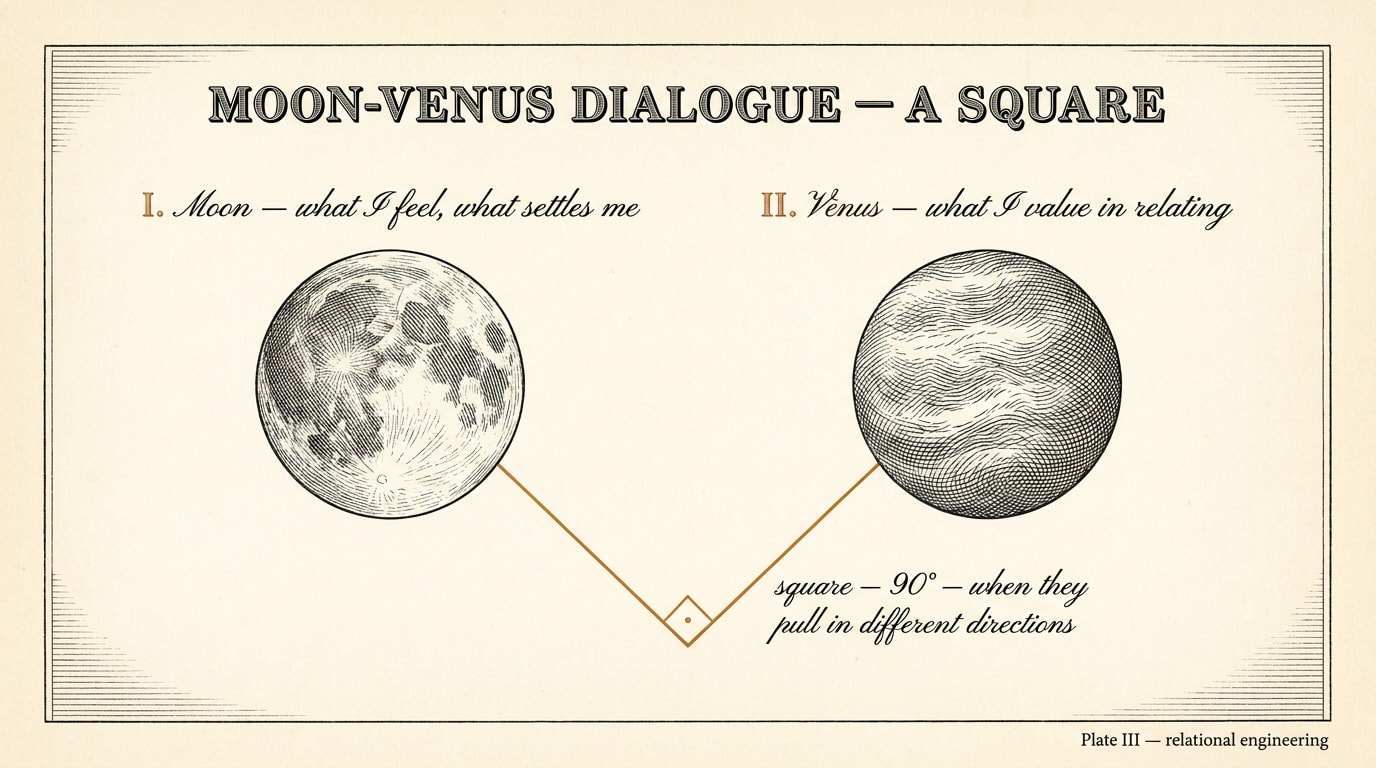
In astrology's vocabulary, two placements describe most of what feels like the codependency shape. The Moon speaks for your emotional needs and how you settle. Venus speaks for your sense of what makes relating feel worthwhile. Both are what astrologers call personal planets: fast-moving, deeply felt, describing inner life rather than public role. Their relationship in a chart often describes how your emotional needs and your relating values are talking, or not talking, to each other.
A Moon in a water sign (Cancer, Scorpio, Pisces) tends to read strongly to atmosphere, picking up on a partner's mood before they've named it. A Venus in an air sign (Gemini, Libra, Aquarius) often prioritises harmony and the comfort of the room. When the two are in friendly conversation (a soft aspect, like a trine of around 120°), you tend to have natural emotional fluency: you read the room and you also know what you want. When they're in a hard aspect — a square of about 90° or an opposition of about 180° — the inner barometer and the relating-value can pull in different directions. The felt experience is often: I give and give and somehow don't quite know what I want for myself.
A hard Moon-Venus aspect doesn't make you codependent. Many people have squares and oppositions between these planets and never develop the pattern; many with the pattern have no such aspect. The structural shape correlates with the felt experience often enough to be useful as vocabulary. It isn't a cause.
The 7th house and Saturn's touch on personal planets
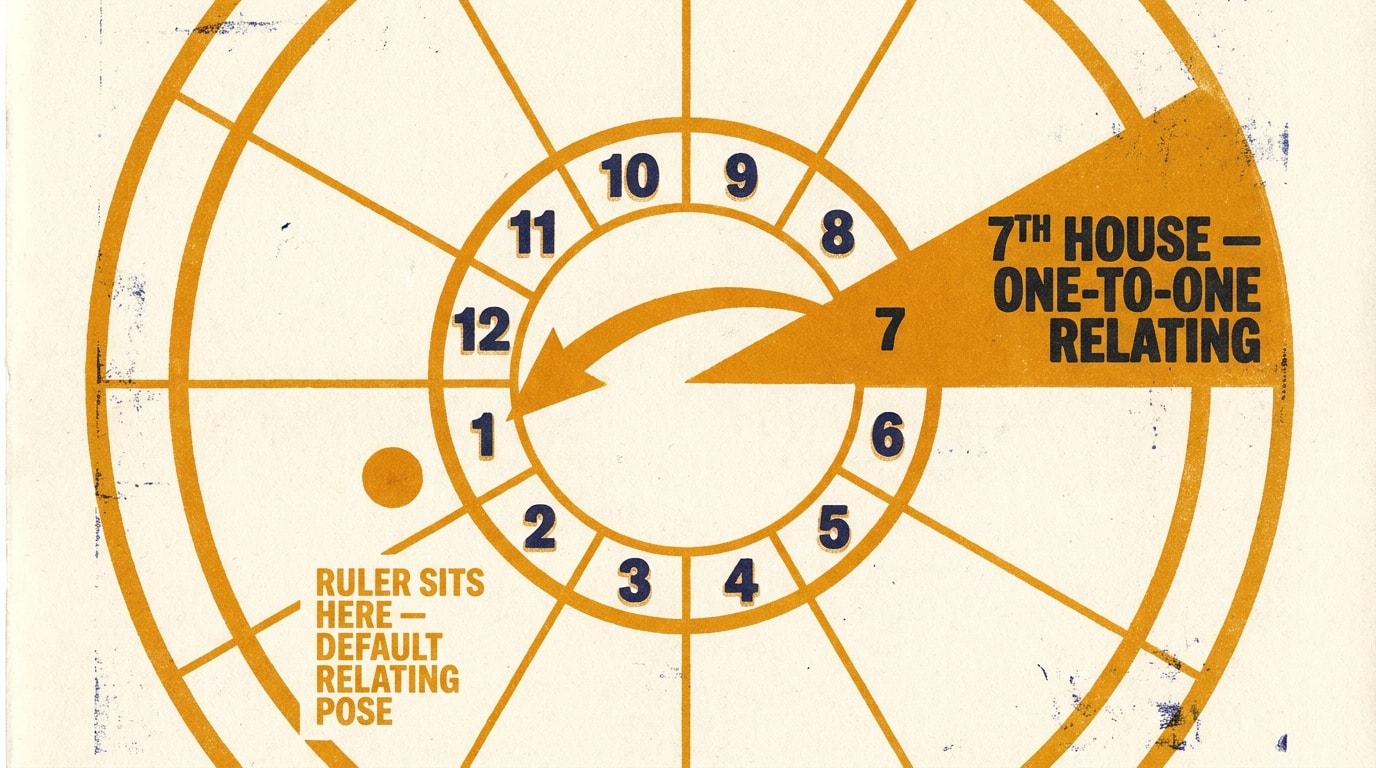
Two more structures often come up in a codependency-shaped reading: the placement of the 7th house ruler, and Saturn aspects to the Moon or Venus. The 7th house is the territory of one-to-one relationships. The sign on its cusp has a ruling planet, and where that planet sits often describes your default pose in close relating. A 7th house ruler in the 12th — the territory traditionally associated with dissolution and what's hidden from view — often reads as I disappear into the relationship; the boundary between me and you becomes quiet, sometimes hard for either of us to locate.
Saturn is the chart's archetype of structure, duty, and worth that feels earned. When Saturn makes a hard aspect to the Moon or Venus, the felt undertone is often to be loved I need to earn it by being useful. Met in childhood and carried forward, that undertone can look from the outside like enormous competence and from the inside like the suspicion the love would evaporate if the usefulness stopped. None of this is character flaw. It's a structural default the chart describes.
Notice the verb in those last two paragraphs: correlate with, not cause. Plenty of people have these placements and don't have the lived pattern; plenty of people have the lived pattern and none of these placements. What becomes of a structural default depends on family, environment, history, and what's already been worked through. The placements are a starting place for noticing, not a sentence.
Vocabulary, not verdict. These placements don't diagnose anything. They give you language for an inner shape you may already recognise. The astrology word for this isn't condition. It's pattern.
A worked example: Moon in Pisces, Venus in Libra, 7th ruler in the 12th
Here is one combination read end to end. The chart is illustrative — a teaching composite rather than a real person.
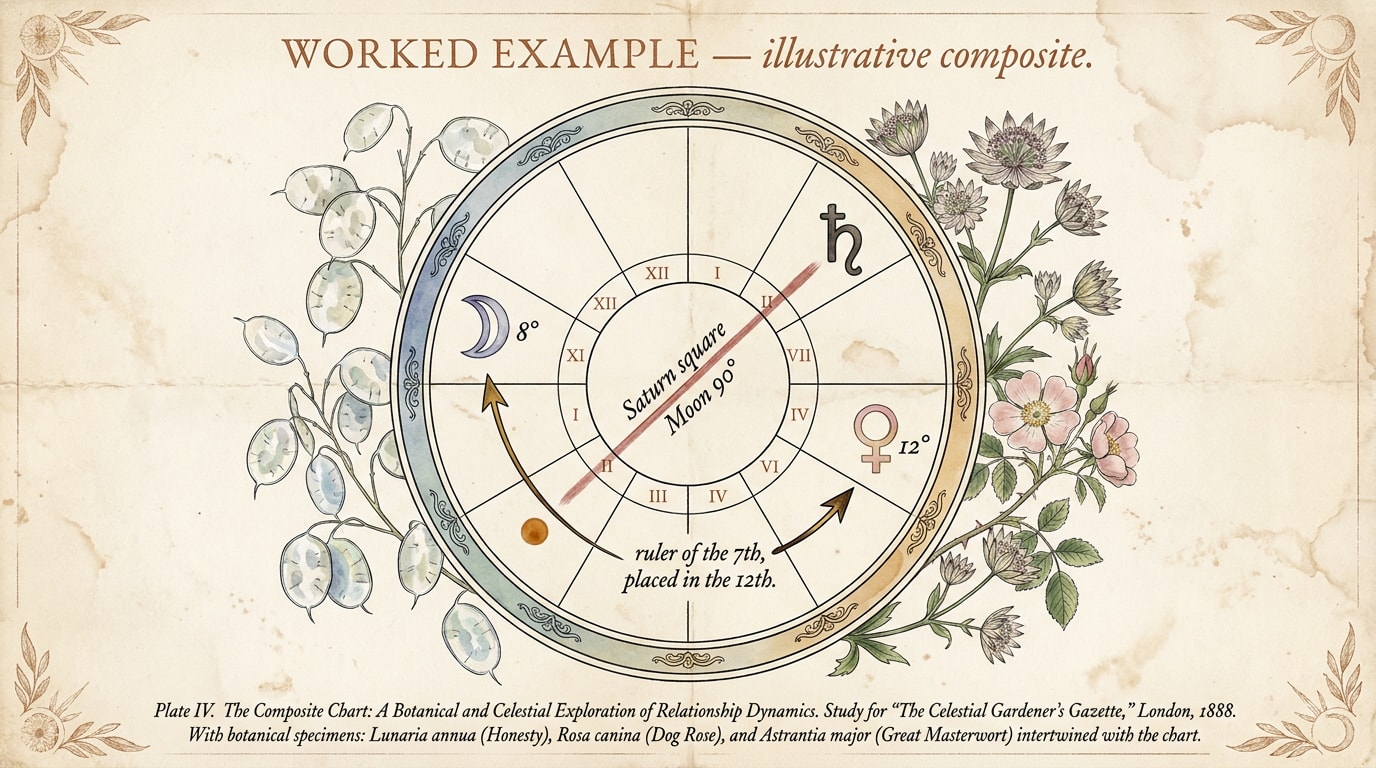
The placements: Moon in Pisces at about 8°. Venus in Libra at about 12°. Saturn squaring the Moon (the 90° hard aspect). The ruler of the 7th house placed in the 12th. None of these, individually, is unusual; the combination is what makes this a teaching chart.
In plain terms: a porous, atmosphere-attuned emotional life (the Pisces Moon). Relating values weighted towards harmony and the other's comfort (the Libra Venus). An old learned undertone, to be loved I need to earn it by being useful (Saturn squaring the Moon). A default relating pose of I disappear into the relationship (the 7th ruler in the 12th).
Put together, the shape is recognisable. She walks into a conversation with her partner already knowing his mood, already adjusted to it, already prioritising his comfort, not quite registering what she wants. He doesn't ask, partly because she doesn't quite ask herself. From the outside this looks like attentiveness; from the inside it can feel like a slow disappearance, the kind that is hard to notice while it's happening.
If the read lands, it lands. If it doesn't, that's information too. A chart's job is to name; what you do with the naming is the work. When the pattern is heavy enough that it's costing you sleep, work, or your sense of safety, that work usually belongs in a therapy room. The BACP register at bacp.co.uk is a sensible starting place for finding an accredited UK therapist; many areas of the NHS also offer talking therapies via self-referral.
A chart can name what's happening. It can't fix it on its own. The map describes the territory; you still have to walk it.
 One morning, a slightly different question to ask the day.
A reflective practice: noticing, not fixing
Once you can name a structural default, you can use it as a self-reflection prompt rather than a verdict. This is journal territory, or quiet thinking time over a cup of tea — not a script for therapy, and not a method for talking yourself out of distress that's already telling you something serious. If what these prompts surface feels too heavy to sit with alone, that's the moment to call your GP, NHS 111, or the Mind information line. Not the moment for more astrology.
 A notebook is sometimes the most honest mirror there is.
Three questions worth turning over when the caretaking shape is loud. When was the last time I named, out loud, something I wanted — not for someone else's benefit, just for me? What do I imagine happens to the people I look after if I stop for a day, and where did I first learn to imagine that? If a chart described my default relating pose as disappearing into the relationship, which part of that sentence — disappearing, into, or the relationship — feels most accurate, and which feels least?
Naming a structural pattern often loosens it slightly. It doesn't change it. The actual shift tends to come through therapy, relationship work, sometimes medication, time, and support. The chart is the map. You still have to walk.
What an astrology lens does here. It gives you a name for something already inside the chart. Not a diagnosis, not a treatment, not a fix — vocabulary that lets the pattern become less personal and more describable.
For more on the wider landscape this sits inside, see our companion pieces on how a chart supports self-understanding and reading toxic-relationship patterns through synastry. If you want to see your own Moon, Venus, and 7th-house structure side by side, WowAstro will calculate your free birth chart and compatibility lens. Date, time and place; a couple of minutes. Worth knowing the shape, not as a diagnosis but as a starting place for honest noticing.
Frequently asked questions
What is codependency in a relationship — and what does codependency mean clinically?
The clinical codependency definition, first described by Melody Beattie and Timmen Cermak in 1986, points to a pattern where one person's sense of self becomes organised around the other's needs, often without either partner intending it. The codependent partner tends to read the other's mood before it's spoken, rearrange their day around it, and feel heavy responsibility for keeping things steady. Not everyone who recognises themselves in a checklist meets that clinical meaning; the distinction is worth carrying carefully. The shorter answer: codependency in a relationship is a recognisable pattern of relating, and naming it is sometimes the first step in working with it.
Which astrology placements are linked to codependency?
No placement makes anyone codependent. Many people with the placements below never develop the pattern, and many with the lived pattern have none of them. With that caution carried, the structures that often give vocabulary for the caretaking shape are: hard aspects (squares or oppositions) between the Moon and Venus, where the inner emotional life and the relating values can pull in different directions; the 7th house ruler, especially in the 12th house, where the default relating pose can read as I disappear into the relationship; and Saturn making hard aspects to the Moon or Venus, often associated with the felt undertone I need to earn love by being useful. Vocabulary for an inner shape, not diagnosis.
Is astrology a substitute for therapy in codependency?
No. They're different tools answering different questions. Astrology can name a structural shape; therapy gives you a relationship and a practice for changing the lived pattern. If you're hesitating between booking a session and reading your chart, book the session. The BACP register at bacp.co.uk is the standard route in the UK for finding an accredited therapist or counsellor; NHS talking therapies are available by self-referral in most areas of England. Astrology sits alongside that conversation; it doesn't compete with it.
Can recognising my chart's structure actually change the pattern?
Recognising a structure can lower the heat around a pattern; it doesn't change the pattern by itself. Actual change tends to come through therapy, relationship work, sometimes medication, time, supportive people, and a fair amount of repetition. The chart's job is to name; you still have to walk the territory. If the pattern feels too heavy to walk on your own — costing you sleep, work, or your sense of safety — please contact your GP, the Samaritans on 116 123, Mind on 0300 123 3393, or NHS 111. More astrology isn't the answer there. A real conversation with someone qualified is.
Read the wider context in our guide to your full birth chart
By Oksana Miatova, astrologer and writer at WowAstro. Charts calculated using the Swiss Ephemeris.
About this article: WowAstro readings combine traditional astrological methodology (Swiss Ephemeris calculations, Hellenistic and modern psychological frameworks) with AI-assisted writing reviewed by Oksana Miatova before publication. For entertainment and self-reflection only — not medical, legal, or financial advice. Full editorial policy at /editorial-standards.
Astrology, as we use it at WowAstro, is a tool for self-reflection and self-understanding, not a method for diagnosing conditions or predicting events, health, or financial outcomes.
If feelings of loss of self, exhaustion in caretaking, or relationship distress are overwhelming or persistent, please speak with a qualified counsellor or therapist. In the UK you can contact Samaritans on 116 123 (free, 24/7), Mind on 0300 123 3393, NHS 111 for non-emergency mental-health support, or find an accredited therapist via the BACP register. Astrology can sit alongside that conversation; it is not a replacement for it.
See what your charts say about each other
A personal AI synastry reading — not a sun-sign table, but an analysis of both natal charts across 8 areas of the relationship
Comments
New here? Get −30% off your natal chart
Leave your email and we will send you the promo code WELCOME30. Straight after that you can comment — no passwords, all automatic.
Quick sign-in
Sign in with Telegram — one click.
Or by email (with a gift)
Already have an account? Enter the same email — we'll email you a sign-in link.