It's a Friday night in someone's small London kitchen. Two friends, a bottle of supermarket red, the kettle still warm from earlier. Your third serious relationship in eight years has just ended, and your friend, kindly, says the thing nobody else has dared to. Love. It's the same shape again, isn't it?
You nod. You knew before she said it. You knew somewhere around the third week, when his you're so different from anyone I've dated had the same cadence the last one used. You knew, and you stayed anyway, and now you're sitting here with a friend who loves you and an unanswerable question. Why does this keep happening?
If you've sat at that kitchen table, this article is for you — with a fair warning. Astrology, used honestly, can offer vocabulary for the pattern underneath repeated relationships. It can't fix the pattern; that work happens in therapy and lived practice over time. And if what you're living through right now is unsafe — if you're afraid of him, if you walk on eggshells — please stop here and ring Refuge on 0808 2000 247 (free, 24/7, UK National Domestic Abuse Helpline). This article isn't the resource you need tonight; they are.
In short. If your relationships keep landing in the same painful shape, astrology offers vocabulary — not a diagnosis — for the default pattern underneath. Venus describes what attracts you on autopilot. Mars describes how you handle conflict on autopilot. The seventh house describes the partner-shape you tend to mirror. Naming the pattern doesn't fix it (therapy does that), but noticing is usually where the work starts. If you're in danger, please ring Refuge on 0808 2000 247.
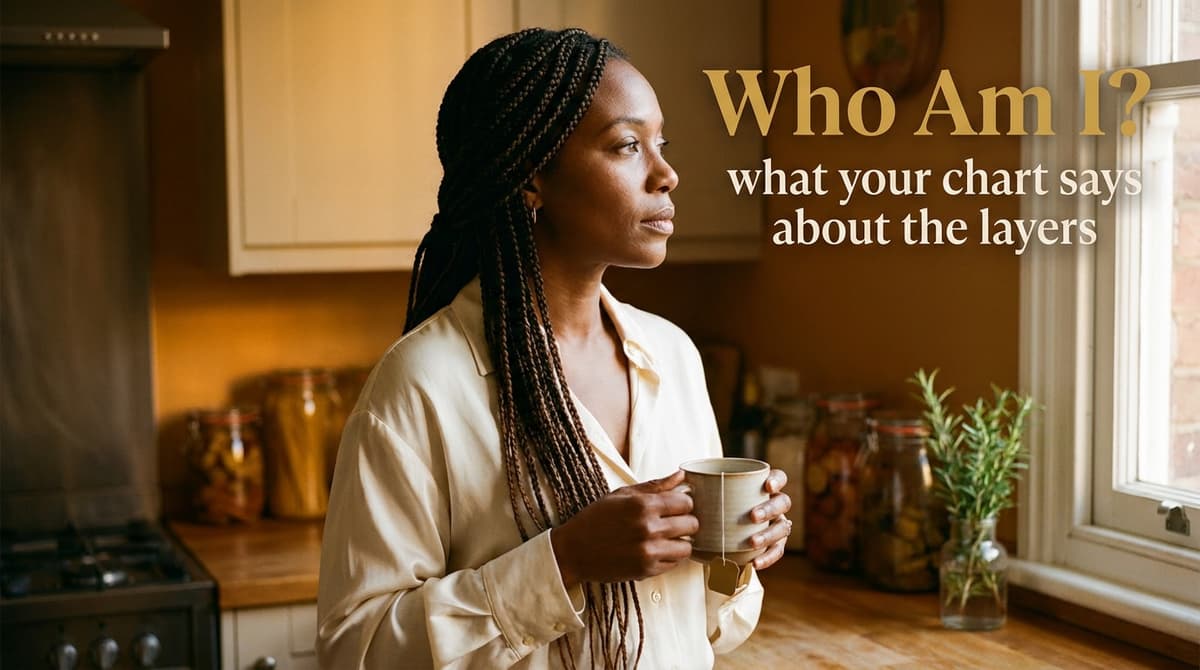
 leaning on rail, plant beside her.
What "toxic relationship" actually means — and what astrology won't claim
A "toxic relationship" is a relational pattern, not a personality type. It's a shape two people fall into in which the consistent effect on one or both of you is to be made smaller. Less yourself. More anxious. More guarded. Less able to recognise the person you were before the relationship began.
Some toxic patterns are slow-cooking and survivable: chronic invalidation, contempt that simmers, the steady erosion of small kindnesses. Some shade into abuse: coercive control, gaslighting, fear-based dynamics. Both versions are real and deserve to be named. The first sometimes responds to couples work; the second usually requires a safety plan first and a therapist second.
That distinction matters for what comes next. This article uses astrology as a vocabulary for the pattern underneath repeated choices — a way of naming the default that's running when you find yourself in the same shape twice. It is not a diagnostic tool, not a partner-rating system, and not a substitute for therapy or safety planning. If what you're reading describes something currently unsafe, please stop here and ring Refuge on 0808 2000 247. Astrology can sit alongside professional support; it can't replace it.
What astrology can do is offer language for a pattern. Three placements in your birth chart describe the parts of you that tend to run on autopilot when relationships begin.
Why patterns repeat: Venus, Mars, and the partnership house
Relationship patterns repeat because most of us run on partner-defaults we never consciously chose. Psychology has names for this: attachment style, repetition compulsion, schema therapy's "lifetraps". Astrology gives the same idea three pieces of vocabulary — Venus, Mars, and the seventh house.

Venus describes what attracts you on autopilot — the type of person your eye and your nervous system go to before your thinking-self has a vote. Mars describes how you handle friction on autopilot — the way conflict tends to come out of you. And the seventh house, traditionally the partnership house, describes the archetype of partner you tend to find yourself opposite — often a shape that mirrors something in you that hasn't been fully integrated yet.
Three placements, three different scales. Together they describe a default attraction-conflict cycle that often runs underneath repeated choices, quietly, until someone — a friend, a therapist, a chart — gives it a name. Naming a default isn't a verdict; it's the noticing step. The bit that usually has to happen before change does. The same pattern of unconscious repetition shows up in other corners of life too; the feel-like-a-fraud version is a related shape that uses different placements but follows the same noticing-first logic.
Three placements to notice when the pattern repeats
There are three placements worth looking at when the same shape keeps recurring. None of them is the whole story; together they sketch the default.

Venus: what attracts you on autopilot
Your Venus sign describes the default in what you find appealing — often before you've thought about it. A Venus in Capricorn often defaults toward people who read as competent and serious; a Venus in Scorpio often defaults toward intensity; a Venus in Pisces often defaults toward soft people who feel like coming home. The defaults aren't bad. They're just defaults.
The question worth sitting with isn't is my Venus toxic? — Venus describes a function, not a verdict. It's what does my Venus reach for first, and does it keep delivering the same painful shape? Venus doesn't doom you to anything. It describes a starting point, not an ending.
Mars: how you handle conflict on autopilot
Your Mars sign describes how friction tends to come out of you when the relationship hits a wall. Mars in Scorpio often defaults to all-in or all-out — doesn't handle small distances well. Mars in Libra often defaults to peace-keeping past the point of self-cost. Mars in Aries often defaults to fast confrontation, the row out loud before the thinking-self has caught up.
Toxic patterns often live in Mars-mismatch. One partner pushes; the other freezes. Both feel unheard. Mars describes a pattern; it doesn't excuse one. My Mars is fiery is an observation, not a defence.
The seventh house: the partner-shape you tend to mirror
The seventh house describes the kind of partner you keep finding yourself opposite — often a shape that mirrors something you haven't yet integrated in yourself. If your seventh house has Pluto on the cusp or in close aspect, you may keep finding yourself in intense, high-stakes partnerships. If Neptune sits there, the recurring shape may be confusion, idealisation, or rescue dynamics. If Saturn, the recurring shape may be partners who carry weight — age, seniority, a particular kind of seriousness.
The seventh house describes a recurring shape; it does not approve of it. Recognising the shape is the start of changing your relationship to it. (For more on how partnership comparison works in astrology, the astrological compatibility guide walks through the method.)
A worked example: Capricorn Venus, Scorpio Mars
Here is one combination read end to end. The chart is illustrative — a plausible composite, not a real person — and is here so we can walk through how the three placements weave together into a pattern.

Venus in Capricorn, Mars in Scorpio.
What attracts her on autopilot — Capricorn Venus. She's drawn to people who read as composed, capable, in charge. A bit older sometimes. Often professionally senior. Often emotionally reserved in a way she reads, at first, as depth. The attraction is real; the reasoning behind it is partly that in charge feels safe to her nervous system. There's nothing wrong with this default — it only becomes a problem when it keeps delivering the same painful shape.
How she handles friction — Scorpio Mars. When something is wrong, she goes all-in or all-out. She doesn't tolerate small distances well — either she's pursuing or she's gone completely.
How the pattern builds. She meets someone whose composure she reads as strength; the Capricorn Venus does its work in the first ten minutes. He's emotionally guarded; she reads guarded as depth. The early months are intense, slightly intoxicating. Then a real disagreement arrives. He withdraws, because that's what guarded people do under pressure. Her Scorpio Mars doesn't tolerate the withdrawal; she pursues harder. He withdraws further. Eventually one of them blows up, or one of them goes silent for good. Six months later she's back at the kitchen table with a friend who has loved her through three of these, and the friend says, love, it's the same shape again.
If reading this and you recognise that the pattern you're in right now is less painful repetition and more I am afraid of him — please stop here and ring Refuge on 0808 2000 247, or in immediate danger, 999. Pattern-recognition belongs to a quieter conversation than safety-planning does.
'Isn't this just blaming the chart?' A fair question. The claim isn't that your Venus made you choose anyone, or that your Mars excuses any behaviour. The claim is much smaller: the chart names a default — a starting attraction, a default conflict mode — that's usually invisible. Naming a default isn't blaming it. It's the first thing therapists and most reflective practices do before any change happens.
The chart isn't predicting this woman's next relationship; it's describing the default attraction-conflict cycle that her particular Venus-and-Mars tends to run when it's not being noticed. Once it's noticed, the cycle can be interrupted — usually in therapy, in journalling, in slow practice with a counsellor or a thoughtful friend, not in the chart. The chart names. The therapist works. Astrology sits alongside that work; it cannot replace it.
What astrology CAN do here — and what it really can't
It's worth being honest about the size of the claim, because most online astrology over-claims badly here, and most online psychology ignores astrology altogether. Both are doing the reader a small disservice.
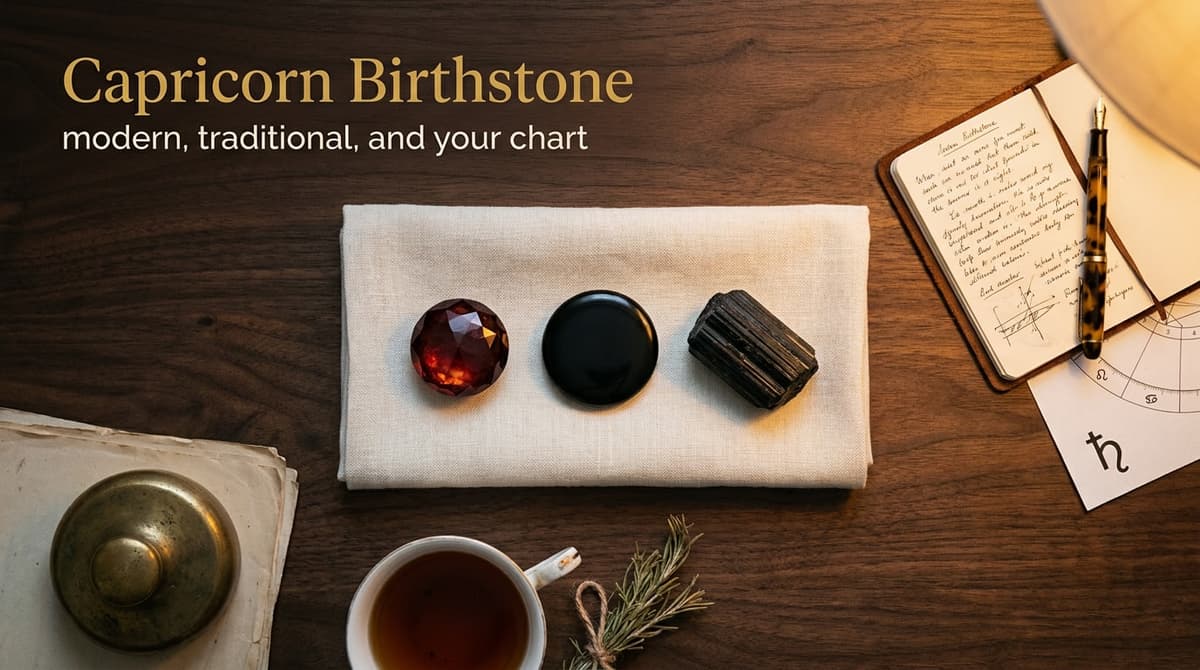
 turning a page slowly.
Astrology can offer vocabulary for the pattern. It can give you language for the default attraction (Venus), the default conflict style (Mars), and the recurring partner-shape (seventh house). It can lower the heat of shame by replacing what's wrong with me? with oh — this is a known shape. Naming a thing accurately is often the first move in changing your relationship to it. (For a wider view of astrology-as-self-reflection, the self-understanding piece sits next door.)
Astrology cannot, however, diagnose your partner. Don't try; a chart isn't a diagnostic tool, and a partner isn't a chart. It cannot, on its own, fix the pattern — the actual shift in how you feel and what you tolerate happens through therapy, through journalling, through trusted friendship, through slow practice. It cannot keep you safe; if the relationship is unsafe, the helplines and your GP are the right resources, not this article. And it cannot predict whether your next relationship will be different. It can describe the default; you change it.
Astrology sits alongside that work; the chart is the map, you still have to walk it.
When you need a person, not a chart
 reading handwritten letter.
Some moments are not for chart-reading. Some moments are for ringing a person. If any of the following applies to you right now, please put this article down and use the relevant number.
- If you are in danger right now — call 999 (UK emergency services).
- If you are not in immediate danger but the relationship is abusive, controlling, or you are afraid — call Refuge on 0808 2000 247 (free, 24/7, UK National Domestic Abuse Helpline). They will listen. They will not pressure you to do anything you're not ready to do. You can also reach Women's Aid for support, planning, and safe options.
- If you are not in danger but your mental health is suffering — speak with your GP about a referral to NHS talking therapies, or contact Mind on 0300 123 3393 (Mon–Fri 9am–6pm) for information and support.
- If you are in crisis or having thoughts of self-harm — please contact Samaritans on 116 123 (free, 24/7).
- If you want to work on the pattern with a professional — couples counselling is available via Relate, and individual therapists can be found through the BACP register or the Mind directory.
A chart can give you language. Only a person can hear you. If you're hesitating between booking a session and reading another article, please book the session first.
If you want to see your own Venus, Mars, and seventh house in one place, WowAstro will calculate a free birth chart for you. Date, time and place; it takes a couple of minutes. The chart won't tell you what to do next — that bit is yours — but it'll show you the shape.
Frequently asked questions
What makes a relationship 'toxic'?
A relationship is toxic when its consistent effect on you is to make you smaller — less yourself, more anxious, more guarded — rather than steadier. The plain-English word covers a wide range: chronic invalidation, contempt, gaslighting, control, fear-based dynamics. Some toxic patterns are survivable with serious couples work; some shade into abuse, which requires a safety plan first and a therapist second. If you're not sure where on that spectrum you sit, Mind and Refuge both have plain-English assessment guides written by people who do this for a living. Astrology can help you notice a pattern; it can't tell you whether you're safe.
Can astrology really explain why I attract toxic partners?
Astrology can offer vocabulary for the default pattern; it can't offer a full explanation. It can describe what you tend to be drawn to (Venus), how you tend to handle friction (Mars), and the partner-shape that tends to recur (the seventh house). The deeper why — childhood patterns, attachment style, lived experience, sometimes trauma — sits in psychology, not in the chart. The chart names; the therapist works. The two answer different questions; they aren't substitutes for each other.
What's a Venus-Mars contact?
A Venus-Mars contact is an aspect — a geometric angle of roughly 0°, 60°, 90°, 120°, or 180° — between your Venus and your Mars, or between your Venus and a partner's Mars when two charts are compared in synastry. It describes how attraction (Venus) and assertion or desire (Mars) interact. Some contacts feel easy; some feel charged and intense. A small but important note: intensity is not a green flag in a relationship. Sustainability is. A strong synastry contact tells you something is loud between you; it doesn't tell you whether the relationship will be good for either of you.
When should I get professional support?
Sooner than you think, and definitely if any of the following describes you right now: you are afraid of your partner; you walk on eggshells around them; you have stopped seeing friends or family because of them; the relationship is affecting your sleep, your work, or your sense of safety. In the UK, Refuge on 0808 2000 247 is the national domestic abuse helpline (free, 24/7). Mind on 0300 123 3393 (Mon–Fri 9am–6pm) is the mental-health information line. Samaritans on 116 123 is for crisis, free and 24/7. For ongoing therapy, your GP can refer you to NHS talking therapies, or you can find a therapist via the BACP register, Mind directory, or Relate for relationship-focused counselling. Astrology can sit alongside any of these conversations; it cannot replace them.
By Oksana Miatova, astrologer and writer at WowAstro. Charts calculated using the Swiss Ephemeris.
About this article: WowAstro readings combine traditional astrological methodology (Swiss Ephemeris calculations, Hellenistic and modern psychological frameworks) with AI-assisted writing reviewed by Oksana Miatova before publication. For entertainment and self-reflection only — not medical, legal, or financial advice. Full editorial policy at /editorial-standards.
Astrology, as we use it at WowAstro, is a tool for self-reflection and self-understanding, not a method for predicting events, diagnosing relationships, or telling anyone what to do.
If anything in this article landed close to a difficult truth and you'd like to speak to someone: — In the UK, Refuge on 0808 2000 247 is the national domestic abuse helpline (free, 24/7). — Mind on 0300 123 3393 (Mon–Fri 9am–6pm) for mental-health support. — Samaritans on 116 123 (free, 24/7) if you're in crisis. — Your GP for a referral to NHS talking therapies, or Relate for relationship counselling. Astrology, used honestly, sits alongside professional support; it is not a replacement for it.
See what your charts say about each other
A personal AI synastry reading — not a sun-sign table, but an analysis of both natal charts across 8 areas of the relationship
Comments
New here? Get −30% off your natal chart
Leave your email and we will send you the promo code WELCOME30. Straight after that you can comment — no passwords, all automatic.
Quick sign-in
Sign in with Telegram — one click.
Or by email (with a gift)
Already have an account? Enter the same email — we'll email you a sign-in link.