"Losing yourself" in astrology has a specific structural meaning: it usually points at a disconnect between your Sun sign (the core self you're growing into) and the placements that surround it — most often a strong Pisces, twelfth-house, or Neptune influence that dissolves the edges of the self, or a Saturn–Sun aspect that suppresses self-expression in favour of duty. The Sun is one of ten placements in a chart; when the other nine are louder for years, you can wake up not recognising what you actually want. This article describes the chart patterns most often behind that feeling, with practical first steps. If the experience is acute and persistent, speak with a GP or qualified counsellor — Samaritans (116 123) and Mind (0300 123 3393) are free UK helplines.
The hoover packed in halfway through the living room, and that was how Anna ended up sitting on the rug at three on a Sunday afternoon, two-and-a-half years after the divorce went through, realising she could not remember when she had last gone for a proper walk. She used to love walking. Used to read three novels a month. Used to know what she wanted to do on a Sunday. Lately, Sundays were a list of small tasks she did because no one else was going to. The thought arrived, almost as a quiet observation: I think I've lost myself. This article is for that specific moment, when a chapter of your life has finished closing (a divorce, post-illness recovery, the empty-nest landed, redundancy, the long caring role completed, post-grad) and the Sun-sign description you used to half-recognise yourself in suddenly feels hollow. Astrology, read traditionally, has a specific answer for that, and it starts with the actual sun sign meaning, not the magazine version of it.
In the canonical tradition, your Sun sign isn't a personality label. It's a direction of becoming: the through-line of who you're growing into across a lifetime. That's the part of the chart most people have heard of but few have heard properly. When a chapter ends, whether the divorce finalised, the empty nest now actually empty, the long caring role completed, the post-illness body still settling, or the post-grad year landing, the roles that were doing your self-naming for you go quiet. The layer underneath isn't fluent enough yet to take over the talking. The Sun, in astrological terms, is that quieter layer. This article reads the sun sign meaning back to that layer for that specific chapter-end moment.
A note on scope. This piece is for when a specific chapter has ended and the old self no longer fits. If the question runs deeper than that, and you've felt for a long time that you never quite knew who you were regardless of any chapter, the sister piece Who Am I? What Your Astrology Chart Says When You've Stopped Knowing takes a wider four-layer reading (Sun, Moon, Ascendant, South Node).
First, a serious note. If what you're experiencing feels heavy (persistent low mood, panic that won't lift, or thoughts of self-harm), please talk to your GP or contact Samaritans (116 123, free 24/7). Astrology can sit alongside professional support; it cannot replace it. This article is for self-reflection. Astrology and therapy answer different questions; use them together if you need both.
Astrology has a name for the layer that didn't dissolve. It calls it your Sun sign, and reads it not as a personality label but as a direction of becoming. The roles went; the direction stayed put.
In short. "I've lost myself" is often what it feels like when a life pivot (divorce, redundancy, empty-nest, illness, geography) dissolves the roles that were doing your self-naming for you. The roles were loud; the noise of them going can mask the direction underneath. Your Sun sign, read traditionally as a direction of becoming rather than a personality label, is one name for that through-line. Astrology doesn't fix the dissolution. It can give the layer underneath a name. This is a self-reflection lens, not a substitute for therapy or medical advice.
When "lost myself" maps to chart patterns
| Chart pattern | What it tends to feel like | What it asks for |
|---|---|---|
| Strong Pisces / Neptune / 12th house | Edges of the self dissolve; you absorb other people's moods | Practices that name "this is mine / this is theirs" |
| Sun–Saturn hard aspect (square, opposition, conj.) | Self-expression feels suppressed by duty or self-criticism | Permission to be visible without earning it first |
| Sun in 6th, 8th or 12th house | The self feels structural rather than personal | Time alone with no productive purpose |
| Moon overpowering Sun (water Moon, fire Sun, etc.) | You feel what's around you more loudly than what you want | Slow listening to the Sun's quieter signal |
| Saturn return (28–30 or 58–60) | The shape of life you built no longer fits | Rebuilding around what is genuinely yours, not inherited |
 potting seedlings, soil-stained hands.
What 'I've lost myself' actually means
'I've lost myself' usually doesn't mean what it sounds like. It more often means that a particular layer of identity, the one that was doing the naming for you, has dissolved, and the quieter layer underneath hasn't found its voice yet.
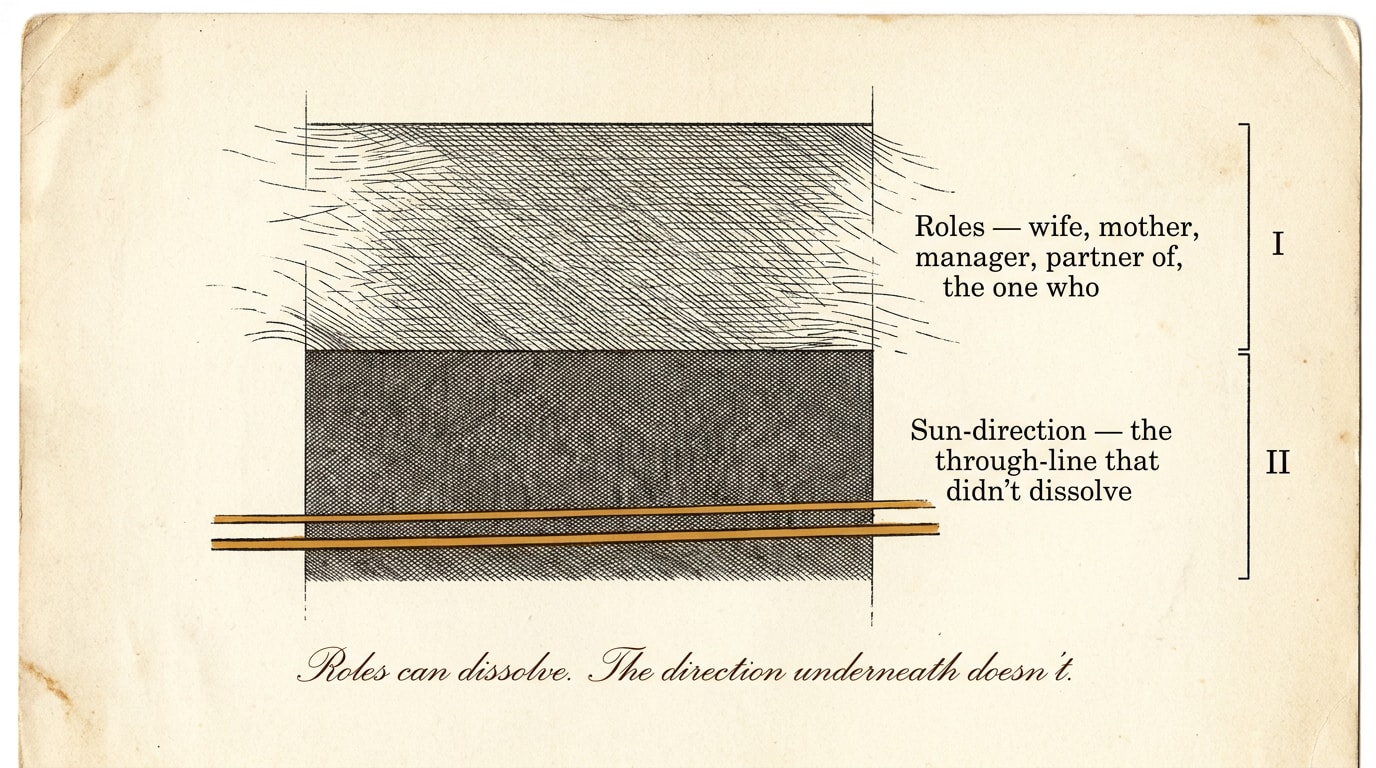
The phrase almost always sits just downstream of a transition. Something has changed in the role-layer, and the description you used to give yourself (I'm the school-mum, I'm the senior copywriter, I'm the partner of, I'm the person who looks after Mum) has thinned out faster than the underneath could replace it.
Identity is stacked, structurally. Roles on top: what you do, who you do it for, what people call you in the supermarket. Core underneath: your values, your temperament, your direction of becoming. When the role-layer dissolves quickly, the core feels suddenly bare. Bare isn't gone. It's under-rehearsed. It was the role that was doing most of the speaking; the core is going to need a minute to find its own voice again.
This is the part where language matters carefully. This article uses astrology as a self-reflection lens, a vocabulary for what's underneath the dissolved layer. It isn't a substitute for therapy or medical advice. Astrology and professional support answer different questions; use them together if you need both. A quick reminder: if the patterns described here feel less like I sometimes don't recognise myself and more like I can't function, that's a Mind (0300 123 3393) or GP conversation, not an astrology one. The two aren't competing; they answer different questions, and good help often involves both.
Why your Sun didn't go anywhere
Your Sun sign is the part of your chart that describes a direction of becoming, and unlike your role-identities, it isn't something life events can dissolve. In the canonical tradition (Liz Greene's Jungian school, Stephen Arroyo's psychological astrology, Robert Hand's symbolism) the Sun isn't treated as a personality label at all. Hand calls it the conscious self. Greene reads it as the individuation process: the long-arc direction of who you're becoming over a lifetime, not who you happen to be on any given Tuesday. A direction, not a verdict.
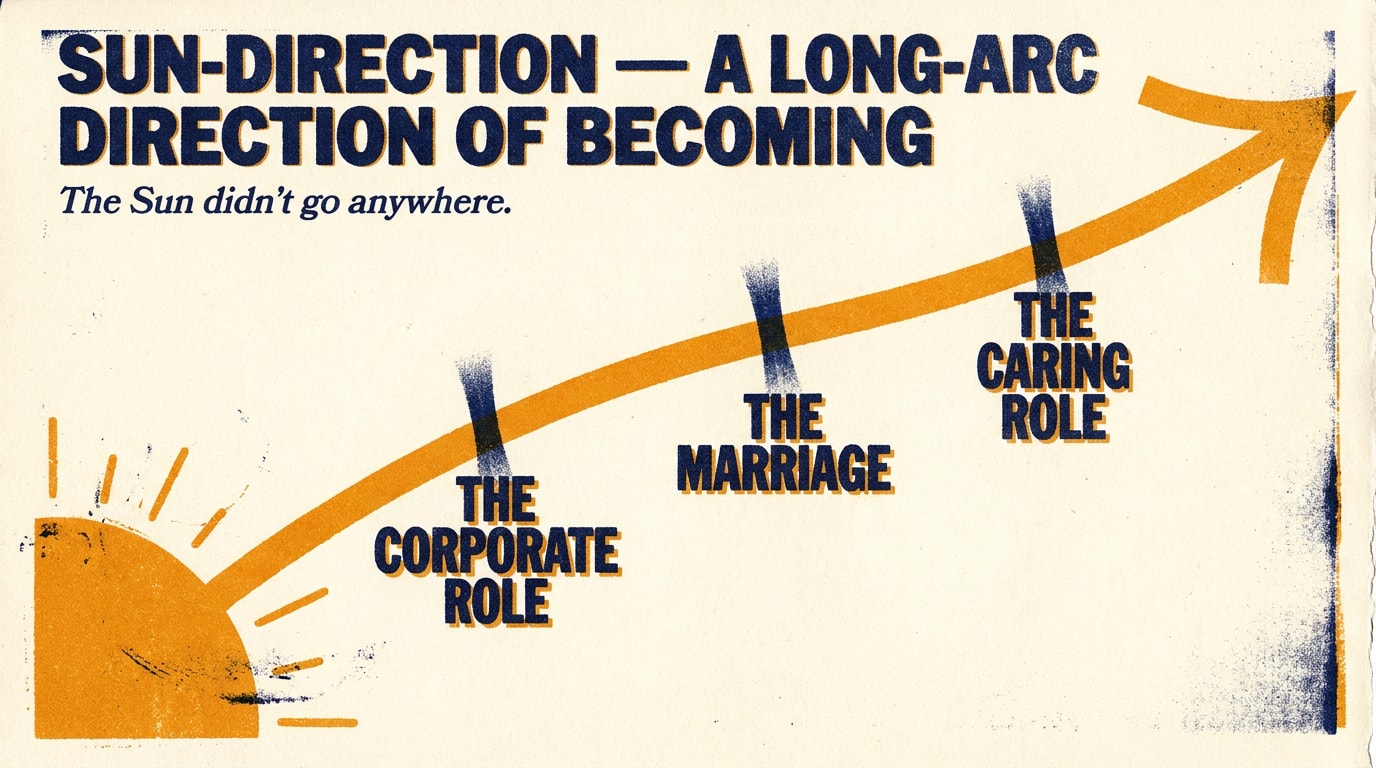
This is the bit that makes the post-pivot reading useful. Roles live in the social world. They were given to you, played, performed, taken away. They can be lost because the place they live is the place where things change. Your Sun sign, in astrological terms, doesn't live in the social world. It lives in your chart, where it has been since the moment of your birth, and it stays put when everything around it moves. The Sun is one of the four foundational placements anyone with a chart can read first, and of those four, it is the one with the longest arc.
The roles dissolved. The direction didn't. The two were never the same thing; they only sounded similar when life was going steadily.
 leaning back in chair, eyes closed briefly.
Reading your Sun when the rest of you is in flux
When the role-layer of identity is in flux, three specific questions about your Sun sign tend to be more useful than a generic personality description. These are reading-frames, not prescriptions.
Direction, not label. What was your Sun-sign direction doing before the role started speaking for it? A Capricorn Sun isn't ambitious as a label; it's a direction toward sustained, structured competence, which can show up as a corporate career, or as building a slow-grown garden, learning an instrument over a decade, raising children with quiet consistency, restoring an old house room by room. The role that just dissolved was one expression. The direction has other expressions waiting.
The second frame is about temperament rather than output. Your Sun-sign describes how you process the world before you decide what to do with it. A Cancer Sun has a tidal, atmospheric way of receiving information; a Sagittarius Sun has a horizon-seeking, big-picture-first way; a Virgo Sun has a particular and detailed way. Temperament doesn't disappear with redundancy or with divorce. It's been there underneath the role the whole time, broadly the same since you were a child.
The third is the quietest of the three. A direction means not yet finished, almost by definition. Your Sun-direction has territory you haven't fully explored, because the role-layer was busy taking up most of the available daylight. When the role-layer dissolves, the disorienting good news is that there's space for those unexplored expressions to come forward. (This isn't a promise; we don't make those.) It's a description of what a direction structurally is: a line that has further still to run.
You can read your Sun three ways at once: direction, temperament, becoming. None of these were lost in the pivot. They were just being spoken-over.
A worked example: Capricorn Sun in a Pisces moment
Here is how 'roles dissolved, direction intact' reads in one case: a person with Capricorn Sun whose marriage has just ended. The chart is an illustrative composite, not a real person. The Capricorn Sun is chosen because it's a sign culturally over-identified with role-output, which makes the pivot-feeling particularly sharp.
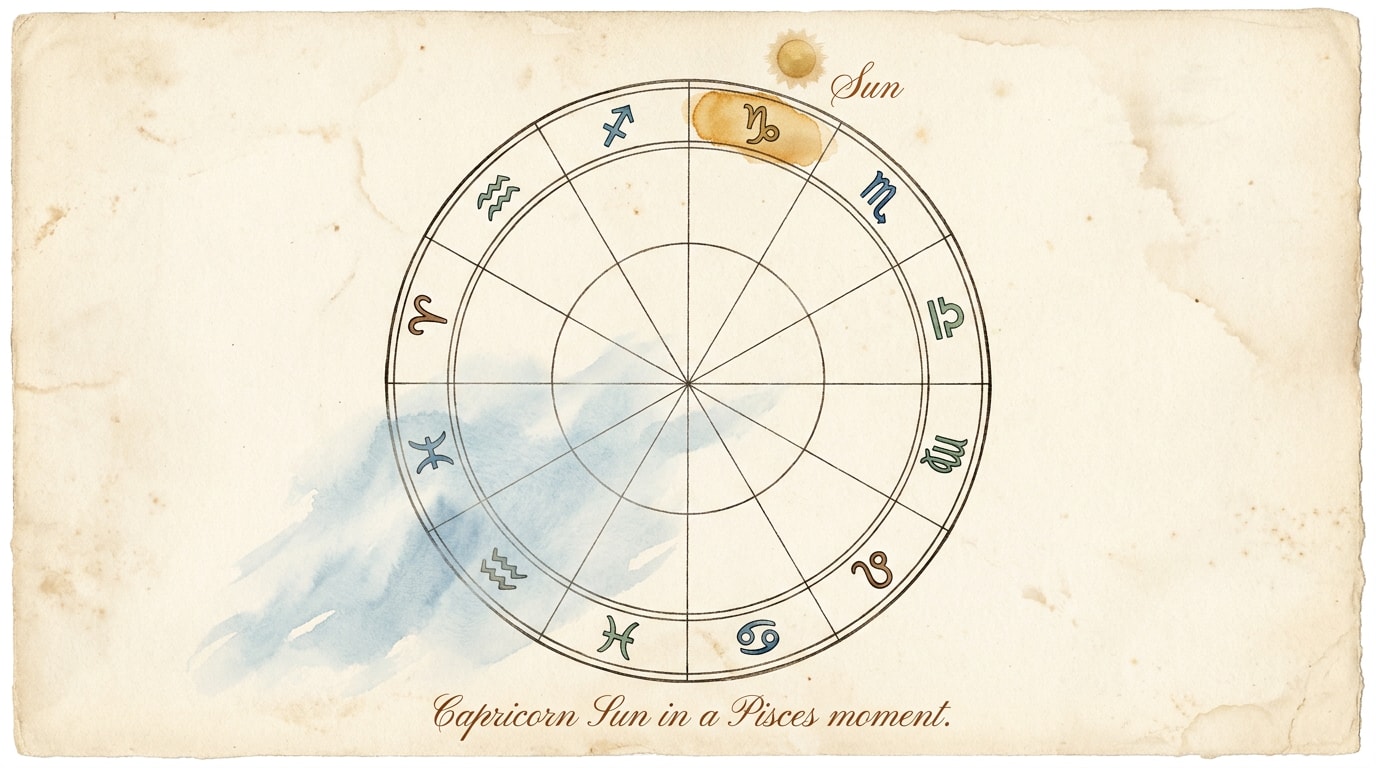
Before the pivot. The Capricorn-Sun direction (toward structure, sustained competence, building things that hold over time) was being expressed through the marriage-and-family arrangement. She ran the household calendar, handled the school applications, knew the family budget down to the milk delivery. From the outside, a wife and mother who got it done. From the inside, steady, slightly stretched, sometimes tired, but on her own ground.
Then divorce comes through over six months. By the end, the role-platform for that direction is gone. Calendar isn't hers to run; school choices are co-parented; the budget is two halves and a more complicated set of conversations. The Capricorn-Sun direction has nowhere it used to go. Inside, this lands as I don't know what I do all day, which she translates, accurately enough, as I've lost myself.
What's around her now feels foggy, formless, unstructured. In astrological symbolism, Pisces (and its modern ruler, Neptune) is associated with exactly that: dissolution, mist, the absence of edges. The period itself feels Piscean. It isn't her Sun-sign; it's the texture of the time she's in.
So what's actually happened? The Capricorn-Sun direction hasn't dissolved. It's been disconnected from the role-platform that was carrying it. The direction itself is still there. It will eventually find a new platform: a slow project, an evening course, a small consultancy, a garden, a Sunday discipline. For now, the work is to recognise that the direction is intact, even in the Piscean fog.
The Sun-direction was never on the platform; it was using the platform. The painful part is the gap between platforms, and that gap has a name in astrology too: a Pisces moment, regardless of your actual Sun sign. The fog isn't proof you're gone. The fog is the period.
'Isn't this just pseudoscience?' A fair question. You don't have to believe planets cause anything for this to be useful. What a chart does, mechanically, is hand you a structured prompt for self-reflection: the same kind of thing journalling apps, personality frameworks, or therapy intake forms do. We aren't predicting events. We're using a centuries-old vocabulary to name two layers (role and direction) that most people already feel during a pivot. The question does astrology work? is the wrong one. The right one is does naming the layer underneath help me notice it again?
A reflective practice: three Sun-sign prompts
Once you can name the layer underneath, you can use your Sun sign as a reflection prompt rather than as a personality verdict. This is journal territory, or quiet thinking time over a cup of tea — not a script for a session with a professional, and not a method to talk yourself out of real distress.
 leaning on counter watching kettle boil.
Three prompts worth turning over slowly, one at a time. First: What was my Sun-sign direction doing through the role that just dissolved? What was it getting expressed through, and what part of the expression was about the role rather than about the direction? Second: What's a small, low-stakes way the same direction might be expressed now, without a role-platform underneath it? Not a five-year plan. A Sunday afternoon experiment. Third: What about my Sun-sign temperament has been quiet for a long time because the role was loud, and what would it feel like to let it be louder for a week, just to see what shows up?
Sit with the prompts more than with the answers. The work is noticing the layer underneath has a shape. A chart can name what's happening; it can't fix it on its own. The actual shift in how you feel day to day usually happens elsewhere — therapy, journalling, time, support, sometimes medication, often more than one of those. The chart is a map. You still have to walk.
If the feeling stays loud and starts interfering with sleep, work, or your sense of safety, that's the moment to talk to someone qualified. (If you found yourself reading the piece on impostor syndrome and recognised something different — that the gap was between how others see you and who you're becoming — that's another shape worth naming, and a different mechanism.)
What an astrology lens does here. It gives the layer underneath a name. Not a verdict, not a treatment, but a vocabulary that lets the feeling become less personal and more describable. The point isn't to find a new identity. The point is to notice that something underneath the dissolved one is still there, and has been all along.
When to ask for help
Astrology is not a substitute for therapy, grief counselling, or medical advice. If the feeling outpaces recognition, the next step isn't more astrology; it's a conversation with someone qualified.
Some specific markers that this is a Mind, Samaritans, or GP conversation rather than a chart conversation: sleep significantly disrupted for more than a few weeks; inability to do work or basic daily tasks; persistent low mood that doesn't lift with normal recovery time; panic that won't subside; any thoughts of self-harm; a sense that the dissolution is shading into something that frightens you.
Astrology, used honestly, sits alongside professional help. It doesn't compete with your GP or your therapist. If you're hesitating between booking a session and reading your chart — book the session first.
In the UK, Samaritans (116 123, free, 24/7) and Mind (0300 123 3393) are good starting points for talking to someone qualified. Your GP can refer you to NHS talking therapies, and in most areas you can also self-refer. These services exist precisely because life pivots are normal, and getting good help through them is normal too.
If you want to see your own Sun sign (its sign, its position, and the other foundational placements that sit alongside it), WowAstro will calculate a free birth chart for you. Date, time and place; it takes a couple of minutes. Useful, particularly, to look at the through-line that didn't move when everything else did.
Frequently asked questions
What does 'I've lost myself' mean?
'I've lost myself' usually describes the feeling that arrives after a life pivot (divorce, redundancy, empty-nest, the end of a long caring role, a geographic move, a serious illness), when the roles that were doing your self-naming for you dissolve faster than the layer underneath can find its voice. This is normal experience after transition. It is not, in itself, a clinical condition (the DSM does not list 'lost self' as a disorder), and most people work through it as the underneath layer slowly becomes audible again. If it outpaces normal recognition, affecting sleep, work, or your sense of safety, that's a professional conversation. Astrology can sit alongside that, not replace it.
Can my Sun sign help me find my direction?
Your Sun sign can describe a direction of becoming: temperament, long-arc shape, the kind of expressions that feel like home over time. That direction doesn't dissolve with role-changes. It will not tell you what to do next, and it doesn't predict. It points at a shape; the choices about new platforms and new expressions are still yours to make. The Sun gives you a name for the through-line rather than a recipe for the next chapter.
Is astrology a substitute for therapy?
No. Astrology, used honestly, is a self-reflection lens. It is not a substitute for therapy, grief counselling, or medical advice. If you're struggling enough that it's affecting work, sleep, or relationships, please see your GP or contact Mind (0300 123 3393), which has a free directory of UK therapists. The NHS offers talking therapies via self-referral in most areas. Samaritans (116 123) is free, 24/7 if you need to talk to someone in the moment. A chart can give you language for what you feel; a therapist gives you tools to work with it. They aren't substitutes for each other.
What's the difference between my Sun and my whole chart?
Your Sun sign is one of about a dozen foundational placements in your birth chart. The chart as a whole describes more than the Sun can on its own. Sun = direction of becoming. Moon = emotional weather. Rising sign = first-impression layer. Houses = the areas of life where these energies show up. The Sun alone is a useful anchor for I've lost myself specifically because direction is the layer the question is asking about, though a wider read can be useful when the question is broader. Our broader guide to astrology for self-understanding walks through more of the chart, if that's the way you want to look at it.
By Oksana Miatova, astrologer and writer at WowAstro. Charts calculated using the Swiss Ephemeris.
About this article: WowAstro readings combine traditional astrological methodology (Swiss Ephemeris calculations, Hellenistic and modern psychological frameworks) with AI-assisted writing reviewed by Oksana Miatova before publication. For entertainment and self-reflection only — not medical, legal, or financial advice. Full editorial policy at /editorial-standards.
Astrology, as we use it at WowAstro, is a tool for self-reflection and self-understanding, not a method for predicting events, health, or financial outcomes.
This article is for self-reflection and entertainment. If feelings of dissolution, anxiety, or self-loss are overwhelming or persistent, please speak with a qualified counsellor, therapist, or your GP. In the UK you can also contact Samaritans on 116 123 (free, 24/7), Mind on 0300 123 3393, or visit Mind.org.uk for resources and a directory of qualified UK therapists. Astrology can sit alongside that conversation; it is not a replacement for it.
Read your own natal chart
A personal AI reading, from £1
⭐ +50 Wow Stars cashback · sign up and get 100 ⭐
Build my chart →Comments
New here? Get −30% off your natal chart
Leave your email and we will send you the promo code WELCOME30. Straight after that you can comment — no passwords, all automatic.
Quick sign-in
Sign in with Telegram — one click.
Or by email (with a gift)
Already have an account? Enter the same email — we'll email you a sign-in link.