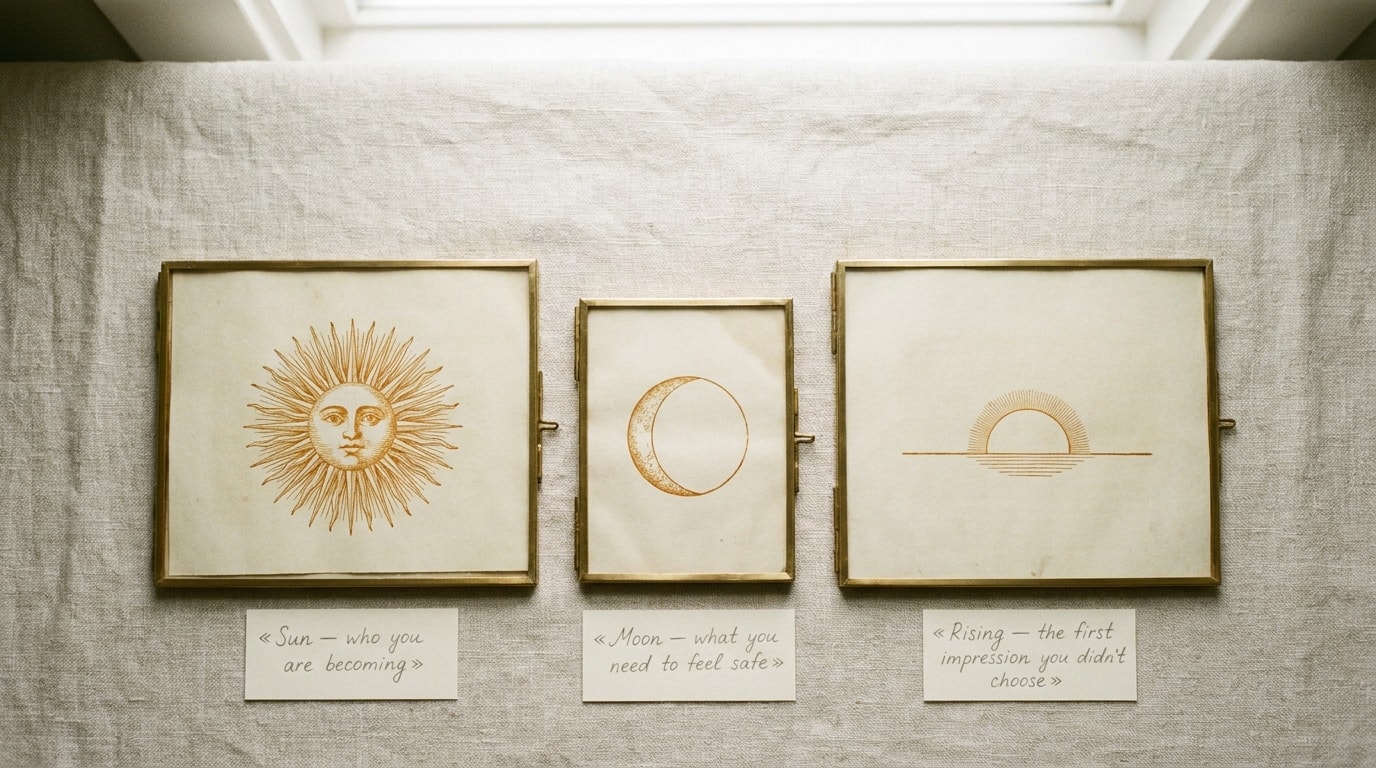
Three signs come up so often in astrology now that they have a nickname: the big three. Sun, Moon and Rising. People swap them on first dates, list them in dating-app bios, and ask each other "what's your big three?" as if it's a quiz with three answers instead of one.
It isn't, quite. The big three aren't three separate verdicts on you; they're three different questions about you, and the interesting bit is how the answers fit together. This guide reads them as one short description, not three carded-up boxes.
In short. Your big three in astrology are your Sun sign, your Moon sign and your Rising sign — also called your Ascendant. The Sun describes the core you're growing into, the Moon describes what you need to feel safe, and the Rising describes how strangers first read you. Together they sketch a quick portrait. They aren't your whole birth chart and they don't predict events; they're a starting point for self-reflection.
 "What's your big three?" over flat whites.
What the big three in astrology actually means
The big three in astrology refers to three placements in your birth chart: your Sun sign, your Moon sign and your Ascendant (the sign rising on the eastern horizon at the minute you were born). These three are the oldest shorthand in Western astrology for "the most important parts of a chart to read first", long before social media gave the trio a snappy name. Traditional and modern astrologers consistently rank them as the foundation of any first read; WowAstro calculates each of them using the Swiss Ephemeris, the same astronomical data professional astrologers rely on.
Yes, "big three" did go viral on TikTok around 2021. The nickname is new; the concept isn't. Astrologers were calling these three placements the heart of a chart well before the app existed. What social media added was the catchy framing and the small dopamine hit of trading them like collectible cards.
One honest note before we go further. Your big three is the first third of your birth chart, roughly speaking. A full natal chart has ten major placements and a layer of houses and aspects underneath. The big three is where you start because it carries the most signal for the least effort, but it isn't a verdict and it isn't a forecast. If a guide promises it'll predict your future from three signs, the writer has wandered off into fortune-telling. For the four-step way to read the rest of the chart once you've got these three, see the full step-by-step walkthrough.
Sun sign: who you're becoming
Your Sun sign is the core you're growing into: your sense of will, the life that lights you up, and the direction your character pulls in over years rather than days. It's the part most people mean when they say "I'm a Scorpio" or "I'm a Libra", and it's the one almost everyone knows from their birthday alone. The Sun moves through one zodiac sign roughly every thirty days, so date of birth gives you the answer without needing time or place.
The Sun is also one of ten major placements in a Western birth chart. Reading only your Sun sign is reading roughly a tenth of you, which is why your daily horoscope column so rarely fits. It's working with one slice and pretending the rest doesn't exist. That isn't a flaw in astrology; it's a flaw in horoscope columns.
Read your Sun as a direction more than a label. A Capricorn Sun isn't doomed to be a workaholic; it describes someone growing into seriousness, structure and a longer view than most of their peers. A Pisces Sun isn't a "vibe"; it describes a person whose centre is empathic and porous to other people's feelings. The Sun is the slow vector: where you're heading over a decade, not what you'll do on Tuesday. For more depth on each Sun sign, the twelve zodiac signs explained one by one goes through them in plain English.
Moon sign: your inner weather
Your Moon sign describes your inner emotional life: what you need to feel safe, how you process feelings in private, and what calms or unsettles you when no one is watching. The Moon moves quickly, changing signs every two and a bit days, so its position depends on the specific day you were born, and often on the time too, since the Moon can change sign in the middle of a date. To know your Moon for certain, you need an accurate birth chart.
A useful way to feel the difference: the Sun is who you're becoming in public, over years; the Moon is what you reach for at half past eleven on a tired Tuesday, with no audience. A Pisces Moon needs drift and time alone with feelings. A Capricorn Moon needs structure, even when no one else needs to see it. The Moon is interior weather: usually less visible than the Sun, often more determinative of mood.
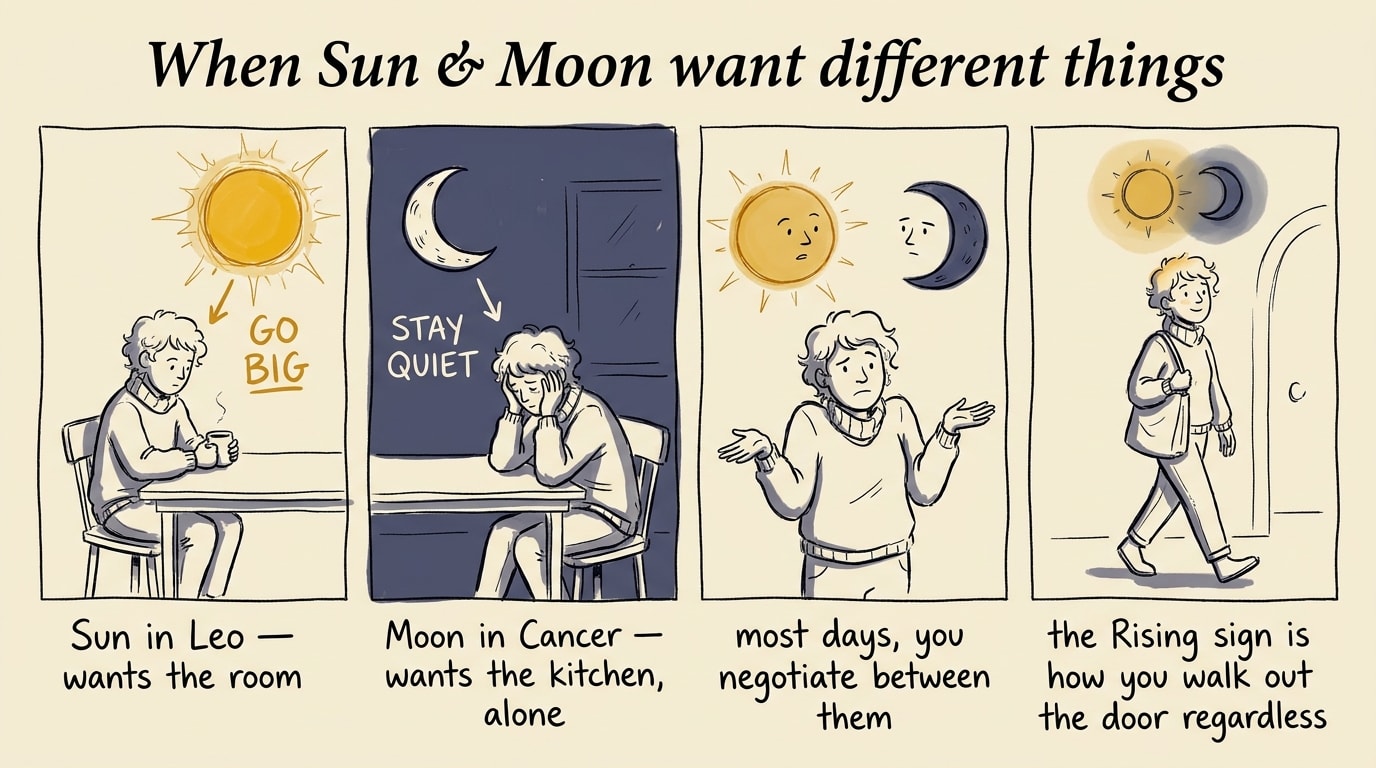
When your Sun and Moon don't match
This is the most common big-three question, by some distance. My Sun is adventurous Sagittarius but my Moon is homebody Cancer — which one is the real me?
Both, in different rooms. They aren't a contradiction to fix. They're answers to different questions: the Sun answers where am I growing, the Moon answers what do I need to feel safe along the way. A person can be growing into a bigger, more public life (Sun in Sagittarius) and still need a small, familiar home to recover in (Moon in Cancer). That's not a bug; that's most people.
Rising sign: the first impression you didn't choose
Your Rising sign — astrologers also call it the Ascendant — describes how strangers first read you in the opening seconds: your manner, your visible style, the surface that people meet before they meet you. It's the door other people walk through to reach you. The Rising moves on every two hours or so as the Earth turns, which is why the time you were born actually matters: without it, the Rising can't be calculated reliably.
A Gemini Rising registers as quick, talkative, restless on the surface, even when the Sun and Moon underneath are quiet and serious. A Capricorn Rising tends to read as composed and reserved, even if there's a fizzing Aries somewhere inside. The Rising is the interface layer; it can sit at a noticeable angle to both Sun and Moon, and that gap is normal. It's the reason people sometimes say "you're not what I expected" once they know you a bit.
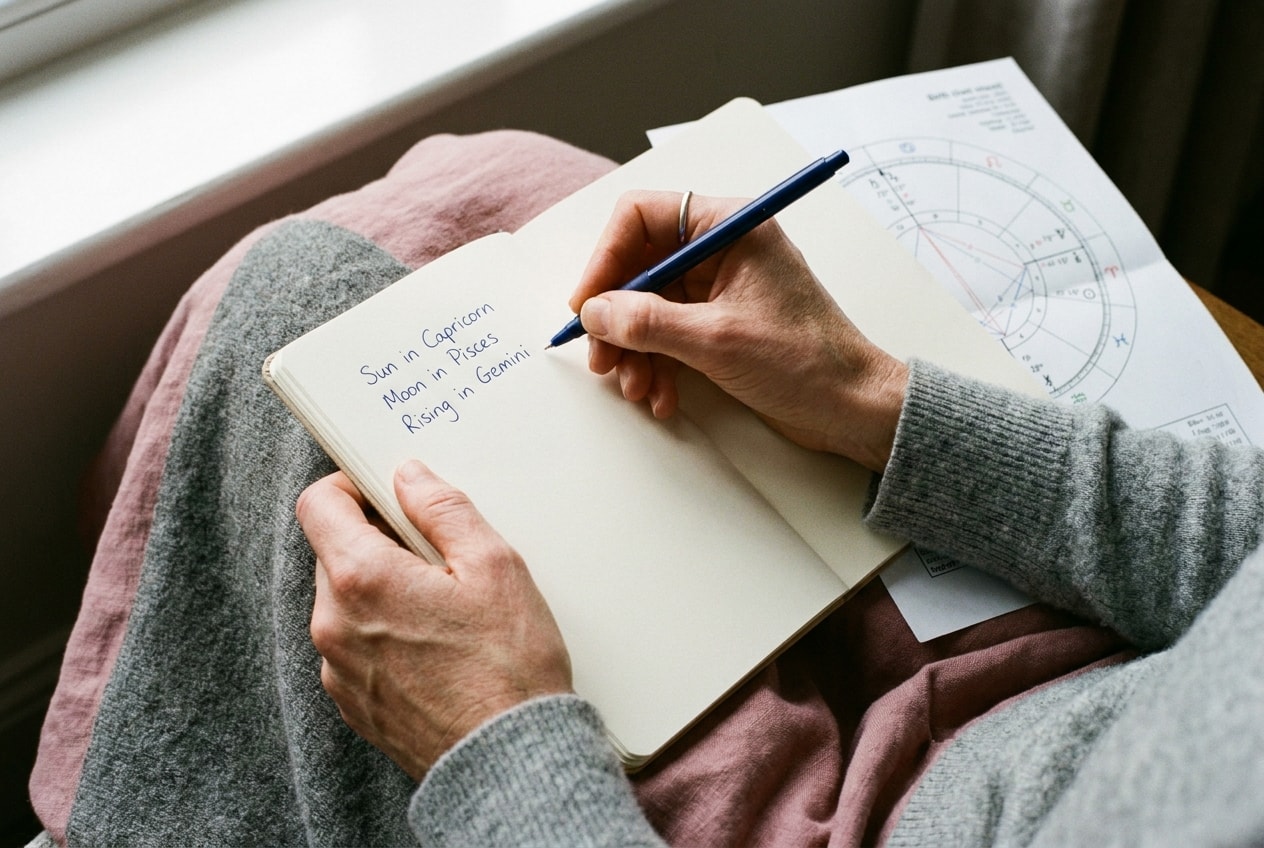 Three signs, three sentences, one person.
If you don't have a noted birth time, you can still read your Sun and Moon, but Rising will be guesswork. Hospital records, baby books and birth certificates usually have the time. Otherwise, an astrologer can do something called rectification: working backwards from key life events to estimate your birth time. It's specialist work, not something a free calculator does for you.
Reading the big three together: a worked example
Most big-three explainers describe each sign on its own and leave you to assemble them. Let's do the assembling, with one chart. The example below is illustrative (not a real person, just a plausible combination), but it shows how the three layers fit.
Sun in Capricorn. Moon in Pisces. Rising in Gemini.
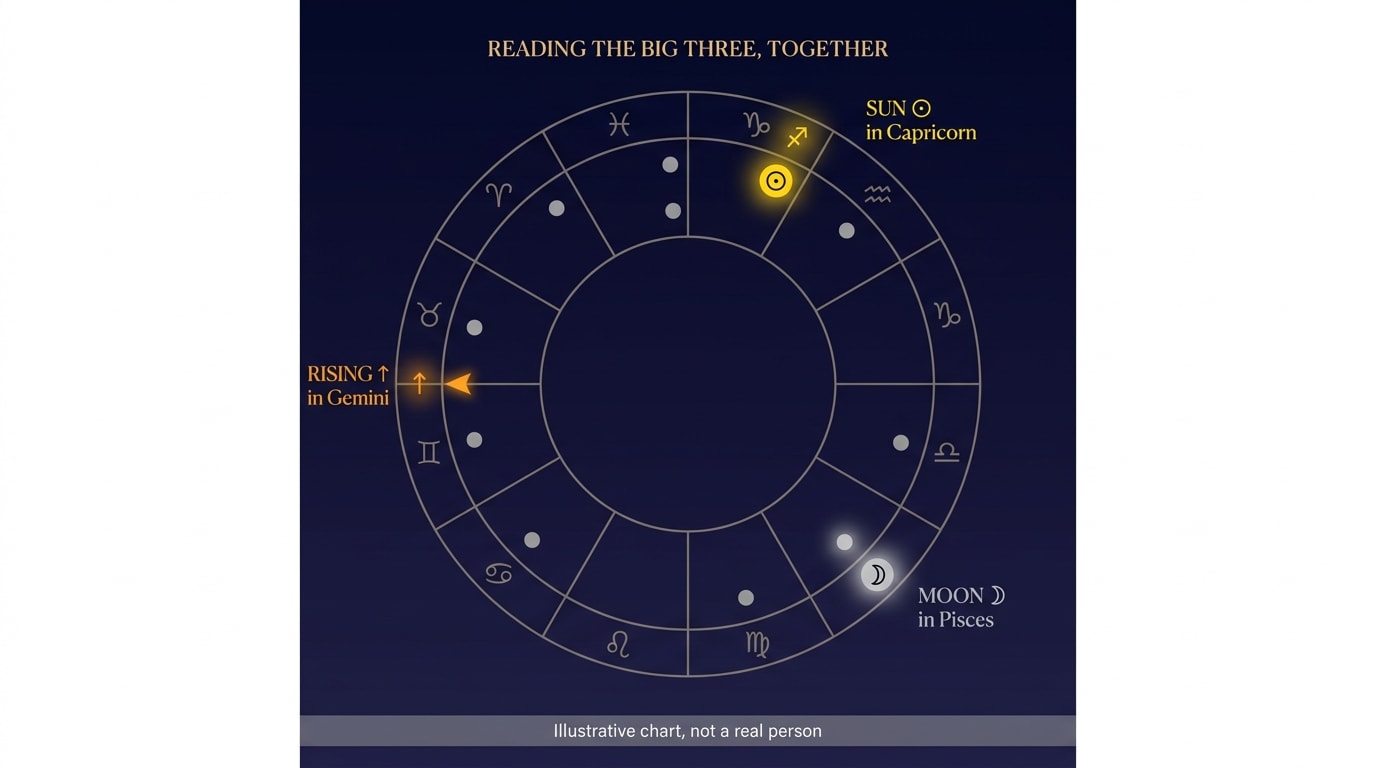
Three different answers to three different questions. The Sun in Capricorn says: this is someone whose core is growing into seriousness, responsibility and the long climb. They're building something, even if they'd shrug at the word "ambitious". The Moon in Pisces says: the inside is much softer than the outside lets on. Dreamy, empathic, in need of drift and quiet to come back to itself. The Rising in Gemini sets the surface as quick, light, conversational; the first impression is bright and talkative, with no advance notice that the Capricorn underneath is doing the long-term planning.
Three layers, one person. The bright, chatty surface (Gemini Rising) is the door. Behind it is the slow, structured, long-view climber (Capricorn Sun). Underneath that is the soft, dreamy interior (Pisces Moon) that almost no one sees. The "contradictions" (chatty vs serious, structured vs drifting) aren't contradictions. They're a description of someone with more than one register, who shows different parts of themselves to different rooms.
You can read your own big three the same way, in three sentences. Sun in X: this person is growing into Y. Moon in X: their inner life needs Y. Rising in X: strangers first see Y. Put the three sentences next to each other and notice what they describe together. That collected description, not any one sign on its own, is what your big three is for.
Key takeaway. Your big three is one short description of you, written in three questions: where you're growing (Sun), what you need to feel safe (Moon), and how strangers first read you (Rising). The interesting bit is how the three answers fit; the boring bit is treating them as three separate verdicts.
If you'd like to keep going past the big three, into the rest of the planets, your houses, and the aspects between them, the full step-by-step walkthrough picks up exactly where this article finishes.
 Sit with the description for a week.
What your big three is for
Your big three is most useful as a starting prompt for self-reflection, not a verdict to obey or a personality test to take. The three signs together describe a recognisable surface of you (your vector, your interior, your interface), but they don't tell you how you'll behave in every situation, and they certainly don't predict events. They're a sketch, not a film.
Try this. Find your big three (the easiest way is to pull a free birth chart). Read each one as a single sentence about you. Sit with the three sentences together for a week. Notice the moments they describe you accurately and the moments they don't. That noticing, not the symbols, is the actual work.
If you'd like to see your big three on your own real chart rather than an illustrative one, WowAstro will calculate a free birth chart for you. Date, time and place is the whole input, and it takes a couple of minutes.
Questions readers ask
How do I find my big three in astrology?
You find your big three by pulling a full birth chart from your date, time and place of birth. The chart shows your Sun, Moon and Rising along with the rest of your placements. Sun and Moon come from date alone (give or take a sign change on the day), but Rising needs the time accurately. A free birth-chart calculator that uses the Swiss Ephemeris is enough to read your big three; you don't need a paid reading for this first step.
What do my Sun, Moon and Rising signs mean together?
Together, your Sun, Moon and Rising are a three-question portrait of you. The Sun answers where your character is growing over years. The Moon answers what you need privately to feel safe. The Rising answers how strangers first read your manner. Reading them as one description (not three carded-up boxes) is the trick: the three answers describe a person with a public vector, an interior life, and a visible surface, and those three can sit at angles without anything being wrong.
Can I read my big three without my birth time?
Partly. If you don't have a noted birth time, you can still read your Sun and your Moon. Both are calculated from date and don't shift by minutes in most cases. Your Rising sign, however, can't be calculated reliably without a noted time, because the Ascendant moves on every two hours as the Earth turns. So without a time you have two of the big three confidently and the third as guesswork. Hospital records, baby books or birth certificates usually have the time. Failing those, an astrologer can do rectification, which means estimating your birth time from key life events.
Why don't my Sun and Moon match — is something wrong?
Nothing is wrong. The Sun and the Moon describe different layers of you and they often don't match. The Sun is the slow vector your character grows along, often visible in your work and public choices. The Moon is the interior, what you need privately and how you process feelings. A person can be growing into an ambitious Sun and still need a soft, quiet Moon at home; that gap is normal, and most of the interesting people you know have one. Your big three isn't asking you to pick a "real" sign and discard the others. It describes a person who reaches in more than one direction at once.
Read the wider context in our guide to your full birth chart
A note on what this is. Astrology, as we use it at WowAstro, is a tool for self-reflection and self-understanding, not a method for predicting events, health, or financial outcomes. Read your big three as a description, take what's useful, leave the rest.
About this article: WowAstro readings combine traditional astrological methodology (Swiss Ephemeris calculations, Hellenistic and modern psychological frameworks) with AI-assisted writing reviewed by Oksana Miatova before publication. For entertainment and self-reflection only — not medical, legal, or financial advice. Full editorial policy at /editorial-standards.
Written by Oksana Miatova, astrologer and writer at WowAstro. Charts calculated using the Swiss Ephemeris, the same astronomical data working astrologers use.
Read your own natal chart
A personal AI reading, from £1
⭐ +50 Wow Stars cashback · sign up and get 100 ⭐
Build my chart →Comments
New here? Get −30% off your natal chart
Leave your email and we will send you the promo code WELCOME30. Straight after that you can comment — no passwords, all automatic.
Quick sign-in
Sign in with Telegram — one click.
Or by email (with a gift)
Already have an account? Enter the same email — we'll email you a sign-in link.