Aquarius is the fixed-air sign of the zodiac (around 20 January – 18 February), associated with held ideas, original thinking and a quiet humanitarian streak. Despite the "Water Bearer" name, the sign is air, not water — the bearer pours air-as-ideas. Aquarius has a dual rulership in modern Western astrology: Saturn (classical, since antiquity) and Uranus (modern, added after Herschel's 1781 discovery). Saturn gives Aquarius rigour and structure; Uranus gives it originality and disruption. Which side leads on a given day depends on the Moon, Rising sign and the rest of the chart.
Six different sites will tell you an Aquarius is independent, intellectual, humanitarian, eccentric and a little aloof — usually in the same order, often in the same words. If you're an Aquarius and you've read those lists thinking "that's only half right, and the half that fits doesn't fit all the time", you weren't being difficult. You were noticing something the listicles skip.
Aquarius traits, honestly described, are structural before they're stylistic. The sign is fixed air, with a quietly disputed dual rulership and a long association with the part of the chart concerned with groups, ideas and the longer arcs of life. Which adjective lands on a given Tuesday depends on the rest of your chart — and the rest of your chart is nine other placements the sun-sign columns never get round to.
In short. Aquarius is the fixed-air sign of the zodiac signs (around 20 January – 18 February), associated with independent thinking, ideas and a quiet humanitarian streak. Despite the Water Bearer name, the sign is air, not water — the bearer pours air-as-ideas. Aquarius Sun energies tend to show up as a mix of Saturn-style rigour and Uranus-style originality; which side leads depends on the Moon, Rising sign and the rest of the chart.
Aquarius at a glance
| Property | Value |
|---|---|
| Element | Air |
| Modality | Fixed |
| Dates (tropical) | ~20 January – 18 February |
| Classical ruler | Saturn (since antiquity) |
| Modern ruler | Uranus (added after 1781 discovery) |
| Natural house | Eleventh (groups, friendships, long-view visions) |
| Polarity | Yang (active/expressive) |
| Opposite sign | Leo |
| Core theme | Ideas held with weight; the long view; groups over rooms |
| Common misconception | That Aquarius is a water sign — the "Water Bearer" pours air-as-ideas |
 A sign that thinks the room over before it joins it.
What Aquarius Sun actually tells you (and what it doesn't)
Your Aquarius Sun describes roughly one tenth of your astrological chart. A chart contains ten things astrologers call planets, Sun, Moon, Mercury, Venus, Mars, Jupiter, Saturn, Uranus, Neptune and Pluto — and the Sun is one of them. It tells you about the core you're growing into; it does not tell you about your emotional life, the impression you make on strangers, how you think, what you find beautiful, or how you act under pressure. Those are the other nine.
That's the structural reason two Aquarians can feel like completely different people. The Sun is one chapter; the other nine placements set the rest of the book. Two Aquarians with very different Moon signs, Rising signs and Mercury signs will read the same aquarius horoscope on a Sunday morning and one will think "yes, that's me" and the other will think "I'm nothing like that" — and they will both be right.
If your sister is an Aquarius Sun and she's the warmest person at the table, she isn't doing Aquarius wrong. She probably has a Cancer Moon or a Pisces Rising and you're meeting those first; the Aquarius Sun is underneath, holding the principles she won't bend on. The standard sun-sign description is a true and useful slice; it just isn't the whole portrait, and the full picture lives in the birth chart, not the sun-sign column.
The Aquarius archetype, in three pieces
The three structural elements below are the load-bearing parts of the Aquarius archetype — the bit underneath the trait list. Read them as the mechanism that produces the descriptions sun-sign columns flatten into single adjectives. Any grown-up description of the astrology of aquarius will name these, even when an aquarius horoscope worth reading hides them under one word like "independent".
Fixed air: ideas held with weight
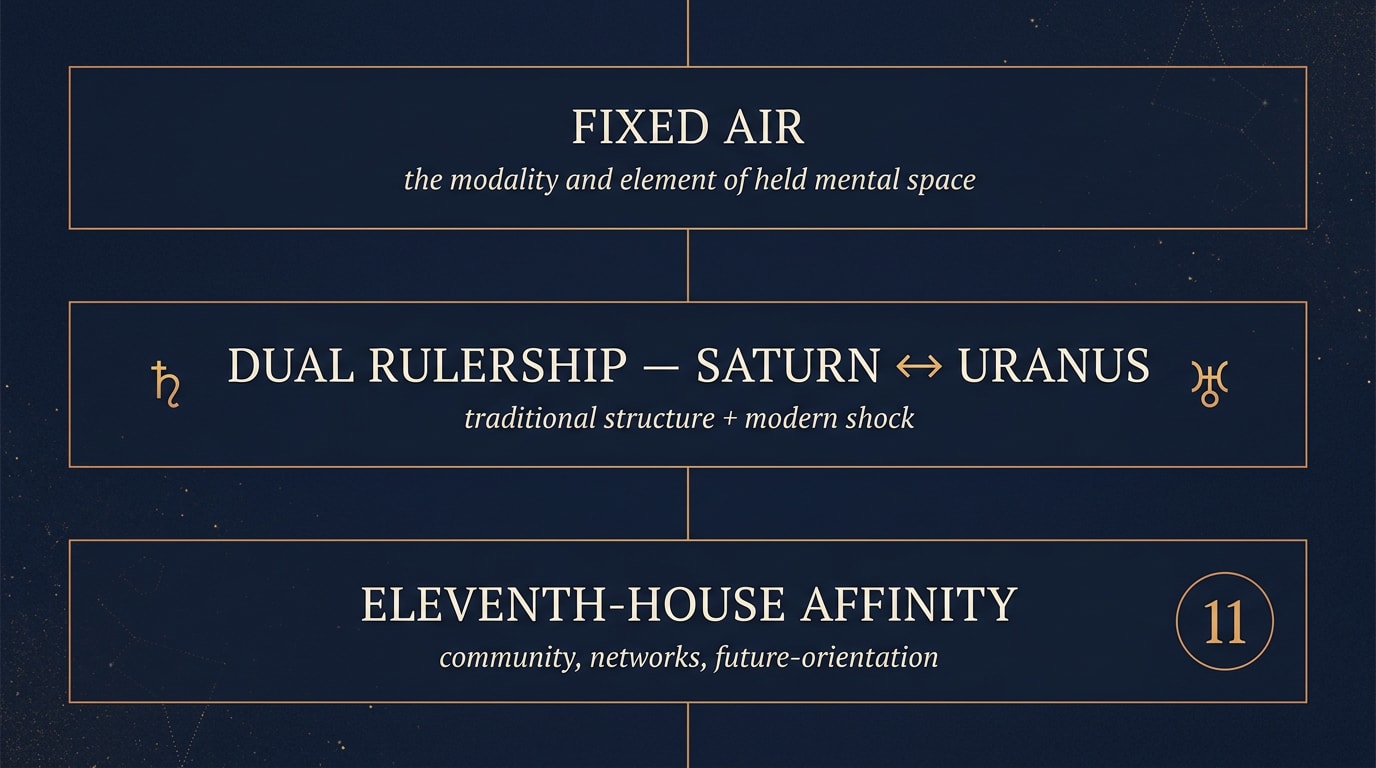
Aquarius is air — and astrologers split air into three: cardinal air (Libra, idea-as-relation), mutable air (Gemini, idea-as-conversation), and fixed air, which is Aquarius. Fixed, in astrology, means a sign that holds its position rather than starting or changing. Apply that to air — to ideas, principles, ways of seeing — and you get the Aquarius signature: ideas held with weight, opinions that don't shift just because the room shifted, the friend who can argue the same point patiently across years. The trope "stubborn intellectual" is mostly that, held ideas, an air sign's medium, applied with fixed-mode persistence. It also explains why Aquarius Sun energies often read as calm-but-immovable; the calm is the air, the immovable is the fixed. The same structure is what makes Aquarians good at long-running projects of thought, the kind that take a decade to finish and don't lose their shape on the way.
Dual rulership: Saturn structure, Uranus originality
Aquarius has two rulers in modern western astrology: Saturn, the traditional one (assigned in classical times), and Uranus, the modern one (added after Uranus's 1781 discovery). Both are still used. Saturn gives Aquarius rigour, structure, rules, taking things seriously, the patient long view. Uranus gives Aquarius originality, disruption, surprise, the willingness to see a familiar problem in a way no one else in the room has tried. Most Aquarius Suns carry both in different proportions.
 The eleventh house is where the long-running group lives.
If you've ever met an Aquarius who's both the most rule-respecting and the most rule-questioning person in the same conversation, you've met the dialectic. It's also why the same person can read as the systems-minded engineer at work and the strange-and-original friend at the pub, both are operating, just driven by different halves of the rulership. The "eccentric Aquarius" trope is the Uranus side dramatised; the "cold, distant Aquarius" trope is the Saturn side caricatured. Neither half is the whole story.
Eleventh-house affinity: groups, ideas, the long view
Aquarius is the natural sign of the eleventh house in classical western astrology, the part of the chart concerned with groups, friends-as-network, ideas held in common, and the longer-arc visions for one's life. That association explains the humanitarian streak that listicles flag as a personality trait, when it's closer to a structural inclination. Aquarius Sun energies tend to think in terms of groups and futures rather than self and the next week, not from any unusual nobility, but because the archetype's natural neighbourhood is the place in a chart where those questions live. It also explains why so many Aquarius Suns find themselves in volunteer roles, member-led organisations, advocacy work, theoretical fields, or simply the long-running WhatsApp group that's still active a decade later. The trope "humanitarian" is fine as a label; the working version is closer to "good at thinking in years and groups instead of weeks and rooms".
In short. Aquarius traits sit on three load-bearing parts — fixed air, the Saturn–Uranus dialectic, and an eleventh-house affinity. Which part you meet first depends on the rest of the chart.
Aquarius Sun, Moon, Rising: same name, different roles
Aquarius in your Sun, your Moon or your Rising shows up in three different ways in aquarius astrology, because each placement plays a different role in a chart. The Sun is the core you're growing into. The Rising sign is the first impression you didn't choose to make, the sign that was coming over the eastern horizon at the moment you were born. The Moon is what you need to feel safe; how you self-regulate, the inner principles you can't compromise.
An Aquarius Sun with a Cancer Moon and a Taurus Rising will read in public as warm, steady, sensible; the Aquarius independence arrives privately, in the principles she won't bend on. Change the Moon and Rising and the same Aquarius Sun reads completely differently: with an Aries Rising and a Scorpio Moon, the independence is still there, but the first impression is direct and the emotional default is intense and private rather than soft and open.
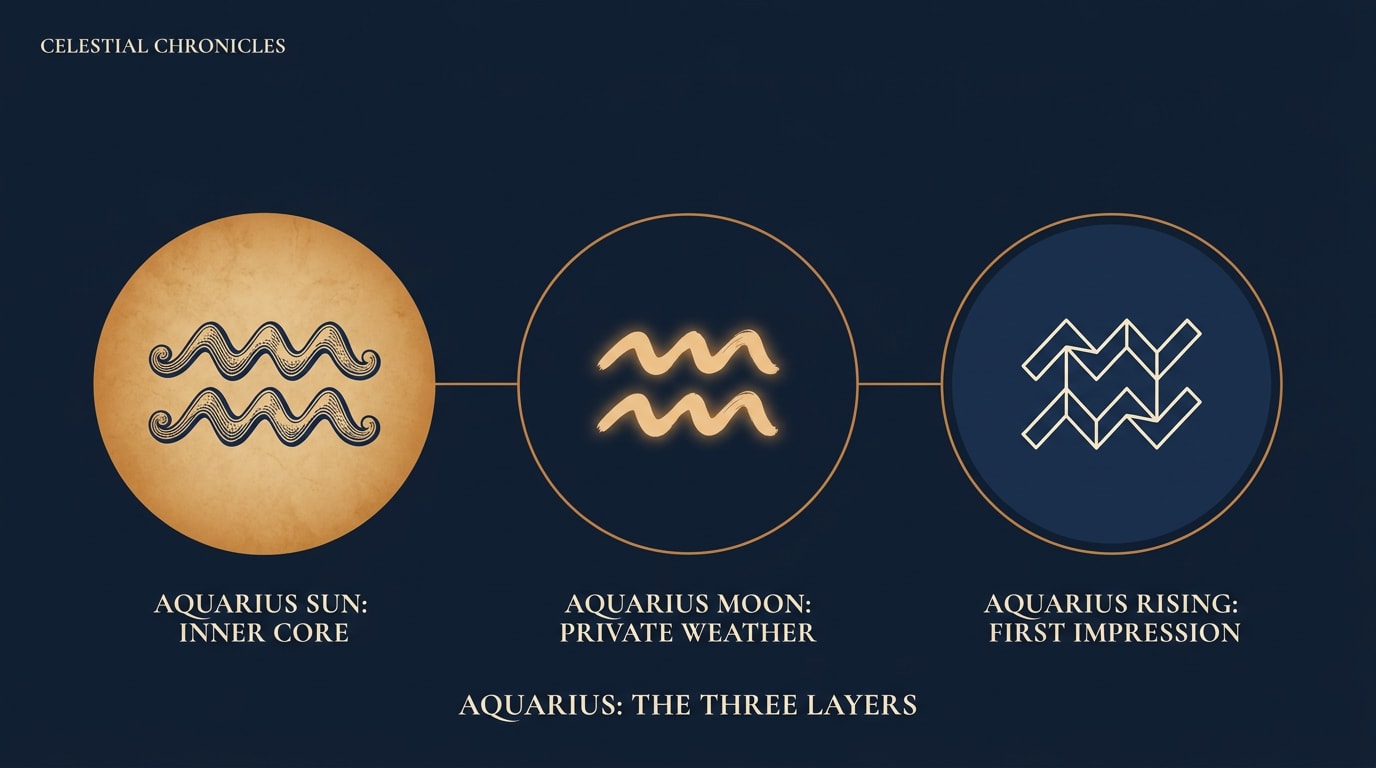
In shorthand: Aquarius Sun is the way you renew yourself, the ideas you live by; Aquarius Moon is how you self-regulate, the inner principles you can't compromise; Aquarius Rising is the look on your face when you walk into a room, the slight detachment of someone observing before joining. Most people who say "I'm an Aquarius but I don't feel like one" have either a non-Aquarius Moon and Rising softening the public read, or an Aquarius Rising without an Aquarius Sun, which produces the look of cool observation without the inner machinery.
You can find out which Aquarius placement you have, and what the other nine are doing, by calculating a full natal chart, date, time and place, takes a couple of minutes.
Where the Aquarius dual ruler came from (Saturn classical, Uranus modern)
The Aquarius dual rulership comes from a quiet shift in western astrology over the last two and a half centuries. Saturn was the classical ruler from antiquity through the Renaissance; Uranus was added after Uranus's discovery in 1781 by William Herschel, and most contemporary aquarius astrology now uses both. Saturn is the planet of structure, time, discipline; Uranus is the planet of disruption, originality, sudden change. The two readings of Aquarius, rigorous-systematic on one side and original-eccentric on the other, come straight from which ruler an astrologer foregrounds.
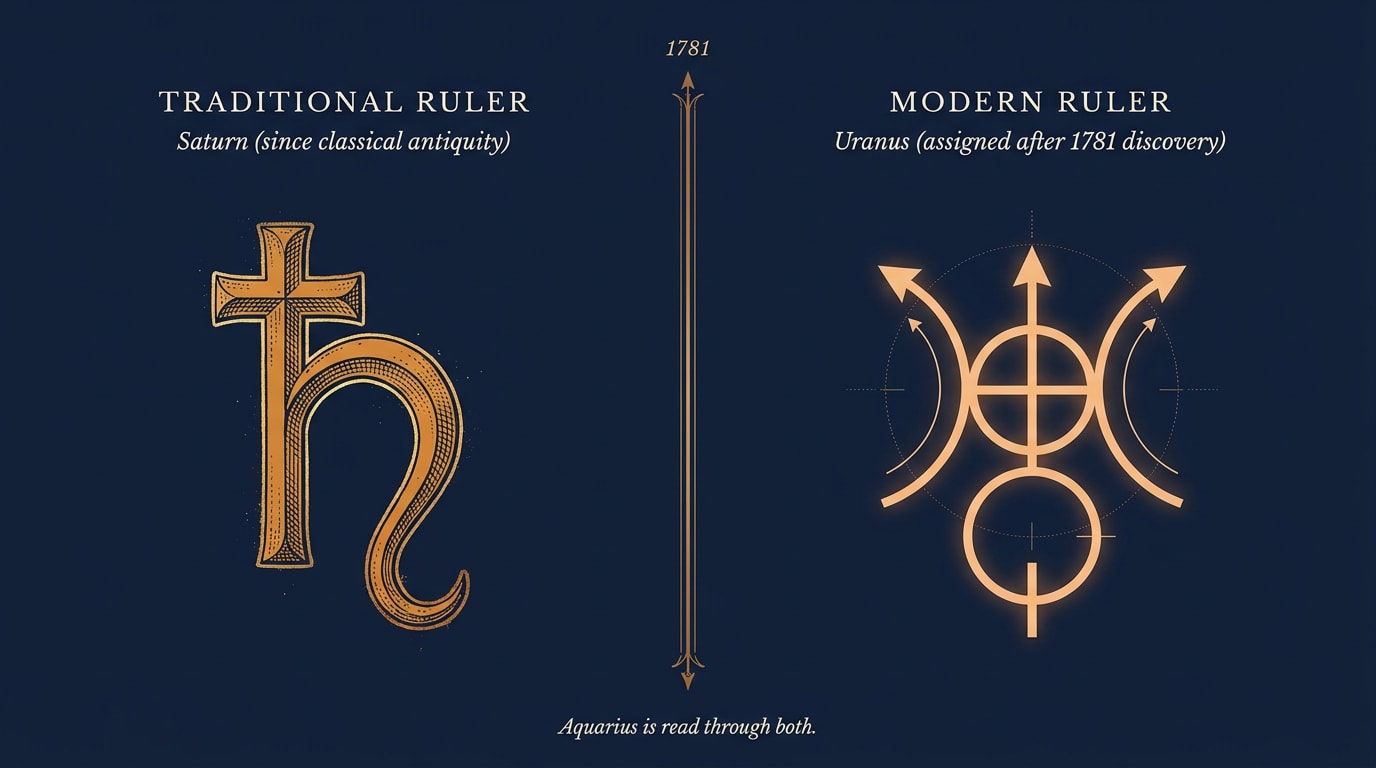
A 1960s aquarius horoscope is more likely to lean Saturn, responsibility, the long view, the steady worker; a 2020s aquarius horoscope is more likely to lean Uranus, originality, disruption, the futurist. Both are correct; both describe pieces of the same archetype. Most working astrologers in 2026 use both rulerships, and a serious aquarius astrology read won't ask you to choose, it'll quietly assume you have some of each, and look at the rest of the chart to see which is louder this year.
 The archetype, when it isn't being dramatised.
What to do with your Aquarius Sun now you know what it is
Your Aquarius Sun is most useful as a starting point, not a finishing one, treat the structural trio above as the load-bearing parts, and the rest of your chart as the bit that says which side leads. Your Sun is one of ten placements. The full chart adds the Moon (inner weather, what you need to feel safe), the Rising sign (the first impression you didn't choose to make), Mercury, Venus, Mars and the slower planets that shape the longer arcs of your life. That's the structural reason people who go beyond their Sun sign tend to find astrology suddenly "click"; they're reading a full sentence instead of one word.
Three practical moves. First, re-read the structural trio above and notice which element you meet first in yourself, the held-ideas part, the Saturn-or-Uranus pull, or the groups-and-futures inclination. Second, look up your Moon and Rising signs; they need your exact birth time and place. Third, if it's still interesting at that point, do the full chart.
If you're curious how Aquarius reads in a pair, particularly with Leo and Aquarius as opposite signs across the zodiac, that's another structural lens worth reading. And if you'd like to see the other nine, WowAstro will calculate your free birth chart, date, time and place, and it takes a couple of minutes. Most of the surprise of being an Aquarius lives there, in the difference between the half the Sun sign already named and the rest the other nine fill in.
Questions readers ask
What are Aquarius personality traits?
Aquarius personality traits tend to show up as a mix of held ideas (fixed-air mode), structured rigour (Saturn ruler), original or unconventional thinking (Uranus ruler), and a quiet humanitarian or group-minded streak (eleventh-house affinity). Which side of each element leads depends almost entirely on the rest of the chart, particularly the Moon and Rising sign. The grown-up summary is that Aquarius Sun describes a way of holding ideas privately and steadily, with a tendency to think in groups and futures rather than in self and the next week. The dramatic versions in tabloids, aloof, eccentric, cold, are the caricature of those structural elements under pressure, not the working archetype. Aquarius female traits and aquarius woman traits follow the same structural pattern; the variations come from the rest of the chart, not from the sign itself.
Is Aquarius a water sign?
No. Despite the name, Aquarius is an air sign in western astrology, not water. The Water Bearer in classical iconography pours not water but air-as-ideas, knowledge flowing out into the world; the imagery is symbolic, not elemental. The four classical elements in astrology are fire, earth, air and water, and each is represented by three signs. Aquarius shares air with Libra (cardinal air) and Gemini (mutable air); Aquarius itself is fixed air. The water signs are Cancer, Scorpio and Pisces. So if you've been reading water-sign descriptions and feeling puzzled because they don't fit, the puzzle is the name, not you.
When is Aquarius season?
Aquarius season is roughly 20 January to 18 February, the four weeks the Sun spends in Aquarius each year. The exact boundary shifts by about a day between years because the Sun changes sign at a different clock time each year, so a birthday on 19 January or 19 February might land either side of the line depending on your year and birth time. The four weeks are seasonally mid-winter in the Northern Hemisphere, the quiet stretch after the new-year reset, which fits the archetype's territory of taking the long view and thinking in years rather than in weeks.
What's the difference between Aquarius Sun and Aquarius Rising?
Aquarius Sun is the core you're growing into; Aquarius Rising is the first impression you make on people who don't know you yet, they're two different roles played by the same sign. Your Sun sign comes from your date of birth; your Rising sign comes from the moment within that date you were born, and from where you were born, because the Rising sign changes roughly every two hours. Plenty of people have Aquarius Rising without Aquarius Sun; they tend to read as cool, observant, slightly detached on first meeting, that's the Aquarius look, but the inner core is whatever sign their Sun is actually in.
A note on what this is. Astrology, as we use it at WowAstro, is a tool for self-reflection and self-understanding, not a method for predicting events, health, or financial outcomes. Read the Aquarius archetype as a description of a recognisable temperament, take what's useful, leave the rest.
About this article: WowAstro readings combine traditional astrological methodology (Swiss Ephemeris calculations, Hellenistic and modern psychological frameworks) with AI-assisted writing reviewed by Oksana Miatova before publication. For entertainment and self-reflection only — not medical, legal, or financial advice. Full editorial policy at /editorial-standards.
Written by Oksana Miatova, astrologer and writer at WowAstro. Charts calculated using the Swiss Ephemeris, the same astronomical data working astrologers use.
Read your own natal chart
A personal AI reading, from £1
⭐ +50 Wow Stars cashback · sign up and get 100 ⭐
Build my chart →Comments
New here? Get −30% off your natal chart
Leave your email and we will send you the promo code WELCOME30. Straight after that you can comment — no passwords, all automatic.
Quick sign-in
Sign in with Telegram — one click.
Or by email (with a gift)
Already have an account? Enter the same email — we'll email you a sign-in link.