Sunday evening, kitchen table, two laptops open to the same colour-coded planner. He flags a missing comma in row eighteen at exactly the moment she does. They both laugh, then both quietly fix it on their own copy, then both notice the laugh has happened before. This is what virgo on virgo compatibility looks like from the inside: two people running the same operating system, mostly without having to say so.
The Sunday-evening scene is the easy version. The question that brings people to this page is usually quieter: is the agreement we have a sign of genuine fit, or the kind of symmetry that becomes claustrophobic by year three? The Sun pair can't answer that on its own, but it can name the trap most listicles politely ignore.
In short. Two Virgo Suns sit on the same arc of the zodiac, an aspect astrologers call a conjunction by sign. A conjunction amplifies whatever the placement already does — so a Virgo-Virgo Sun pair doubles the practical, observant, mutable-earth quality. What that buys you is alignment on values, standards, and how things ought to be done. What it costs you is the contrast a non-Virgo partner would have provided, where the critical eye lands on someone wired differently and softens. With another Virgo, both eyes are on, both partners are running the same filter, and the standards quietly keep rising. The Moon, Venus, Mars and Rising placements in both charts decide whether that closeness reads as comfortable or claustrophobic.
 The shared filter, working in real time.
What "same sign" actually means in astrology
A same-sign pair is what astrologers call a conjunction by sign: both Suns sitting on the same arc of the zodiac, 0° apart in sign terms.
A conjunction is the closest aspect there is: the two placements blur together and amplify what the sign already does. There's no contrast, no friction, no angle to bend around. For Virgo + Virgo, that means doubling the things Virgo as a sign is built for: practical attention, useful observation, an instinct for improving the thing in front of you. The shared filter is the dominant feature of the pair.
This works differently from the more famous aspect pairings the listicles fight over. Sign-pair compatibility usually gets discussed in terms of synastry, the proper word for astrological compatibility, which we cover in the full guide, which overlays both charts and looks at how each planet in one chart relates to each planet in the other. Most pair-articles describe friction (squares, oppositions) or harmony (trines, sextiles). The conjunction is the rarer thing: not friction, not harmony, but amplification.
| Same sign (conjunction) | Opposite sign (opposition) | Other aspect | |
|---|---|---|---|
| What it does | Amplifies the shared quality | Pulls opposing qualities into balance | Adds friction or harmony |
| How it feels | Recognition, instant fluency | Magnetism with built-in disagreement | Varies, two different voices |
| Risk | Echo chamber, no contrast | Endless seesaw | Standard relationship work |
So when this guide talks about virgo on virgo compatibility, the Sun pair is doing something quite specific — and quite different from what most compatibility articles describe.
What two Virgos actually get right
The Virgo-Virgo Sun pair gets shared filter right in a way most pairings spend years working toward.
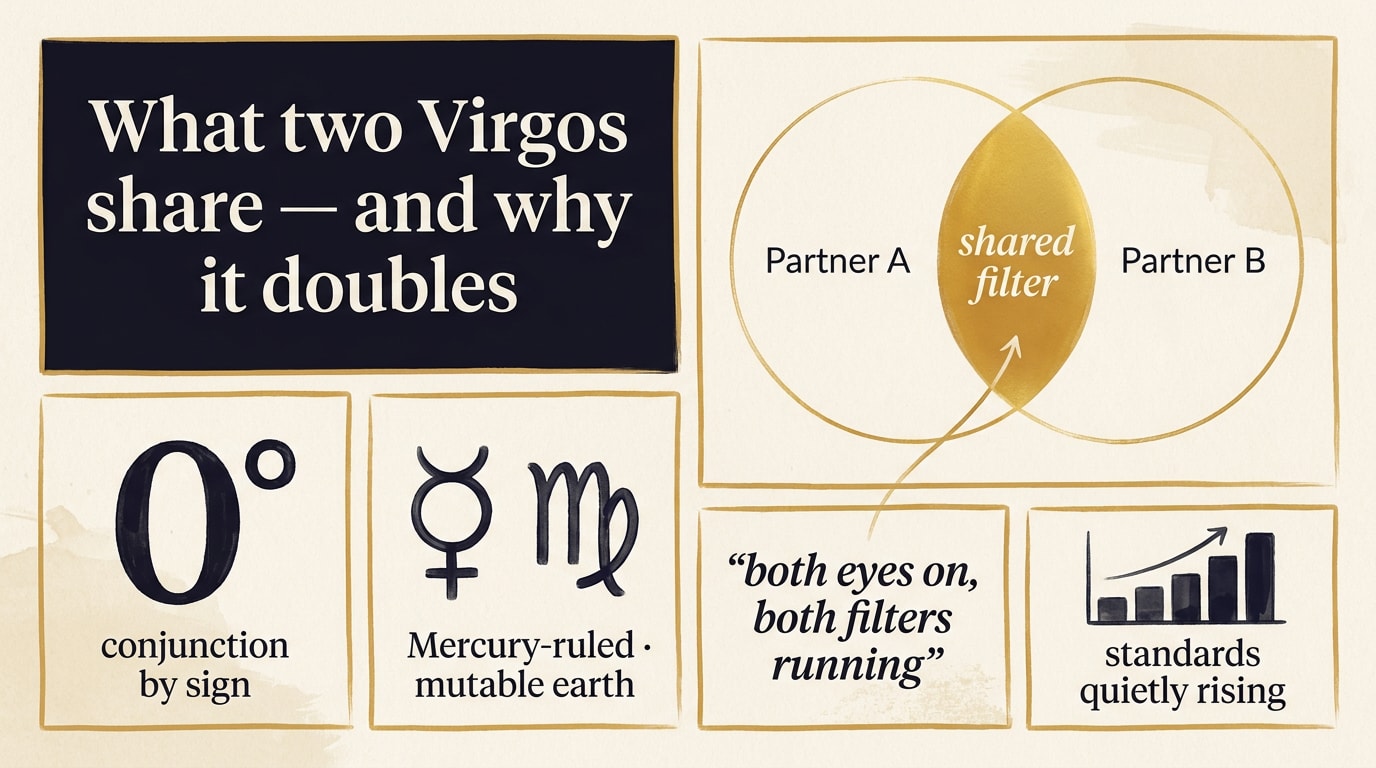
Virgo is Mercury-ruled, mutable-earth: practical, attentive, oriented toward improving the thing in front of you, and uncomfortable with mess for its own sake. For a sense of how Virgo sits in the wider context, the twelve zodiac signs cover the personal traits side. What matters for a Virgo-Virgo pair is that both partners are already running that operating system before they meet each other.
That has real consequences for daily life. How to load a dishwasher, what counts as "ready" before you leave the flat, whether the email needs another read before it goes — the questions that quietly grind down most couples, and a Virgo-Virgo pair has usually settled most of them by month two without anyone calling a meeting. There's mutual respect for competence and an unspoken agreement that something half-done is a problem worth fixing.
A non-Virgo partner often experiences Virgo's attentiveness as picky. Another Virgo experiences it as recognition. The reading is correct on both sides, but the second one feels much better to live with.
Where it gets harder: the mirror, with no relief
The same shared filter that builds the early ease is what makes the long-term version harder.
Virgo's critical eye is famous, and worth being plain about. It's the same Mercury-ruled attentiveness that makes the sign useful, turned toward what isn't right yet. In a Virgo on their own, that becomes self-criticism. In a Virgo with a non-Virgo partner, the eye lands on someone wired differently, and the difference itself softens it. The Sagittarius partner shrugs at the small thing and goes for a walk; the Pisces partner doesn't notice it in the first place. Each response, in its way, takes the temperature down.
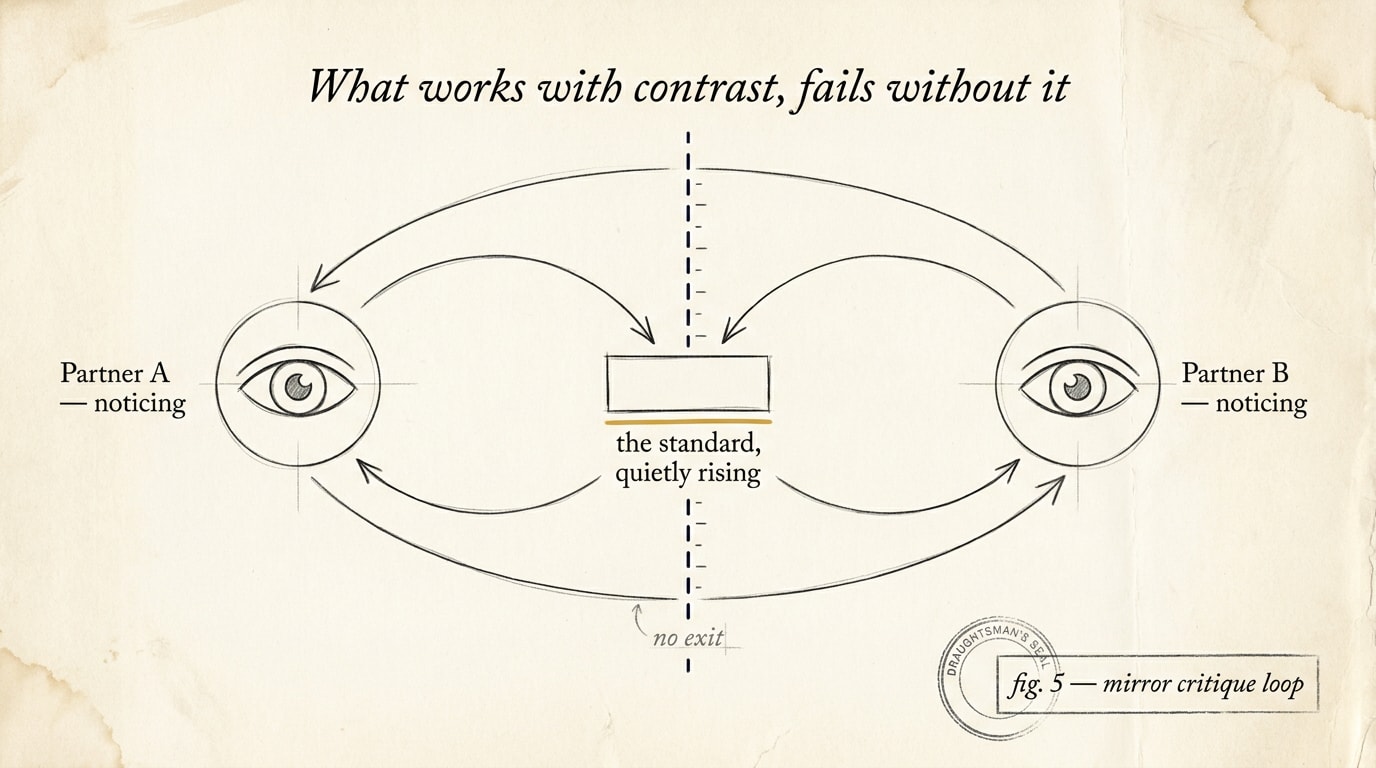
With another Virgo, that doesn't happen. The eye lands on someone with the same eye. Both partners are noticing, both are flagging, and neither is in the mood to relax the standard, because the standard is the thing both of them are quietly proud of holding.
 The same eye, on both sides.
The risk is not dramatic. It's a relationship where standards quietly keep rising, where small daily failures get counted, and where neither person has the contrast that would let them stop counting. It can read for years as "we both just care about doing things properly" before someone notices that the count has become the relationship's background music.
Practitioners observe that this is the central long-term question for any same-sign pair, but it's especially live for Virgo because of what Virgo's filter is naturally tuned to find. Named out loud — "are we both being a bit hard on each other this week?", "let's both stop noticing this one for a bit" — the pattern becomes manageable. Unnamed, it tends to corrode the affection it once shared.
Where the same-sign listicles are right, and where they're wrong
The same-sign listicles get the recognition story half-right and almost everything else wrong. Here's the honest sorting, one cliché at a time.
| Cliché | Status | What's actually going on |
|---|---|---|
| "You'll understand each other" | ✅ Mostly true | Shared operating system makes the day-to-day fluent. Real. |
| "You agree on everything" | ⚠️ Sometimes | The real question is whether agreement is alignment or symmetry. Different things. |
| "Two Virgos are perfect together" | ❌ Lazy | Perfection isn't a sign trait; it's a stereotype the listicles recycle. |
| "Soulmates" | ❌ Not from this | A Sun-pair verdict can't deliver "soulmates". That word points at Moon-Moon contacts and house overlays. |
| "You'll never argue" | ❌ Wrong | Two Virgos can argue with extraordinary precision when they do. The arguments tend to be about facts and standards, often unwinnable on both sides. |
The pattern: when a same-sign article promises a verdict, it's reading the conjunction as a guarantee. When it describes a quality without promising an outcome, it's closer to honest. The first sells more clicks; the second is more useful when you're actually in the relationship.
A worked example
Two people, made up for the sake of explanation, both with Virgo Suns. The rest of the chart is what makes them recognisable as a couple instead of as a pair of siblings.
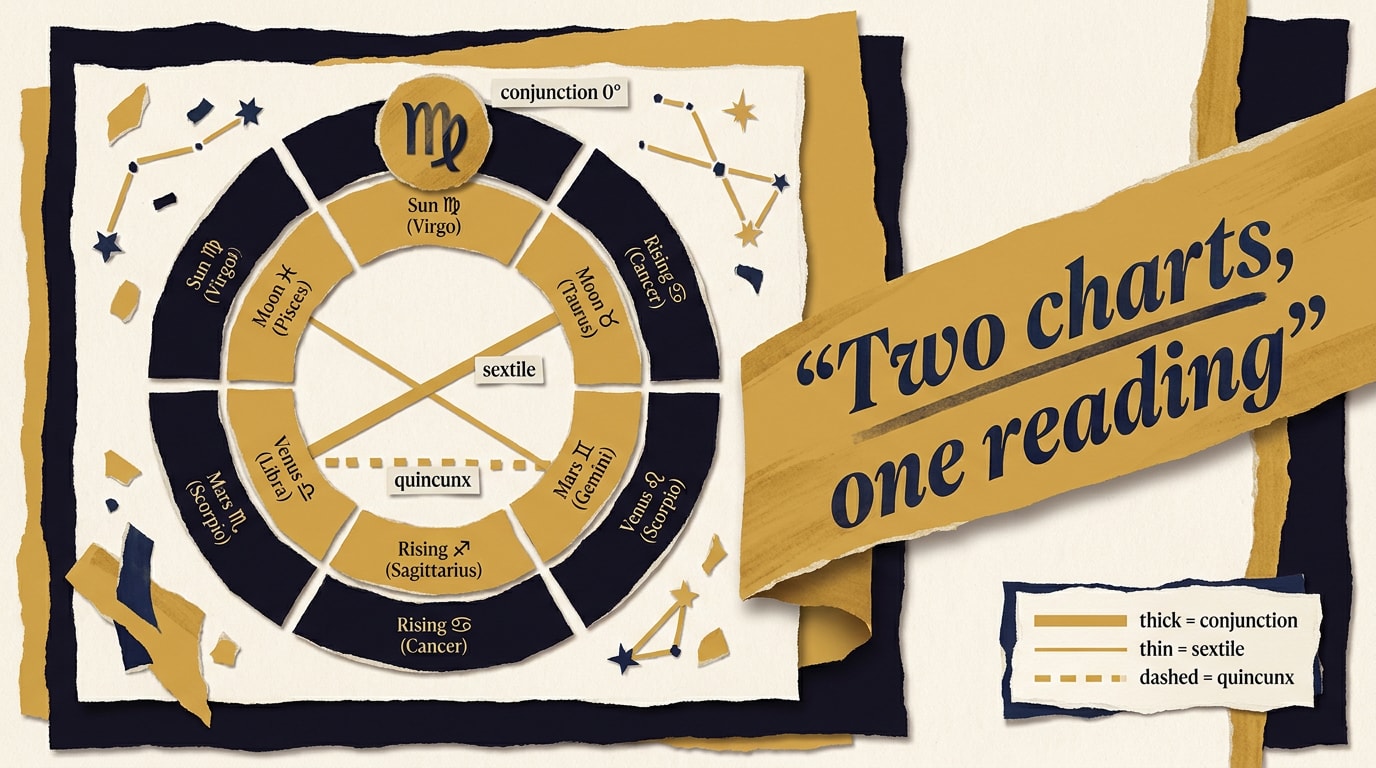
Partner A: Sun in Virgo, Moon in Pisces, Venus in Libra, Mars in Gemini, Rising in Sagittarius. Partner B: Sun in Virgo, Moon in Taurus, Venus in Leo, Mars in Scorpio, Rising in Cancer.
Start with the Suns. Same sign, the conjunction we've already covered: both Mercury-ruled, both observant, both the shared filter. Now the placements that actually run the relationship.
The Moons. Pisces Moon and Taurus Moon sit roughly 60° apart on the zodiac — an aspect called a sextile by sign, easy and helpful. Both are receptive, but one runs on imagination and one on the body. The Pisces Moon partner softens the practical Sun by needing the dreamier evening once a week. The Taurus Moon partner insists that the slow Sunday with no plans is a feature, not laziness. Between them they break the symmetry the Suns would create on their own.
The Venuses. Libra Venus and Leo Venus are both warm-toned: one refined and aesthetic, one generous and a bit performative. Both want the dinner-table to look right, both want the gift-giving to mean something specific. The values match without doubling the same value.
Mars. Gemini Mars and Scorpio Mars are 150° apart, an aspect called a quincunx, which describes a mismatch that asks for adjustment rather than a verdict. One runs on curiosity and quick exchange; the other on focused, slow depth. Worked through, this is the couple whose arguments are interestingly different in shape from their daily life.
Risings. Sagittarius Rising and Cancer Rising — an outward, expansive surface meeting a reserved, protective one. They read each other accurately within twenty minutes of meeting because the Sun-pair fluency is already there.
What you have when you put all that down is a recognisable couple, not because two Virgos do or don't go together, but because of the five other layers underneath. The mirror that H2-3 warned about is broken usefully by the Moon, Venus and Mars contrasts — the standards are still shared, but the temperaments aren't identical, so the eye has somewhere to rest.
What the worked example shows. The Sun conjunction is the loudest note in the chord because it's the easiest to look up. The Moon, Venus, Mars and Rising placements do most of the work of deciding whether a same-sign pair feels comfortable or claustrophobic.
How to actually check your own chart
If you'd like to do this for your own relationship rather than an imagined couple, here's the practical version.
First, get the data: date, time to the nearest minute if possible, and city of birth, for both of you. Without exact birth times you lose the Rising signs and the house overlays, but you still get a useful Moon, Venus and Mars read.
Second, read in order. Sun pair (which you've now done). Moon to Moon, are you emotionally similar, or productively different? Venus to Venus and Venus to Mars across both charts — what does each of you call affection, and do those vocabularies overlap. Mars to Mars. Then Risings and house overlays if you have the times. For a longer walk-through of the method itself, synastry, the method, in plain English covers the order of reading without committing to a specific pair.
Third — the part the Sun-sign sites can't do — run the full synastry properly, or have the tool do it. WowAstro will compare both of you using the Swiss Ephemeris, the same astronomical data working astrologers use. Date, time and place for both, £5, a couple of minutes.
 The reading is the start, not the answer.
Questions readers ask
Are two Virgos compatible?
The Sun pair can't answer that on its own. It can tell you the pair tends to share a filter — practical, observant, oriented toward improving things — and that the early ease comes from a shared operating system. Whether two specific Virgos are compatible depends on the rest of both charts: the Moons, the Venuses, the Mars placements, the house overlays. Plenty of Virgo-Virgo couples build long, durable relationships. Plenty don't.
Can two Virgos fall in love?
Yes, and the shared filter makes early attraction easy. Two Virgos tend to notice the same things in each other — competence, care, attention to the small details others skip. Whether the early fluency deepens depends on the Moons and Venuses.
What's the trap of two Virgos?
The mirror, with no relief. Both partners run the same critical filter, and the contrast a non-Virgo partner would have provided isn't there. Standards quietly keep rising and small daily failures get counted. Named out loud, the pattern becomes manageable. Unnamed, it corrodes the affection it shared.
Is a conjunction good or bad in synastry?
Neither. A conjunction amplifies whatever the placement is — it doesn't grade the placement. A Sun-Sun conjunction means strong recognition between the two partners' sense of self, and whether that recognition is comforting or claustrophobic depends on the sign involved and on the rest of both charts.
A note on what this is. Astrology, as we use it at WowAstro, is a tool for self-reflection and self-understanding, not a method for predicting events, health, financial outcomes or whether a relationship will last. Read a synastry chart as a description of a dynamic — take what's useful, leave the rest.
Written by Oksana Miatova, astrologer and writer at WowAstro. Charts calculated using the Swiss Ephemeris, the same astronomical data working astrologers use.
See what your charts say about each other
A personal AI synastry reading — not a sun-sign table, but an analysis of both natal charts across 8 areas of the relationship
Comments
New here? Get −30% off your natal chart
Leave your email and we will send you the promo code WELCOME30. Straight after that you can comment — no passwords, all automatic.
Quick sign-in
Sign in with Telegram — one click.
Or by email (with a gift)
Already have an account? Enter the same email — we'll email you a sign-in link.