It is Sunday afternoon, eight months in. She has been talking for twenty minutes about an allotment they could share — the compost heap, the herbs, the slow lunches with friends pulling carrots they grew. He has been listening properly, the way he always does, and has just asked how much the council waiting list is and whether they'd really have time after their day jobs and what they'd do with the produce if there was too much. Each question is reasonable. Each one lands like a small hand-brake on the picture she was building.
She opens her laptop on the kitchen table after dinner. She is the one with the picture. He is the one with the calculator. Neither of them is wrong. Both are starting to wonder, quietly, whether the gap is a problem or just the way the pair works. The first site she finds tells her they are a sweet match, 92 percent compatible, one of the gentlest pairings in the zodiac. The second hands her the same verdict with different decoration. The third uses the word soulmate twice in two paragraphs. None of them mention the small thing she came in with — whether what she's noticing this afternoon is the dynamic working or the dynamic drifting.
Here is the honest version. Pisces and Taurus sit two signs apart on the zodiac, what astrologers call a sextile, an angle of 60°. The geometry explains why the pair feels easy. The Venus-Neptune contrast underneath explains the imagining-versus-building dynamic. Neither, on its own, decides what the pair does with it. That sits in the rest of the chart.
In short. Pisces and Taurus share the textbook sextile, the 60° aspect that pairs two complementary elements: water and earth, both receptive. The pair's ruling planets, Neptune and Venus, sit in productive contrast — one dissolving, the other holding. The sweetness the SERP keeps reaching for is real and has a specific structural reason. The risk it ignores is real too: water flows, earth holds, and if the asymmetry stays unnamed, Pisces ends up imagining alone and Taurus ends up carrying the practical alone. Which way it goes is decided by four things synastry can show but Sun-sign tables can't: the Moon contacts, the Venus and Mars placements, Saturn's role, and the house overlays.
 One picture, one waiting list.
The sextile — why two signs apart feels easy
Pisces is the twelfth sign of the zodiac. Taurus is the second. Drawn on a chart, they sit roughly 60° apart on the wheel, an angle astrologers call a sextile.
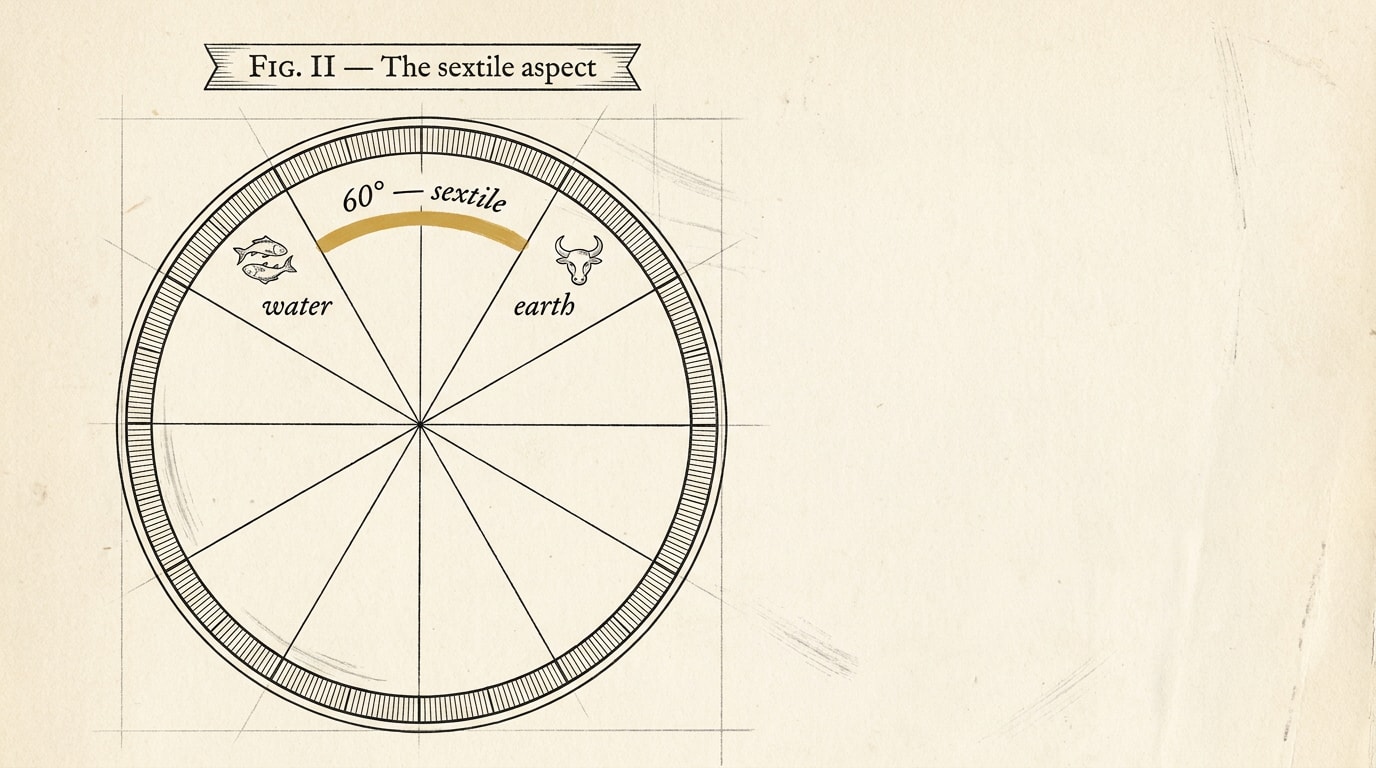
A sextile is one of the easy aspects in synastry tradition, alongside its better-known cousin the trine. Where the trine pairs two signs that share an element (water with water, earth with earth), the sextile pairs two signs whose elements complement each other. In Pisces and Taurus that means water and earth — the two receptive elements in Western astrology, the ones that take in rather than push out.
Water makes earth fertile. Earth gives water somewhere to settle. The metaphor is doing real work here, not decoration. Pisces's emotional weather lands in a Taurus partner the way rain lands in good soil; Taurus's slow steady comfort gives Pisces's feelings a shape to settle into. Neither has to push, and neither resists. The shared evenings fall into a recognisable rhythm almost by accident, because both are wired to absorb what the other brings rather than to argue with it.
This is the structural reason the sites that call the pair a sweet match are gesturing at something real. The sextile geometry is doing the work the listicles credit to "destiny". Whether the ease deepens into a durable relationship or quietly tips into asymmetric drift is a different question, which we'll get to.
For a refresher on what each sign means as an individual placement, the twelve zodiac signs explained covers the personality side. This piece is about the dynamic between the two.
Venus and Neptune — the planetary contrast at the heart of the pair
Taurus is ruled by Venus. Pisces is co-ruled by Jupiter, the traditional ruler before Neptune was discovered in 1846, and by Neptune, the modern ruler. Both Pisces co-rulers point at something boundless, but Neptune is the one doing the everyday work — and the contrast between Neptune and Venus is the real story of this pair.
Venus describes your sense of taste in life: what you find beautiful, how you express affection, what you want to bring home and keep. Taurus-Venus is sensory and slow, drawn to the kind of comfort that lasts: heavy fabric, good bread, a chair that feels right. A Taurus expresses care by making physical space liveable.
Neptune does almost the opposite kind of work. Neptune dissolves the literal. It is the planet of imagining, of atmosphere, of longing for the version of life that hasn't quite arrived yet. A Pisces Sun, Neptune-flavoured, processes by sensing what a place feels like before saying what it is. The Pisces partner is the one who walks into a flat and immediately knows what it could feel like to live there, who holds the picture of the trip before anyone has booked it, who can describe the mood of a project the other person hasn't yet seen.
Put them side by side. One person tuned to what is solid and beautiful in the room as it stands. The other tuned to what could be beautiful about it that isn't there yet. The Pinterest mood-board and the council waiting list, on the same kitchen table. The pair needs both ends. Without the imagining the relationship is purely functional. Without the body the imagining stays unbuilt. The "dreamer meets doer" framing the SERP keeps reaching for is, when you trace it back to its causes, just this: Venus on one side, Neptune on the other, doing different but complementary kinds of work.
Water and earth — what the elemental dynamic actually does
Water and earth are the two receptive elements in Western astrology, traditionally classified as yin, meaning they absorb rather than initiate. Two receptive elements together produce the particular kind of ease this pair is famous for. They also produce the particular kind of asymmetry nobody names.
The ease — two receptive temperaments share a frequency
Both signs are wired to take in. Pisces takes in mood. Taurus takes in sensory information. Neither leads with assertion, neither bulldozes the other's atmosphere with one of their own. The result is low daily friction. The evenings have a recognisable shape. The food gets cooked. The flat is comfortable.
It is also why the kitchen table fills up the way it does. When two people are both tuned to absorb what's in the room, the room slowly fills with what they both like without anyone deciding to make it happen. It's real, and it is also, alone, not enough.
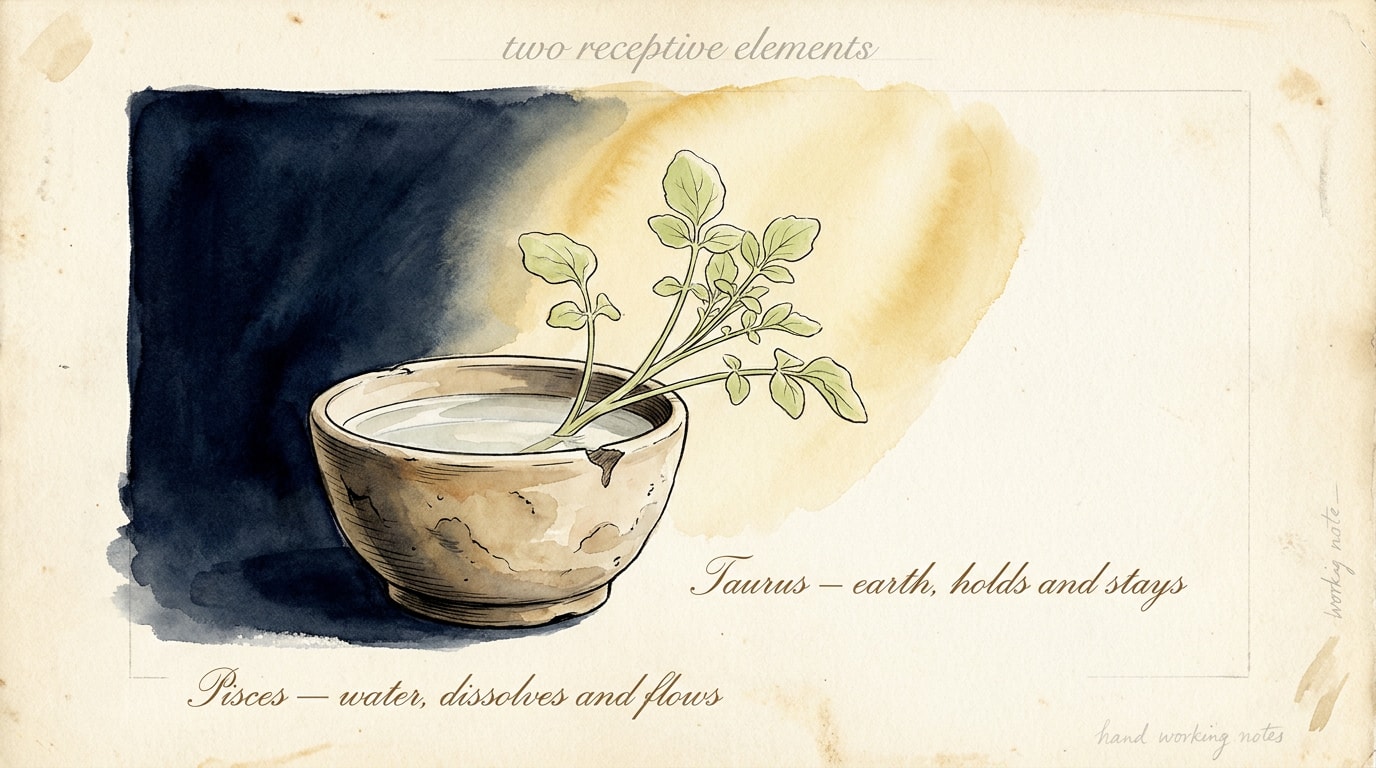
The asymmetry — water flows, earth holds
Water and earth do different work. Water moves, takes the shape of whatever holds it, finds the lowest path. Earth stays, holds form, supports weight. In the pair, Pisces is the one who keeps moving the picture of what the relationship could be. Taurus is the one who keeps holding the actual ground it's standing on.
The pair tends to work when both name the asymmetry consciously. Pisces brings the imagining, Taurus brings the body, and both partners share the work of turning one into the other. The pair tends to drift when the asymmetry stays unnamed: Pisces keeps imagining without asking what it would take to build, Taurus keeps holding the practical without asking whether the imagining is being heard. By month thirty, in the unnamed version, Pisces feels lightly accused of not being practical enough and Taurus feels lightly used as logistics. Neither person was wrong on a Tuesday. The pattern was wrong.
In short. Pisces brings the atmosphere; Taurus brings the body that holds it. The pair tends to work when both name the asymmetry consciously — and tends to tip when the imagining drifts away from the building.
The four things synastry actually checks for a sextile pair
Whether a Pisces-Taurus pair shares the practical work or quietly splits it (Pisces imagining, Taurus carrying) depends on four things you can't see from the Sun signs alone: the Moon contacts, the Venus and Mars placements, Saturn's role, and the house overlays. The full synastry method covers these end to end; this section is the short version with the dream-meets-body pair specifically in mind.
The Moon-to-Moon contact is the foundation. A shared element between the two Moons amplifies the easy climate the Sun pair already produces. Two water Moons together, or a Pisces Moon and a Cancer Moon both leaning receptive, will be even gentler with each other than the Suns suggest. That's lovely. It also doubles the asymmetric-labour risk. Introducing one earth Moon into the pair, even just on one side, will usually produce more direct practical conversation — somebody who comes back to the picture with a notebook and a kettle and asks what the first week actually looks like.
Venus and Mars is where the chemistry sits, and in this pair specifically where the will-to-build lives. Comfort comes from element; the willingness to finish a shared project comes from this contact. A pair with both Mars placements in fixed or earth signs produces a couple that completes things. The same configuration in fully mutable signs produces a couple that keeps starting things and never quite arrives. A Venus-Mars contact across the two charts, particularly to a Mars in a sign that values follow-through, is the synastric placement that turns the shared imagining into a shared build.
Saturn is usually written about as the hard planet, the one that brings limits and discipline, and most compatibility articles treat a Saturn contact as a warning sign. For a comfort-leaning pair it's almost the opposite. A Saturn contact in synastry tends to be the placement that brings the structure required to turn ideas into things — schedules, deposits paid, the practical second draft of a plan that started as a feeling. Long Pisces-Taurus pairs with a working Saturn contact tend to book the allotment visit on a particular Saturday rather than agree it "would be nice to do at some point".
House overlays are where each of you lands in the other's chart. A Pisces Sun dropped into the partner's 5th house (the house of creative play and what we make for its own sake) reads as "my partner is part of what I make and imagine". A Taurus Sun in the partner's 4th house (home and roots) reads as "my partner is part of what I build and live in". These mutual overlays are remarkably common in long Pisces-Taurus pairs, and once you've seen one of them in your own chart you stop being surprised that the kitchen table ended up with both the mood-board and the waiting list on it.
In short. Pisces-Taurus is the textbook water-earth sextile — Neptune's atmosphere meeting Venus's body in easy collaboration. Whether the pair shares the practical work or quietly splits it is decided by the rest of the chart. The Sun signs name the dynamic. They do not, on their own, finish the sentence.
One real-feeling worked example
Two people, illustrative, not a real couple. Let's call them Maya and Sam.
Maya: Sun in Pisces, Moon in Capricorn, Venus in Aries, Mars in Taurus, Rising in Virgo, Saturn in Aquarius. Sam: Sun in Taurus, Moon in Pisces, Venus in Taurus, Mars in Taurus, Rising in Cancer.
The Sun-Sun sextile is the headline. Pisces and Taurus sit ~60° apart on the wheel, the easy aspect we've been describing. So far, the SERP framing holds: easy, complementary, the kitchen-table pair.
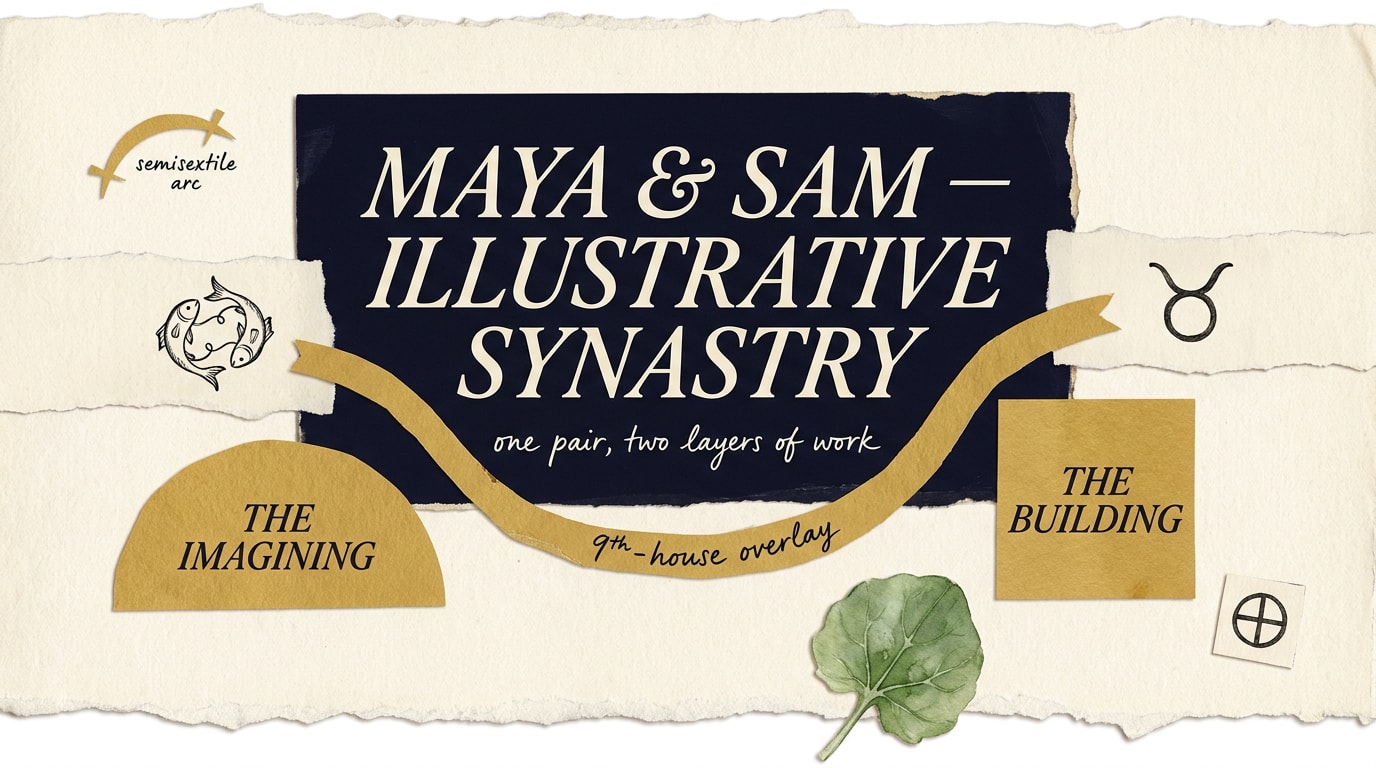
Now look down the chart. Maya's Moon in Capricorn and Sam's Moon in Pisces form a sextile by sign, earth meeting water, the same elemental complementarity as the Suns, doubled at the emotional layer. The unusual thing is what each Moon does for its own Sun. Maya's Capricorn Moon is a quietly grounded foundation underneath a Pisces Sun, she's the Pisces who actually writes the to-do list. Sam's Pisces Moon is the imaginative underside of his Taurus Sun — he builds, but he privately needs the atmosphere too. Together the pair has both ends of the dynamic on both sides, which is how the practical work tends to get shared rather than split.
The chemistry placement is more interesting than a flat "trine" would have been. Maya's Venus is in Aries (direct, decided, knows what she wants, unusual for a Pisces Sun) and Sam's Mars is in Taurus (slow, sensory, builds in his own time). The two sit at a semisextile, a 30° angle, the small adjustment aspect that asks each partner to translate even within the easy frame. In practice it shows up as Maya being willing to say what she wants and Sam being willing to do it on his timeline rather than hers — a low-key, repeated micro-negotiation that the receptive Suns would otherwise leave to drift. Sam's Venus in Taurus sits conjunct his own Mars, which makes him affectionate the way he is practical: slow, considered, in the same key.
The Saturn picture is honest rather than flattering. Maya's Saturn in Aquarius sits at a square (90°) to Sam's Taurus Sun. A Saturn-Sun square in synastry is not friction-free — it's the placement of long-term commitment with conscious limits, the "yes to this, with weight" configuration. For a comfort-leaning pair that would otherwise rely on the receptive Suns to keep things easy, the square is the structural placement that prevents drift. It asks both partners to take the relationship seriously enough to surface difficult things on a schedule.
The Risings carry the recognition layer, and they carry it twice. Sam's Cancer Rising puts Maya's Pisces Sun in his 9th house, the house of meaning, journeys, larger horizons. He sees her as part of what makes his life feel meaningful rather than just functional. Maya's Virgo Rising puts Sam's Taurus Sun in her 9th house too — he reads as the patient builder of the bigger thing she's pointing toward. A mutual 9th-house overlay says, in plain English: "this is part of what I'm doing here."
 The picture, slowly turning into a plan.
What you end up with is a recognisable couple. Two Suns at the easy collaborative angle on the wheel, two Moons doubling the receptive climate while each privately holding the other's note, a Venus-Mars semisextile asking the pair to translate even within the easy frame, a Saturn square that adds the weight of long-term commitment, and a mutual 9th-house overlay that makes the imagining feel like a shared project rather than one person's reverie.
What the worked example shows. The famous Sun pair is one note in a chord. It tends to be the loudest one on horoscope sites only because it's the easiest to look up. The Moons, the Venus and Mars contacts, Saturn, and the house overlays between two charts do most of the work the listicles try to hang on a Sun pair. And in a comfort-leaning pair, the placements that bring the weight, the squares, the semisextiles, the long Saturn aspects — are often the ones doing the most useful structural work.
What to actually check if you're in this pairing
Three things worth knowing, beyond your Sun signs.
First, find your Moon signs. The Moon takes a little more than two days to move through each sign, so depending on the time of day either of you was born, your Moon could be one of two adjacent signs. A free chart at astro.com gives the answer in under a minute. Notice particularly whether either of you has a Moon outside the receptive elements (water or earth). An earth Moon on either side often brings the practical follow-through the pure-Pisces water side might otherwise leave to Taurus alone. A fire or air Moon on either side often brings the language for talking about the asymmetry directly rather than letting it sit.
Second, find your Venus and Mars. The same free chart lists them. The placement to look for is any Mars in a sign that values finishing things — Capricorn, Taurus, Virgo, Scorpio. That's the placement that turns the shared imagining into a shared build. A Venus-Mars contact across the two charts, especially to a Mars in one of those signs, is the closest synastry comes to insurance against the "we should do that sometime" that quietly never happens.
Third, look at where Saturn sits in both charts, particularly whether one person's Saturn touches the other's personal planets. In a comfort-leaning pair, Saturn is an asset rather than a warning. It's the placement that brings the spine to do the budgeted Saturday conversation rather than the indefinite postponement. A Saturn square or opposition reads, in a pair like this, as durability rather than friction.
One honest aside before the practical step. If the answer to all three is we have no shared-build placements anywhere in the chart, that's not a verdict. It's a piece of information. Long Pisces-Taurus pairs in a fully receptive configuration tend to invent the structure externally — a regular standing date for the practical conversation, a shared friend or housemate who books the visits, sometimes a third party who tells the truth. The chart describes the dynamic; what you do with it is still up to you.
If you'd like to see this on your own charts rather than an illustrative one, WowAstro will run the full synastry for both of you using the Swiss Ephemeris, the same astronomical data working astrologers use. Five pounds, both birth dates with times and cities, a few minutes.
 Two truths, both correct.
Questions readers ask
Are Pisces and Taurus compatible?
The Sun pair on its own can't answer that. What it can tell you is that the pair sits at the textbook water-earth sextile, the easy-collaboration aspect, with a Venus-Neptune contrast that gives the dynamic its specific flavour: Pisces brings the atmosphere, Taurus brings the body. Whether two specific people are compatible depends on the rest of both charts: the Moons, the Venuses, the Mars placements, the house overlays. Plenty of Pisces-Taurus couples build long, considered, beautifully-textured relationships. Plenty of same-sign couples don't.
What's the "dreamer meets doer" thing about Pisces and Taurus?
It's a lazy version of something real. Pisces is Neptune-flavoured (Neptune is the planet of dissolving and imagining); Taurus is Venus-flavoured (Venus is the planet of solid sensory beauty). So yes, one tends to bring the atmosphere and the other tends to bring the body. The useful version of the question isn't whether the cliché is true — it's whether the pair is doing the asymmetry consciously (sharing the work) or unconsciously (one person dreams, the other carries). The conscious version is what the romance language is gesturing at. The unconscious version is what the romance language hides.
What's the risk of a Pisces-Taurus relationship?
Not incompatibility. The slow drift into asymmetric labour. Pisces imagines the trip, the project, the move; Taurus is the one who ends up doing the visa research, the cost-benefit, the booking, the unbooking. Named out loud and shared (Pisces does the imagining and the first draft of the practical; Taurus does the second draft and brings the picture back to the table), the pair runs well. Unnamed, the imagining drifts further from the building, and the building quietly starts to resent the imagining. Long Pisces-Taurus pairs tend to need explicit "who does what" conversations, especially around shared projects, rather than relying on the elemental ease to sort it out. For a comparison with another earth-water sextile that has a different risk profile (avoidance rather than asymmetric labour), the Taurus-Cancer compatibility piece walks through the same five-factor method.
Are Pisces and Taurus soulmates?
Soulmate is decoration, not a synastry term. The pair tends to feel a particular soft recognition that the romantic articles call soulmate; what produces it is the receptive-element ease, the Venus-Neptune complementarity, and, in some cases, a Moon-Moon contact between the two charts. All three are nameable mechanisms. Whether the recognition turns into a durable relationship is decided by the rest of the chart, which the word soulmate is not designed to read. Treat the early ease as a real signal worth noticing, and the rest of the chart as the more useful read.
A note on what this is. Astrology, as we use it at WowAstro, is a tool for self-reflection and self-understanding, not a method for predicting events, health, financial outcomes or whether a relationship will last. Read a synastry chart as a description of a dynamic — take what's useful, leave the rest.
Written by Oksana Miatova, astrologer and writer at WowAstro. Charts calculated using the Swiss Ephemeris, the same astronomical data working astrologers use.
See what your charts say about each other
A personal AI synastry reading — not a sun-sign table, but an analysis of both natal charts across 8 areas of the relationship
Comments
New here? Get −30% off your natal chart
Leave your email and we will send you the promo code WELCOME30. Straight after that you can comment — no passwords, all automatic.
Quick sign-in
Sign in with Telegram — one click.
Or by email (with a gift)
Already have an account? Enter the same email — we'll email you a sign-in link.