She has been quietly looking at flights to Lisbon for a week. He says, casually, what about the same Cornwall cottage as last year, the one with the view. She says yes, that would be lovely, and a small disappointment lands she can't quite explain. By Tuesday he has booked Cornwall. Nobody is wrong. Both are quietly slightly diminished.
She opens a tab the next morning. The first site rates Sag and Cancer as 38 per cent compatible, with the kind of confidence percentages always have when nobody has explained where they came from. The second calls them opposites attract, which is geometrically wrong but emotionally close. None mentions the holiday.
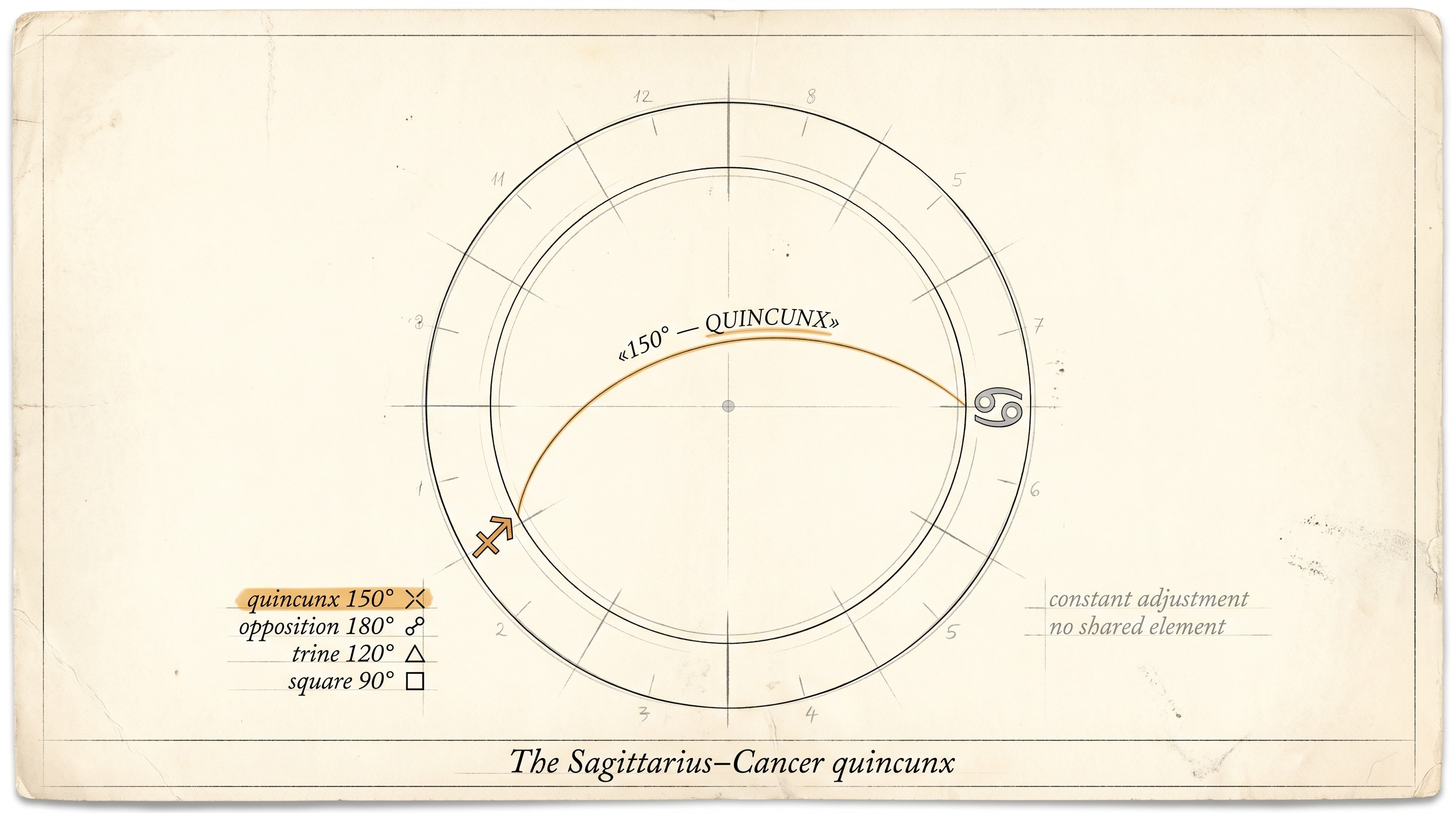
Here is the honest version. Sagittarius and Cancer sit five signs apart on the zodiac, what astrologers call a quincunx, an angle of around 150°. It is the angle of constant adjustment between two signs that share nothing obvious and have to keep recalibrating because what works for one rarely works for the other in the same form. The holiday is not the relationship's problem; it is the geometry.
In short. Sagittarius and Cancer sit 150° apart on the zodiac — a quincunx, or inconjunct. They share no element, no modality, no built-in bridge. Jupiter-ruled Sag wants the horizon; Moon-ruled Cancer wants the hearth. Whether the difference completes the relationship or quietly drains it is decided by four things synastry can check but Sun-sign tables can't.
 Two open tabs, two different holidays.
The quincunx — what 150° apart actually means
Sagittarius is the ninth sign of the zodiac, Cancer the fourth. Five signs apart, an angle of 150°: a quincunx, sometimes called an inconjunct. The awkward middle distance, neither close enough to feel familiar nor far enough to be a clean opposition.
Most relationship aspects have an obvious character. A trine (120°) feels easy. A square (90°) is friction. An opposition (180°) is polarity down a shared axis. The quincunx is none of those: the angle of two signs that share no element, no modality, no traditional ruler family. The work isn't to find common ground; the work is to keep adjusting because there isn't any.
Compatibility sites have long called Sag and Cancer opposites — geometrically wrong (Sag's opposite is Gemini, Cancer's is Capricorn). Real opposites share an axis; quincunx pairs share nothing. An opposition couple argues about the same thing from opposite ends; a quincunx couple barely argues at all, because there is no shared subject.
For individual sign traits, the twelve zodiac signs explained covers what Sagittarius and Cancer are like as personalities. This piece is about what happens when they try to plan a Sunday.
Jupiter outward, Moon inward — why the pull goes opposite directions
The two signs are ruled by planets that describe opposite metaphors for what a life is for, which is the closest thing to a real explanation of why this pairing feels the way it does.
Sagittarius is ruled by Jupiter, the planet of expansion, travel and meaning-making. The instinct is to enlarge: the next country, the bigger idea, the conversation that hasn't been had yet. Sagittarius finds restriction the most painful thing in a relationship and freedom the most romantic.
Cancer is ruled by the Moon, the body of containment and hearth. The instinct is to hold: the chair that is hers, the person who knows how she takes her tea on the morning her sister calls. Cancer finds absence the most painful thing and presence the most romantic.
When the dynamic completes, the wanderer brings the bigger world home, and the hearth-keeper gives it somewhere worth being brought back to.
When it competes, she reads his absences as abandonment; he reads her holding as a leash. Same pull, opposite directions, both unable to soften without feeling they're disappearing into the other person's shape. The quincunx makes the risk visible; it does not, on its own, decide which way the relationship goes.
The four things synastry actually checks for a quincunx pair
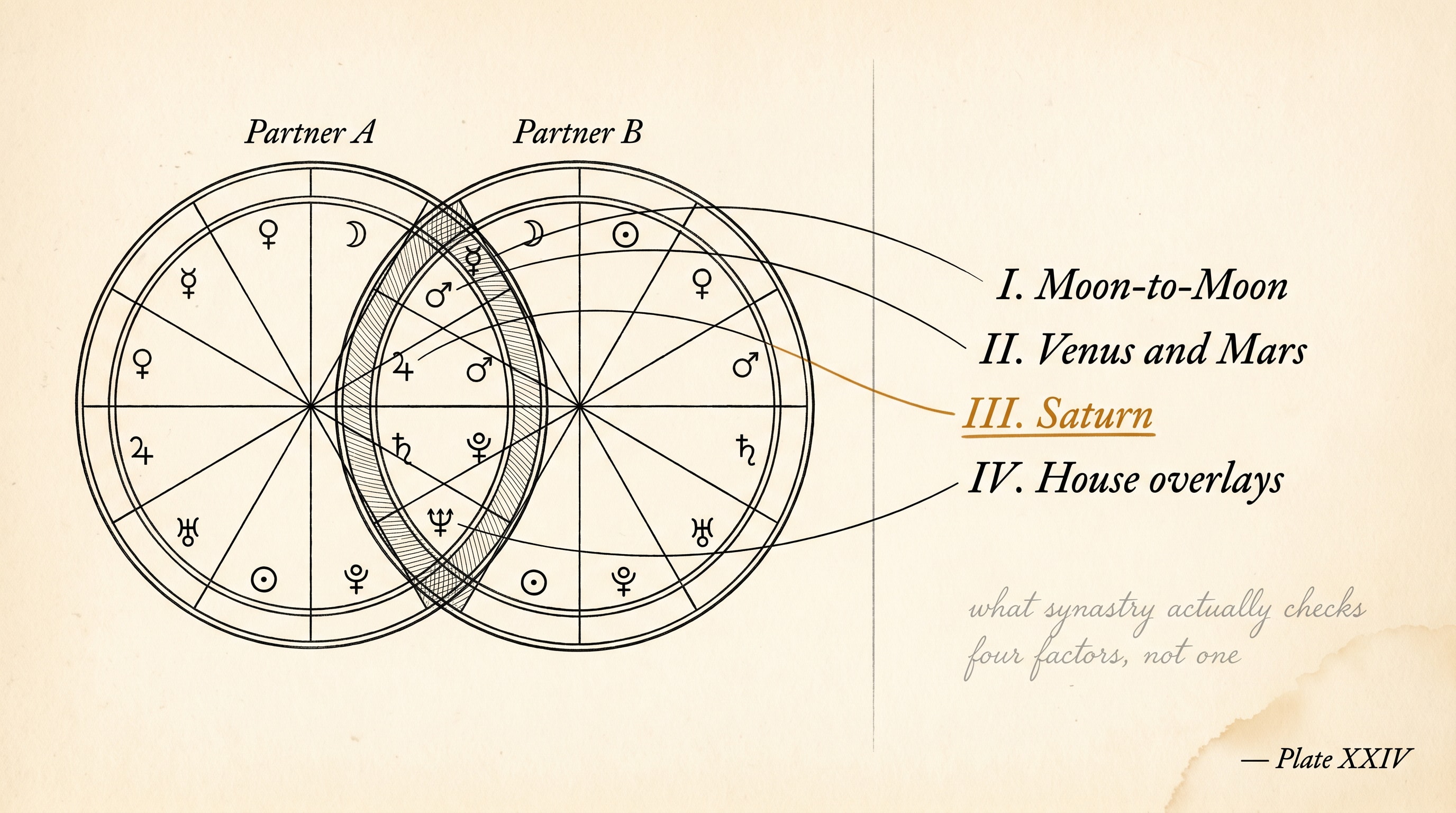
Whether a Sag-Cancer pair lives in completion mode or competition mode depends on four things you can't see from the Sun signs alone: the Moon contacts, Venus and Mars, Saturn's role, and the house overlays.
Moon-to-Moon: the daily emotional climate
Your Sun is who you are; your Moon is what you need to feel safe. The Moon-to-Moon contact is the first thing any working astrologer reads in a synastry chart.
A Cancer with a Sagittarius Moon already has the wanderer's instinct built in; a Sagittarius with a Cancer Moon already has the hearth-pull. Either internal mix softens the pair-level quincunx. When the Moons sit in an easy aspect, the daily climate works even when the Sun-Sun pull doesn't. When they clash, the quincunx amplifies.
Venus and Mars: chemistry beyond temperament
Venus describes how you love; Mars describes how you act and pursue. A Venus in one chart meeting a Mars in the other is what people clumsily call chemistry. Comfort comes from shared element; chemistry comes from this contact specifically.
A Sag-Cancer pair has neither shared element nor modality, so the Venus-Mars contact carries more weight than in an easier match. A sextile or a trine produces the pull that gets the couple through the calibration. Without it, the pair can love each other deeply and still find the romantic temperature lower than they'd like.
Saturn: the structural spine the relationship needs
Saturn doesn't get much attention in compatibility writing, which is a shame, because in a quincunx pair it does more of the actual work than any other planet. The relationship has no built-in scaffolding, so it has to be constructed deliberately. Saturn is the planet of construction.
A Saturn contact in synastry — one person's Saturn touching the other's personal planets — gives the relationship the durability everyone hopes for. Without it, a Sag-Cancer pair can be very warm and structurally adrift; with it, the pair tends to find its way to long-term decisions without quite knowing why.
House overlays: where each of you lands in the other's life
When you drop your partner's planets into your chart, they land in particular houses. The overlays describe what each of you involuntarily sees in the other.
A Sagittarius Sun landing in someone else's ninth house (travel, philosophy, higher meaning) reads as "my partner brings the bigger world into my life". A Cancer Sun in someone else's fourth house (home, roots) reads as "my partner is part of what makes this a home". These overlays sometimes do more work than the Sun-Sun quincunx.
In short. Sag and Cancer are a textbook quincunx pair: five signs apart, no shared element or modality, the angle of constant calibration. Whether the dynamic completes or competes is decided by the rest of the chart: Moons, Venus-Mars, Saturn, house overlays. The Sun signs name the geometry; they don't, on their own, finish the sentence.
One real-feeling worked example
Two people, illustrative, not a real couple. Call them Maya and David.
Maya: Sun in Sagittarius, Moon in Pisces, Venus in Capricorn, Mars in Libra, Rising in Leo. David: Sun in Cancer, Moon in Taurus, Venus in Cancer, Mars in Scorpio, Rising in Pisces.
The Sun-Sun quincunx is the headline: the 150° awkwardness already described.
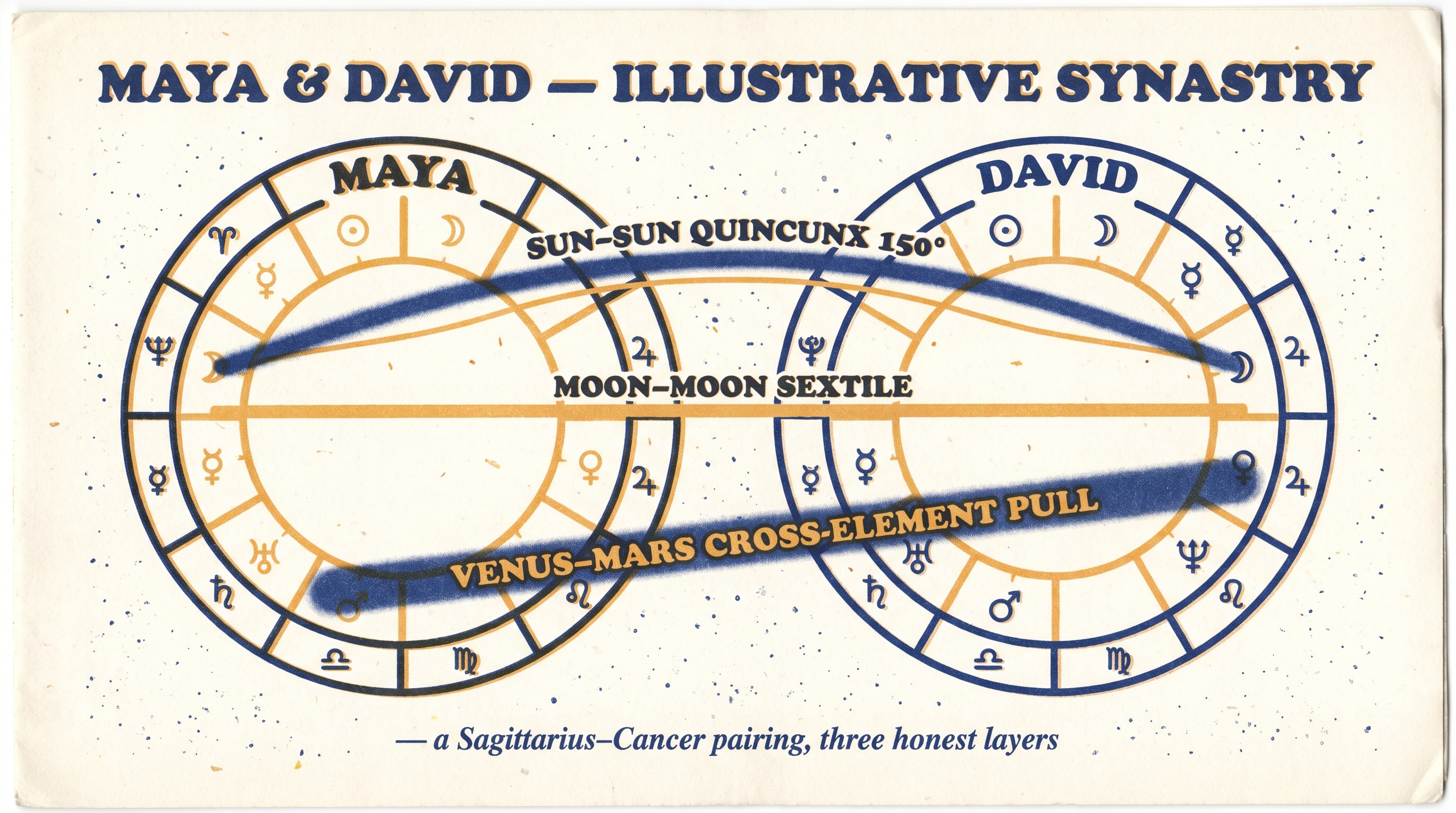
Now look down the chart. Maya's Pisces Moon and David's Taurus Moon form a sextile, water and earth, around 60° — a steady emotional climate where her dreaminess doesn't threaten him and his groundedness doesn't restrict her. Two compatible Moons sitting under a Sun pair the SERP calls difficult.
Maya's Venus in Capricorn and David's Mars in Scorpio form a soft cross-element pull, chemistry that doesn't burn loud but doesn't burn out either. Add Saturn somewhere doing structural work, and the spine is there.
Then the overlays. Maya's Sagittarius Sun drops into David's tenth house, his career and public-role part — he sees her as someone who shapes who he is in the world. David's Cancer Sun drops into Maya's twelfth house, her introspective, hidden part — he reaches the bit of her that her wandering Sun doesn't always remember exists.
 Not leaving, not staying. Adjusting.
A recognisable couple. Sun signs at the textbook quincunx; Moons and Venus-Mars softening the daily climate; house overlays letting each see the other as part of something larger than the kitchen-vs-Lisbon argument. Works, because of the calibration and despite the geometry.
What to actually check if you're in this pairing
Three things worth knowing, beyond your Sun signs.
First, find your Moon signs. The Moon takes a little more than two days to move through each sign, so depending on the time of day either of you was born, your Moon could be one of two. A free chart at astro.com gives the answer in under a minute. Two compatible Moons absorb most of the quincunx friction; two clashing ones amplify it.
Second, find your Venus and Mars signs. If your Venus is in aspect to their Mars, or vice versa, you will find a pull that comfort alone doesn't account for. The Sag-Cancer pair needs this contact more than easier pairings do.
Third, look at where Saturn sits. If Saturn touches the other person's personal planets, the relationship has spine. A quincunx pair without it tends to be fond and structurally adrift; one with it tends to last.
If you'd like to see this on your own charts, WowAstro will run the full synastry for both of you using the Swiss Ephemeris. The full synastry guide walks through the method end to end.
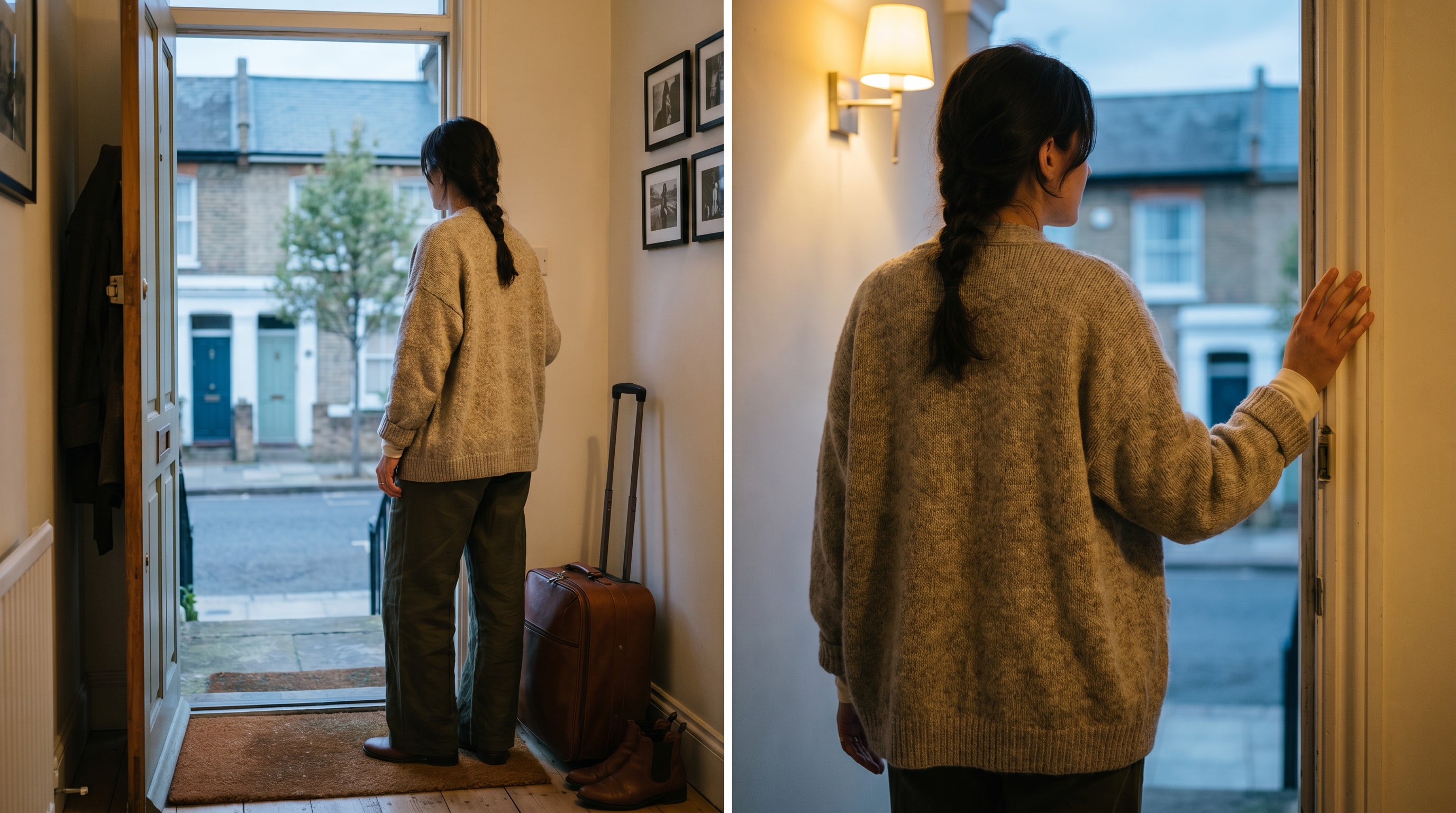 The wanderer, at the hearth.
Questions readers ask
Are Sagittarius and Cancer compatible?
The pair sits five signs apart on the zodiac, an angle astrologers call a quincunx, around 150°. The two share no element, no modality, no built-in bridge. Whether the quincunx feels complementary or corrosive depends on the rest of the chart — the Moons, the Venus-Mars contact, Saturn's role, and the house overlays. The Sun signs name the geometry; they do not, on their own, finish the sentence.
What's the danger of a quincunx in synastry?
The drift. Quincunxes show up not as fights you can name but as small, accumulating disappointments neither person can quite explain. Worked through, the calibration becomes one of the relationship's most reliable features. Worked against, both partners slowly stop asking and the relationship hollows from the inside.
Does Cancer-Sagittarius actually last?
Sometimes. Sun-Sun quincunxes don't predict duration. Long Cancer-Sag pairs almost always have a Saturn contact somewhere doing the slow structural work, plus easier contacts (Moons, Venus-Mars) keeping the daily climate liveable. For the same logic in an opposition rather than a quincunx, the Cancer-Capricorn compatibility piece covers the 180° version.
Why do compatibility sites give Sag-Cancer different scores?
Because Sun-Sun percentages are theatre. There is no astronomical fact behind "38 per cent compatible": the number is invented by the vendor to give the page something to display. A useful read of a pair needs the whole chart, not one tenth of it. Percentage scorers guess about strangers; synastry reads the two specific people in front of you.
If the calibration ever starts to feel more exhausting than rewarding, talking it through with a couple's therapist tends to do work no chart can do alone. Astrology is a lens for self-understanding, not a substitute for the slower professional kind.
A note on what this is. Astrology, as we use it at WowAstro, is a tool for self-reflection and self-understanding, not a method for predicting events, health, financial outcomes or whether a relationship will last. Read a synastry chart as a description of a dynamic, take what's useful, leave the rest.
Written by Oksana Miatova, astrologer and writer at WowAstro. Charts calculated using the Swiss Ephemeris, the same astronomical data working astrologers use.
See what your charts say about each other
A personal AI synastry reading — not a sun-sign table, but an analysis of both natal charts across 8 areas of the relationship
Comments
New here? Get −30% off your natal chart
Leave your email and we will send you the promo code WELCOME30. Straight after that you can comment — no passwords, all automatic.
Quick sign-in
Sign in with Telegram — one click.
Or by email (with a gift)
Already have an account? Enter the same email — we'll email you a sign-in link.