Maya opens a third browser tab. The first article said the Capricorn birthstone is garnet. The second said it's blue topaz, turquoise or tanzanite, depending on which December list the jeweller was using. The third gave a list of eight stones, half of them dark and «Saturn-ruled», the rest apparently optional. She closes all three. Her sister, also Capricorn, born three weeks later in January, had been told categorically that her stone was garnet. Maya's late-December birthday hadn't earned her the same simple answer.
Here's the honest answer those three articles skipped. There isn't one Capricorn birthstone, because there isn't one question. Three different traditions answer «what's the Capricorn stone» in three different ways, the calendar adds a December/January split most lists pretend doesn't exist, and a fourth layer (your actual birth chart) sits quietly behind all of them. None of these answers is wrong; they're answering different questions. Once you can see which is which, it becomes a lot easier to pick one, or to put your phone down and choose what you actually like.
In short. «The Capricorn birthstone» is three lists answering three different questions, plus a calendar split. The modern commercial calendar assigns blue topaz, turquoise and tanzanite to December (with garnet kept on some older December lists), and garnet alone to January, per GIA's standardised list (1912, updated 2002). The traditional astrological tradition ties the stones of Capricorn to its ruler Saturn — onyx, obsidian, jet, smoky quartz and black tourmaline, the heavy, dark, grounding family. And your own birth chart may have Capricorn placed somewhere other than your Sun (Midheaven and Saturn-in-Capricorn especially carry weight), which changes the question entirely.
 The honest answer rarely sits at the top of the search results.
Why there isn't one Capricorn birthstone
«Capricorn birthstone» is three different questions wearing one coat, which is why the search results quarrel so amiably, and that's before the calendar even gets a word in. What you find online is really three separate traditions piled on top of each other, none of them labelled, and most writers never say which one they've reached for. The first is the shopfront calendar your local jeweller stocks by, which sorts stones by the month of birth. The second is the old European lapidary line, which sorts stones by planet — and since Saturn rules Capricorn, the Capricorn entry is simply Saturn's stones, the dark and weighty family. The third is a wider astrological gathering of everything the early texts ever filed under Saturn, whether for its colour, its heft, its opacity or its dull lead-grey sheen. Taken one at a time, each tradition is perfectly coherent; the apparent contradiction only shows up when all three are ladled into a single bowl and served as one answer.
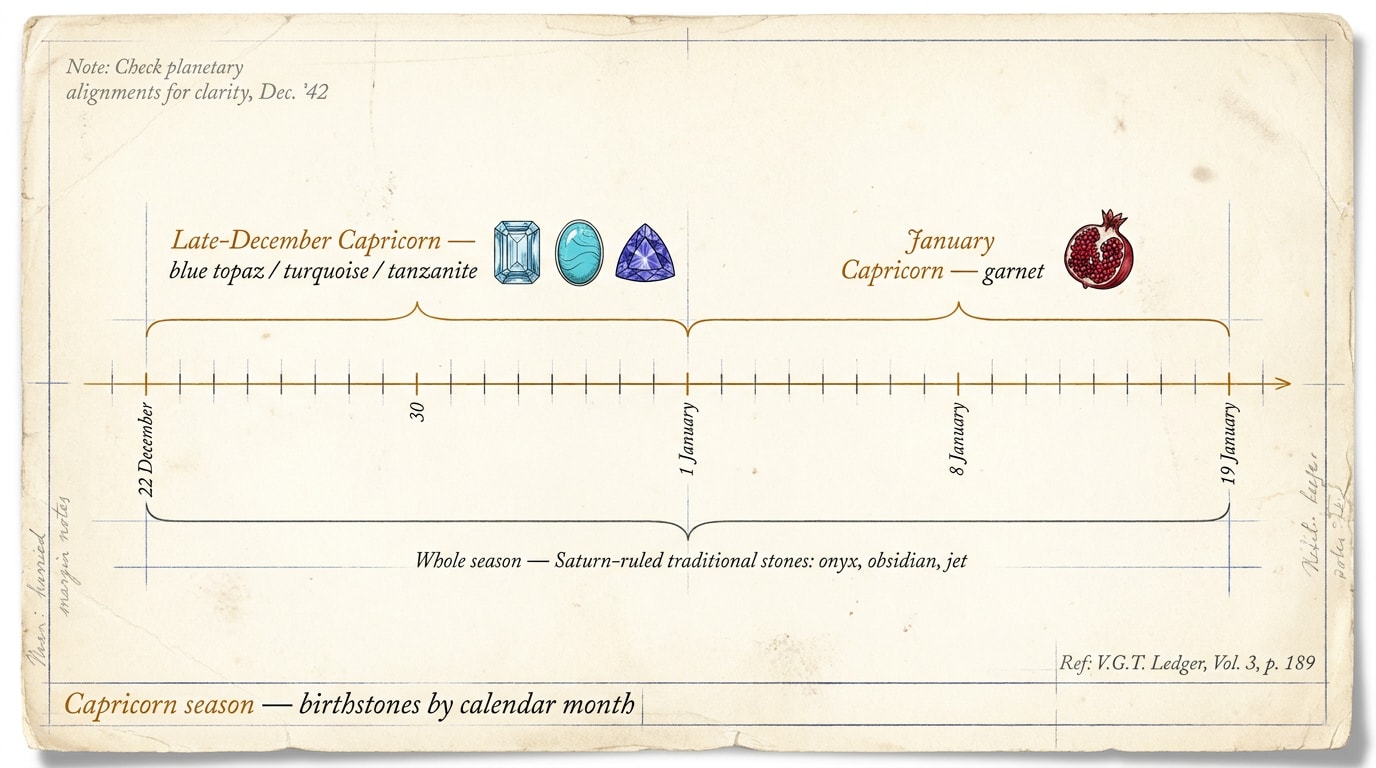
There's also the calendar problem, which is specific to Capricorn and nobody mentions it. Capricorn season runs roughly 22 December to 19 January, which means birthstone lists (assigned by month, not by sign) hand Cap two different answers depending on which side of New Year's Eve your birthday lands. Late-December Caps get the December list. January Caps get garnet. Same sign, different stones. The practical way through all of this is to ask yourself which question you're actually asking. The next three sections take the three traditions one at a time, and the cusp problem gets a paragraph of its own.
What the December and January calendar hands a Sea-Goat
In the modern commercial system used by GIA and the British Gemmological Association, December's birthstones are blue topaz, turquoise and tanzanite (with zircon as a fourth on most lists, and garnet kept on some older December lists as a holdover). January's birthstone is garnet, and only garnet. This is the list every high-street jeweller works from, the list that decides which gem sits in the «December» or «January» tray at Hatton Garden, and the list every birthstone-ring website quotes without thinking. Its modern shape was fixed in 1912, when the American National Association of Jewelers pinned down the month-by-month assignments; Jewelers of America later adopted it formally, and GIA keeps it current. Tanzanite joined the December slot in 2002, a full generation after the stone itself was first unearthed.
The history sits at the back of every Cap birthstone. Turquoise has been mined in Persia (modern Iran) for around five thousand years and in the Sinai for nearly as long, which is why turquoise jewellery shows up in pharaonic tombs and Persian royal courts alike. Tanzanite, by contrast, is barely older than colour television: it was discovered in northern Tanzania in 1967, mined commercially from a single small area near Mount Kilimanjaro, and added to the December list in 2002 partly because Tiffany & Co. wanted a new winter stone for the calendar. Blue topaz on the market is almost always heat-treated and irradiated colourless topaz, a disclosed trade norm rather than a fault. Garnet's name comes from the Latin granatum, pomegranate seed, which is exactly what a faceted almandine looks like in good light.
A note for cusp-dwellers. Capricorn season runs ~22 December to ~19 January. If your birthday is 22-31 December, the calendar gives you December's stones (blue topaz, turquoise, tanzanite, or garnet on the older list). If your birthday is 1-19 January, the calendar gives you garnet outright. Both readers are Capricorn by sun sign. The calendar isn't being mystical about this; it's just a month-by-month list that pre-dates the standardised tropical sign-dates and never reconciled with them. The traditional astrological answer (next section) doesn't care about the calendar at all.
Saturn's stones, and so the Sea-Goat's
In the traditional astrological lapidary tradition, the stones of Capricorn are the stones of its ruler, Saturn. This isn't a calendar-month assignment. It's a planetary-correspondence assignment, derived from the way medieval European, Arabic and earlier Hellenistic astrologer-physicians grouped substances by planet — lead, sombre fabrics, slow-growing trees, dense bones and certain stones all sat under Saturn for reasons that combined colour (dark, lead-grey, black), weight (heavy in the hand), and visible quality (opaque, sober, undemonstrative). Nicholas Culpeper, the seventeenth-century English physician whose «Complete Herbal and English Physician» (1652) remains the most widely-cited British source for this tradition, names lead as Saturn's metal and groups Saturn with cold and dense matter. Marbode of Rennes, writing around 1090, and the Picatrix (the 12th-century Latin translation of a 10th-century Arabic magical text) both place black and dark stones in the Saturn family.
 Tradition gives you a name, not a verdict.
The logic that ties dark stones to Saturn is metaphorical rather than chemical, and once you see it the canon stops feeling arbitrary. Saturn was the slow planet, the cold planet, the planet of limits and gravity and weight, the planet of bone and stone and earned authority. Medieval astrologers placed substances under Saturn that felt the same way: lead (the heaviest common metal), dark wool, slow-growing wood, and the stones that catch the eye not by sparkle but by sobriety. Onyx, the opaque banded chalcedony you can carve into seals and signet rings. Obsidian, volcanic glass with an inner darkness like a still pond at night. Jet, fossilised wood soft enough to carve and heavy enough to feel substantial, beloved of Victorian mourning jewellery for exactly this reason. None of this is a healing claim. It's a metaphor that gave craftsmen and astrologers a way to organise the world without modern chemistry. If you're asking «what stone did the old tradition associate with my Saturn-ruled sign», the answer is one of the heavy and dark family, and the same answer holds whether you were born in December or January.
Other Saturn-correspondence and Capricorn-associated stones
Beyond onyx, obsidian and jet, a wider pool of stones gets named on Capricorn lists, and the honest accounting separates the older Saturn-correspondence canon from more recent additions made for thematic-fit reasons. Worth knowing as a shortlist if the three core stones feel out of reach, don't suit you, or simply don't appeal.
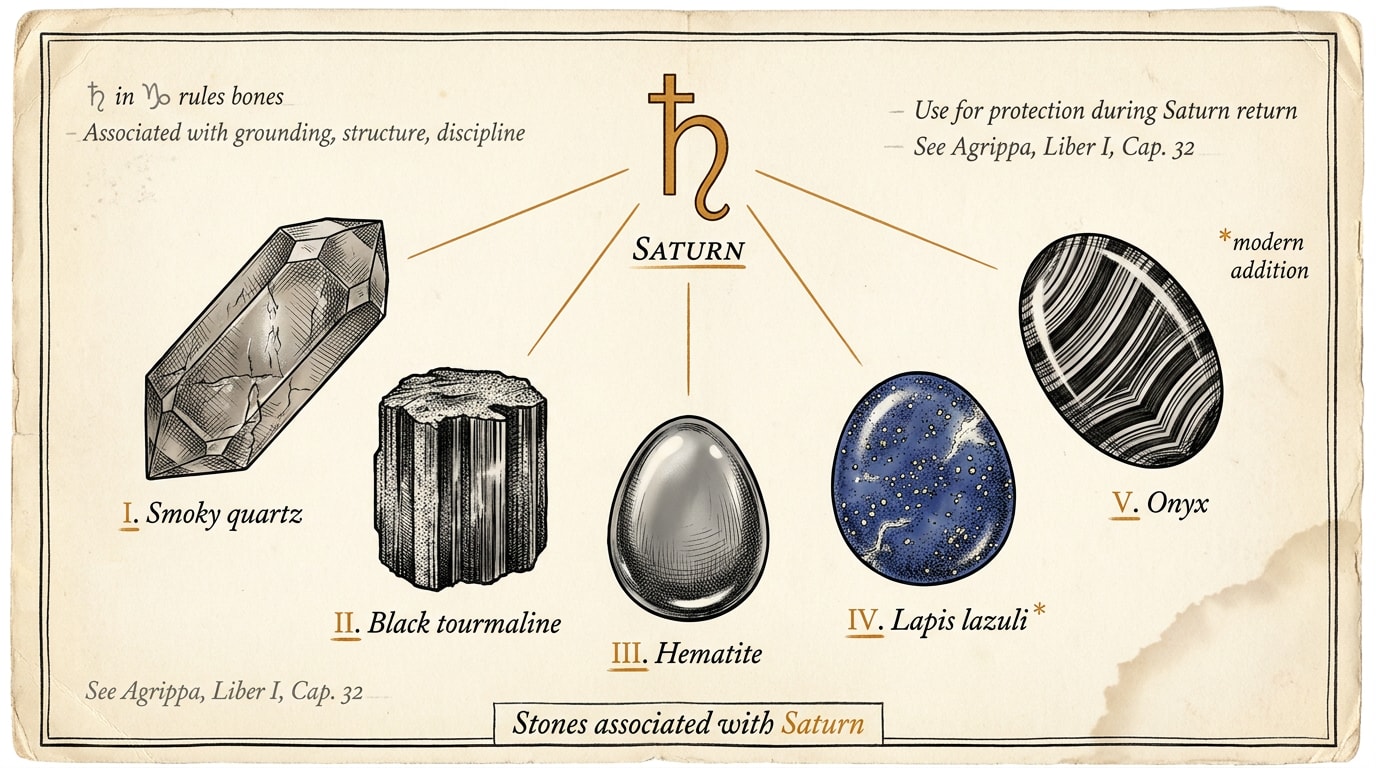
Smoky quartz is translucent brown-grey quartz, the smoke-tinted member of a very familiar family. Old astrological-mineralogical texts grouped it with Saturn for the same reasons as obsidian and jet: the colour is sober, the appearance is grounded, and the lustre is more reflective than radiant. It also has the practical advantage of being inexpensive and available in any size, from small tumbled stones to large faceted ones.
Black tourmaline (schorl, to gemmologists) is an opaque black silicate that turns up on most modern Capricorn-correspondence lists. Older European lapidaries don't separate tourmalines from one another (the species wasn't isolated until the eighteenth century), but the colour and weight fit the Saturn family without strain, and the modern addition is fair as long as it's flagged.
Hematite is an iron-oxide stone with a metallic grey-to-silver lustre, dense and weighty in the hand. Some Renaissance lapidaries grouped it with Saturn by mass and colour, and modern crystal-correspondence writing has carried that grouping forward. It polishes to a mirror finish and is sometimes mistaken for blackened silver, which a Saturnine reader can take as a compliment to the planet.
Lapis lazuli is deep blue with golden pyrite flecks, and its inclusion on modern Capricorn lists is more thematic than canonical. The colour isn't a Saturn colour (deep blue traditionally sits closer to Jupiter or Venus), but the stone's association with authority, wisdom and quiet substance — the lapis used by Egyptian and Mesopotamian rulers in ceremonial regalia — has made it a Cap-friendly addition in twentieth-century crystal-revival writing. Honest to flag as modern, fair to wear if it appeals.
What a birthstone tradition can and can't claim. Traditional planetary correspondence says one thing only: «this stone was associated with this planet, for these reasons». It does not say the stone will heal you, ground your root chakra, summon discipline, or shield you from Saturn's weight. That second batch of promises comes from twentieth-century crystal-healing writing — a parallel genre with no foothold in the old astrological texts. Buy and wear what you find beautiful; the symbolic association is the gift, the medical promise was never on the table.
Buying a real Capricorn stone without overpaying
So you've landed on garnet, blue topaz, or one of Saturn's darker stones, and now you'd rather pay for the genuine article than a marked-up imitation. What follows is the plain, unglamorous sort of guidance you get from someone with nothing on the shelf to sell you — tedious, but the kind of tedium that keeps money in your pocket.
Where to look, in the UK. For the widest choice, head to Hatton Garden — Britain's main jewellery quarter, roughly three hundred dealers packed into a few central-London blocks, most happy to let you browse off the street without an appointment for ordinary stones. Boodles, the independent heritage UK jeweller founded in 1798, carries reputable stock and has been doing so for long enough that its buyers know their garnet varieties cold. Liberty's gem counter, Selfridges and the better independent regional jewellers (your county's old high-street name, often family-run for several generations) frequently offer better value than the big names. For free education, the V&A's gem gallery in South Kensington (the William and Judith Bollinger Gallery, to give it its full name) is unbeatable: you can see the difference between natural and treated stones, in good light, without anyone trying to close a sale.
What to read on the tag. Garnet is a family, not a single stone — almandine is the affordable workhorse (the deep wine-red one most people picture), pyrope is a slightly lighter red, rhodolite is pink-violet, demantoid and tsavorite are the green and luxury-priced ones. A tag saying «garnet» without a species name usually means almandine, which is perfectly honest if disclosed. Turquoise needs the most caution: a lot of cheap «turquoise» on the market is dyed howlite or magnesite, which is disclosed in reputable shops and undisclosed in market-stall jewellery. If the price seems impossibly low, the answer is usually howlite. Almost all blue topaz on the market is colourless topaz that's been heat-treated and irradiated to colour, which is a normal and disclosed trade practice rather than a fault. Tanzanite is virtually always heat-treated, also disclosed. Onyx and obsidian are usually inexpensive, but dyed black agate is sometimes sold as «onyx» in cheap jewellery, so buy from a source that names the material exactly.
What to ignore. The moment a listing starts promising you a stone's «vibration», «energy frequency», «root-chakra alignment» or what it «will activate», you've stepped out of gemmology and into something else. Neither the December–January calendar nor the old Saturn-stone lapidaries ever traded in talk like that. A description heavy on healing language usually means the seller is pricing the story, not the stone. The label that earns your attention carries carat weight, country of origin, treatment status and clarity grade — that's the gemmologist's tag, and it tells you what you're actually handing over money for.
From «Capricorn birthstone» to your Capricorn placements
A Capricorn birthstone search assumes Capricorn is your Sun, but Capricorn might be living somewhere else in your chart entirely, and knowing where it actually sits changes which stone-correspondence has anything to do with you. A chart isn't one sign; it's a spread of ten bodies — the Sun, Moon, Mercury, Venus, Mars, Jupiter, Saturn, Uranus, Neptune and Pluto — each parked in one of the twelve signs, with a Rising sign and a Midheaven both pinned down by the exact minute you were born. Capricorn could be holding any of those slots, and for the Sea-Goat two of them carry more weight than the rest: the Midheaven (the public-and-career face of the chart) and Saturn itself, Capricorn's own ruler.
 One stone, one symbol, ten placements in a chart.
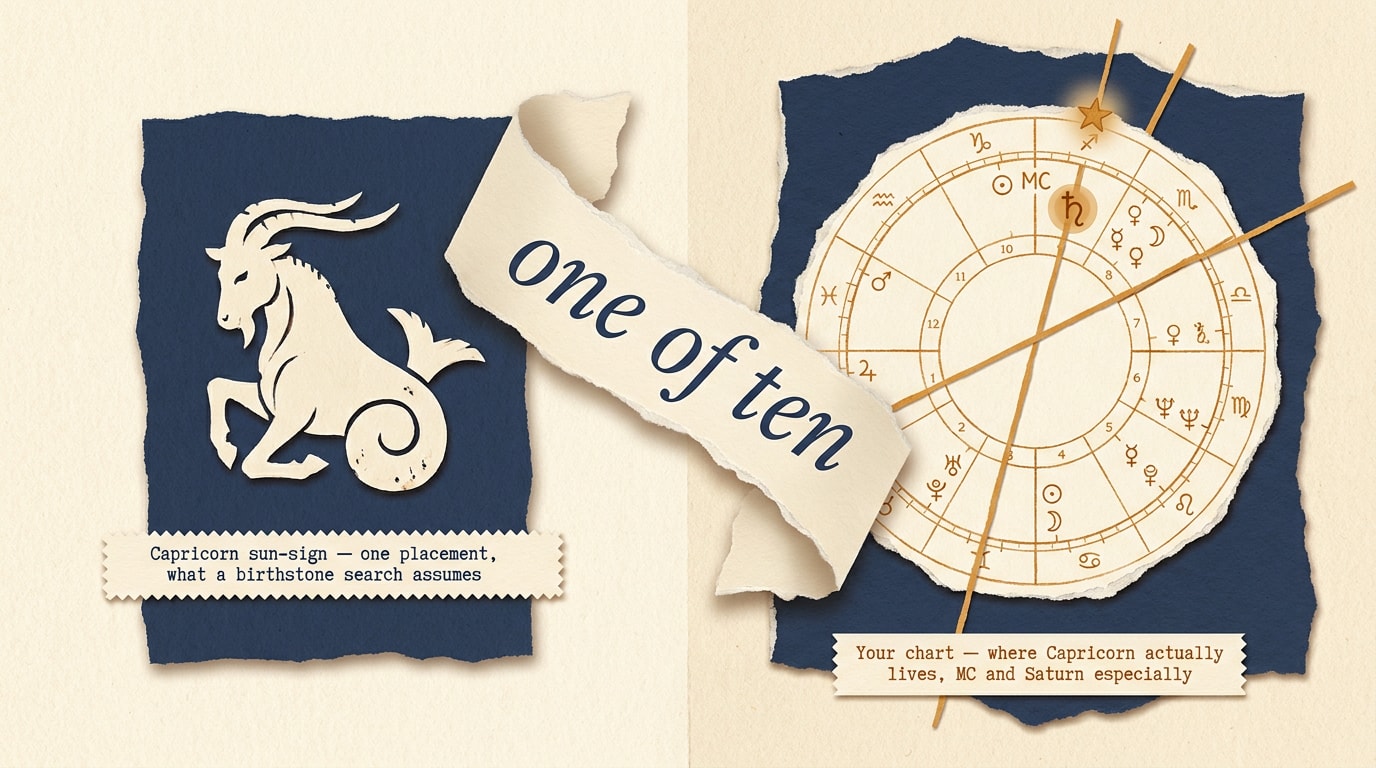
If your Moon is in Capricorn, your emotional baseline is built for restraint and quiet competence; you steady yourself with order. If your Venus is in Capricorn, your affection is given practically rather than theatrically — substantial gifts, kept promises, slow trust. If your Midheaven is in Capricorn, your public-and-career identity is built to weather time, which is a Saturnine compliment rather than a Saturnine burden. And if you have Saturn-in-Capricorn (the whole cohort born between late 2017 and early 2020 sits on this, as do other generations on earlier passes), your structural-building lessons arrive in Capricorn's mode — slowly, weightily, with the patience of a planet that takes nearly thirty years to come back around. A birthstone for your Sun is one thing; a birthstone for the placement that's actually loudest in your chart might be quite another, and the only way to know which is which is to look at the whole chart rather than the sun-sign label.
If you'd like to see where Capricorn actually lives in your chart rather than the sun-sign label, WowAstro will calculate a free birth chart for you. Hand it your birth date, your birth time and where you were born, and a couple of minutes later it's done. The stone is a small symbol; the chart is the longer description.
Questions readers ask
What is the actual Capricorn birthstone?
There isn't one — there are three honest answers, and the calendar cuts one of them in half. Ask «what stone does the modern commercial calendar give people born in Capricorn season» and the reply turns on your birth-month: late-December Caps draw blue topaz, turquoise, tanzanite or zircon (with garnet still clinging to some older December lists), while January Caps draw garnet outright, all per GIA's standardised birthstone list — the industry reference since 1912, amended in 2002 to admit tanzanite. Ask «what stone did the old astrological tradition tie to Capricorn as a Saturn-ruled sign» and the reply is the dark and weighty family — onyx, obsidian, jet, smoky quartz, black tourmaline — sourced from Culpeper, Marbode of Rennes and the Picatrix. Ask «what other stones get named on modern Capricorn lists» and you get hematite for Saturn-correspondence reasons and lapis lazuli for thematic ones. Work out which question you're really asking, and the answer falls out of it.
Is garnet or blue topaz the Capricorn birthstone?
Both are real, and they answer different questions, with your birth-month deciding which applies. Garnet holds the January slot, fixed by jewellery-industry convention since 1912 and stocked by every high-street jeweller in the UK. Blue topaz is one of December's stones in the modern list, alongside turquoise and tanzanite. Born late in December, you fall under the December list — and because some older December lists also held on to garnet, that's where the «garnet for all Capricorns» shortcut comes from. Born in January, you get garnet with no ambiguity at all. Neither stone is more «real» than the other; the choice sits with you, and the traditional astrological answer (any of the Saturn-correspondence stones) is open to both groups regardless.
What is the lucky stone for Capricorn?
«Lucky» belongs to a different conversation than the one tradition is having. Astrological correspondence says «this stone was associated with this planet, for these reasons» — it makes no promise that the stone will hand you luck, money, love, success, discipline or any other outcome. When the «lucky stone» question comes up for Capricorn, the names that surface most often are garnet (the January calendar stone), blue topaz or turquoise (the December calendar stones), and onyx or obsidian (the traditional Saturn-correspondence stones). Want one for the symbolism rather than a guaranteed result? Any of those does the job. Want one purely because it's beautiful? That reason stands on its own and needs no backing.
Can I wear a different birthstone if I'm a Capricorn?
Yes — and tradition has no quarrel with it. These lists hand you correspondences, not commands. Nothing in the modern commercial system or the old astrological one obliges a Capricorn to wear garnet or onyx in preference to emerald, amethyst, sapphire or whatever else catches the eye. Fall for a stone that «belongs» to another sign and wear it anyway; the old astrologers would likely respect a genuine preference far more than a stone worn out of dutiful habit. Treat the birthstone tradition as a doorway into choosing something that means something to you, not a closed rulebook you're bound to obey. Wear the one you'll actually want to look at.
Astrology, as we use it at WowAstro, is a tool for self-reflection and self-observation, not a method for predicting events, health, or financial outcomes. Traditional correspondence-stones are symbolic associations, not medical recommendations or guaranteed luck-bringers. Take what's useful from any tradition, leave the rest.
Written by Oksana Miatova, astrologer and writer at WowAstro. Charts calculated using the Swiss Ephemeris, the same astronomical data working astrologers use. Historical correspondences drawn from Nicholas Culpeper's «Complete Herbal and English Physician» (1652), Marbode of Rennes' «Liber Lapidum» (~1090), and the Picatrix (12th-century Latin); modern birthstone list per the Gemological Institute of America.
Read your own natal chart
A personal AI reading, from £1
⭐ +50 Wow Stars cashback · sign up and get 100 ⭐
Build my chart →Comments
New here? Get −30% off your natal chart
Leave your email and we will send you the promo code WELCOME30. Straight after that you can comment — no passwords, all automatic.
Quick sign-in
Sign in with Telegram — one click.
Or by email (with a gift)
Already have an account? Enter the same email — we'll email you a sign-in link.