Eli has three tattoo references open on his phone — a detailed scorpion in fine line, a phoenix mid-flight with feathers fanning behind it, and a small map of Scorpius with one warm-amber dot for Antares. His appointment at Watermelon Tattoo in Glasgow is in two weeks. He is sitting at the window of a new flat he moved into a month ago, after a year in which a long relationship ended, a job ended, and a city changed. Phoenix is, almost embarrassingly, his year. Scorpion is the classic Scorpio mark his school friend wears as a sleeve. Constellation is the quietest and possibly the most beautiful. He has no idea which one is "his".
Here is the honest reason the three don't sort themselves out. "Scorpio astrology tattoo" isn't one design question; it is three layered ones, and the Pinterest grid mixes the layers without telling you which is which. There is the glyph itself, the compressed mark astrologers have been writing for centuries. There is the symbol set Scorpio's rulers have gathered around themselves, and within it the scorpion-eagle-phoenix progression that 19th-century esoteric writers added to the tradition. And there is the constellation itself in the night sky, with Antares as a red supergiant marking the Scorpion's heart. Pull the three apart and choosing gets quieter — often a smaller design than the loudest pin on the board.
In short. A Scorpio astrology tattoo lives in three layers. The glyph ♏, which astrologers have written for the sign since the Hellenistic period. The symbol set ruled by Mars (the traditional ruler since classical antiquity) and Pluto (the modern co-ruler added after Pluto's discovery in 1930) — including the scorpion as the ancient base symbol, plus the eagle and phoenix that 19th- and 20th-century esoteric writers added as "higher stages" of Scorpio. And the constellation Scorpius itself, with Antares (the red supergiant marking the heart) and Shaula (the bright star at the stinger's hook). A fourth question sits behind the three: where Scorpio actually lives in your chart, not just your sun-sign label.
 Three references, after a year of change.
The glyph itself ♏
The ♏ glyph is a stylised scorpion, a curved shape ending in an arrow-like upturned stinger — and astrologers have been writing it in some form since the Hellenistic period. Open any sixteenth-century European astrological manuscript and the shape is already recognisable. Its current Unicode point is U+264F, which means it is now also one of the few two-thousand-year-old symbols that copies and pastes cleanly into a tattooist's design file.
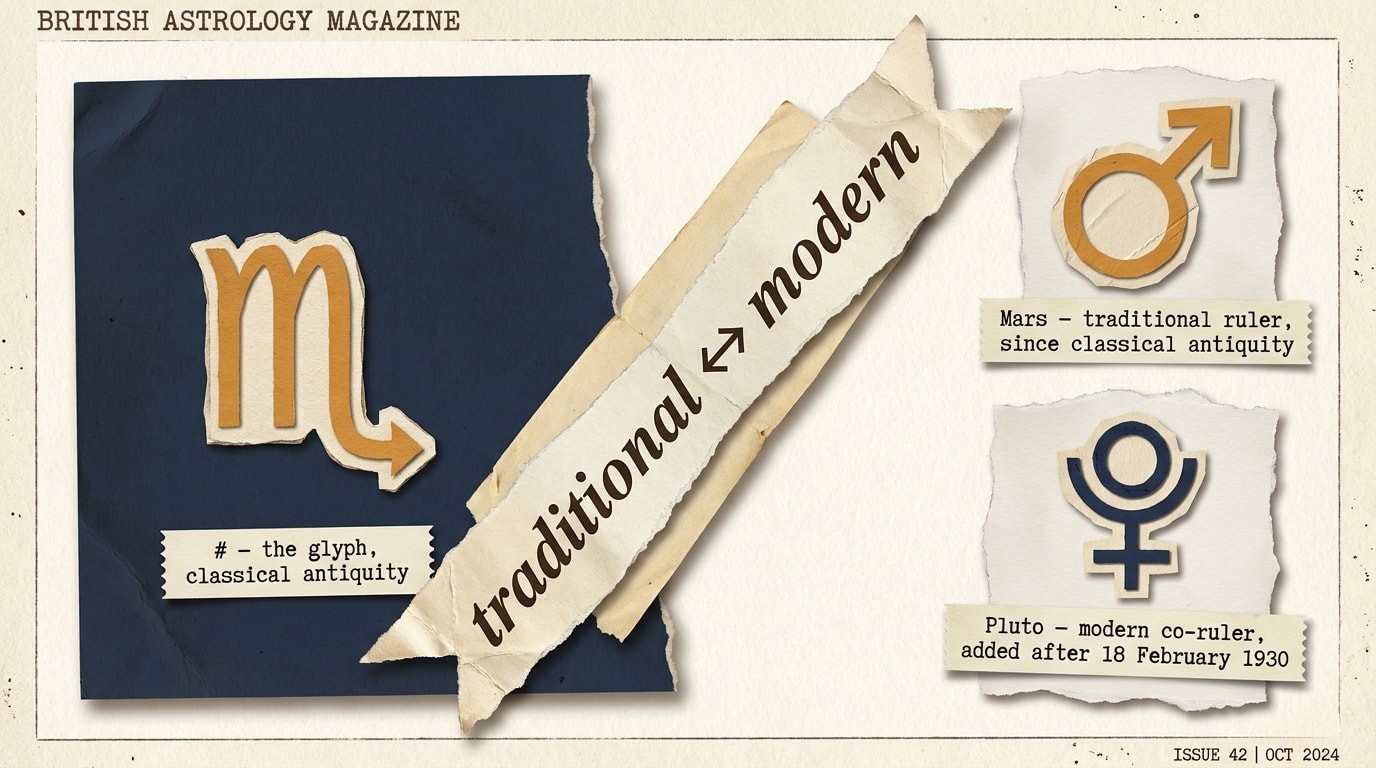
Scorpio is associated in Western astrology with two ruling planets. Mars is the traditional ruler, assigned to Scorpio from classical antiquity, when astrologers worked with the seven visible planets and Mars was the closest match for Scorpio's focused, slow-burning drive — William Lilly's "Christian Astrology" (1647) records this rulership matter-of-factly, citing the older Hellenistic canon. Pluto is the modern co-ruler, added in the twentieth century after Pluto's discovery at the Lowell Observatory on 18 February 1930. Most contemporary scorpio astrology uses both: Mars for how Scorpio acts day to day, Pluto for the longer transformation arcs. Tattoo-wise, this means you have two planetary glyphs to choose from as quiet additions — ♂ for the classical layer, ♇ for the modern one.
The scorpion as a celestial figure predates the modern glyph by millennia. Mesopotamian astronomical tablets from around 2000 BCE name a scorpion constellation in Sumerian as GIR.TAB, sometimes depicted as a scorpion-man (a hybrid figure with a human upper body and a scorpion lower body). Greek astronomy carried the figure forward — Aratus's "Phaenomena" (c. 270 BCE) gives the constellation as Skorpios, the scorpion sent by Artemis or Gaia to kill the hunter Orion, then placed in the sky opposite him so the two never appear together. The visual lineage is genuinely old.
As a tattoo, the glyph is the most condensed astrological mark you can make. Small, legible to anyone who knows the symbol, invisible to anyone who doesn't, equally good behind the ear or on the inside of a wrist. If you want a Scorpio tattoo that doesn't announce itself, this is it.
Scorpion, eagle, phoenix: the three-stage symbol set
The reason a Pinterest board for "Scorpio tattoo" is half scorpions and half phoenixes, with the occasional eagle in the mix — is that modern astrology treats Scorpio's symbology as a three-stage progression. Scorpion is the base symbol. Eagle is a "mid stage". Phoenix is a "rebirth stage". This is the part of the SERP most worth getting right, because it is the part where Pinterest captions go widest and least honest.
Here is the provenance, plainly. The scorpion is the ancient base symbol, attested in Greco-Mesopotamian astronomy and assigned to Mars-ruled Scorpio in the classical Western canon. That part is canonical. The three-stage progression, scorpion-to-eagle-to-phoenix — is not. It is a nineteenth- and twentieth-century esoteric addition, documented in H.P. Blavatsky's "The Secret Doctrine" (1888) and Manly P. Hall's "The Secret Teachings of All Ages" (1928), then carried into modern psychological astrology by writers like Liz Greene and Stephen Arroyo. It is a chosen interpretive framework, not a promised mechanism. Worth wearing if it resonates; worth knowing where it comes from before you do.
The four symbols that turn up most often in tattoo work:
| Symbol | Tradition / origin | Typical tattoo use |
|---|---|---|
| Scorpion | Ancient — Mesopotamian (Sumerian GIR.TAB, ~2000 BCE) and Greco-Roman iconography; Mars-ruled in classical Western astrology | The honest classical Scorpio mark — direct, unambiguous, slightly dangerous-looking by design |
| Eagle | Nineteenth-century esoteric tradition ("mid-stage" Scorpio); not in ancient astrological sources, widely re-used by twentieth-century psychological astrologers | A confident bird in profile |
| Phoenix | Greco-Egyptian antiquity (the bennu in Egyptian iconography); specific assignment to Scorpio is a nineteenth-century esoteric move | The most demanding piece — feather detail and bird anatomy ask a lot of a tattooist |
| Mars glyph ♂ and Pluto glyph ♇ | Classical planetary glyphs for Scorpio's two rulers, paired with ♏ | Very small, very precise; often the cleanest option for the astrological reference without iconography |
Which one is your Scorpio tattoo depends less on which is "correct", all of them are legitimate within their own tradition — and more on which moment you are commemorating. Scorpion for the classical, no-qualifier Scorpio mark. Eagle for the version of Scorpio that has stepped back to a wider view. Phoenix for a specific chapter you've already lived through. Both rulers' glyphs as quiet additions for the chart-literate. The honest part is choosing one because it fits the layer you mean.
The constellation itself
The third layer is the easiest to draw badly and the most rewarding to draw well. The Scorpius constellation in the night sky is one of the few zodiac patterns that genuinely looks like its name, a curving line of stars with a clear hook at the end — and it carries two distinct visual landmarks that work as tattoos in their own right: Antares (the red supergiant marking the Scorpion's heart) and Shaula (the bright star at the tail's stinger).
 The chart printout goes in your pocket before the reference images do.
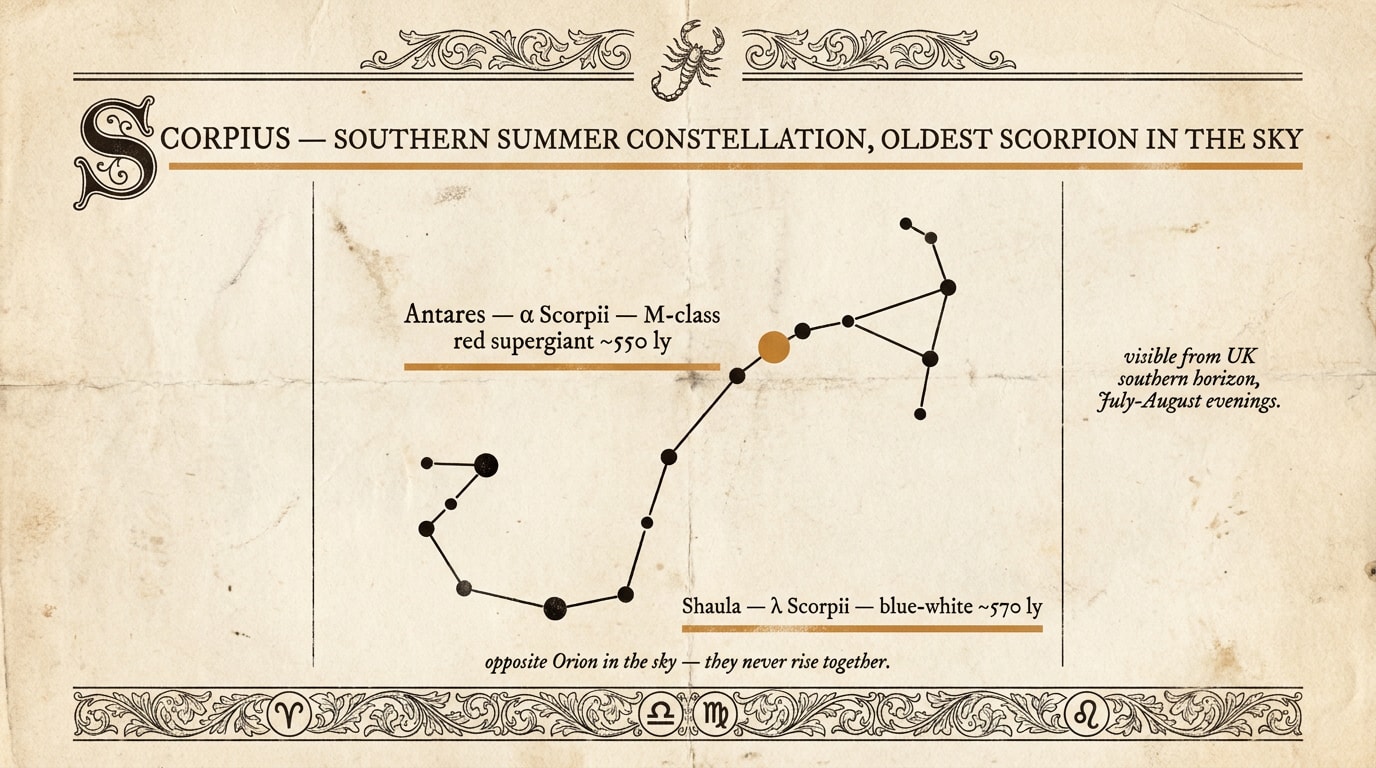
Antares, α Scorpii in modern astronomy, an M-class red supergiant about 550 light-years away — is the fifteenth-brightest star in the night sky. Its name comes from the Greek "anti-Ares", meaning "rival of Mars", because its colour is similar to Mars when both are bright in the sky at the same time. As a tattoo, a single slightly larger warm-amber dot among the constellation's smaller dots reproduces what the eye actually sees on a clear summer night, the noticeably red star at the centre of the curving line. From UK latitudes Scorpius sits low on the southern horizon in July and August evenings, never rising high, which gives the constellation a particular quality of being half-glimpsed even when fully present.
Shaula, the bright star at the hook of the stinger, is α Scorpii's quieter companion at the far end of the constellation. A blue-white star about 570 light-years away, its name comes from the Arabic "al-šawlā'", meaning "the raised tail" — Arabic astronomy preserved many of the older star names through the medieval period, and Shaula is one of them. In a constellation tattoo, Shaula often sits as the second-largest dot, anchoring the hook at the other end of the curving line from Antares.
The scorpion in the sky is older than the Greek myth. Mesopotamian astronomical tablets from around 2000 BCE recorded the constellation as GIR.TAB, sometimes drawn as a scorpion-man — a hybrid figure with a human upper body and a scorpion lower body. The Greek mythological layer arrives later in Aratus's "Phaenomena" (c. 270 BCE): the constellation is the Skorpios that killed the hunter Orion, placed in the sky opposite him so they never appear together. Look at the summer sky for Scorpius and the winter sky for Orion, and the myth is encoded in their never-meeting. A constellation tattoo isn't just a star map; it's also one of the oldest mythological-astronomical pairings on the planet.
What a tattoo can and can't claim. A Scorpio tattoo commemorates something, a placement, a turning point, the year you'd like to set down — but it does not trigger one. The tradition behind every symbol here, the glyph, the scorpion, the phoenix, the constellation, is a language of symbolic association, not a mechanism. A phoenix on your forearm is not "activating" your Pluto; it is honouring something you have already lived. This distinction matters more for Scorpio than for most signs because the phoenix-and-transformation territory attracts retailers who blur the line freely. A permanent mark deserves clean language about what it is.
The personalising layer
A "Scorpio astrology tattoo" search quietly assumes Scorpio is your Sun, but Scorpio might live somewhere else in your chart entirely, and if it does, that placement is often the more interesting answer to the design question than the sun-sign label. Every birth chart has ten planets (the Sun, the Moon, Mercury, Venus, Mars, Jupiter, Saturn, Uranus, Neptune, Pluto) each sitting in one of the twelve signs, and your Rising sign, the sign on the eastern horizon at the moment you were born — is set by your exact time of birth. There is also the 8th house, traditionally ruled by Scorpio, where a stellium (several planets together in one house) can give a chart a strongly Scorpio quality even without a Scorpio Sun. (For the full Scorpio archetype as a recognisable temperament across these placements, the companion piece on Scorpio traits and personality does the long version.)
A few short prompts, less prescription than orientation.
| Placement | What it means | Design suggestion |
|---|---|---|
| Sun in Scorpio | Core sense of self runs in the deep-private register | The glyph alone is enough |
| Moon in Scorpio | Emotional weather is Scorpio-coloured — intense in private, slow to extend full trust, deep when you do | A small crescent moon paired with the glyph |
| Mars in Scorpio | Mars in its own sign of traditional rulership | The Mars glyph ♂ paired with ♏, or a scorpion with the stinger detail given particular care |
| Venus in Scorpio | Aesthetic and relational register tends toward depth, privacy and intensity | A small rose with a thorn detail, or the Venus glyph ♀ near the Scorpio glyph |
| Rising in Scorpio | Others read you as held, watchful, slightly guarded | The constellation pattern, read as a body in the sky |
| 8th-house stellium | Multiple planets in the 8th house — strongly Scorpio even without Sun, Moon or Rising in Scorpio | Phoenix imagery works particularly well here |
Knowing which of these you have changes which design is yours rather than vaguely "Scorpio". A reader with Sun in Scorpio and nothing else might wear the glyph and stop there. A reader with three Scorpio placements or an 8th-house stellium has more material to work with, and probably a more layered tattoo at the other end of it.
If you're booking one in the UK
A handful of practical pointers if you've decided which Scorpio design you want and now you want to find a UK studio that will do the work well. Most of this is dull and useful, which is the usual register for advice that isn't trying to sell you anything.
Where to look. Sang Bleu London in Dalston (high-end fine-line, geometric, astrologically-aware, strong for both the glyph and the constellation) is the most-named option in the UK for fine-line astrology work. Sacred Electric in Manchester is well known for botanical and fine-line, strong for phoenix and eagle work that needs feather detail. Forevermore in Bristol does minimal dotwork, strong for the constellation map and small glyph. Watermelon Tattoo in Glasgow covers fine-line and astrological across the range. Smaller independent studios in Edinburgh, Brighton, Leeds and Belfast each have a handful of fine-line specialists. A useful search phrase is "fine-line tattoo studio + your city" rather than "zodiac tattoo" — the former returns craft-led studios, the latter returns Pinterest boards.
What to take to the consult. A print-out of your birth chart (any free chart calculator will produce one in a couple of minutes); three to five reference images you actually like, not your whole Pinterest board; the size and placement you have in mind, or a willingness to let the tattooist suggest one. A good astrology-aware tattooist will ask which placement you're commemorating; bringing the chart is the answer to that question before it is asked.
What to ignore. Studios advertising "manifestation tattoos", "energy-activation tattoos", "chakra-aligned ink", "trauma-release tattoos" or anything promising the ink will do something to your life are leaning on marketing language, not tattoo-craft language. A good tattooist designs and executes a symbol. What the symbol means to you is between you and your chart. Also ignore advice about timing your tattoo to specific Pluto transits unless you specifically know what electional astrology is — for most readers it's a nice-to-know, not a must-have, and the meaning of a Scorpio mark doesn't depend on the date you ink it.
One more thing, voice on. If you are commemorating a hard year, a loss, an ending, a chapter you have only just survived — please also tell a human who knows you. A friend, a counsellor or your GP. A tattoo can mark the moment beautifully. It can't be the conversation, and the people around you can.
From the sun-sign label to your full Scorpio chart
A Scorpio astrology tattoo search assumes Scorpio is your Sun, but the more interesting question, the one that turns a generic "Scorpio tattoo" into a tattoo only you would wear — is where Scorpio actually sits in your chart. Sun, Moon, Mars, Venus, Rising, the 8th house; any of those is a real reason to wear the mark, and each one slightly changes which version of the design fits.
 A few years on, it sits with you like a wedding ring.
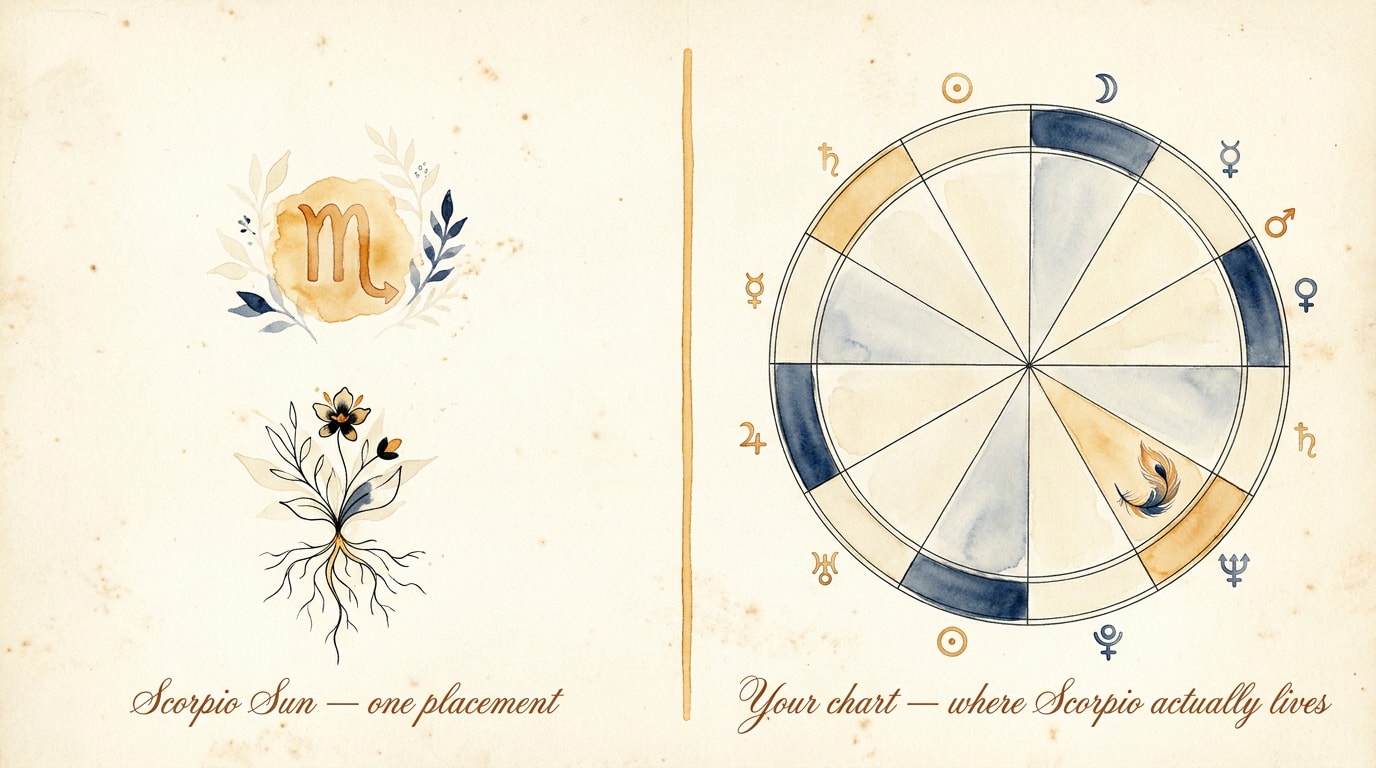
If you'd like to see where Scorpio actually lives in your chart rather than the sun-sign label, the placements that determine which of the three layers is yours to wear — WowAstro will calculate a free birth chart for you. Date, time and place; it takes a couple of minutes. The tattoo is permanent. The chart is the longer description.
Questions readers ask
What does a Scorpio astrology tattoo actually mean?
It lives in three structural layers, and treating it as one layer is why the Pinterest results feel so confusing. The first layer is the glyph ♏, a stylised scorpion shape astrologers have written in some form since the Hellenistic period and which appears in any sixteenth-century European astrological manuscript. The second layer is the symbol set ruled by Mars (traditional, since classical antiquity) and Pluto (modern, added after Pluto's discovery in February 1930), which includes the scorpion as the ancient base symbol plus the eagle-and-phoenix three-stage progression added by 19th- and 20th-century esoteric writers like H.P. Blavatsky and Manly P. Hall. The third layer is the constellation itself, with Antares (α Scorpii, an M-class red supergiant about 550 light-years away, marking the Scorpion's heart) and Shaula (λ Scorpii, the bright blue-white star at the hook of the stinger). A fourth layer sits behind all three: where Scorpio actually lives in your birth chart, not just your sun-sign label.
What's the difference between a scorpion and a phoenix tattoo for Scorpio?
Both are real Scorpio tattoos, and they live in different layers of the same idea. The scorpion is Scorpio's ancient base symbol, attested in Mesopotamian astronomy from around 2000 BCE (Sumerian GIR.TAB) and Greek astronomy from the Hellenistic period (Aratus's "Phaenomena", c. 270 BCE), and assigned to Mars-ruled Scorpio in the classical Western astrological canon. The phoenix is part of a three-stage progression, scorpion, eagle, phoenix — added to Scorpio in nineteenth- and twentieth-century esoteric writings (Blavatsky's "The Secret Doctrine", 1888; Manly P. Hall's "The Secret Teachings of All Ages", 1928), then carried into modern psychological astrology. The phoenix as an image is itself ancient (the bennu in older Egyptian iconography), but its specific assignment to Scorpio is a modern esoteric move, not part of ancient canon. Neither is more "correct" than the other. Scorpion fits the reader who wants the classical no-qualifier Scorpio mark; phoenix fits the reader who has lived through a death-and-rebirth chapter and wants to commemorate the rebirth half. Both are legitimate within their own tradition; the honest part is choosing the one that fits the layer you mean.
Can I get a Scorpio tattoo if I'm not a Sun-Scorpio?
Yes, and the tattoo can be more interesting because of it. The sun-sign you were told at twelve is one placement of ten in your chart, and Scorpio can sit on any of them — Moon, Mercury, Venus, Mars, Jupiter, Saturn, the outer planets, or your Rising sign (set by the exact time of your birth). There is also the 8th house, traditionally ruled by Scorpio, where a stellium (several planets together in one house) can give a chart a strongly Scorpio quality without a Scorpio Sun. If you have your Mars in Scorpio, you are wearing Mars in its own sign of traditional rulership; the Mars-glyph-and-scorpio-glyph combination is your design. If you have your Moon in Scorpio, the moon-and-glyph reads accurately. If you have an 8th-house stellium, the phoenix often resonates particularly well because the 8th house is the chart's transformation room. The mark commemorates whichever placement you are choosing to honour; the sun-sign label is one option, not the only one.
Will a Scorpio tattoo trigger my transformation?
No, and an honest tattooist will tell you so — especially around phoenix imagery, where the retail language tends to slide. The tradition behind every Scorpio symbol here, the glyph, the scorpion, the eagle, the phoenix, the constellation, is a language of symbolic association, not a mechanism. A phoenix on your forearm is not "activating" your Pluto or "triggering" your rebirth; it is honouring something you have already lived. The distinction matters because a permanent mark deserves clean language about what it is. If you want a tattoo because the symbol means something to you, because it commemorates a placement you have, a chapter you have closed, a quiet decision, that's a perfectly good reason, and tradition supports it. If a retailer or studio is selling you the idea that the ink itself will "activate", "trigger", "manifest", "protect from" or "attract" something for you, they are selling you marketing language rather than craft. The mark is small, permanent and yours; what it means is determined by you, not by the ink.
Read the wider context in our guide to your full birth chart
About this article: WowAstro readings combine traditional astrological methodology (Swiss Ephemeris calculations, Hellenistic and modern psychological frameworks) with AI-assisted writing reviewed by Oksana Miatova before publication. For entertainment and self-reflection only — not medical, legal, or financial advice. Full editorial policy at /editorial-standards.
Astrology, as we use it at WowAstro, is a tool for self-reflection and self-observation, not a method for predicting events, health or financial outcomes. A tattoo is a commemorative mark, not an activation device — the symbol carries the meaning you bring to it, no more and no less. Tattoos are permanent; take time before you book. If you are commemorating a hard year, the people around you are the other half of the work.
Written by Oksana Miatova, astrologer and writer at WowAstro. Charts calculated using the Swiss Ephemeris, the same astronomical data working astrologers use. Symbol and rulership history drawn from William Lilly's "Christian Astrology" (1647) and the standard Western astrological canon; the three-stage scorpion-eagle-phoenix progression traced honestly to H.P. Blavatsky's "The Secret Doctrine" (1888) and Manly P. Hall's "The Secret Teachings of All Ages" (1928) as nineteenth- and twentieth-century esoteric additions, not ancient canon; constellation references from Aratus's "Phaenomena" (~270 BCE), Mesopotamian astronomical record, and modern positional astronomy.
Read your own natal chart
A personal AI reading, from £1
⭐ +50 Wow Stars cashback · sign up and get 100 ⭐
Build my chart →Comments
New here? Get −30% off your natal chart
Leave your email and we will send you the promo code WELCOME30. Straight after that you can comment — no passwords, all automatic.
Quick sign-in
Sign in with Telegram — one click.
Or by email (with a gift)
Already have an account? Enter the same email — we'll email you a sign-in link.