You're at brunch on a slow London Sunday and a friend, two glasses of wine in, asks whether the person you've been seeing for eight months is your soulmate. You hear yourself answer, with more conviction than you feel, that you're not sure you believe in any of that. Three hours later, kettle on at the flat, you find yourself typing what does soulmate actually mean into the search bar.
Three tabs come back: a dictionary entry, a Wikipedia page about Plato, a personal-development author selling a course. None of them quite answers the question, not because they're wrong but because they're answering different questions. The word, it turns out, carries several different things at once.
This article won't tell you who your soulmate is. It will tell you what the word actually means, across myth, romance, modern English and pop culture, and what astrology can honestly say about each layer. Most of what gets sold under the word is selling certainty about something that doesn't come with any.
In short. Soulmate carries four overlapping meanings: a mythological half-of-whole (Plato), a romantic life-partner (18th-century English coinage), a modern dictionary sense (a person ideally suited to you), and a pop-culture "the one". Astrology has structural language for some of what people mean (Saturn aspects, Venus-Mars contacts, Sun-Moon midpoints, North Node connections, often called "soulmate markers"), but no marker guarantees lifelong love. A chart describes themes and pulls, not destinies.
 The moment a familiar question lands again.
What "soulmate" literally means, and why you find different answers
The word "soulmate" carries four overlapping meanings, and most arguments about whether soulmates "exist" are really arguments about which meaning is in play.
The Cambridge Dictionary, taking the most cautious line, defines a soulmate as "a person who is perfectly suited to another in temperament". That's the modern lexical sense — a starting point, not the whole story. Outside the dictionary, the word reaches in three other directions: backwards into myth, sideways into romantic-poetic convention, and forwards into pop-culture commerce. Each direction is a real strand of what English speakers mean when they use the word, and most of us reach for two or three of those strands at once without realising.
When two people argue about soulmates over the kitchen table, they're often using different definitions and don't know it. Naming the four is half the work.
A note before we go further. If you're moving through something difficult right now (a recent break-up, a long-running relationship that hurts, the quiet weight of a partnership that's ended), the word can land hard. Please talk to a qualified counsellor, your GP, or Samaritans on 116 123 (free, 24/7). Astrology and reflective reading can sit alongside professional support; they can't replace it.
The myth: Plato's half-of-whole
The original soulmate idea comes from Plato's Symposium, written about 2,400 years ago. The relevant passage is a speech given by the character Aristophanes, the comic playwright, and it's pitched somewhere between serious philosophy and a joke he can't quite resist.
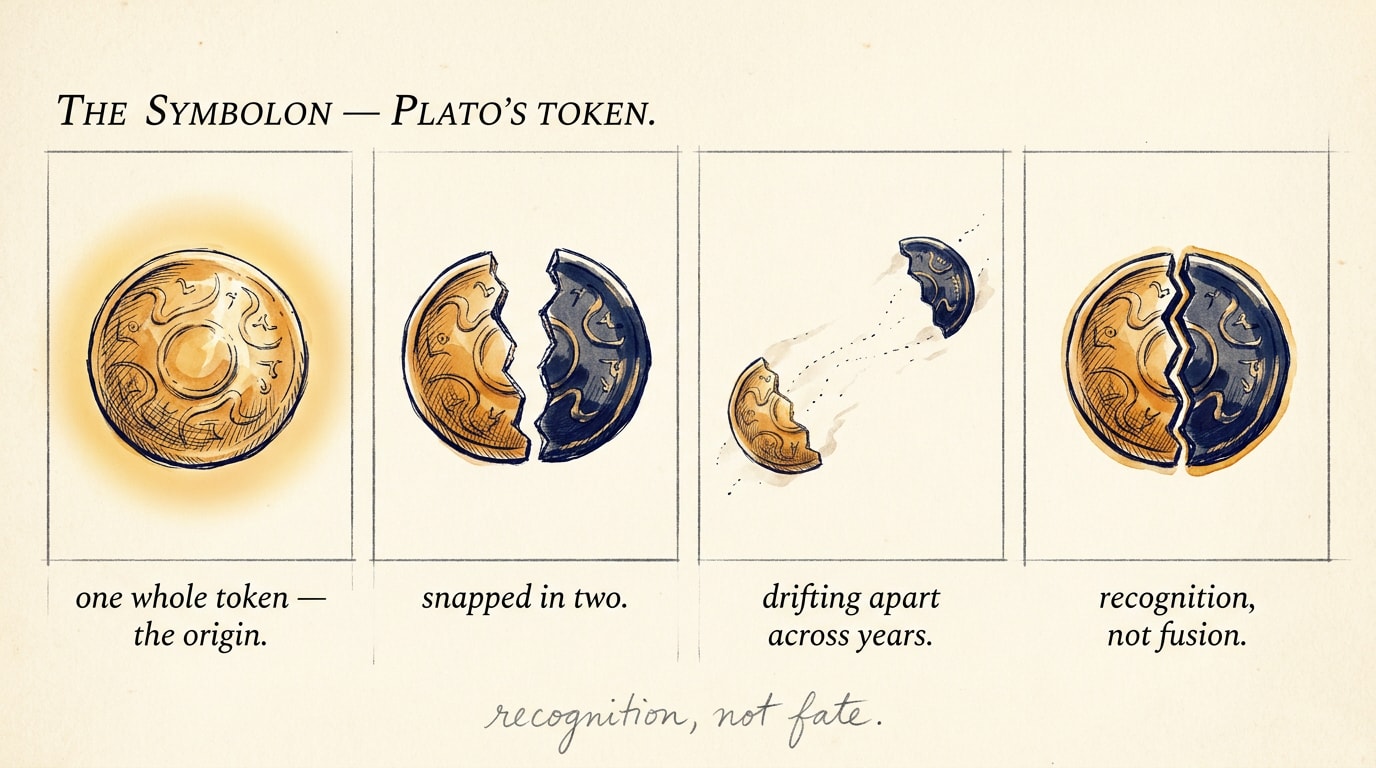
Once, Aristophanes says, humans were whole beings, spherical, two-faced, four-legged, walking by rolling along like cartwheels. The gods, alarmed by their strength, split each one down the middle, and ever since, each half has wandered the world looking for its other. The Greek word in the text is symbolon — a broken half-coin or pottery shard used as a recognition token between people who'd never met. Two pieces, jagged-edged, that only fit one other piece exactly.
This is where the "two halves of a whole" idea comes from, and it's worth being clear: in its original form, it's partly mythic and partly comic, told by a character who knows he's being theatrical. It's not a serious doctrine of predestination. It's a story about belonging — about the experience of meeting someone and feeling, irrationally, that you've found a piece you didn't know was missing. The story has lasted twenty-four centuries because that experience is recognisable, not because Plato discovered a hidden mechanism in the universe.
The romantic sense: an 18th-century coinage
The word "soulmate" as a single English term doesn't show up in writing until the late 1700s. The Oxford English Dictionary credits one of its earliest documented uses to the poet Samuel Taylor Coleridge, who wrote in an 1822 letter that "to be happy in married life… you must have a Soul-mate". By the late 19th century, the term was a romantic-poetic convention, popularised in Victorian fiction and letters: a lifelong partner whose mind and feelings match your own.
This is the sense most modern English speakers half-mean when they say is he the one?. It's about a deep, sustained match: not a magical recognition at first sight, but the slower thing built across years of shared evenings and difficult conversations. Closer, probably, to what most long partnerships actually feel like from the inside: less "I knew the second I met her", more "I noticed, over time, that she keeps showing up as the person I want at the table".
 The romantic sense, in everyday clothes.
The pop-culture sense: "the one", and what gets sold alongside it
The most commercially active sense of "soulmate" today is the pop-culture the one — a single, predestined person you'll know on sight, often paired with a course, an app, or a book promising to help you find them. This sense draws from the Plato myth (one perfect half) plus modern romantic-comedy convention plus what's politely called the manifesting industry. It's the sense most likely to make readers uncomfortable.
Honest framing: this sense is partly real and partly commercial, and both can be true at the same time. People do report instant-recognition experiences with partners. Some of those partnerships last; some don't. The marketing built on top of the experience, attract your soulmate in 30 days, manifest the one with this aligned routine — is a separate thing from the experience itself. The experience deserves to be taken seriously; the marketing deserves to be looked at sideways.
If you find "the one" language a bit cringey, you're not alone. The cringe is mostly aimed at the commerce, not at the underlying experience.
Astrology, used honestly, sits alongside whatever you already think about all of this. It doesn't sell you a soulmate. It offers a structural vocabulary for some of what people mean when they use the word, and is clear about the bits it can't name.
What astrology can honestly say: soulmate markers in synastry
In synastry, the practice of comparing two birth charts (explained at length in our astrological compatibility guide and unpacked further in what is synastry?), astrologers often discuss four kinds of contact between charts as so-called "soulmate markers": Saturn aspects, Venus-Mars contacts, Sun-Moon midpoints, and North Node connections. None of them guarantees lifelong love.
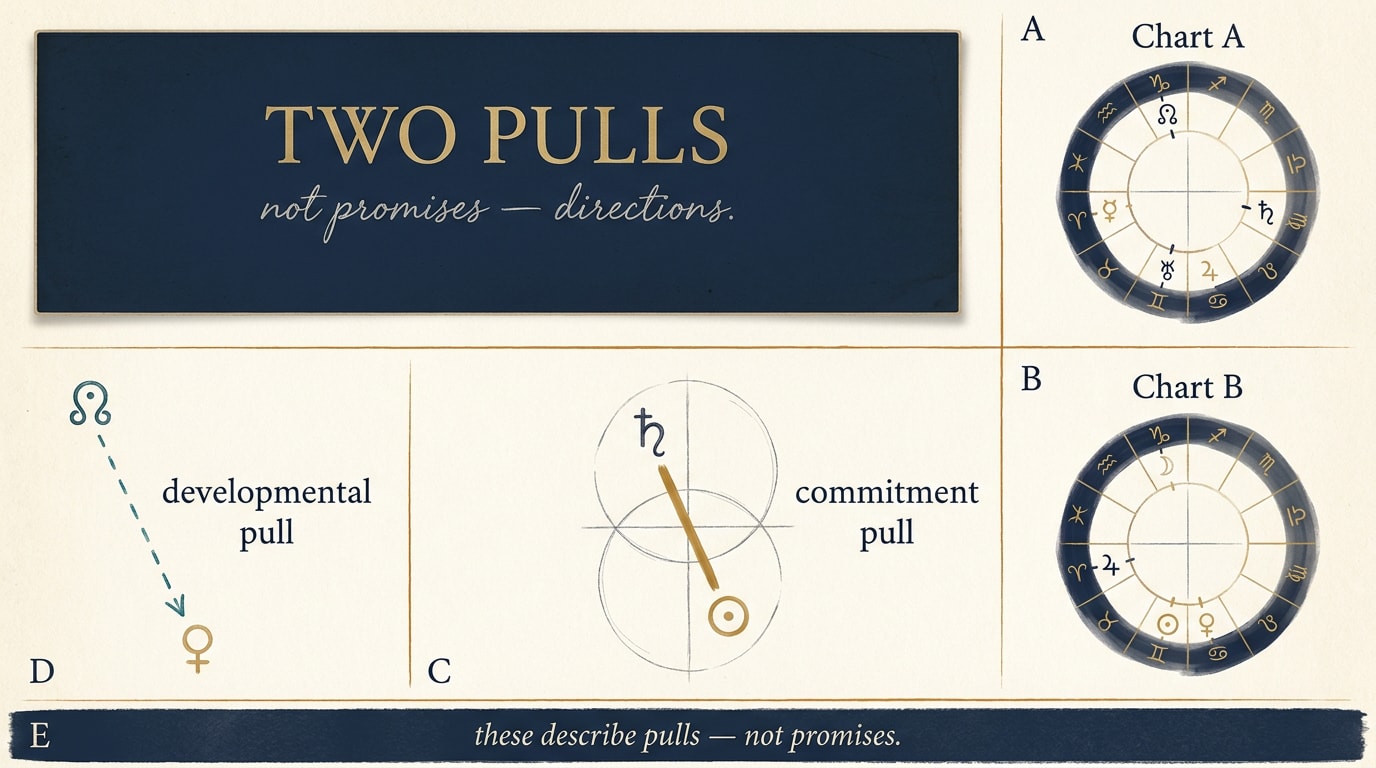
These markers describe themes and pulls — recurring patterns astrologers see across many relationships. They aren't promises, they don't tell you who your soulmate is, and they don't predict whether a partnership will last. They name a structural layer beneath the felt experience. Here's what each of the four actually points at.
The first marker is the Saturn aspect. When one person's Saturn closely contacts the other's Sun, Moon, Venus or Ascendant, the connection often feels structurally serious. Saturn is the planet of structure and time, and when it touches another person's chart you tend to get a relationship that asks something of both people, often for the long run. Some couples describe it as "I knew within a month he was a person I wanted to build with"; others as "it felt heavier than I expected from the start". Both descriptions can come from the same aspect.
Second, Venus-Mars contacts. When one person's Venus aspects the other's Mars, or vice versa, the chemistry is direct: wanting, leaning in, the physical and erotic charge that's harder to describe than to feel. This is what people clumsily call "attraction" in everyday speech, and it really is structural in the charts. Relationships with no Venus-Mars contacts often produce the friendship-everyone-keeps-saying-should-be-a-relationship-but-never-quite-is.
A third pattern, less obvious to most readers, is the Sun-Moon midpoint contact. When one person's Sun or Moon sits very close to the midpoint between the other person's Sun and Moon, there's an unusual quality of mutual recognition. At its tightest it produces the sense of having been understood at a level that doesn't need words. Not always pleasant; being seen accurately by someone isn't always comfortable. But distinctive.
The fourth, often the most retrospective in feel, involves the North Node. When one person's planets contact the other's North Node, the relationship tends to feel developmental. The North Node, in modern astrology, describes a direction of growth, and when someone else's planets keep landing on yours, both of you tend to be quietly pulled toward becoming a slightly different version of yourselves in the other's company. People often only notice it years later: "I didn't realise how much being with him had changed me until I thought about who I was before".
These markers describe what the chart sees. They don't promise anything. People with all four markers don't always last; people with none of them sometimes build the most enduring partnerships imaginable. The chart is the map; the relationship is the walking.
'Are these markers real?' A fair question. The astrological claim is structural, not magical: these specific aspects between charts recur in relationships people describe as deeply connected. We're not predicting outcomes or guaranteeing anything. We're naming patterns astrologers have noticed over centuries, and being clear about exactly where their predictive power runs out — which is well before "destiny".
A reminder, because it matters. If a relationship is causing serious distress (patterns of harm, persistent anxiety, sleep loss, fear), that's a conversation with a qualified counsellor, your GP, Relate UK (the relationship-counselling charity, 0300 003 0396), or BACP for finding an accredited therapist. Astrology is a language for self-reflection; it isn't crisis support.
Why no marker guarantees lifelong love
No astrological marker, soulmate or otherwise, guarantees lifelong love, because a chart describes pulls, not choices.
 Markers describe pulls; people make the relationship.
Two people with a strong Saturn-Venus contact still need to choose each other on Tuesday morning when one of them is short with the other. Two people with no markers at all can build a forty-year partnership through attention, care, and the slow accumulation of shared life. The chart is the map; the relationship is the walking. The word "soulmate", used in synastry, names the pull. It does not name what either person does with it.
If a relationship that once felt like a soulmate connection has ended, the markers weren't lying. The pull was real. Pulls change as people change, and so do relationships. None of that diminishes what the connection meant when it was alive. Some loves are meant to last a long time and don't; some are meant to be brief and matter forever. The chart never claimed otherwise.
A reflective practice: what to actually do with the word
If the word "soulmate" keeps surfacing in your thinking, it's usually pointing at something specific — and the something is worth naming.
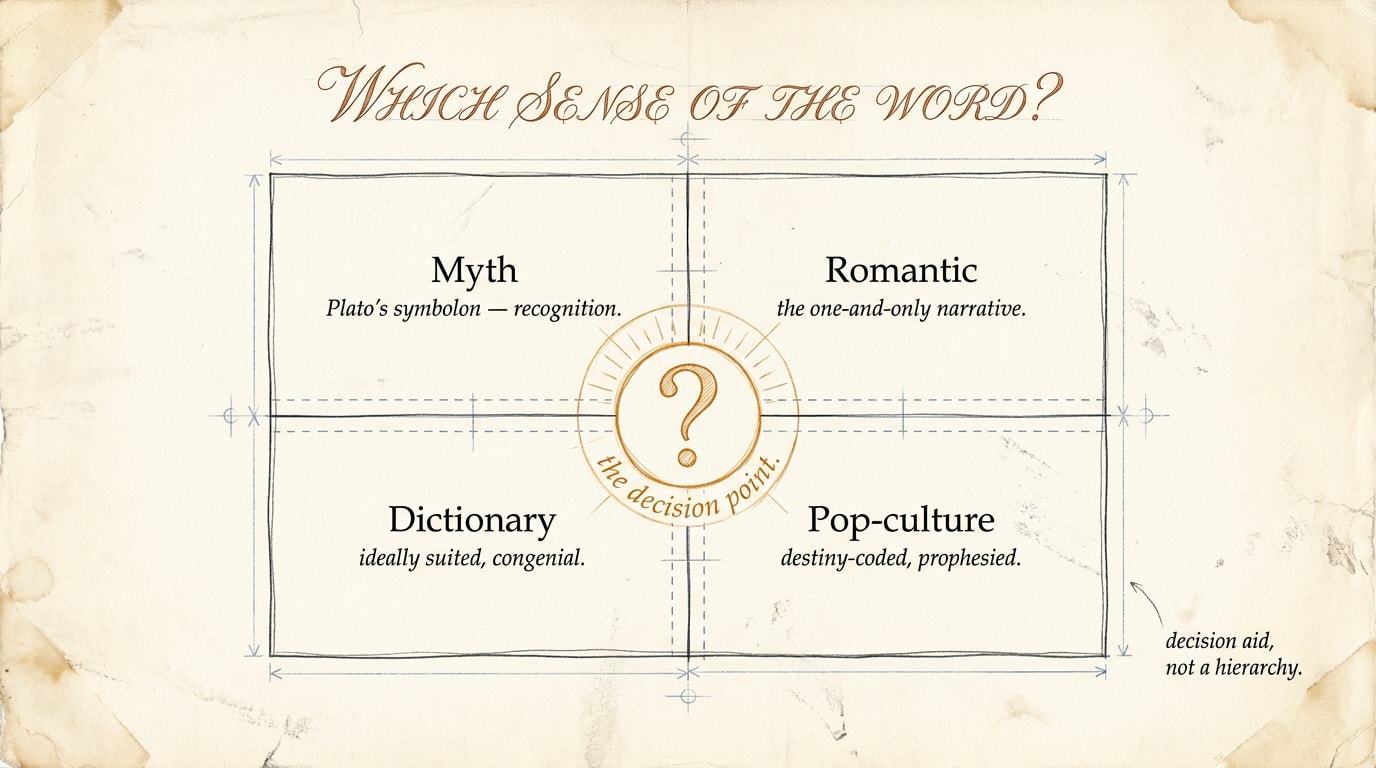
This is journal territory, or quiet thinking time over a cup of tea — not a script for a session with a professional, and not a way to talk yourself out of real distress. Three questions worth turning over when the word has caught your attention again.
Which of the four meanings (myth, romance, modern dictionary, or pop-culture) am I usually reaching for when I use the word? What am I actually asking about when I wonder whether someone is my soulmate: recognition, commitment, chemistry, or developmental pull? And if I knew, beyond doubt, that no astrological marker on its own carries any promise of lifelong love, would I still want what I'm wanting?
Sit with the questions, not the answers. Naming what you mean often loosens the question, which is most of the work. If the feeling stays heavy (a recent break-up, a long-running difficulty, persistent loneliness that affects your sleep, your work, or your sense of safety), that's the moment to talk to someone qualified, and the resources at the bottom of this page are a good place to start.
What an astrology lens does here. It gives you a vocabulary for some of what the word carries: themes, pulls, recognisable patterns. Not a verdict, not a treatment, just a way of naming the structural layer beneath an old, plural word.
If you want to see the structural layer in your own relationship (Saturn aspects, Venus-Mars contacts, the rest of the five factors), WowAstro's compatibility chart compares two birth charts in detail. It won't tell you who your soulmate is. It will tell you what the charts actually say.
Frequently asked questions
What does soulmate actually mean?
Soulmate carries four overlapping meanings: mythological (Plato's half-of-whole), romantic (the 18th-century coinage of a deeply matched lifelong partner), modern dictionary (a person perfectly suited to another in temperament), and pop-culture (the one, often packaged with a course). Most people use the word in two or three of those senses at once without realising. The word isn't broken; it's plural. Knowing which sense you mean clears most of the disagreement.
Do soulmates really exist?
It depends which definition you mean. The Platonic myth isn't a literal claim; it's a story about belonging. The romantic sense (a deeply matched partner) exists in the sense that long, sustained partnerships of mutual fit are a real and observable thing. The dictionary sense is real by definition. The pop-culture "the one", sold with the certainty of predestination, has mixed evidence and a lot of marketing built on top of it. Honest answer: pick a definition first, and the question becomes answerable.
Can astrology tell me who my soulmate is?
No. Astrology describes structural pulls between two charts (recognition, commitment, chemistry, developmental gravity), but it doesn't name a single predestined person. Synastry shows themes. People with strong markers still need to choose each other; people without markers sometimes build the most lasting partnerships of anyone they know. Anyone claiming a chart can identify your soulmate is selling certainty that the chart doesn't offer.
Is feeling like you've found your soulmate a sign that you have?
Subjective recognition is real and worth taking seriously, but it isn't proof of predestination. Many people report instant-recognition with a partner they later parted from; others report a slow, late-arriving recognition with someone they're still with thirty years later. Both are valid forms of meeting. If the recognition is paired with serious distress (sleep loss, panic, persistent anxiety), please contact your GP, Samaritans on 116 123, or Mind on 0300 123 3393. Reflective reading is no substitute for support.
Read the wider context in our guide to your full birth chart
By Oksana Miatova, astrologer and writer at WowAstro. Charts calculated using the Swiss Ephemeris.
About this article: WowAstro readings combine traditional astrological methodology (Swiss Ephemeris calculations, Hellenistic and modern psychological frameworks) with AI-assisted writing reviewed by Oksana Miatova before publication. For entertainment and self-reflection only — not medical, legal, or financial advice. Full editorial policy at /editorial-standards.
Astrology, as we use it at WowAstro, is a tool for self-reflection and self-understanding, not a method for predicting events, health, finances, or who you will end up with.
If a relationship (past or present) is causing serious distress, please speak with a qualified counsellor, your GP, or one of these UK services: Samaritans on 116 123 (free, 24/7), Mind on 0300 123 3393, Relate UK on 0300 003 0396, or find an accredited therapist via BACP. Astrology can sit alongside that conversation; it is not a replacement for it.
See what your charts say about each other
A personal AI synastry reading — not a sun-sign table, but an analysis of both natal charts across 8 areas of the relationship
Comments
New here? Get −30% off your natal chart
Leave your email and we will send you the promo code WELCOME30. Straight after that you can comment — no passwords, all automatic.
Quick sign-in
Sign in with Telegram — one click.
Or by email (with a gift)
Already have an account? Enter the same email — we'll email you a sign-in link.