It is Sunday morning, and you are both already at odds without quite knowing it. You want a slow day at home: coffee, the paper, perhaps a walk later. He has a list. Market, gym, two small admin things, dinner with his sister. Both of you think you are being reasonable. By eleven you feel slightly invisible. By noon he is wondering, quietly, why you don't take the shape of your shared life more seriously. Nobody has raised a voice. Everyone is faintly frustrated.
You open a tab. The first site tells you opposites attract, with a kind of romantic shrug. The second hands you a percentage, 67% compatible, as though that means anything. The third warns that Cancer and Capricorn are simply too different. Three articles, three verdicts, no help with Sunday.
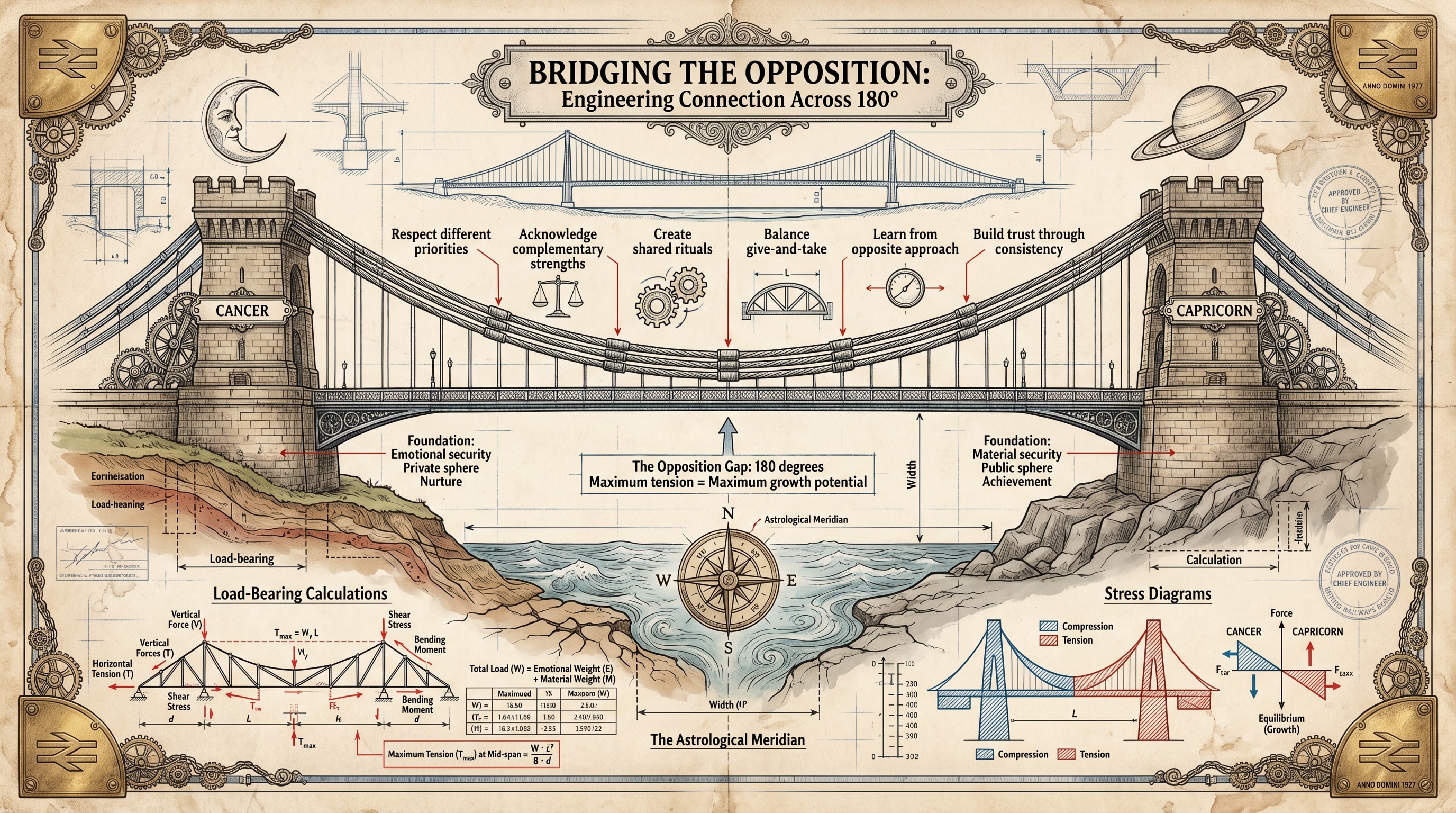
Here's the honest version. Cancer and Capricorn sit at opposite points of the zodiac, exactly 180° apart, what astrologers call an opposition. That opposition isn't a flaw. It's the structural pairing of two halves of the same axis. Synastry, the proper word for compatibility, looks at both whole birth charts, ten planets each, and tells a more useful story than any Sun-sign table or percentage scorer ever can.
In short. Cancer and Capricorn sit on the same axis of the zodiac, what astrologers call the vocation axis, between home and world. The Sun-sign opposition gives the relationship a built-in polarity that either completes a picture (each half supplies what the other is missing) or splits it down the middle (each half experiences the other as the problem). Which way it goes is decided by four things synastry can show but Sun-sign tables can't: the Moon contacts, the Venus and Mars placements, Saturn's role, and where each of you lands in the other's chart.
 Two people, same morning, different lists.
The opposition axis — what it actually means
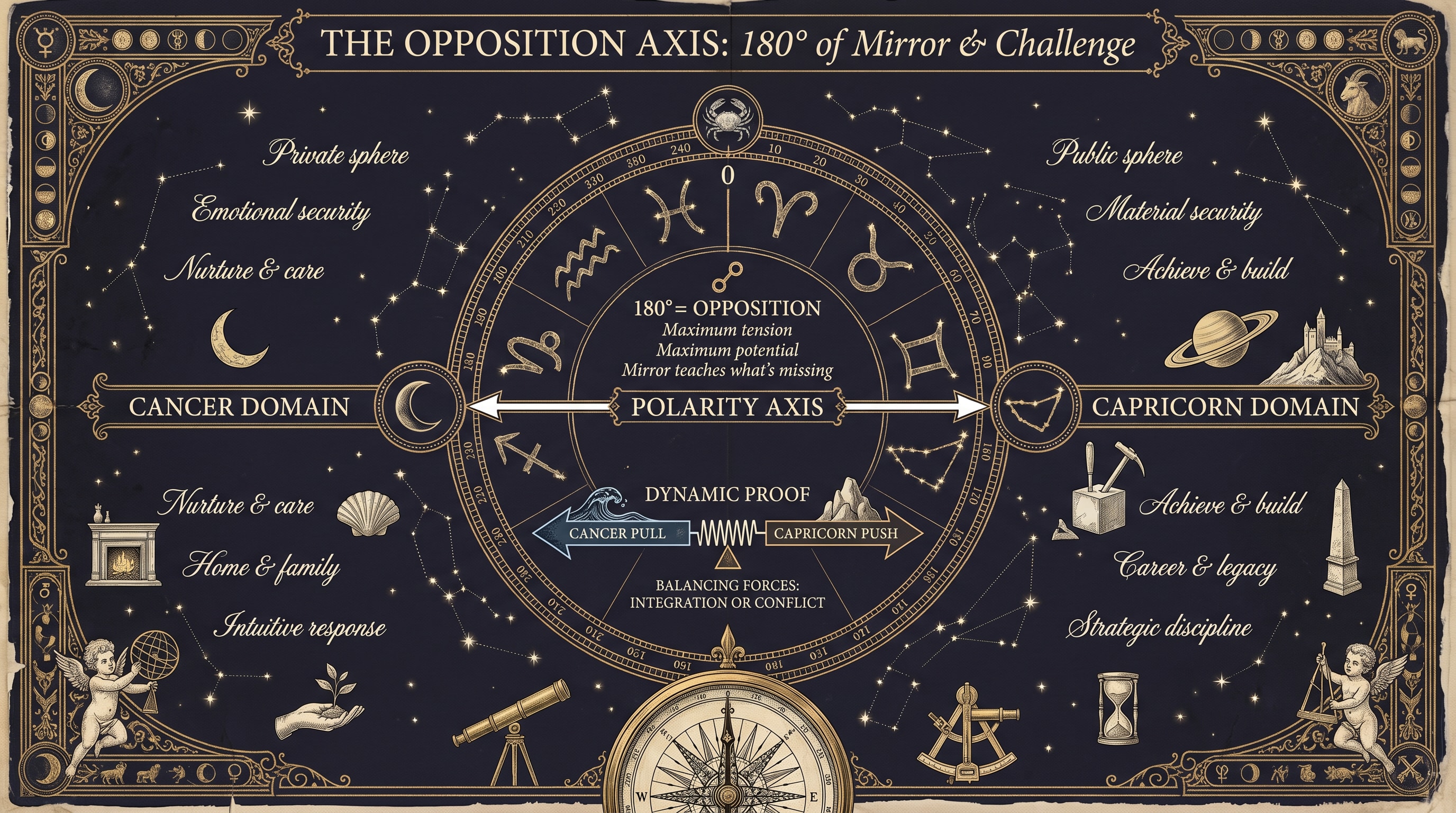
Cancer is the fourth sign of the zodiac. Capricorn is the tenth. Drawn on a chart, they sit directly across from each other. In astrological language this is an opposition, an angle of 180°. In plain language, it is the line that runs through your life between the inside and the outside.
Cancer is cardinal water, the sign of home, family, emotional shelter, the place you return to when you stop performing for anyone. The fourth house, which Cancer governs, is the part of any chart that describes the foundation: roots, family of origin, the room you'd want to be in at the end of a long week. Capricorn is cardinal earth, the sign of structure, ambition, public role, the thing you build with your time. The tenth house, which Capricorn governs, describes the part of you the world sees: career, reputation, the answer you give at a party when someone asks what you do.
In synastry tradition this axis is sometimes called the vocation axis — the line between who you are at home and who you are at work, between private life and public role, between the nest and the ladder. Both ends are necessary. A life that's all 4th house can lose its shape; a life that's all 10th house can lose its meaning. The Cancer-Capricorn pairing puts the two ends in the same room and asks the couple to do something useful with the difference.
For a refresher on what each sign means, the twelve zodiac signs explained covers the personal traits side; this piece is about the dynamic.
Why oppositions can complete or compete
An opposition is a tension that can go one of two ways. It can complete a picture, with each half supplying what the other is missing. Or it can split the picture in two, with each half experiencing the other as the problem.
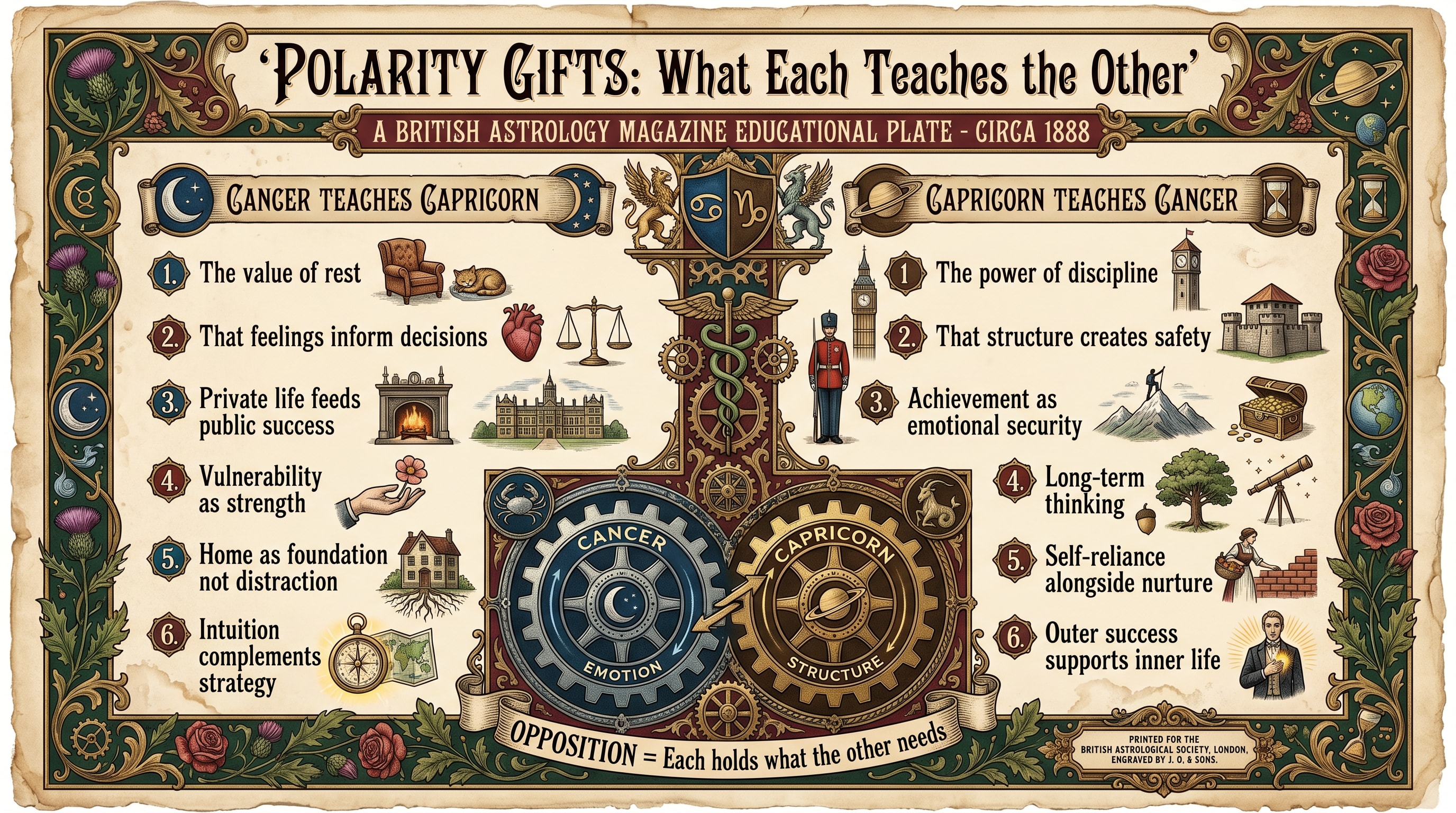
Cancer's instinct is to soften the world, to make a room hospitable, to remember how someone takes their tea, to register the mood of a Tuesday evening before anyone speaks. Capricorn's instinct is to organise it, to keep the calendar honest, to know which job is unfinished, to build the kind of structure inside which a life can actually happen. Both are real responses to being alive.
When the dynamic works, the Cancer half becomes the inside of the life the Capricorn half is constructing on the outside. The Capricorn half becomes the structure that the Cancer half's emotional world has room to live in. Couples in this groove tend to describe it as serious in a good way, a relationship that gets quietly more solid year on year.
When it doesn't work, the same difference becomes the wound. She experiences his planning as coldness; he experiences her softness as inefficiency. Both feel unseen, one in their care, one in their effort. The polarity competes, and what should have been complementary becomes adversarial. The Sun-sign opposition makes the risk visible. It does not, on its own, decide which way the relationship goes.
The four things synastry actually checks for an opposition pair
Whether a Cancer-Capricorn pair completes the opposition or competes with it depends on four things you can't see from the Sun signs alone: the Moon contacts, the Venus and Mars placements, Saturn's role, and the house overlays.
Moon-to-Moon: do you feel safe in the same room?
Your Sun is who you are. Your Moon is what you need in order to feel safe, what comes out when you've stopped performing. Two people with the same Sun sign can have wildly different Moons, and the Moon-to-Moon contact is the first thing any working astrologer reads in a synastry chart.
A Cancer with a Capricorn Moon is already negotiating the vocation axis inside himself, and may bring a built-in patience for the opposite sign that a Cancer with a Pisces Moon doesn't have to learn. When the two Moons sit in an easy aspect, same element or a trine, there's a particular kind of relief in the other person's company. When the Moons clash, the small things accumulate faster than the big strengths can absorb.
Venus and Mars: chemistry beyond temperament
Venus describes how you love and what you find beautiful. Mars describes how you act and pursue. A Venus in one chart meeting a Mars in the other is the placement people clumsily call chemistry. Comfort comes from element and temperament; chemistry comes from this contact in particular.
A water Venus meeting an earth Mars, or vice versa, often produces what long Cancer-Capricorn couples describe as a slow burn that builds. Not the instant electricity of two fire signs; something steadier and, in many cases, more durable. A pair with no Venus-Mars contact at all can love each other deeply and still find the romantic temperature lower than they'd like.
Saturn: the planet Capricorn rules, and the one that builds the relationship's spine
Saturn doesn't get much attention in compatibility writing, which is a shame, because in a Cancer-Capricorn pair it does more of the actual work than any other planet. Saturn is the traditional ruler of Capricorn, so a Capricorn Sun usually carries some structural weight by default. In synastry, a Saturn contact between two charts (one person's Saturn touching the other's personal planets) is what gives the relationship the durability everyone hopes for and few articles mention.
A Cancer-Capricorn pair without a Saturn contact can still feel deeply matched and quietly drift. The same pair with a Saturn contact tends to find its way to the long-term decisions — moving in, building, committing — without quite knowing why those decisions came so naturally.
House overlays: where each of you lands in the other's life
When you drop your partner's planets into your chart's wheel, they land in particular houses, areas of life. The overlays describe what each of you involuntarily sees in the other.
A Cancer Sun landing in someone else's 10th house, the Capricorn-ruled house of career and public role, reads as "my partner is part of who I am in the world". A Capricorn Sun landing in someone else's 4th house, the Cancer-ruled house of home and roots, reads as "my partner is part of what makes this a home", a remarkable mirror that often shows up in long pairs of this kind.
In short. Cancer and Capricorn make up the textbook opposition pair, the vocation axis between home and world. Whether the polarity completes or competes is decided by the rest of the chart: the Moons, Venus and Mars, Saturn's structural role, and the house overlays. The Sun signs name the polarity. They do not, on their own, finish the sentence.
One real-feeling worked example
Two people, illustrative, not a real couple. Let's call them Maya and Daniel.
Maya: Sun in Cancer, Moon in Taurus, Venus in Gemini, Mars in Pisces, Rising in Virgo. Daniel: Sun in Capricorn, Moon in Virgo, Venus in Aquarius, Mars in Scorpio, Rising in Cancer.
The Sun-Sun opposition is the headline: Cancer opposite Capricorn, the axis we've been describing. So far, the SERP framing holds: opposites, ostensibly attracted.
Now look down the chart. Maya's Moon in Taurus and Daniel's Moon in Virgo form a trine, both earth signs, an angle of 120°, the easiest aspect there is. On the romantic sites this never gets a mention. In practice it is most of the relationship: a steady emotional climate where neither has to translate what they need. She finds him grounding; he finds her settled. Two of the most compatible Moons you can have, sitting under a Sun-sign pair the SERP would call too different to work.
Venus and Mars next. Maya's Venus is in Gemini, affection through wordplay and curiosity and easy talk. Daniel's Mars is in Scorpio, action through depth and persistence rather than speed. The angle between them is a quincunx, around 150°, an awkward aspect that asks for adjustment rather than offering an easy fit. The chemistry has to be articulated to work, but worked through, it produces a particular kind of slow-built intimacy that long Cancer-Capricorn pairs often describe.
Then the overlays. Daniel's Rising is in Cancer, putting his most public layer directly on top of Maya's Cancer Sun. The moment they met, something in his way of being felt like her own. Maya's Cancer Sun, dropped into Daniel's chart, lands in his first house, the part of him that reads as "who I am". He doesn't see her as someone in his life; he sees her as part of his sense of self.
 The polarity, talked through.
Daniel's Capricorn Sun, dropped into Maya's chart, lands in her fifth house, the house of play and creativity, the part of life that isn't quite work. She reads him as something more like creative output and pleasure than a project. A small inversion: he is her play; she is his self.
What you end up with is a recognisable couple. Two people whose Sun signs sit on the structural axis the article opened with, whose Moons and overlays make room for the difference, and whose Venus-Mars asks them to talk to each other a bit more carefully than they'd otherwise need to. Works, because of the friction and despite the polarity. Doesn't, without the friction or against the polarity.
What to actually check if you're in this pairing
Three things worth knowing, beyond your Sun signs.
First, find your Moon signs. The Moon takes a little more than two days to move through each sign, so depending on the time of day either of you was born, your Moon could be one of two signs. A free chart at astro.com gives the answer in under a minute. Look at whether the two Moons sit in an easy aspect (same element, or four signs apart) or a friction aspect (three signs apart, or opposite).
Second, find your Venus and Mars signs. The same free chart will list them. If your Venus is in aspect to their Mars, or vice versa, you'll find a kind of pull that comfort alone doesn't account for.
Third, look at where Saturn sits in both charts, especially the Capricorn half. If Saturn touches the other person's personal planets, the relationship has spine. A Cancer-Capricorn pair without any Saturn contact tends to be very fond and structurally adrift; one with Saturn doing its quiet work tends to last.
If you'd like to see this on your own charts rather than an illustrative one, WowAstro will run the full synastry for both of you using the Swiss Ephemeris, the same astronomical data working astrologers use. The full synastry guide goes through the method end to end if you want the longer read.
 Two halves of the same axis.
Questions readers ask
Is Capricorn compatible with Cancer?
The two signs sit at opposite points of the zodiac, what astrologers call an opposition. That polarity is the structure of the pairing, and the sites that say "opposites attract" are gesturing at something real. Whether the opposition completes (each half supplies what the other is missing) or competes (each half experiences the other as the problem) depends on the rest of the chart: the Moons, the Venus-Mars contact, Saturn's role and the house overlays. The Sun signs name the polarity. They do not, on their own, finish the sentence.
What's the danger of an opposition in synastry?
The completion-versus-competition split. When both halves of the axis insist on their own mode without making room for the other's, neither half feels seen, one in their care, one in their effort. The Sun-sign opposition makes this risk visible, but it isn't a verdict. Long Cancer-Capricorn pairs tend to have at least one easy contact lower down in the chart, an easy Moon aspect or a flattering house overlay, that gives both halves a foothold from which to do the work.
Does Cancer-Capricorn actually last?
Sometimes, and the Sun signs alone won't tell you which times. Long Cancer-Capricorn pairs almost always have a Saturn contact somewhere in synastry doing the slow work of holding the relationship together, plus enough easier contacts (Moons, houses) to keep the daily climate liveable. If you want to see how the same logic plays out in a same-element pair, the Cancer-Scorpio compatibility piece covers two water signs.
Why do compatibility sites give Cancer-Capricorn different scores?
Because Sun-Sun percentages are theatre. There is no astronomical fact behind "Cancer-Capricorn 67% compatible": the number is invented by the vendor to give the page something to display. A useful read of a particular pair needs the whole chart, not one tenth of it. The percentage scorers are guessing about strangers; synastry reads the two specific people in front of you.
A note on what this is. Astrology, as we use it at WowAstro, is a tool for self-reflection and self-understanding, not a method for predicting events, health, financial outcomes or whether a relationship will last. Read a synastry chart as a description of a dynamic, take what's useful, leave the rest.
Written by Oksana Miatova, astrologer and writer at WowAstro. Charts calculated using the Swiss Ephemeris, the same astronomical data working astrologers use.
See what your charts say about each other
A personal AI synastry reading — not a sun-sign table, but an analysis of both natal charts across 8 areas of the relationship
Comments
New here? Get −30% off your natal chart
Leave your email and we will send you the promo code WELCOME30. Straight after that you can comment — no passwords, all automatic.
Quick sign-in
Sign in with Telegram — one click.
Or by email (with a gift)
Already have an account? Enter the same email — we'll email you a sign-in link.