She has held a paint chip the colour of warm clay against the living-room wall for a fortnight. He would like to put four shortlisted swatches up for one more week, just to see how they sit in the morning light versus the evening. Neither of them has raised a voice. Neither of them is being unreasonable. The chip has been on the wall through two Sundays now, gathering a tiny halo of Blu-Tack residue, and the living room is still — strictly speaking — the colour it was when the conversation began. She opens her phone on the bus the next morning and types taurus libra compatibility into Google. The first result says they are a Venus love-match. The second says they are a Venus power couple. The third gives them 82 per cent and sells her a consultation. She closes the tab.
Here is the thing none of those listicles quite finish saying. Every one of them notices that both signs are ruled by Venus, and every one of them stamps the verdict and moves on. The fact is right. The verdict is half-finished. Taurus and Libra are both ruled by Venus, but Venus is two-natured, and the two halves of her sit in different rooms of the chart. This guide separates the parts of the Taurus-Libra cliché that hold up from the parts that don't, explains the unusual 150° quincunx between the two signs — the "adjustment" aspect that asks the couple to translate without a shared element or modality — and names something the listicles consistently flatten: the two-sides-of-Venus split that makes a Sun-Venus couple recognisable as one in the first place.
In short. Taurus Sun and Libra Sun describe one tenth of one chart each, a Venus pair, not a relationship verdict. "Both ruled by Venus" is structurally true and interpretively unfinished. Taurus is fixed earth and gets Venus through the body — the meal, the fabric, the weight of a chair, the wanting-to-keep. Libra is cardinal air and gets Venus through the room — the proportion, the conversation, the wanting-to-balance. The signs sit 150° apart on the zodiac, the aspect called a quincunx, which describes a translation gap between two signs that share no element and no modality. Underneath, the shared Venus signature is the bridge. Moon, Venus, Mars and Risings across the full charts do the real work.
 A fortnight on the wall, still.
Why the Taurus-Libra listicles disagree
Six top results give six different verdicts on the same Sun pair, because each one reads one planet out of ten and calls the result a relationship.

Your Sun sign covers roughly one tenth of one chart. Compatibility actually runs across ten planets in your chart and ten in your partner's, plus the angles between them. When six sites call the same pair Venus-blessed, beautifully matched, hard work in the long run, doomed, harmonious and "Venus power couple", each writer is internally consistent. They are all reading one placement and a single shared rulership, and filling in the rest with mood.
Synastry, the proper word for astrological compatibility, which we cover in the full guide, works differently. It overlays both birth charts and looks at how each planet in one relates to each planet in the other. Same two people, ten layers of information, instead of one cell of a 12×12 grid with a Venus glyph stamped on it.
| Sun-sign verdict | Synastry | |
|---|---|---|
| What it compares | One Sun sign vs one Sun sign | Ten planets in each chart, plus angles |
| Data needed | Two dates of birth | Date, time and city of birth for both |
| Houses (areas of life) | Not used | Used: where one person's planets land in the other's life |
So when this guide talks about taurus libra compatibility, the Sun pair is the entry point, not the conclusion.
What the Sun pair actually describes
The Taurus-Libra Sun pair describes a specific way of arriving at decisions and holding them, not a relationship outcome.
Taurus is a Venus-ruled, fixed-earth sign. The Taurus Sun decides by feel — does this taste right, does this fabric sit right, does this chair hold the body kindly — and once the decision lands, holds it. Holding is what fixed signs do. Pressed to revisit the choice, Taurus often refuses, not from stubbornness but because the body has already settled. The chair is here. The chair is fine. We can sit down now.
Libra is also a Venus-ruled sign, but cardinal air: relational, weighing, careful. The Libra Sun decides by considering every option on its own terms, weighing how each would land for everyone involved, and arriving at the one that feels fair and proportionate. Once a Libra has chosen, the Libra often keeps a small open file on the alternatives, not from indecision but because new information might still arrive. Closure is what cardinal-air does not particularly love. The room could still be improved.
What this pair shares on the Sun level is one ruling planet and nothing else in the standard taxonomies — no shared element (earth and air), no shared modality (fixed and cardinal). The single placement reliably predicts a translation gap around how decisions get closed, and the paint-chart-on-the-wall-for-a-fortnight scene. It does not predict whether you are compatible. That sits in the rest of the chart, and there is more there than the listicles suggest.
The 150° quincunx: the adjustment, explained
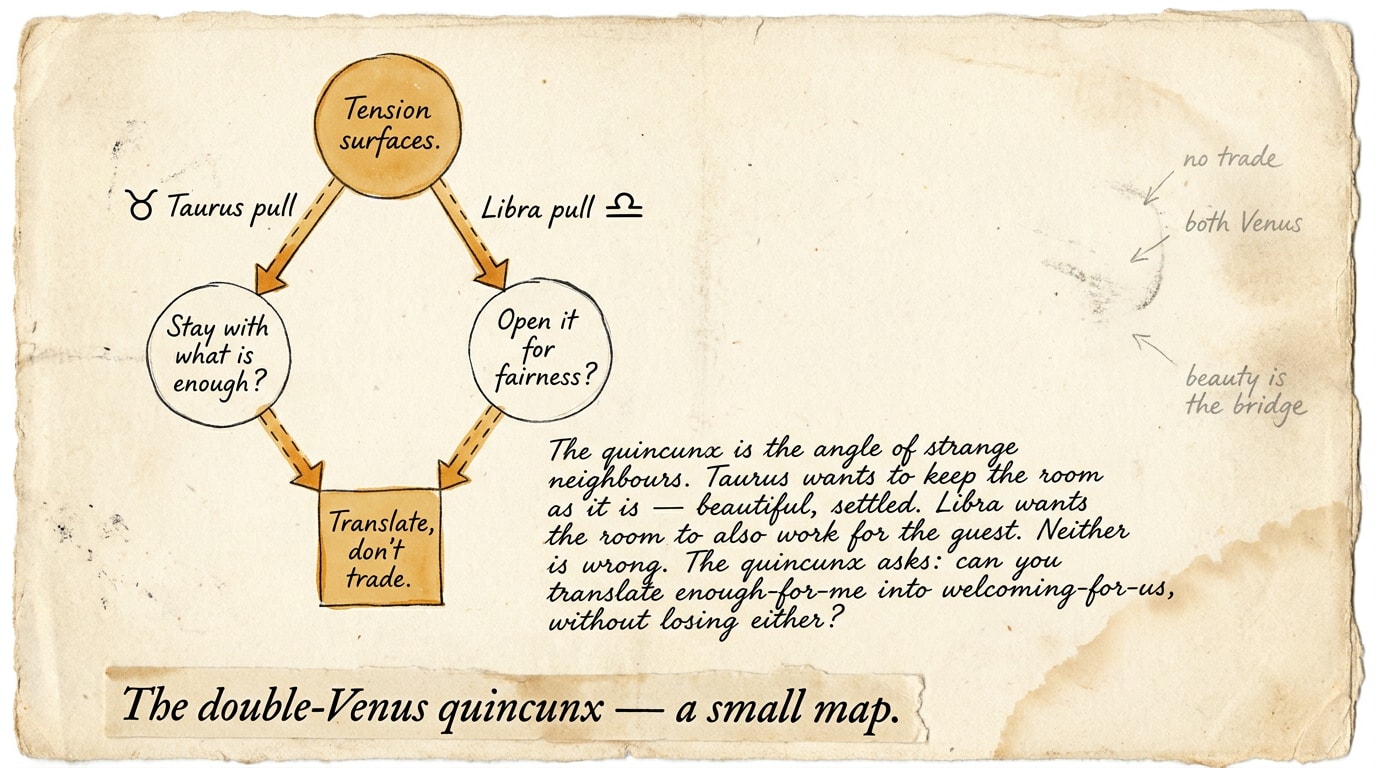
Taurus sits at 30° and Libra at 180° on the zodiac wheel, which means the Sun pair forms an aspect astrologers call a quincunx, also known as the inconjunct — at 150° apart.
A quincunx is an angle of around 150° between two placements. The signs share no element, no modality, and no aspect on the standard wheel where the easy translations live — no trine, no sextile, no opposition. They are five sign-positions apart, which in plain English makes them neighbours-of-neighbours who never quite see each other from the same angle.
This is less famous than the square or the trine, and gets called a "minor" aspect in some textbooks. In synastry, though, it usually describes a specific place: where two people have to translate for each other constantly because no shared element or modality is doing the work in the background. The same geometry runs between another Venus-touched pair we cover separately, but the flavour is different in each case.
 The third Sunday morning, paint still drying.
For Taurus-Libra the translation work is usually about closure. Libra wants to lay out the options, hear the views, weigh the proportion, and arrive at a choice that holds for everyone — and then, having chosen, keep the open file on the alternative just in case. Taurus wants to feel the choice in the body, and once it has landed, settle. Both are legitimate ways of being in a conversation. Worked through, the couple learn to name the difference out loud ("I want to choose, now", "I want to weigh, still") and the small ongoing translation becomes one of the relationship's quieter strengths rather than its recurring quiet wound.
Two sides of Venus: the surprise the listicles flatten
Here the article promises something the Top results do not deliver: a structural reason this pair often work better than the Sun-pair geometry suggests — and also why the "both ruled by Venus, you'll be fine" stamp is not the answer.
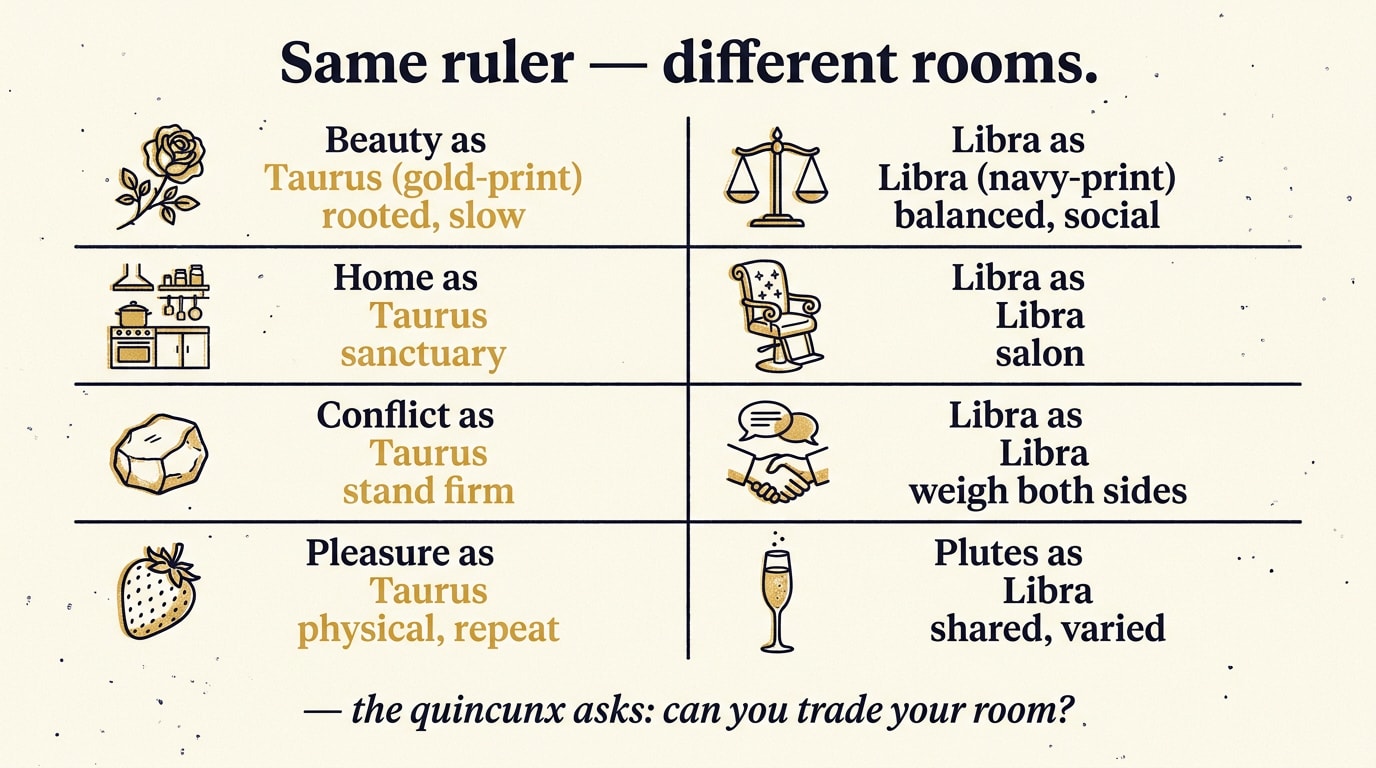
Both Taurus and Libra are ruled by Venus, the planet of beauty, value and harmony. The listicles stop there and stamp the verdict. What they miss is that Venus is two-natured. The classical-rulership scheme gives Venus two signs — one earth, one air — and the planet expresses through each half of her nature differently. Taurus gets Venus through the body: the sense of taste, the weight of a fabric, the rightness of a chair under the spine, the meal that takes three hours and is worth it, the simple unembarrassed wanting-to-keep what you have. Libra gets Venus through the room: the proportion, the conversation, the symmetry of an arrangement, the wanting-to-balance what is here so that everyone can be at ease.
Same goddess, two halves. A Taurus-Libra couple meet on shared ground — both notice beauty, both care about the home, both are kind to guests, both find the cheap-feeling thing unpleasant in a way they cannot quite explain — and on adjacent ground: Taurus by texture, Libra by symmetry; Taurus by the chosen, Libra by the considered; Taurus settles, Libra weighs.
What this means in practice: the shared-Venus affinity is real, and the split is where the work is. Use the affinity consciously — build the home together, take Sunday properly, eat well, choose the well-made thing. Negotiate the split honestly — name out loud "I want to choose, now" versus "I want to weigh, still" so the paint-chart-on-the-wall-for-a-fortnight becomes a conversation rather than a small unnamed thing. Most of the listicles flatten this entirely because they are still busy collecting the gold star both signs share for having the right ruling planet.
Where the listicles are right, and where they're wrong
The Taurus-Libra clichés are a mix of accurate temperament reading and recycled stereotype. Here is the honest sorting, one cliché at a time.
| Cliché | Status | What is actually going on |
|---|---|---|
| "Sensual-aesthetic affinity" | ✅ Mostly true | Venus link doing real work. Both signs notice beauty and value comfort; the cliché is pointing at something. |
| "Decision-pacing mismatch" | ✅ Mostly true | Taurus settles into the chosen; Libra keeps weighing the alternative. Named, it becomes manageable. |
| "Venus-Venus love-match" | ⚠️ Real but unfinished | The shared rulership is real; the cliché ends there. Without the two-sides-of-Venus split named, the stamp hides the work. |
| "Taurus is too possessive for Libra" | ❌ Sun-sign error | Possessiveness lives in Mars contacts and the placement of Venus in a particular house, not in a Sun sign. Plenty of Taurus Suns have Aquarius Venuses and are anything but possessive. |
| "Libra is too flighty for Taurus" | ❌ Sun-sign error | Flightiness is usually a Moon-in-air or Mercury question, not a Sun trait. Plenty of Libra Suns have Capricorn Moons and run on entirely steady emotional ground. |
| "Soulmates because Venus-Venus" | ❌ Not from this | A Sun-pair verdict can't deliver "soulmates". That word, when it is used at all, points at Moon-Moon contacts and house overlays. |
| "Doomed" | ❌ Lazy | The patterns labelled doomed are usually Mars or Pluto questions across the full chart, not a Sun pair. |
The rule: when a listicle promises a verdict, it is reading one placement. When it describes a quality without promising an outcome, it is closer to honest. The first sells clicks; the second is more useful in the actual relationship.
A worked example
Two people, made up for the sake of explanation, who met when she was doing the architectural drawings for the small flat-conversion he had bought to live in, and who have been navigating exactly the conversations this article is about. The rest of the chart is what makes them recognisable as a couple.
Partner A — Maya (Taurus Sun): Sun in Taurus, Moon in Virgo, Venus in Aries, Mars in Cancer, Rising in Scorpio. Partner B — Sam (Libra Sun): Sun in Libra, Moon in Capricorn, Venus in Sagittarius, Mars in Pisces, Rising in Taurus.
Start with the Suns. Taurus and Libra — the quincunx we have already covered: the adjustment, the decision-closing gap, five sign-positions apart, no shared element, no shared modality, both ruled by Venus through opposite halves of her nature. Now the placements that actually run the relationship.
The Moons. Virgo Moon and Capricorn Moon form a trine by sign, earth meeting earth, both practical, both fond of routine and a clean kitchen at the end of the day. The emotional baseline of the relationship is unusually steady — neither of them needs the other to perform reassurance; they regulate by getting on with things. On a Sunday morning, the two of them are perfectly recognisable as a couple, even though the Sun pair would have predicted them standing in the kitchen with the paint chip and the four shortlisted swatches.
The Venuses. Aries Venus and Sagittarius Venus form a trine by sign, fire meeting fire — a quietly bold, eclectic, warm aesthetic that surprises both of them given how settled their Suns are. They tend to say yes to the unconventional choice when it's right: the second-hand piece nobody else wanted, the strong colour on the small wall, the trip neither of them quite planned. Where the Sun-pair quincunx asks for translation, the Venus-Venus trine returns the couple to shared aesthetic ground over and over.
Mars. Cancer Mars and Pisces Mars are both water, a trine by sign. Neither of them fights well in the moment — Cancer Mars retreats into the shell, Pisces Mars dissolves the disagreement and reconvenes it the following day, gently. The rows happen, but a week later, in writing, kindly. Nothing breaks.
Risings. Scorpio Rising and Taurus Rising form an opposition by sign — the most direct aspect on the wheel. First-impression magnetism is unmissable. Both partners read a room with weight; both pick up on what is left unsaid. They recognised each other across the small developer's office on the day she walked in with the drawings, and neither of them could quite explain why.
What you have when you put all that down is a recognisable couple, not because Taurus and Libra do or do not go together, but because of the five other layers underneath — and because the Venus-Venus trine, on top of the parallel Venus rulership of both Sun signs, is doing quiet structural work in the background.
What the worked example shows. The famous Sun pair is one note in a chord. It tends to be the loudest one on horoscope sites only because it is the easiest to look up. The Moons, the Venuses, Mars and Risings between two charts do most of the work the listicles try to hang on a Sun pair — and the underlying Venus rulership pattern (both Suns Venus-ruled, here, plus a Venus-Venus trine on top) often does more than any single aspect.
How to actually check your own chart
If you would like to do this for your own relationship rather than an imagined couple, here is the practical version.
First, get the data: date, time to the nearest minute if possible, and city of birth, for both of you. Without exact birth times you lose the Rising signs and the house overlays, but you still get a useful Moon, Venus and Mars read.
Second, read in order: Sun pair (now done), Moon to Moon, Venus to Venus and Venus to Mars across both charts, Mars to Mars, then Risings and house overlays if you have the times. Pay particular attention to the Venus contacts — for a Taurus-Libra couple the Venus story is unusually load-bearing.
Third, the part the Sun-sign sites can't do — run the full synastry properly, or have the tool do it. WowAstro will compare both of you using the Swiss Ephemeris, the same astronomical data working astrologers use. £5, a couple of minutes.
 The reading is the start, not the answer.
Questions readers ask
Are Taurus and Libra compatible?
The Sun pair on its own cannot answer that. What it can tell you is that the pair tends to arrive at decisions and close them at different speeds — Taurus by feel and then by holding, Libra by weighing and then by keeping the alternative open — and that those two ways have to learn to translate to each other. Underneath, the two signs share a Venus rulership that gives the pair an unusual aesthetic and harmonic affinity, with a real split inside it: Taurus does Venus through the body, Libra through the room. Whether two specific people are compatible depends on the rest of both charts: the Moons, the Venuses, the Mars placements, the house overlays. Plenty of Taurus-Libra couples build long, considered, beautiful-feeling relationships. Plenty of same-sign couples don't.
What's the hardest part of Taurus-Libra?
The closing gap. Taurus settles into the chosen, Libra keeps weighing the alternative — not from indecision but from a sense that new information might still arrive. Named out loud, "I want to choose, now" versus "I want to weigh, still", the gap becomes manageable. Unnamed, it becomes the paint-chart-on-the-wall-for-a-fortnight scene, and the small unnamed thing on the sofa at midnight after the dinner party.
What's the best part?
The shared Venus material. Both signs notice and care about how things feel, look and land. Taurus brings the eye for texture and the patient hand for getting the home actually right; Libra brings the eye for proportion and the social grace that steadies a room. Together the couple tend to build homes, evenings and small rituals that are unusually pleasant to be inside. The shared rulership is the bridge — and the two halves of Venus, named honestly, become two complementary instruments rather than a single stamped verdict.
Should I worry about a quincunx between our Suns?
No. The quincunx describes an adjustment aspect, not a friction one: two signs that share no easy translation and have to learn each other's language. Long-lasting relationships often have one such adjustment at the centre of the chart, and the work of recognising it without taking it personally is what makes the rest of the synastry usable. The chart describes the dynamic; what you do with it is still up to you.
A note on what this is. Astrology, as we use it at WowAstro, is a tool for self-reflection and self-understanding, not a method for predicting events, health, financial outcomes or whether a relationship will last. Read a synastry chart as a description of a dynamic — take what is useful, leave the rest.
Written by Oksana Miatova, astrologer and writer at WowAstro. Charts calculated using the Swiss Ephemeris, the same astronomical data working astrologers use.
See what your charts say about each other
A personal AI synastry reading — not a sun-sign table, but an analysis of both natal charts across 8 areas of the relationship
Comments
New here? Get −30% off your natal chart
Leave your email and we will send you the promo code WELCOME30. Straight after that you can comment — no passwords, all automatic.
Quick sign-in
Sign in with Telegram — one click.
Or by email (with a gift)
Already have an account? Enter the same email — we'll email you a sign-in link.