Sunday, half past five. The laptop has been closed since Friday. You did the long walk, made the slow lunch, ignored the inbox the way the wellness columns suggested. You open the laptop now just to check, just to be ready for Monday, and the feeling you spent the weekend trying to outrun is already waiting in the dock. Four days of rest gave you back, by a generous count, about a Tuesday morning's worth of energy.
You read the NHS page about burnout in April. You think it's describing you. You also think nothing on the page tells you what to do with that knowledge if you can't simply stop.
This article isn't another "5 signs you're burnt out" listicle, and it isn't a treatment plan. If what you're experiencing feels heavy — persistent low mood, panic that won't lift, or thoughts of self-harm — please talk to your GP or contact Samaritans on 116 123 (free, 24/7). Astrology can sit alongside professional support; it can't replace it.
What follows is a different question. Not "how do I fix this" — for that, the clinical picture you already have is the right starting place. The question here is: what does astrology, used honestly, add as a reflective layer on top of the clinical picture?
In short. Burnout is a clinical and occupational phenomenon. The NHS, the WHO, and your GP describe it accurately, and that's the layer that matters most. What astrology adds, used as a self-reflection lens, is a structural vocabulary for the gap behind the feeling: between what your natal placements suggest you can sustainably carry (Saturn, the 6th house, Mars) and what your current life is actually asking. Astrology doesn't treat burnout. It can sit alongside the clinical picture and give you a name for the structural pattern underneath.
 The minute you reopen the laptop, before Monday officially starts.
What burnout actually is, and where astrology fits
Burnout is a state of chronic exhaustion linked to prolonged occupational stress. In 2019 the WHO classified it in the ICD-11 as an occupational phenomenon — explicitly not a medical condition in itself — with three dimensions: persistent exhaustion that rest doesn't refill, growing cynicism or distance from your work, and a sense that what you're producing has dropped in quality even when the hours haven't. That's the working definition the clinical world uses, and it's the one your GP will recognise.
The UK clinical pathway is straightforward in principle, even when it feels anything but in practice. The first step is your GP. From there: occupational health, talking therapies (most areas allow self-referral via the NHS), and where workload is the obvious driver, an honest conversation about it.
What this article uses astrology as is something narrower. A self-reflection lens. A vocabulary. Not a treatment plan, not a substitute for the conversation with a qualified counsellor or therapist, and certainly not a substitute for the conversation with your GP. The two layers answer different questions. Clinical describes symptoms accurately and gives you a route through. Astrological, used honestly, adds a different kind of language for the underlying shape of the load — three parts of your birth chart carry most of that weight, and we'll come to them in a moment. Use the two together if you need both.
If the NHS page recognised you, that's the layer that matters first. What follows is supplement, not replacement.
Three astrological pressure-points worth knowing
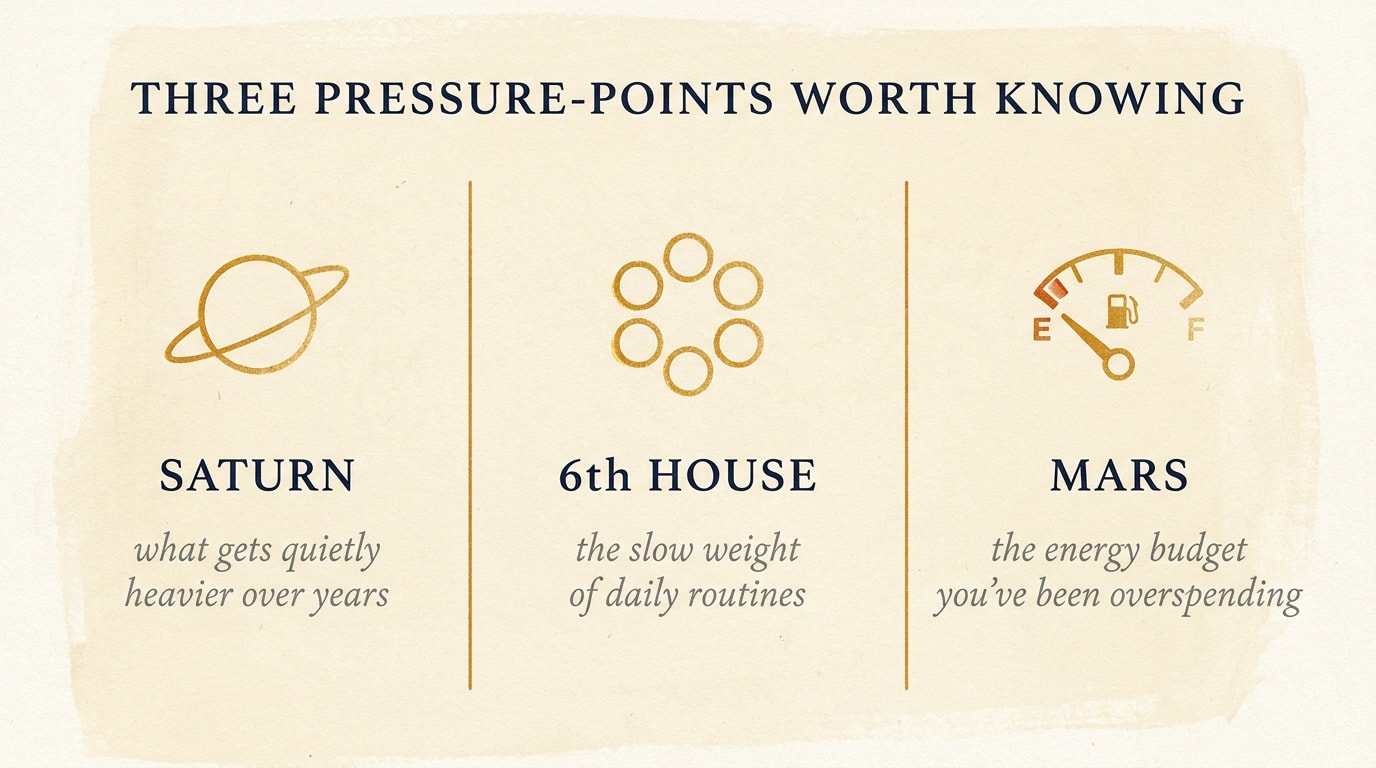
Three parts of a natal chart describe sustainable capacity from three different angles. When current life pressure exceeds what any one of them can carry, the body and the mind tend to register that mismatch, often as the kind of exhaustion that sleep doesn't quite refill.
Saturn: time, structure, sustainable load
Saturn, in astrology, is the part of the chart that describes what you can sustainably carry over time. Long-term capacity. The structural load-bearing bit. (If the word Saturn already rings a particular bell for you — your late twenties, say — that's worth knowing about: see Saturn return: what it is for the full pattern.) Robert Hand, in his canon textbook Horoscope Symbols, calls Saturn the Lord of Time — a rather grand way of saying: the part that knows what's a sustainable rhythm and what isn't. When current life demands exceed what Saturn's natal indication suggests is sustainable, the body registers it as exhaustion that sleep doesn't refill.
A useful question Saturn-thinking points at: what are you currently carrying that you wouldn't have agreed to carry if asked all at once, in advance? Saturn rarely complains about heavy things you signed up for knowingly. It tends to register the accumulated weight of things absorbed one quiet decision at a time — close cousin to the inner-critic dimension of Saturn, but here pointed at structural load rather than self-worth.

The 6th house: daily routine, the small repeated thing
In astrological house symbolism, the 6th house is the part of the chart concerned with daily routines, work patterns, the small things that accumulate. The bit Liz Greene and Stephen Arroyo both spend a lot of pages on, because it's where chart symbolism meets life as it's actually lived day to day.
When the 6th-house pattern in your chart is heavier than the rhythm a body can keep, you get burnout at the level of "I sleep eight hours and wake up tired", rather than "I'm having a bad week". The 6th house asks: not what big thing has gone wrong, but what small repeated thing has accumulated past the point you could keep up with it. The commute is fine. The two-hour meeting is fine. The slack notifications at 9pm are fine. Six months of all three at once is the question the 6th house is asking.
Mars: the action-fuel, depleted
Mars in a chart is drive, motivation, the fuel for getting things done. Depleted Mars doesn't look dramatic. It looks like: "I know I should care about this; I literally cannot make myself." The cynicism dimension in the WHO triad — the growing distance from work that used to engage you — maps onto something Arroyo describes well in his work on Mars psychology. Fuel-out isn't laziness. It's a real, depleted resource.
These three frames together don't diagnose anything. They give you three different ways to look at where the empty is sitting in your particular shape. Not a verdict, just three vocabularies that may make the feeling more describable than "I'm just exhausted".
When the wellness advice keeps failing you
If the standard wellness checklist (sleep, walks, hydration, no caffeine after 2, set boundaries) isn't shifting the dial, it probably isn't because you're doing it wrong. It's because the checklist quietly treats burnout as a behaviour problem, when for many readers it's a structural mismatch problem.
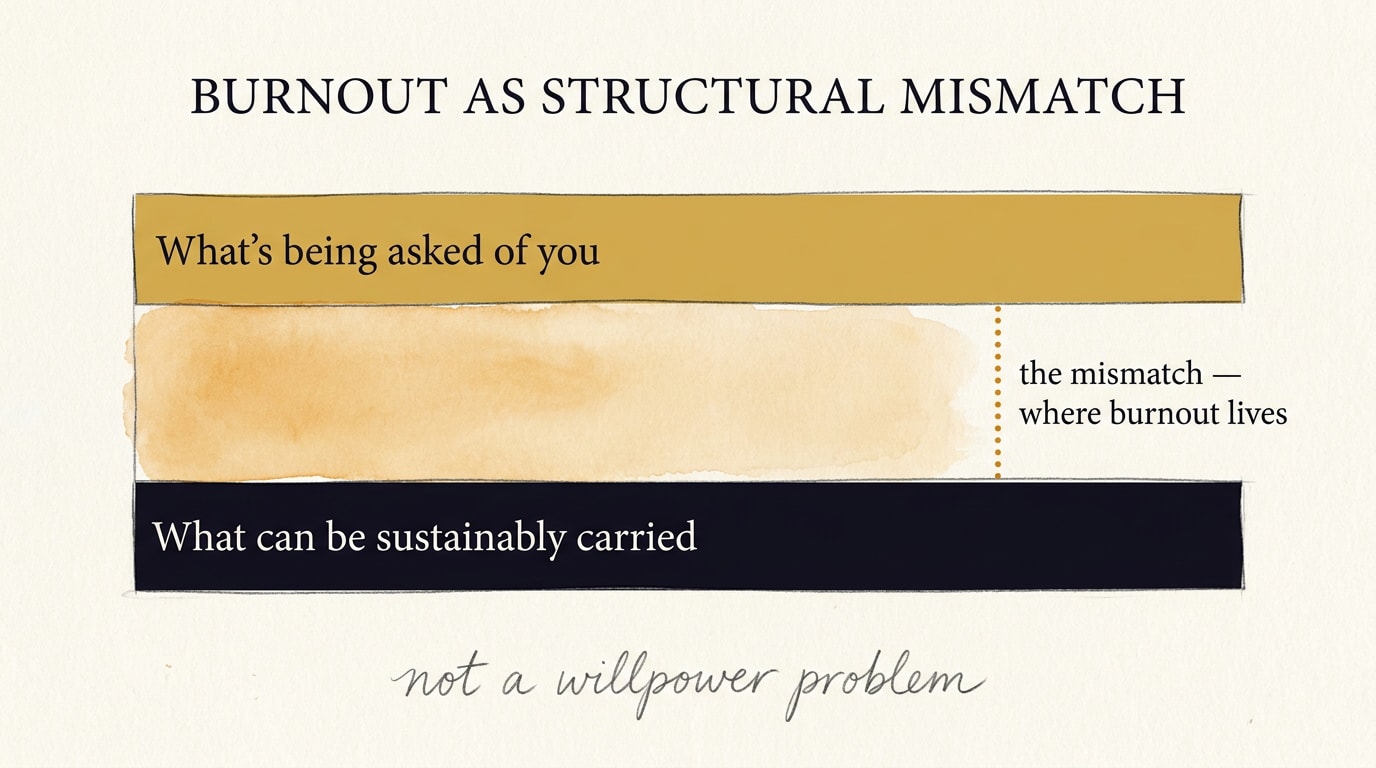
Structural mismatch, in plain terms, is the gap between what your chart suggests you can sustainably carry and what your current life is actually asking. You can do every wellness ritual properly and still be running at a deficit if the gap is wide enough. The walk at lunch helps. It is also, mathematically, not going to close a fifteen-percent monthly deficit on its own. That isn't a personal failing; that's arithmetic.
A quick reminder while we're here. If the patterns described in this article feel less like "I sometimes feel exhausted on a Sunday" and more like "I can't function", that's a Mind.org or GP conversation, not an astrology one. The two aren't competing; they answer different questions.
Naming the gap doesn't close it. But it changes what you're looking at. Instead of "am I doing the wellness things hard enough", the question becomes: "is my current life asking more than my structural baseline can carry, indefinitely?" That's a different question, and it tends to have different answers.
The gap isn't a willpower problem. Burnout is rarely solved by trying harder at wellness. Astrology, here, isn't offering a new way to try harder. It's offering a different question: not "what should I add", but "what is the structural shape of the load".
A worked example: Sarah, 32, Saturn transiting her natal Sun
Here is one specific astrological pattern read through one illustrative composite person. Sarah is thirty-two, runs a small but real team in a mid-sized London company, and is, by every external measure, doing well. She is also, in her own private accounting, in the middle of what astrologers call a Saturn transit to her natal Sun.
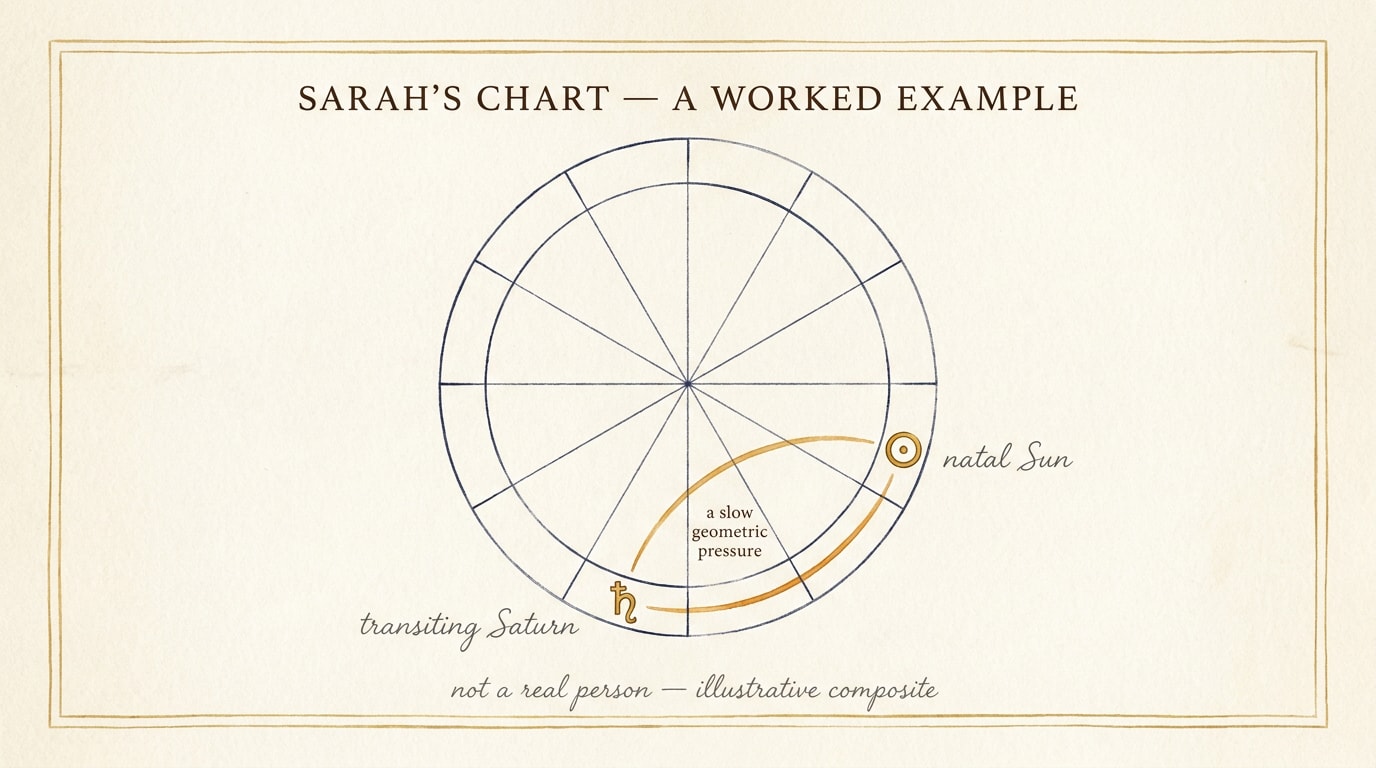
She is also, for the record, not a real person. The chart pattern is real — Saturn transits to natal points follow a predictable astronomical schedule that you can verify in any ephemeris — but Sarah is an illustrative composite, the kind of person three or four friends will recognise themselves in.
The factual picture first. Sarah has been running, for about eighteen months, on what she privately calls "the second wind that never quite arrives". She sleeps eight hours and wakes tired. She does the yoga app, no caffeine after 2pm, the walk at lunch when the diary allows it. The NHS page recognised her; she didn't know what to do with that.
One astrological vocabulary for what she's in is this: a long Saturn transit to her natal Sun. In plain terms, Saturn (in the sky now, in real astronomical time) sits in a slow geometric relationship to the position of the Sun on the day Sarah was born. Saturn orbits the Sun roughly every 29.5 years, so it returns to any given angular relationship with a natal point on a predictable schedule, including a major Saturn-to-Sun transit around ages 28 to 30 and again around 58 to 60. Sarah is in one such window now.
That transit window typically lasts twelve to twenty-four months. Hand, in Planets in Transit, names it as a season of compression, with time-debt arriving in the form of a forced restructuring of what you can sustainably carry. Greene, in her Saturn book, calls Saturn the part of the chart that turns up to ask whether what you've been doing actually fits you, and rather declines to leave until you've had a serious think about the answer.
What that vocabulary doesn't do, importantly, is cause Sarah's exhaustion. Saturn doesn't cause anything. It's a descriptive frame for a season the chart was always going to point to at this point in her life — a kind of weather, predictable but not deterministic. What it does do is give her a name for why this particular eighteen-month stretch feels structurally different from previous busy patches. The clinical picture is what her GP will work with. The astrological vocabulary is what she might journal with on a Sunday evening.
Once she has the name for the window, the question shifts. Less "what's wrong with me", more "I'm in a known structural season, and now what does this season actually ask". Naming a pattern doesn't close it. It does, often, take some of the personal sting out.
'Isn't this just pseudoscience?' A fair question. The claim here is structural, not magical: a thirty-two-year-old happens to be in a window the chart predicted would arrive, and the language for that window is rather older than the modern language of burnout. You don't have to believe Saturn causes anything for the vocabulary to be useful — the same way you don't have to believe in personality types to find one a useful prompt.
 Late afternoon in the pub, the menu open, the question allowed to be a question.
A reflective practice: naming, not fixing
Once you can see your own shape through one or two of these three frames (Saturn, the 6th house, Mars), you can use them as a self-reflection prompt rather than as evidence against yourself. This is journal territory, or quiet thinking time over a cup of tea, not a script for a session with a professional, and certainly not a method for talking yourself out of real distress.
Three questions worth turning over when the running-on-empty feeling is loud.
If you had to describe what you're currently carrying in three honest words, what would they be? Are any of those three words new this year, or genuinely heavier than they were eighteen months ago? Sit with the words, not the answers. That's the Saturn question.
What's the smallest repeated daily thing that's accumulated past what it used to take? Not the dramatic things, the small ones. The five-minute task that now takes fifteen because something in the day has shifted. That's the 6th-house question, and it's often the place burnout actually lives.
If you were being honest with yourself, is your fuel-tank half-empty rather than just-low? And if it is, would you be making different decisions about what to say yes to in the next month? That's the Mars question, and the answer is sometimes uncomfortable.
A chart can name what's happening; it can't fix it on its own. The actual shift in how you feel day to day usually happens elsewhere: therapy, journalling, sleep, medication, time, support, the difficult conversation at work you've been postponing. The chart is the map. You still have to walk.
What an astrology lens does here. It gives you a name for something already inside the chart — a structural vocabulary that lets "I'm running on empty" become more describable. Not a verdict. Not a treatment. Just one more way of looking at a pattern that's already there.
If you want to see your own Saturn, 6th house, and Mars placements at a glance, WowAstro will calculate a free birth chart for you. Date, time and place; it takes a couple of minutes. The chart won't fix what you're carrying. It might give you a structural language for it.
Frequently asked questions
What are the signs of burnout, in plain terms?
The most widely-used clinical description, from the WHO in 2019, names three dimensions: persistent exhaustion that rest doesn't seem to refill, a growing cynicism or sense of distance from your work, and a feeling that what you're producing has dropped in quality even when the hours haven't shifted. In everyday terms it can show up as the Sunday-evening dread that's now a Sunday-afternoon dread, the eight hours of sleep that wakes you still tired, the wellness rituals that used to help and now don't. If most of that recognises you, the right first step in the UK is your GP. They'll talk you through the clinical picture and the support options, including talking therapies (often self-referral via the NHS).
How can I tell if it's burnout or depression?
Burnout and depression share some surface features — exhaustion, low motivation, withdrawal — but they're different things, and the distinction matters because it affects what kind of support helps. Burnout is, broadly, the WHO's "occupational phenomenon" tied to chronic work stress, and often eases when the stressor does. Depression is a clinical condition that doesn't reliably ease when the external situation improves, and may need other kinds of support. If you're genuinely not sure which you're looking at, that question is exactly what your GP is there for. The Mind UK helpline is 0300 123 3393 if you want to talk it through with someone first.
Does astrology help recover from burnout?
Astrology does not recover you from burnout. It's not a treatment, not a recovery plan, not a substitute for sleep, professional care, or, in many cases, an honest conversation about your workload. A chart isn't a diagnosis and shouldn't be treated like one. What an astrology lens can do is describe a structural pattern that sometimes sits behind the feeling, giving vocabulary for the gap between what your placements suggest you can sustainably carry and what current life is asking. Naming that gap sometimes makes the feeling less personal and easier to sit with. NHS care first; astrology, used honestly, can sit alongside that conversation, not instead of it.
I'm sceptical of astrology. Can I still find this article useful?
You don't have to believe the planets cause anything for the vocabulary to be useful. What a chart does, mechanically, is hand you a structured prompt for self-reflection — the same kind of thing journalling apps, personality frameworks, or therapy intake forms do. The "does it work?" question is the wrong one; the right one is "does this prompt help me notice something I'd otherwise miss?" If yes, the vocabulary is doing the job. If no, close the tab and try a different prompt. And if what you're noticing tips into something heavier than reflection can hold, the same advice applies as always: talk to your GP, contact Samaritans on 116 123, or Mind on 0300 123 3393.
Read the wider context in our guide to your full birth chart
By Oksana Miatova, astrologer and writer at WowAstro. Charts calculated using the Swiss Ephemeris.
About this article: WowAstro readings combine traditional astrological methodology (Swiss Ephemeris calculations, Hellenistic and modern psychological frameworks) with AI-assisted writing reviewed by Oksana Miatova before publication. For entertainment and self-reflection only — not medical, legal, or financial advice. Full editorial policy at /editorial-standards.
Astrology, as we use it at WowAstro, is a tool for self-reflection and self-understanding, not a method for predicting events, health, or financial outcomes. Nothing in this article is medical or psychological advice.
If feelings of exhaustion, low mood, or hopelessness are overwhelming or persistent, please speak with your GP, a qualified counsellor, or contact NHS 111. In the UK you can also reach Samaritans on 116 123 (free, 24/7) or Mind on 0300 123 3393. Astrology can sit alongside that conversation; it is not a replacement for it.
Read your own natal chart
A personal AI reading, from £1
⭐ +50 Wow Stars cashback · sign up and get 100 ⭐
Build my chart →Comments
New here? Get −30% off your natal chart
Leave your email and we will send you the promo code WELCOME30. Straight after that you can comment — no passwords, all automatic.
Quick sign-in
Sign in with Telegram — one click.
Or by email (with a gift)
Already have an account? Enter the same email — we'll email you a sign-in link.