Half past eleven on a Sunday night. She's on the sofa, the phone face-down on the cushion beside her. He hasn't replied to a text she sent four hours ago. The text was fine — said hope you had a good day, see you Tuesday. She knows it was fine. She's read it back twice. She also knows she's about to pick the phone up again, refresh, and feel the small drop when there's still nothing.
She has a name for this now. Her therapist gave it to her on Tuesday. Anxious attachment style. What she hasn't worked out yet is what to do with the name — except, somehow, that the naming made the shape louder.
Psychology has a developmental account of why this pattern forms. Astrology has a different kind of account — a structural mirror for what the pattern looks like, daily, in your chart. Four placements — Moon-Saturn aspects, Venus, the seventh house, and the Ascendant — describe the daily shape of anxious attachment style. Not as diagnosis. Not as fate. Just as language for the thing you're already doing.
If what you're experiencing right now is more than a Sunday-night phone vigil — panic that won't lift, sleep that won't come, intrusive thoughts you can't quiet — please talk to your GP or contact Samaritans on 116 123 (free, 24/7). Astrology can sit alongside that conversation; it can't replace it.
In short. Anxious attachment style is a patterned default. Psychology calls it anxious-preoccupied attachment, traces it to early caregiving (Bowlby, Ainsworth, Main), and works with it in attachment-focused therapy. Astrology offers complementary vocabulary for how that pattern shows up in your chart: tense Moon-Saturn aspects, Venus, the seventh house, and the Ascendant. The chart mirrors; therapy works. If anxiety is affecting your daily life, please contact your GP or Mind on 0300 123 3393.
 The pause when a book names a pattern you didn't have a word for.
What anxious attachment style actually is, and what astrology won't claim
Anxious attachment style, sometimes called anxious-preoccupied attachment in the academic literature, is a patterned way of relating in close relationships. It looks like hyper-attentiveness to a partner's availability, a fear of being too much or not enough, and a nervous system that struggles to settle when closeness feels uncertain. It isn't a personality disorder, isn't a diagnosis your GP issues, and isn't something a chart can confirm or rule out.
The framework comes from attachment theory — John Bowlby's research from the 1950s through the 1970s, Mary Ainsworth's 1978 "Strange Situation" study with infants, and Mary Main's later work on adult attachment in the 1980s and 90s. It is well-established in clinical and developmental psychology, and if you've read Levine and Heller's Attached, started attachment-focused therapy, or scrolled through attachmentproject.com at 2am, you've already met it.
This article uses astrology as a complementary lens — vocabulary for how that pattern shows up in your chart. Not a treatment. Not a substitute for therapy. Not a tool to diagnose yourself or anyone else. Astrology and attachment theory answer different questions; use them together if you need both.
If the patterns described here feel less like I get anxious when he doesn't reply and more like I can't function — that's a GP, NHS 111, or Mind conversation, not an astrology one. The two aren't competing; they answer different questions.
Why astrology has anything to add to attachment theory
Attachment theory describes how the pattern formed. Astrology can describe how the pattern looks now.
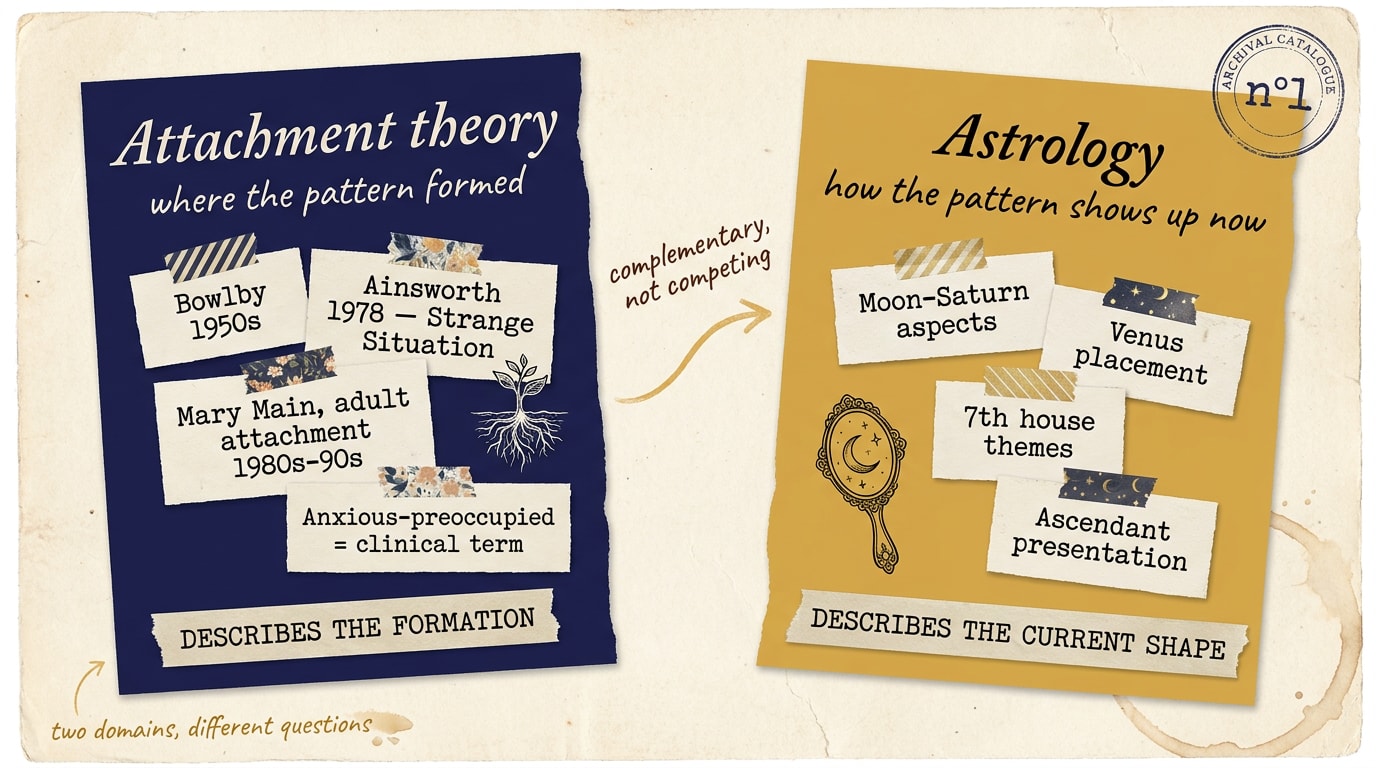
Psychology answers the developmental questions: what happened in early caregiving, why your nervous system learned to associate closeness with vigilance. Those questions belong to therapy and the research literature. Astrology doesn't compete there.
What astrology offers is a structural mirror — vocabulary for the daily shape of the pattern in adult life. Two domains, two different questions. Therapy: where did this come from and how do I change it. Astrology: what does it look like on a Sunday night with the phone face-down. Both can be true. Neither replaces the other.
The reader who has just been given the label anxious-preoccupied by a therapist is often looking for daily-shape language — something that names what's happening as it happens, without medicalising it further. Naming the daily shape isn't a verdict. It's the noticing step, the bit that has to happen between the developmental understanding and the lived change.
Four placements that show the anxious-attachment pattern
Four placements are worth looking at when the anxious-attachment shape recurs. None of them alone is the whole story; together they sketch the daily default.
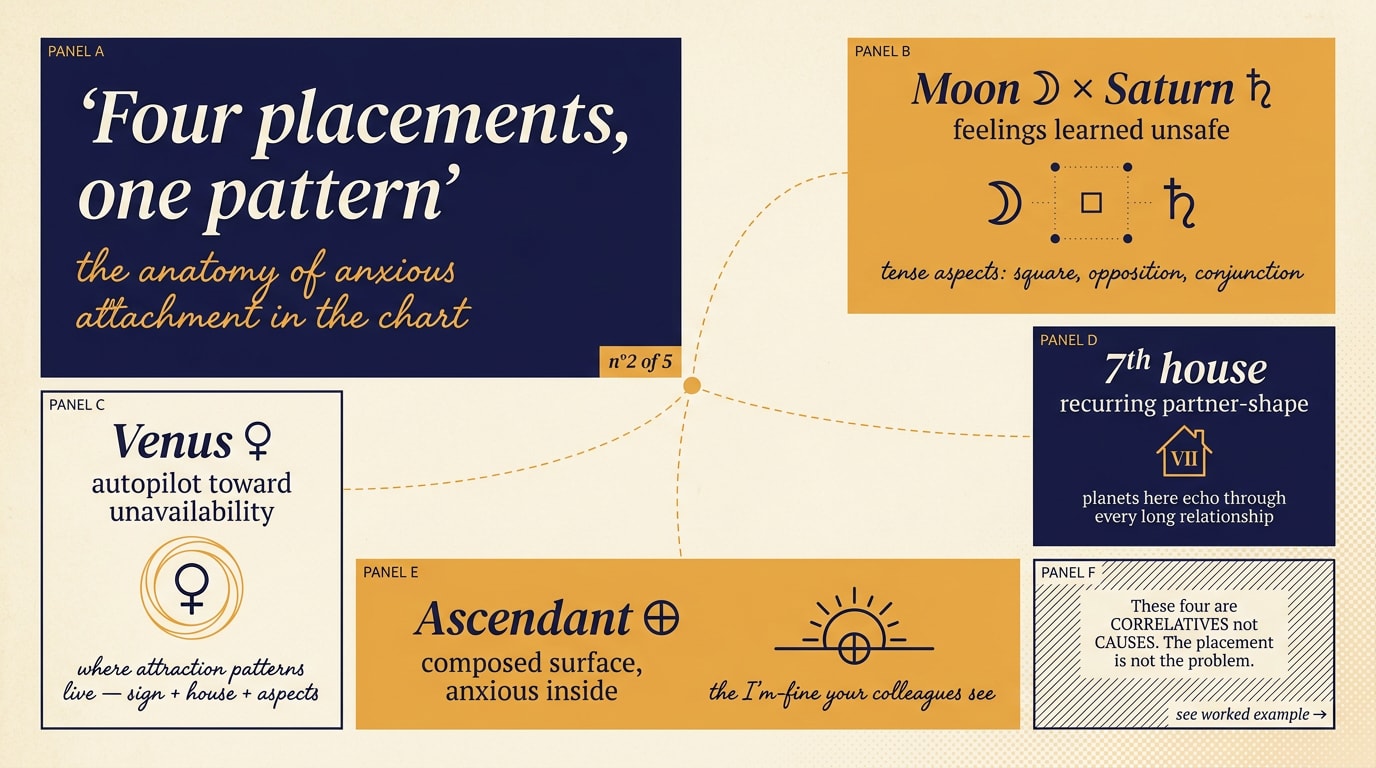
These aren't a checklist. A chart with all four can belong to someone securely attached; a chart with none can belong to someone deeply anxious-attached. Astrology is a mirror, not a microscope.
Moon-Saturn aspects: when feelings learned to feel unsafe. Tense Moon-Saturn contacts — square, opposition, or conjunction — describe a nervous system that grew up with the message that feelings were too much, too needy, or unsafe to express directly. The Moon is the emotional baseline; Saturn is the inherited structure carrying internalised rules about what's acceptable. A square or opposition between them often correlates with someone who learned early that emotional needs went unmet or were criticised, so the adult nervous system stays braced. In the anxious-attachment frame, this is the placement that most directly mirrors the developmental story.
Venus: the relational autopilot that reaches for unavailability. Your Venus sign and aspects describe what relational availability you find familiar — and for many anxious-attached readers, the default reaches toward partners who are slightly unavailable, emotionally reserved, or already half-distant. Venus in Capricorn often defaults toward composed, busy people whose reserve reads as depth. Venus in Aquarius often defaults toward partners who maintain emotional distance as a principle. Venus in close aspect to Saturn or Pluto can correlate with attraction toward people whose unavailability is part of the appeal. Venus describes a starting attraction, not an ending — one you can notice and, with time and support, reroute.
The seventh house: the partner-shape that keeps showing up. The seventh house describes the recurring archetype of partner you find yourself opposite, and for anxious-attached readers, the recurring shape is often the avoidant: composed, hard to read, slow to commit, quick to withdraw. If your seventh house has Saturn on or near the cusp, the recurring partner may carry weight — older, more reserved, more emotionally guarded. If Uranus sits there, the recurring shape may be the unpredictable one whose disappearances feel chaotic. If the ruler of your seventh house is in a tense aspect to your Moon or Venus, the partnership archetype tends to feel unreachable in some quietly familiar way.
The Ascendant: composed on the outside, anxious inside. Your Ascendant — the sign rising at your birth — describes how you present to the world. For many anxious-attached readers, the Ascendant looks composed, capable, even unbothered, while the inner experience is anything but. An Ascendant in conjunction or square to Saturn often correlates with someone who looks more put-together than they feel — the I'm fine presented to colleagues while the nervous system is bracing. Air Ascendants (Gemini, Libra, Aquarius) can layer on extra social composure that further hides the anxiety.
The placement isn't the problem. None of these four causes anxious attachment style. Anxious attachment is a developmental pattern with a clinical description, and the placements correlate, describe, and mirror — they don't determine. A chart isn't a diagnosis and shouldn't be treated like one.
 The bench, the phone face-down — choosing to look outward instead of into the screen.
A worked example: Moon square Saturn with Venus in Capricorn
Here is one combination read end to end, in an illustrative composite — a plausible chart, not a real person.
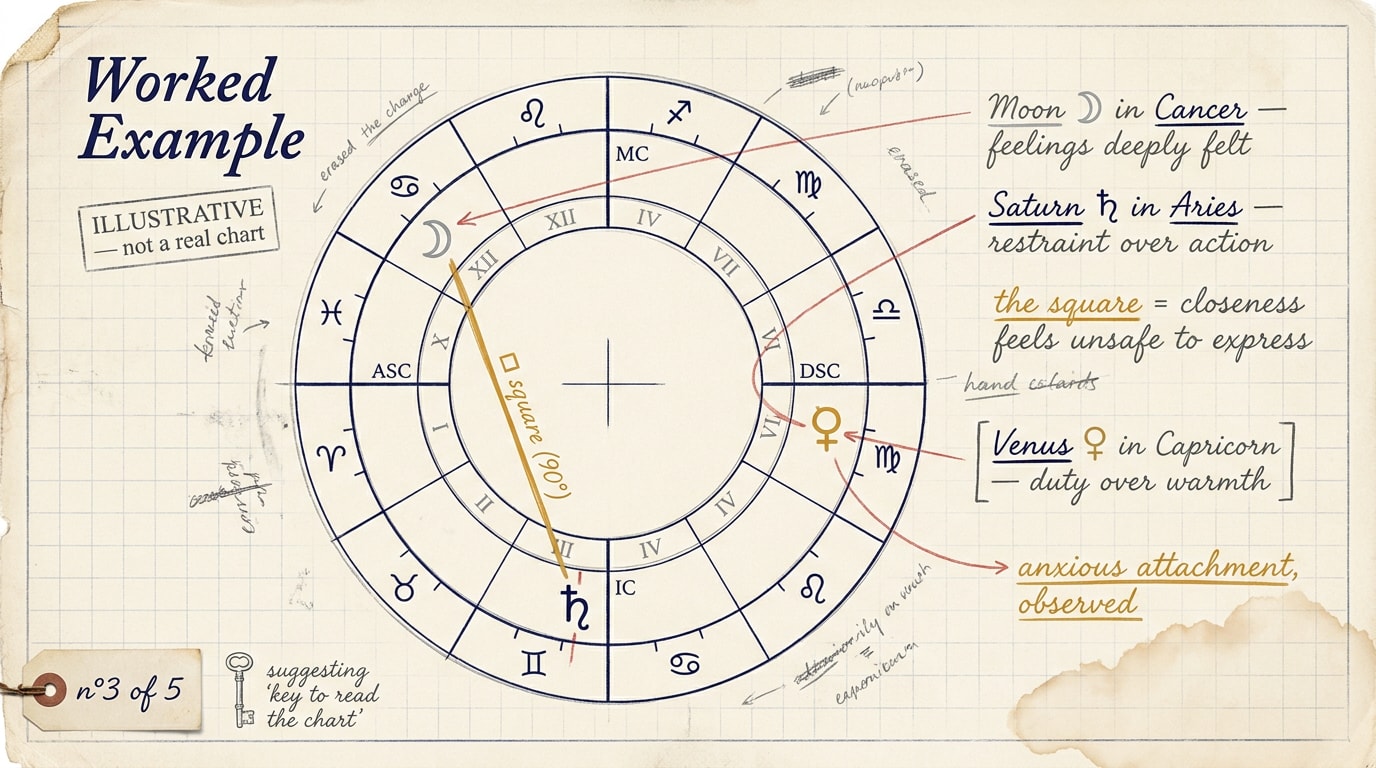
Moon square Saturn, with Venus in Capricorn.
As a child, the Moon-Saturn part of her registered that big feelings made adults uncomfortable. The lesson absorbed wasn't articulated — it was structural. Don't be too much. Now, as an adult, the same nervous system runs every close relationship through a constant background check: am I being too much right now? was that too needy? did I say too much? The check happens before the conscious thought has caught up.
Her Venus in Capricorn does its own quiet work in parallel. She's drawn to people who present as composed, busy, capable. The first thirty seconds of attraction often happen with someone whose reserve she reads as steadiness. In real time, the composure she falls for is often partial unavailability — and her Moon-Saturn nervous system, already primed to fear withdrawal, now has a partner-pattern that delivers withdrawal as a feature.
The daily shape that builds is small and recognisable. She texts him on Sunday afternoon. He doesn't reply for three hours. The Moon-Saturn part of her hears the old message — you've been too much. The Venus-in-Capricorn part of her thinks he's busy and reserves are normal and she should just wait. Both parts are true. The waiting feels like a vigil. By 11pm she's done the thing she does — phone face-down, refresh, drop, refresh, drop — and the worst part is she's watching herself do it.
If reading this you recognise the pattern as currently overwhelming — affecting your sleep, your concentration, your sense of safety — please contact your GP for a referral to NHS Talking Therapies, or in immediate crisis call NHS 111 (select the mental-health option) or Samaritans on 116 123. Pattern-recognition belongs to a quieter conversation than crisis support does.
The chart isn't predicting her future. It's describing a daily pattern shape that this combination tends to run when it's not being noticed. Once it's noticed — usually in attachment-focused therapy, sometimes with EFT or schema work, sometimes through long careful relationships with a steady partner — the shape becomes workable. The chart names. The therapist works. Astrology sits alongside that work; it can't replace it.
'Isn't this just astrology dressed up as psychology?' A fair question. The claim isn't that planets cause attachment style — attachment style has a developmental cause, well-documented in attachment theory. The claim is much smaller: the chart describes the daily shape of a pattern that already has a developmental account. Naming the daily shape isn't a competing scientific claim. It's the same thing journalling apps, personality frameworks, and therapy intake forms do — hand you a structured prompt for self-reflection. The right question isn't does it work? It's does this prompt help me notice something I'd otherwise miss?
What astrology can do here, and what it really can't
It's worth being honest about the size of the claim, because most online astrology over-claims badly on attachment topics, and most attachment-theory writing ignores astrology altogether. Both are doing the reader a small disservice.
What astrology can offer is vocabulary for the daily shape. It can lower the heat of self-criticism by replacing what's wrong with me? with oh — this is a known shape, and it has a structural mirror in my chart. It can sit alongside attachment theory without competing with it. It can make the pattern feel less personal and more shared, since many people have these placements and many people recognise these dynamics.
What astrology cannot do is diagnose anxious attachment. Only a qualified clinician can offer that designation. It cannot cause anxious attachment in anyone — the placements correlate, they don't determine. It cannot replace attachment-focused therapy, EFT (Emotion-Focused Therapy, developed by Sue Johnson), schema therapy, or any other clinical approach designed for this work. It cannot provide a partner-diagnosis — he must be avoidant because his Moon is in Aquarius is not how this works and shouldn't be how this works. And it cannot fix the pattern on its own. The actual shift in how anxious attachment feels day to day happens through therapy, lived practice with a secure partner, and time.
Astrology sits alongside that work; the chart is the map, you still have to walk it.
When the pattern needs a person, not a chart
There is a line between anxious attachment is sometimes loud and anxious attachment is running my life, and on the other side of that line, this article isn't the right tool.
 Some evenings the work for the day is just leaning on the rail and letting it settle.
A chart can give you language. Only a person can hear you. If you're hesitating between booking a session and reading another article, please book the session first — the support lines and therapist registries are in the footer below.
If you want to see your own Moon-Saturn aspects, Venus, seventh house, and Ascendant in one place, WowAstro will calculate a free birth chart for you. Date, time and place; it takes a couple of minutes. The chart won't tell you who you are — that bit is yours — but it'll show you the shape your therapist already named. If you'd like to keep reading, the related piece on toxic relationship patterns covers a different version of the same noticing-first logic, and the inner-critic-and-Saturn article covers the self-worth side of the same Saturn structural frame.
Frequently asked questions
What is anxious attachment style in plain English?
Anxious attachment style is a patterned way of relating in close relationships, characterised by hyper-attentiveness to a partner's availability, a fear of being abandoned or "too much", and a nervous system that struggles to settle when closeness feels uncertain. It's one of four attachment styles described in attachment theory (alongside secure, avoidant, and disorganised) and was developed by John Bowlby, Mary Ainsworth, and later Mary Main as a framework for understanding how early caregiving shapes adult relational patterns. It's a framework, not a diagnosis, and many people who recognise themselves in the description benefit from attachment-focused therapy.
Can astrology really show anxious attachment in my chart?
Astrology can offer vocabulary for the daily shape of a pattern that attachment theory already describes; it can't show you whether you have anxious attachment in a diagnostic sense. Four placements often correlate with the anxious-attached description: tense Moon-Saturn aspects, Venus and its aspects, the seventh house, and the Ascendant. The correlation is structural and qualitative, not deterministic. A chart with all four can belong to someone securely attached; a chart with none can belong to someone deeply anxious-attached. If you want clarity on your attachment style, an attachment-focused therapist is the right person to ask.
How do I heal anxious attachment, and does astrology help?
The honest answer: astrology doesn't heal anxious attachment, and the word "heal" is doing a lot of work in that question. What attachment-focused therapy (or EFT, or schema therapy) can do is help you recognise the pattern as it happens, build internal capacity to self-soothe, and over time develop more secure relational habits — often with a steady partner, a steady therapist, and steady practice. Astrology can sit alongside that journey as vocabulary for the daily shape, useful for noticing, not useful as treatment in itself. The BACP register at bacp.co.uk lists attachment-focused therapists in the UK; your GP can refer you to NHS Talking Therapies.
Should I see a therapist or just read about my chart?
If anxious attachment is affecting your daily life — your sleep, your work, your relationships, your sense of safety — please see a therapist. A chart will not change the pattern; therapy can. If you're managing day to day but want to understand the pattern better, both can be useful: a chart gives you vocabulary for what you're noticing, a therapist gives you tools to work with it. If you can only access one, choose therapy — it does the actual changing. Mind has a free UK therapist directory at mind.org.uk, NHS Talking Therapies are available via GP referral, and BACP lists attachment-focused therapists. Astrology sits alongside that conversation; it cannot replace it.
Read the wider context in our guide to your full birth chart
By Oksana Miatova, astrologer and writer at WowAstro. Charts calculated using the Swiss Ephemeris.
About this article: WowAstro readings combine traditional astrological methodology (Swiss Ephemeris calculations, Hellenistic and modern psychological frameworks) with AI-assisted writing reviewed by Oksana Miatova before publication. For entertainment and self-reflection only — not medical, legal, or financial advice. Full editorial policy at /editorial-standards.
Astrology, as we use it at WowAstro, is a tool for self-reflection and self-understanding, not a method for predicting events, diagnosing attachment style, or telling anyone what to do about their relationships.
If anything in this article landed close to a difficult truth and you'd like to speak to someone: — Samaritans on 116 123 (free, 24/7) if you're in crisis or struggling. — Mind on 0300 123 3393 (Mon-Fri 9am-6pm) for mental-health information and support. — NHS 111 (select the mental-health option) for non-emergency NHS mental-health support. — Your GP for a referral to NHS Talking Therapies, or BACP for attachment-focused therapists, or Relate for relationship-focused counselling. Astrology, used honestly, sits alongside professional support; it is not a replacement for it.
See what your charts say about each other
A personal AI synastry reading — not a sun-sign table, but an analysis of both natal charts across 8 areas of the relationship
Comments
New here? Get −30% off your natal chart
Leave your email and we will send you the promo code WELCOME30. Straight after that you can comment — no passwords, all automatic.
Quick sign-in
Sign in with Telegram — one click.
Or by email (with a gift)
Already have an account? Enter the same email — we'll email you a sign-in link.