Maya wants to book the venue tonight. David wants to think about it until Sunday. The email goes out three days late, after a small, slow disagreement that wasn't really about the venue. He's a Taurus. She's an Aries. They've both noticed the pattern by now, and one of them has started typing the pair into Google to see whether the chart has anything to say about it.
The first result calls it «a classic complementary pair». The second says they're «set up to frustrate each other». The third gives a percentage. None of those paragraphs mentioned the thing none of them ever do. Every one looked at a single placement, your Sun sign, and made a relationship out of it. A real chart has ten planets in it. Comparing two Sun signs and calling the result taurus aries compatibility is like grading a holiday by what time the flight took off. Some signal, yes. Not enough to build on.
This guide separates the parts of the Taurus-Aries cliché that hold up from the parts that don't, explains the 30° semisextile between the two signs, and shows what the rest of the chart usually does with the pace gap.
In short. Taurus Sun and Aries Sun describe one tenth of one chart each — a temperament pair, not a relationship verdict. The pace mismatch is partly structural, because Aries is Mars-ruled and Taurus is Venus-ruled. The signs sit 30° apart on the zodiac, an aspect called a semisextile — adjacent-sign awkwardness rather than dramatic clash. «Taurus calms Aries down» is a Moon-Moon question, not a Sun trait. The Moon, Venus, Mars and Rising placements do most of the work.
 The moment one of them wants to decide and the other doesn't.
Why the Taurus-Aries listicles can't agree
Three different sites can hand you three different verdicts on the same Taurus and Aries because each one is judging the whole relationship off a single planet and pretending that planet is the couple.

The Sun is one planet of the ten that sit in a birth chart, so a Taurus or Aries label hands you about a tenth of the picture and stays quiet about the other nine. A real reading lines up all ten of your planets against all ten of your partner's, plus the angles those planets make to one another. That's why one site can stamp Taurus-Aries «complementary» while the next calls them «set up to frustrate» — each writer is reading the same lone Sun and colouring in the gaps from mood, and both can sound perfectly sure of themselves.
The honest method has a name — synastry, the proper term for astrological compatibility, which we cover in the full guide — and it works the opposite way round. You lay David's chart and Maya's chart on top of each other and read how every planet in one answers to every planet in the other. That turns a single cell of a 12×12 wall chart into twenty moving pieces describing the same two people.
| Sun-sign verdict | Synastry | |
|---|---|---|
| What it compares | One Sun sign vs one Sun sign | Ten planets in each chart, plus angles |
| Data needed | Two dates of birth | Date, time and city of birth for both |
| Houses (areas of life) | Not used | Used: where one person's planets land in the other's life |
So when this guide talks about taurus aries compatibility, the Sun pair is the entry point, not the conclusion.
What Taurus and Aries actually share at Sun level
At Sun level, Taurus and Aries describe a difference in tempo between two people, not the fate of the relationship they're in.
Aries is a Mars-ruled, cardinal-fire sign: direct, first-mover, comfortable with confrontation, allergic to the slow build. The Aries Sun tends to want resolution now and reads delay as either dishonesty or boredom. Call it the Spark, the placement that wants to start.
Taurus is a Venus-ruled, fixed-earth sign: steady, sensual, slow to commit and slow to leave, attuned to comfort and to the worth of a thing rather than the speed of getting to it. The Taurus Sun is built for the long settle-in and reads quick resolution as decisions being made before they've actually been thought about. Call it the Builder, the placement that wants to keep.
What this pair shares is less obvious than the difference: both placements care about something concrete. Aries cares about action, Taurus about the thing being built. Neither is wired for vague drift. Where they part company is on speed — the same Venus-Mars polarity that drives chemistry across full synastry charts is already sitting inside the Sun pair. Mars wants now. Venus wants when it's ready.
That single placement reliably predicts a particular rhythm of misunderstanding — the venue conversation, the can-you-just-pick-one conversation — and a particular mutual respect once both people stop expecting the same operating system from each other. It doesn't predict whether you're compatible. That sits in the rest of the chart.
The 30° semisextile: the awkward-neighbour aspect, explained
Aries and Taurus sit 30° apart on the zodiac wheel, which means the Sun pair forms an aspect astrologers call a semisextile.
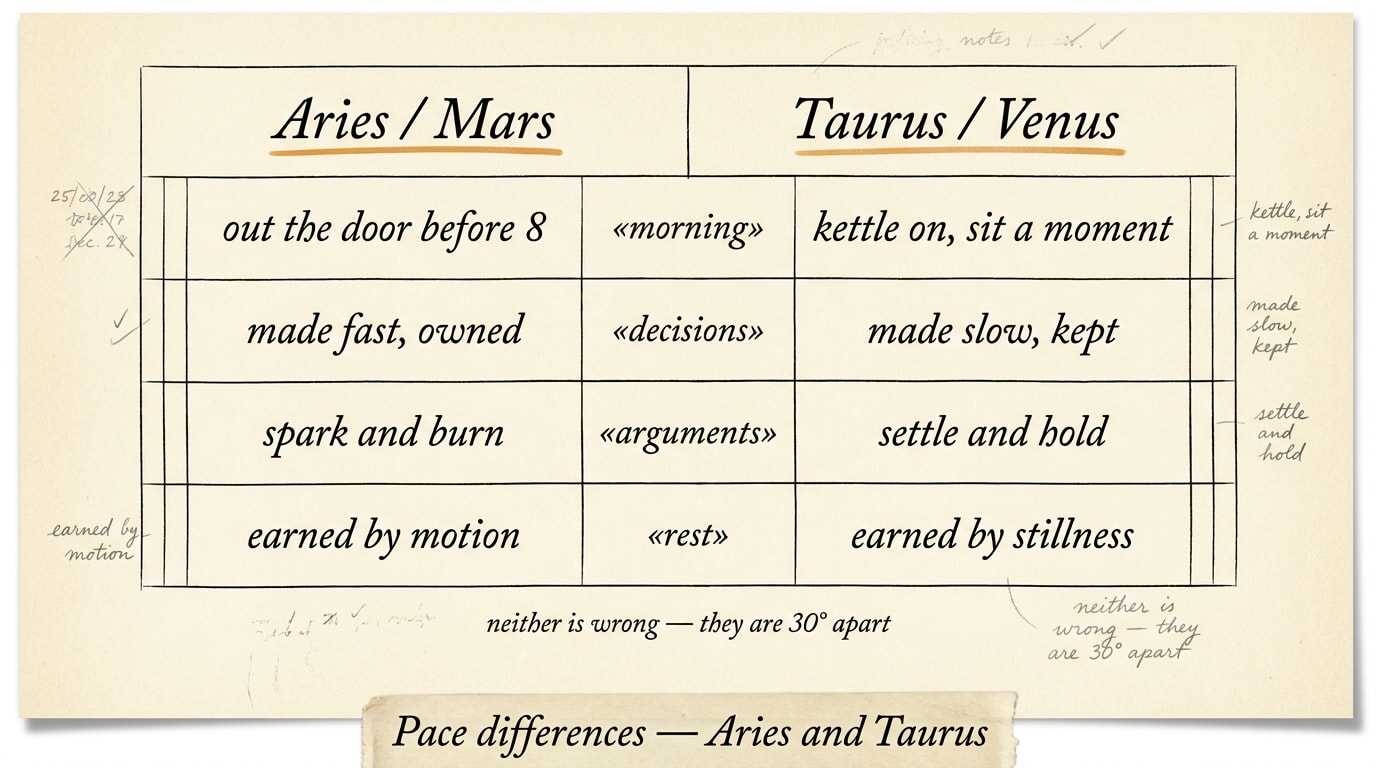
A semisextile is an angle of around 30° between two placements — what you get when two signs sit immediately next door on the wheel. It's the «awkward-neighbour» aspect: the two rooms share a wall, but the wallpaper doesn't match. It's less famous than the square or the trine and rarely gets a paragraph in sun-sign sites, but it's standard in working astrology — in synastry it usually describes a place where two people keep meeting a small, ongoing adjustment rather than a dramatic clash.
The Taurus-Aries semisextile shows up as the recurring negotiation around pace. Aries wants the venue booked on Tuesday evening. Taurus wants to think until the weekend and notices, quietly, that three of the choices haven't been priced yet. Worked through, this is the couple who learn to flag the difference out loud — «I'd like to decide this tonight», «I'd rather sit with it until Sunday» — and the small ongoing negotiation becomes the quiet backbone rather than the weekly argument. It's a much gentler aspect than the Aries-Cancer square, which has built-in pressure rather than mild rubbing.
 Two paces, one kitchen.
Practitioners observe that plenty of long marriages have a semisextile somewhere in the synastry. What those couples have in common is that they stopped reading the adjustment as a flaw — they learned to budget for it.
Sorting the Taurus-Aries clichés
Some of what gets said about Taurus and Aries is fair temperament reading; the rest is stereotype passed around until it sounds like fact. Below, each line gets weighed honestly against what a chart can actually support.
| Cliché | Status | What's actually going on |
|---|---|---|
| «Pace mismatch» | ✅ Mostly true | Venus rhythm vs Mars rhythm. The structural pace gap is real and lives in the Sun pair itself. |
| «Complementary pair» | ⚠️ Partly | When both people stop expecting the other's operating system, the Builder and the Spark do cover ground neither would alone. When they don't, the same gap becomes the weekly argument. |
| «Taurus calms Aries down» | ❌ Sometimes | Calming-influence is a Moon-Moon question, not a Sun trait. Plenty of Taurus Suns are nervier than the Aries opposite them. |
| «Aries is too hot-headed» | ❌ Lazy | Tone of action lives in Mars placement, not in being an Aries Sun. An Aries with Mars in Pisces is no one's idea of hot-headed. |
| «Taurus is too stubborn» | ❌ Same mistake | Stubbornness lives in fixed-cluster placements or Sun-Saturn aspects, not in being a Taurus Sun. |
| «47% match» (or any percentage) | ❌ Made up | No real chart math produces a single compatibility percentage. The number is decoration. |
| «Soulmates because they balance each other» | ❌ Listicle filler | A Sun-pair verdict can't deliver «soulmates». That word points at Moon-Moon contacts and house overlays, not a Sun semisextile. |
A simple filter: the moment a piece hands you a verdict or a percentage, it has taken one placement and tarted it up as the whole couple. The lines that name a tendency without telling you how the relationship ends are the ones worth trusting.
A worked example: Maya and David
Take the David and Maya from the top of this piece — invented, but both carrying the exact Taurus-Aries Sun pair. What turns them into a couple you'd recognise is the nine planets the listicles never mention.

Maya: Sun in Aries, Moon in Pisces, Venus in Taurus, Mars in Aries, Rising in Sagittarius. David: Sun in Taurus, Moon in Cancer, Venus in Gemini, Mars in Capricorn, Rising in Libra.
Start with the Suns. Aries and Taurus, the semisextile we've already covered: adjacent on the wheel, Mars-flavoured next door to Venus-flavoured, the recurring pace negotiation. Now the placements that actually run the relationship.
The Moons. Pisces Moon and Cancer Moon is a trine by sign, both water, both receptive, both fond of slow time. On a Sunday morning the two of them are perfectly recognisable as a couple even though the Sun pair would have predicted a venue argument.
The Venuses. Taurus Venus and Gemini Venus are adjacent signs themselves, different aesthetic registers, one slow and sensual, one curious and verbal, but neither one cold. They give each other slightly different gifts and learn to mean them.
Mars. Aries Mars and Capricorn Mars are both cardinal: one moves on instinct, the other on strategy. They get things done together.
Risings. Sagittarius Rising and Libra Rising form a sextile by sign, warm and graceful, the first impressions reading easily into each other.
What you have is a recognisable couple, not because Taurus and Aries do or don't go together, but because of the five other layers underneath quietly rescuing the Sun pair.
What the worked example shows. The Taurus-Aries headline is a single note in a fuller chord — it only dominates the horoscope pages because a Sun sign is the one thing you can look up from a birthday alone. The Moons, Venuses, Mars and Rising signs across David's and Maya's charts carry the weight the listicles keep trying to load onto two Sun signs.
Checking your own Taurus-Aries match
To run this on a real relationship instead of Maya and David, the steps are short.
Begin by gathering the raw material: for each of you, the birth date, the birth time down to the minute if you can dig it out, and the birth city. Skip the birth times and you forfeit the Rising signs and the house overlays — but the Moon, Venus and Mars comparison still works without them.
Then take the placements in a set order. The Sun pair you've already handled here. Next the two Moons against each other, then Venus against Mars in both directions, then Mars against Mars. Leave the Risings and the house overlays for last, assuming you've got the birth times.
Third, the part the Sun-sign sites can't do: run the full synastry properly, or have the tool do it. WowAstro will compare both of you using the Swiss Ephemeris, the same astronomical data working astrologers use. Both sets of birth data, five pounds, a few minutes.
 Different paces, one pavement.
Questions readers ask
Are Taurus and Aries compatible?
The Sun pair on its own can't answer that. What it tells you is that the pair shares a Venus-Mars polarity that shows up as a recurring pace gap — Aries wants now, Taurus wants when it's ready. Whether two specific people are compatible depends on the rest of both charts: Moons, Venuses, Mars, house overlays. Plenty of Taurus-Aries couples build durable relationships. Plenty of Taurus-Taurus couples don't.
Why are Aries and Taurus so different?
They sit next door on the zodiac wheel — Aries at 0°, Taurus at 30°, a 30° aspect called a semisextile. The wheel is built so that no two signs in a row share their ruling planet, element or modality. Aries is Mars-ruled, cardinal, fire. Taurus is Venus-ruled, fixed, earth. Same neighbourhood, completely different houses.
Is Aries attracted to Taurus (and vice versa)?
Sometimes, often, sometimes not. Genuine attraction lives in Venus-Mars contacts across the two charts, not in being an Aries or a Taurus Sun. A Venus-Mars trine creates more durable chemistry than any Sun-sign reputation.
Should I worry about the semisextile between Aries and Taurus?
No. A semisextile points to a small standing adjustment, not a sentence of doom. Of all the named angles the Suns can make, it's the mildest — clock the pace gap, say it out loud, and stop treating the other person's tempo as a personal slight. A chart can only describe the dynamic; the rest of it is yours to handle.
A note on what this is. Astrology, as we use it at WowAstro, is a tool for self-reflection and self-understanding, not a method for predicting events, health, financial outcomes or whether a relationship will last. Read a synastry chart as a description of a dynamic — take what's useful, leave the rest.
Written by Oksana Miatova, astrologer and writer at WowAstro. Charts calculated using the Swiss Ephemeris, the same astronomical data working astrologers use.
See what your charts say about each other
A personal AI synastry reading — not a sun-sign table, but an analysis of both natal charts across 8 areas of the relationship
Comments
New here? Get −30% off your natal chart
Leave your email and we will send you the promo code WELCOME30. Straight after that you can comment — no passwords, all automatic.
Quick sign-in
Sign in with Telegram — one click.
Or by email (with a gift)
Already have an account? Enter the same email — we'll email you a sign-in link.