
Somewhere around your birthday, the Sun returns to the exact spot in the zodiac it sat at the minute you were born. A solar return chart is the snapshot of the whole sky at that moment — and astrologers read it as a one-year theme map running from this birthday to the next. It isn't always on your birthday itself, which is the first quietly interesting thing about it.
The promise tends to get oversold. TikTok will tell you your solar return chart predicts your year. It doesn't. What it does, quite usefully, is describe the themes the year is likely to surface, the questions worth holding, and the rooms of your life that this particular trip around the Sun seems to be pointing a torch at.
In short. A solar return chart is the astrological chart calculated for the exact moment the Sun returns to its natal zodiac position, which happens roughly, but not exactly, on your birthday each year. Astrologers read it as a one-year theme map running from this solar return to the next. Its Ascendant indicates the year's keynote, the Sun's house shows where the year's focus lives, and aspects to the natal chart show how those themes converse with the rest of you.
 A quiet birthday morning. The chart, before the cards.
What a solar return chart actually is
A solar return chart is the astrological chart erected for the exact minute the Sun returns to the same zodiac longitude it held at the minute you were born. The Sun's apparent path through the zodiac takes one tropical year, 365.2422 days, and at the end of that year, give or take a few hours, the Sun arrives back at exactly the spot it sat on the day you were first counted into the world. WowAstro calculates that moment using the Swiss Ephemeris, the same astronomical data working astrologers rely on. Before it's an astrological event, it's an astronomical one: the astronomy is true.
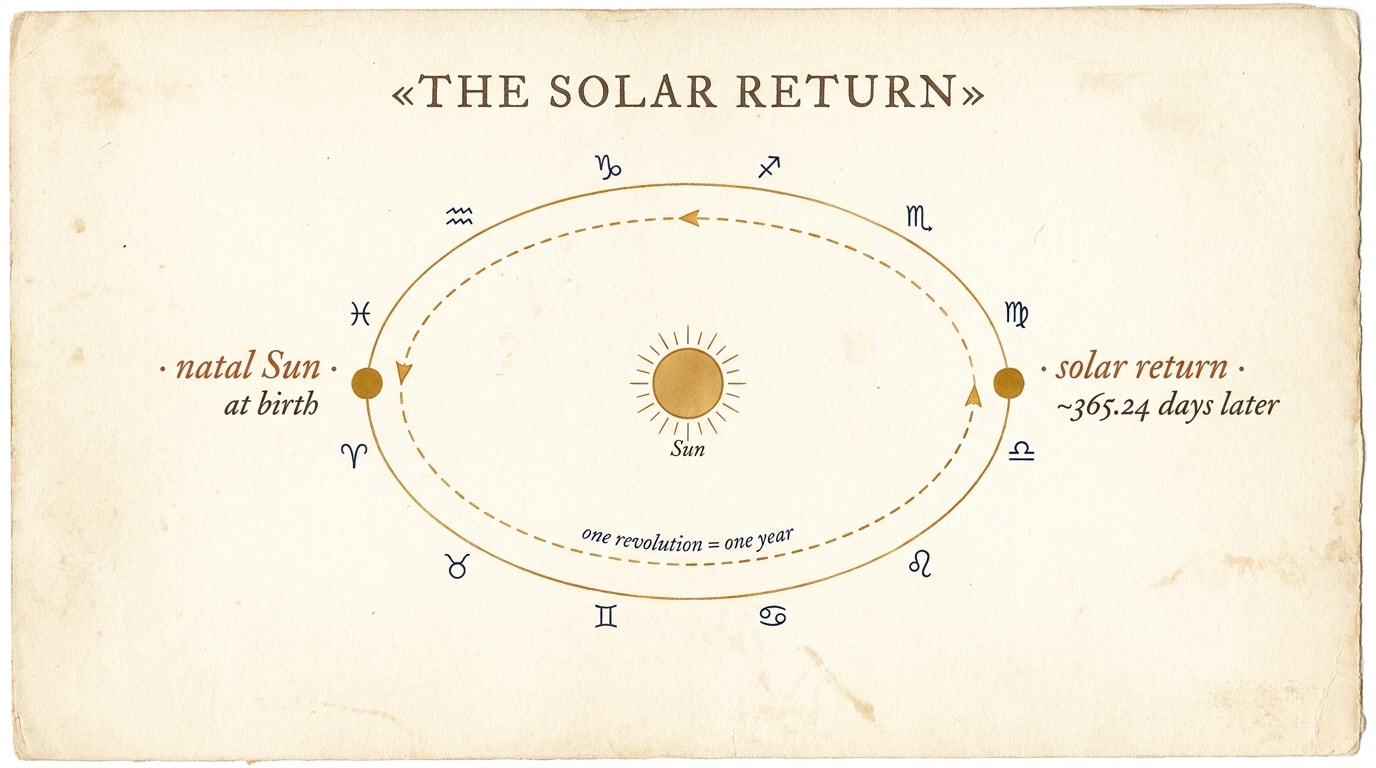
What's slightly less obvious is that this is a classical technique, not a TikTok invention. The solar return chart was codified in the 17th century as part of European astrology's predictive toolkit, and it has been quietly refined by working astrologers in every century since. The general behaviour of transits, moving planets read against your birth chart, sits underneath everything that follows. A solar return chart is just one specific, structured way of doing that: a snapshot rather than a running commentary.
A useful image. Think of your natal chart as a portrait that doesn't move; a solar return chart is a fresh photograph of the sky taken on one specific afternoon a year. The portrait describes who you are. The photograph describes the room the year is going to put that portrait in.
So when, exactly, is yours?
Why your solar return isn't always on your birthday
Your solar return falls within roughly one day either side of your calendar birthday, not always on the date itself. The tropical year is 365.2422 days long, but the calendar year alternates between 365 and 366 days. That small mismatch means the Sun arrives back at its natal position a few hours earlier or later each year — sometimes slipping into the day before, sometimes onto the day after your birthday. The exact return-time depends on what time of day you were born and on where the leap-year cycle sits in the year you're tracking. If your astrology app says your solar return is on the 13th and your birthday is the 12th, that isn't a bug; that's how the year works.
A worked example to walk through the arithmetic, illustrative rather than a real person. Imagine someone born on the 12th of June at 4:30 pm BST in London. In a non-leap year, their solar return might land at around 10:15 pm on the 12th. The next year, after a leap day has been inserted into the calendar, the same astronomical moment falls at around 4:00 am on the 13th, with the same astronomy in a different calendar slot. After four years and one leap day, the times have drifted by close to a full day. Then the cycle resets.
In short. The Sun returns to its natal position once every tropical year (365.2422 days). Your solar return time drifts by about five or six hours each year and can slip onto the day before or after your birthday. Look it up in any free solar return calculator using your birth date, time and place of birth.
Two things worth holding. If you don't know your birth time, the Sun's position is still usually accurate to within a fraction of a degree, because the Sun moves slowly through the zodiac. A missing birth time hurts the Moon and the Ascendant far more than it hurts the Sun. And the "on the day" convention isn't wrong, exactly. It's a useful approximation that gets quietly less precise the further the calendar drifts from the tropical year. Once every four years, the calendar catches up.
How to read a solar return chart: four layers
Read a solar return chart in four layers, in this order: the Ascendant of the chart (the year's keynote), the Sun's house placement (where the year's focus lives), the shape of the chart (which areas of life are loaded), and the aspects between the solar return and your natal chart (how the year's themes converse with the rest of you). Most beginner readings fail because every placement is treated as equally important; the layered order is the difference between a useful read and a list of fragments. The hierarchy isn't fashionable, but it's how working astrologers actually read these charts.
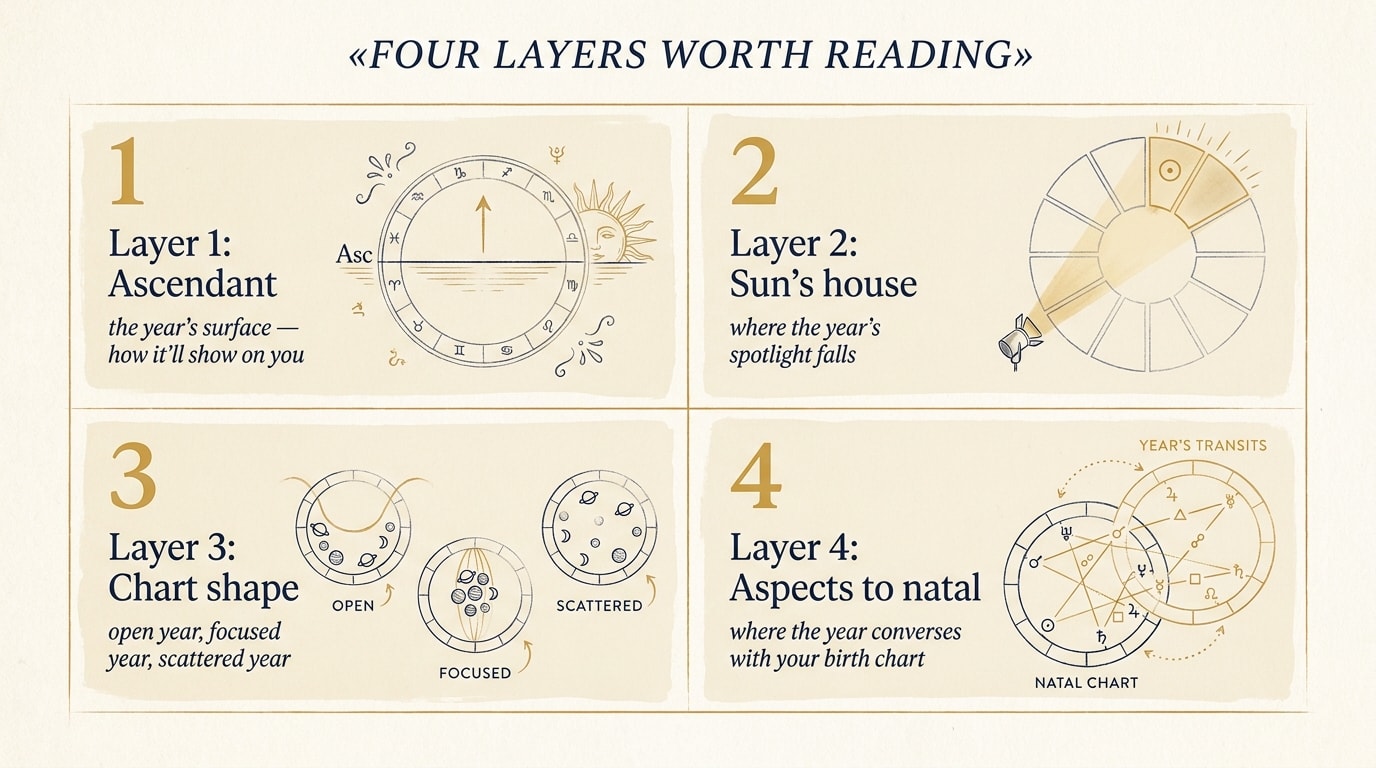
Layer 1: the Ascendant of your solar return — the year's keynote
This is the first thing you look at. The sign on the Ascendant of your solar return chart (astrologers shorten this to ASC of SR) describes what the year is most likely to ask of you. A Libra Ascendant in a solar return often surfaces themes of partnership, balance and fairness; a Capricorn Ascendant in a solar return tends to ask for structure and grown-up responsibility; a Cancer Ascendant often turns the year towards home, family and emotional safety. The keynote isn't a verdict. It's the question the year is going to keep returning to.
Layer 2: the Sun's house in the solar return — where the year's focus lives
Once you have the keynote, find the Sun. The house of your solar return chart that contains the Sun (the SR Sun) points to the area of life the year is most likely to put a torch on. The Sun in the sixth house often turns the year towards routines, work and health habits; the Sun in the tenth house tends to point at public role and reputation; the Sun in the fourth house turns the year quietly towards home and the people it contains. Not exclusively, never exclusively. But disproportionately.
Layer 3: the shape of the chart — which areas are loaded
Step back and look at the whole chart. If three or four planets in your solar return chart cluster in one house, that area of life is heavily emphasised; the year is asking a lot of attention there. If the planets are spread evenly across the chart, the year is more likely to be one of balance across several rooms of your life, rather than a deep dive into one. The shape is a quick read of the year's overall pressure pattern, and it's the layer most beginners skip.
Layer 4: aspects between the solar return and your natal chart — how the year converses
This is the last of the four layers because without the first three it becomes a salad of fragments. Look for major aspects, conjunctions, oppositions, squares, trines — between planets in the solar return and planets in your natal chart. A solar return Saturn making a square to your natal Moon is one such conversation; a solar return Venus on your natal Mercury is another. These are the points where this year's themes intersect with patterns that have been with you the whole time. Read with the first three layers in place, the aspects sharpen the picture. Read first, in isolation, they tend to overwhelm it.
 The layered read, one note at a time.
Don't start with vertex, part of fortune, asteroids or the progressed solar return. They can add useful texture later, but most readings that feel like word-salad started by reading the smallest details first. The four layers above are enough to make a chart legible. Everything else is decoration on a structure that needs to stand up first.
What a solar return chart isn't: common misuses
A solar return chart describes the themes the year is likely to surface; it does not predict specific events, dates or outcomes. This sounds obvious written down. It is also the most common misuse of the technique, amplified by social-media framing of the chart as a forecast of the events ahead. Classical and modern astrological practice both treat the solar return as a descriptive, reflective tool, not a predictive one, and reading it as a crystal ball produces consistently poor results. The same solar return chart correlates with very different lived years depending on what the person actually does with the themes the chart surfaces.
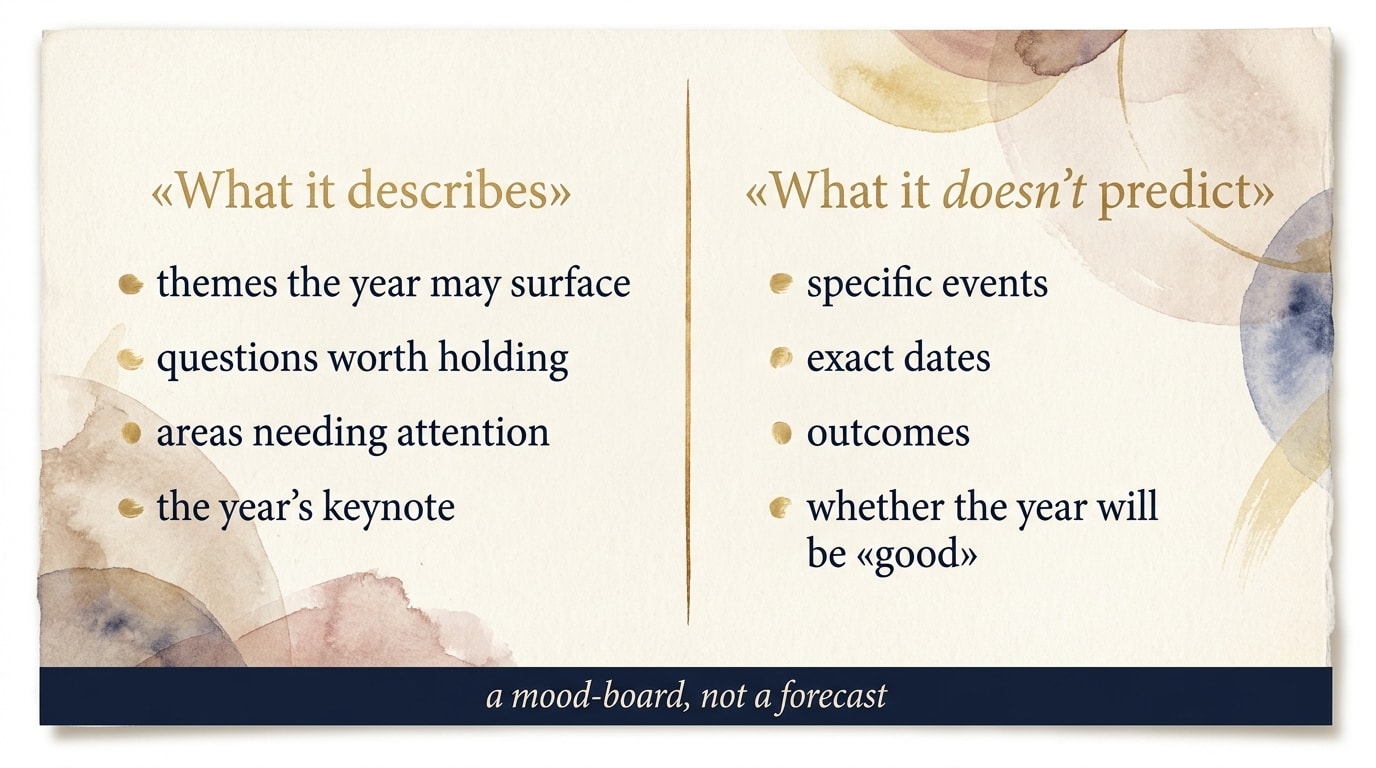
What a solar return chart does well: surface the year's keynote, point a torch at the areas of life likely to need attention, raise honest questions about commitments and rhythms, give a frame for self-reflection at the year-mark of your life. What it doesn't do: name specific events with dates, predict whether you'll get a job, a relationship or a diagnosis, guarantee a good year or warn of a bad one, replace the work of actually living the year. These two columns are not the same kind of thing. Conflating them is where most disappointment with the technique comes from.
What a solar return chart isn't. It isn't a prediction. It isn't a calendar of events. It isn't a verdict on whether the next year will be "good" or "bad". It's a description of themes — a torch held over the rooms of your life that this trip around the Sun seems to be pointing at.
The "themes, not events" framing matters because the alternative (your solar return chart will deliver X by Y) is both bad astrology and bad reasoning. It's bad astrology because the canonical literature doesn't claim event-level prediction; it claims thematic description. It's bad reasoning because the same astrological themes show up reliably across very different lived outcomes — the chart describes the shape of the question, not the answer the person ends up giving it. So what is it actually for, in practice?
When to use a solar return chart: an annual reflection ritual
Use your solar return chart as an annual reflection ritual at the year-mark of your life — once the week before your birthday, once again in the first month after, and once mid-year when something needs reframing. The chart is a tool for thinking, not a tool for predicting, so its value depends on when and how you sit with it. Readers who use it as a yearly journaling prompt tend to find it more useful than readers who arrive at it expecting answers. Three moments are enough.
 The yearly check-in. Not a verdict, a conversation.
The week before your birthday, look at the year ending. Which themes from the previous solar return chart actually showed up in your year? What got built, what got tested, what turned out not to matter? This sets honest ground for the new chart, and it's the step most people skip. The first month after your birthday, look at the new chart with one question, "what is this year asking me to take seriously?" — and write three sentences in a journal. Don't try to predict; describe. The mid-year check-in is the simplest of the three. When something surprising or difficult arrives, go back to the chart. Often the difficulty turns out to be the chart's keynote arriving in the only form it had available.
If you'd rather have someone collate this for your specific chart, Sun position, Ascendant, house emphasis, aspects to your natal, that's what a year-ahead reading is for. And for a different kind of yearly window, the Saturn return rather than the Sun's annual loop — see the Saturn return explained. Different timescale, different question, but the same honest framing: themes for reflection, not events for prediction.
Questions readers ask
What is a solar return chart in astrology?
A solar return chart is the astrological chart erected for the exact minute the Sun returns to the zodiac position it held at your birth, which happens roughly once a year around your birthday. Astrologers read it as a one-year theme map running from this solar return to the next. The Ascendant of the chart describes the year's keynote, the Sun's house placement shows where the year's focus lives, and aspects between the solar return chart and your natal chart show how this year's themes converse with your long-standing patterns. It's a snapshot of the sky at one specific moment, not a running commentary.
Why isn't my solar return on my actual birthday?
Because the tropical year is 365.2422 days long, but our calendar alternates between 365 and 366 days. The astronomical moment when the Sun reaches its natal position drifts by about five or six hours each year and can slip into the day before or after your birthday. If your software shows your solar return on the 13th when your birthday is the 12th, that isn't an error — it's the natural mismatch between calendar time and the tropical year. Every four years the calendar catches up with a leap day, and the drift resets.
Does a solar return chart predict the events of your coming year?
No. A solar return chart describes the themes the year is likely to surface and the areas of life likely to need attention; it doesn't predict specific events, dates or outcomes. Read as a calendar of events, it produces inconsistent results, because the same chart correlates with very different lived years depending on what the person does with the themes the chart raises. The honest framing is themes for reflection, not events for prediction — and it makes the technique more useful, not less.
What's the most important thing to look at in my solar return chart?
The Ascendant of the solar return chart, followed by the house your Sun falls in. The Ascendant indicates the year's keynote — the question the year is most likely to ask. The Sun's house placement shows where the year's focus is most likely to live. Together those two cover most of what beginner readings actually need. Leave the smaller details (lots, asteroids, vertex, progressed solar return) until those two are second nature. Reading the smallest details first is the most common reason a solar return chart ends up feeling like word-salad.
A note on what this is. Astrology, as we use it at WowAstro, is a tool for self-reflection and self-understanding, not a method for predicting events, health, or financial outcomes. A solar return chart describes themes for reflection, not events for prediction. Read the descriptions as questions, take what's useful, leave the rest.
About this article: WowAstro readings combine traditional astrological methodology (Swiss Ephemeris calculations, Hellenistic and modern psychological frameworks) with AI-assisted writing reviewed by Oksana Miatova before publication. For entertainment and self-reflection only — not medical, legal, or financial advice. Full editorial policy at /editorial-standards.
Written by Oksana Miatova, astrologer and writer at WowAstro. Solar return positions calculated using the Swiss Ephemeris, the same astronomical data working astrologers use.
Read your own natal chart
A personal AI reading, from £1
⭐ +50 Wow Stars cashback · sign up and get 100 ⭐
Build my chart →Comments
New here? Get −30% off your natal chart
Leave your email and we will send you the promo code WELCOME30. Straight after that you can comment — no passwords, all automatic.
Quick sign-in
Sign in with Telegram — one click.
Or by email (with a gift)
Already have an account? Enter the same email — we'll email you a sign-in link.