It's 11.47 on a Monday night. The alarm goes off in six and a quarter hours. You're lying on your back, eyes open, replaying a phrase from this morning's meeting — what your colleague said, what you said back, what you should probably have said instead, and what he might have meant, and whether the room read it the way you meant it. You know the thought isn't helping. You know you should be asleep. You can't stop. This is the third hour.
If you've ever lain there at midnight asking how to stop overthinking, the honest answer is that astrology can't make your mind switch off — and anyone selling that is selling something. What it can do is name the four places in your chart where overthinking tends to live louder than average, and naming a shape usually lowers its temperature by a degree or two. That's not a cure. It's a vocabulary. Sometimes a vocabulary is the bit that's been missing.
In short. If you're wondering how to stop overthinking, the honest answer is that astrology won't make your mind switch off. What it can do is name four places in your chart where overthinking tends to live louder than average — your Mercury sign, any Saturn-Mercury aspect, Virgo placements, and the tenants of your 3rd and 6th houses. Naming the shape often lowers its temperature. If the loop is keeping you up most nights or affecting daily life, please contact your GP, Samaritans (116 123, free 24/7), or Mind (0300 123 3393, Mon-Fri 9am-6pm).
 Eleven-forty-seven, third hour, same thought.
What overthinking actually is, and what astrology won't claim
Overthinking is the persistent, repetitive analysis of the same thought, decision, or memory long past the point where the thinking is useful. Psychology distinguishes two main flavours: rumination, which loops over something already finished, and worry, which loops over something not yet decided. Both are well-described patterns, both are common in adults, and neither is, on its own, a clinical diagnosis. For some people the loop tips into anxiety. For most it's a recurring weather rather than a permanent climate.
That distinction matters because this article is using astrology as a self-reflection lens — a vocabulary for the shape your particular loop tends to take. It isn't a treatment. It isn't a diagnosis. It isn't a substitute for therapy. If your overthinking has stopped being background noise and started running your evenings, please talk to your GP or contact Mind on 0300 123 3393 (Mon-Fri 9am-6pm). Astrology can sit alongside that conversation; it can't replace it.
What a chart can do, used honestly, is offer language for the structure behind the loop. The loop doesn't come from nowhere. Something in the wiring of your particular mind makes it more likely to keep weighing, keep inspecting, keep replaying. Astrology has names for that wiring — and naming wiring you didn't choose is often the first step in not taking its verdict so personally.
Why astrology has anything to say about overthinking at all
A fair question at this point: why would a centuries-old symbol system know anything about a thought-pattern that has its own modern psychological literature?
The short answer is that astrology has a long-standing vocabulary for how thought moves through you — and overthinking is, structurally, a particular way thought moves. Mercury in canon astrology is the planet of mind, of how you process and decide and speak. Saturn is structure, limit, and the inherited measuring-stick that asks have I done enough yet. Virgo is the sign of refinement and the eye for what isn't-quite-right. The 3rd house is daily mind-chatter; the 6th house is the analysis-of-task layer of life. When several of these reinforce each other, the chart describes someone who is wired to think a lot — and, sometimes, to think the same thought a lot.

WowAstro calculates these positions using the Swiss Ephemeris, the same astronomical data working astrologers rely on, so the Mercury in your chart is a real astronomical point with a real birth-date position, not a vibe. The claim isn't that the planet causes your overthinking. The claim is the milder one: a chart gives you a structured prompt for noticing where, in you specifically, the loop tends to find traction. That's the kind of thing a personality framework or a therapy intake form does, in different vocabulary.
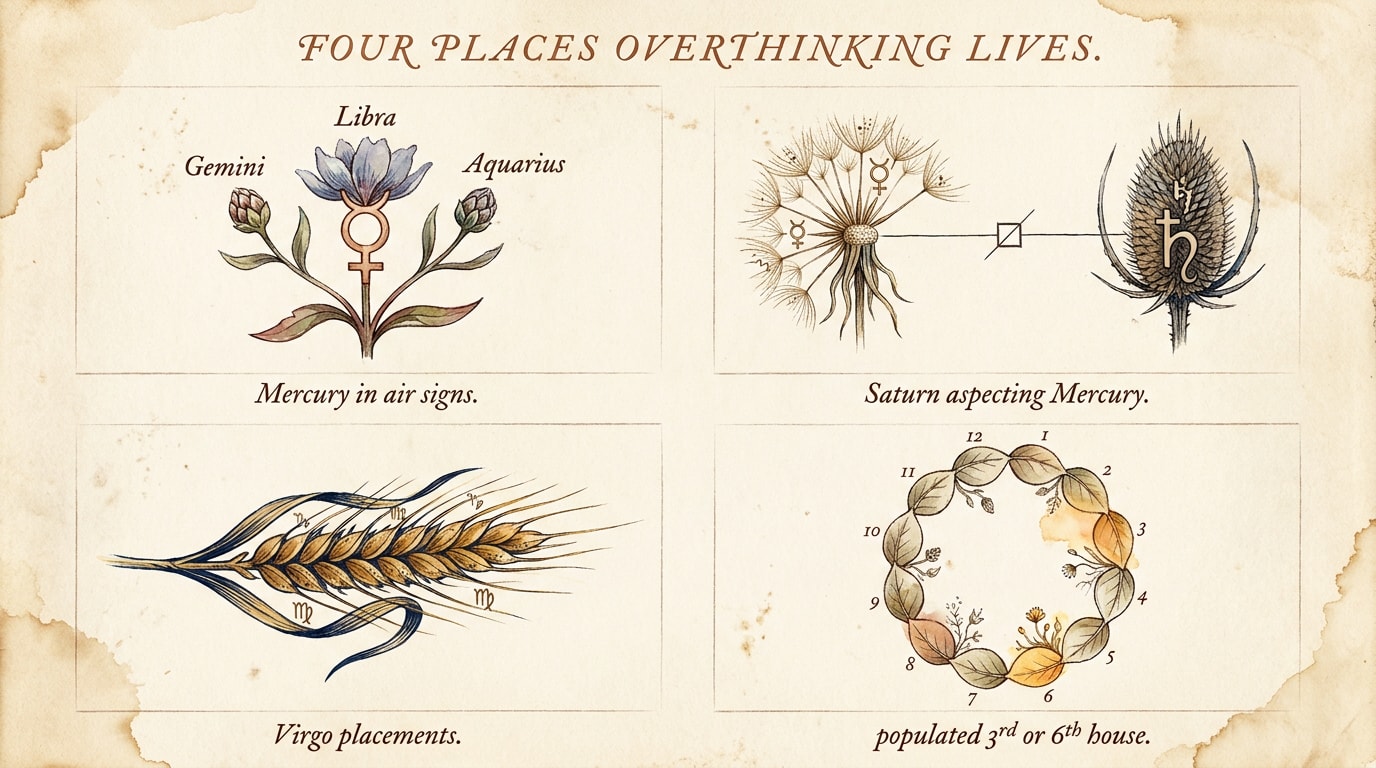
Four places in your chart where overthinking tends to live
In canon astrology, overthinking-prone wiring tends to cluster around four chart anchors. None of them, on its own, makes someone overthink. They describe tendencies — what's louder than average in this particular chart. Most overthinkers have one or two of these going on. A few have all four — and those are usually the people most relieved to read that this is a known shape, not a personal failing.
Mercury in an air sign
Mercury is the planet astrology uses for mind. When Mercury sits in air — Gemini, Libra, or Aquarius — it has, structurally, a faster setting than Mercury in earth or water. Mercury in Gemini collects ideas the way other people collect mugs. Mercury in Libra weighs both sides of every argument as a default mental gesture. Mercury in Aquarius tests every received idea against its own internal logic before agreeing to it.
Each of these is, in good conditions, what makes someone quick, articulate, lateral-thinking — the person you want in the room when a problem needs unpicking. In other conditions, at 11pm on a Sunday with no actual problem to solve, the same mental machinery turns inward and starts running a loop. The mind that's good at weighing is also the mind that won't put down the scale.
Saturn aspecting Mercury
Saturn, read structurally rather than as punishment, is the inherited model of have I done enough. When Saturn forms a tense angle with Mercury — most commonly a square (ninety degrees apart) or sits very close to it (a conjunction) — the inner-critic voice and the thinking voice get tangled together in a way that's hard to unhear once you've noticed it.
The practical effect is what some therapists call the inspector loop. You think a thought. Saturn inspects it. You revise. Saturn inspects the revision. You revise the revision. There's no stop condition built in, because Saturn always finds another thing to flag — that's the job Saturn does. People with a hard Mercury-Saturn aspect are often slow-built thinkers, often perfectionist communicators, often the ones who rewrite an email six times before sending. None of which is, in itself, a flaw; it's just a particular wiring of mind-plus-standard.
Virgo placements
Virgo, in canon astrology, is the sign of refinement, analysis, and the eye for what isn't-quite-right yet. A Virgo Sun, Moon, Mercury, or Rising tends to bring an analytical, slightly-anxious texture to whatever it touches. The Virgo Moon, in particular, often produces an inner standard of done-properly-ness that's higher than the room requires.
It isn't a flaw — Virgo is also why your friend with three Virgo placements is the one who notices the typo in your draft and gently fixes it before anyone else has noticed it's wrong. The same attention-to-what's-imperfect that makes Virgo a brilliant editor of other people's work can, turned on the inside of one's own head, look very much like overthinking. The work isn't to delete Virgo; it's to know which problems actually need the editor and which ones don't.
 Version six is in the editor; nobody asked for it.
A populated 3rd or 6th house
The 3rd house in astrology covers the daily mind — immediate environment, short journeys, conversation, the chatter of moment-to-moment thought. The 6th covers daily work, routines, and the analysis-of-task layer of life. When several planets sit in either house, the chart describes someone who lives a lot of their life inside that domain.
A loaded 3rd house often means the mind is constantly running — picking up signals, processing, narrating what just happened. A loaded 6th often means daily life is heavily analysed — to-do lists, optimisations, checks, refinements. Both are productive in moderation. Both can tip into overthinking when the volume gets stuck on high. The houses describe where your mental energy lives, not whether it loops, but a quiet kitchen and a loud 3rd house tend to produce different evenings.
None of these four placements is a verdict. Together they're a map of where overthinking tends to find traction in your particular chart. The map doesn't make the loop disappear; it describes the terrain it travels.
A worked example: Mercury in Virgo with Saturn square Mercury
Here is one combination read end to end, in an illustrative composite — a plausible chart, not a real person.
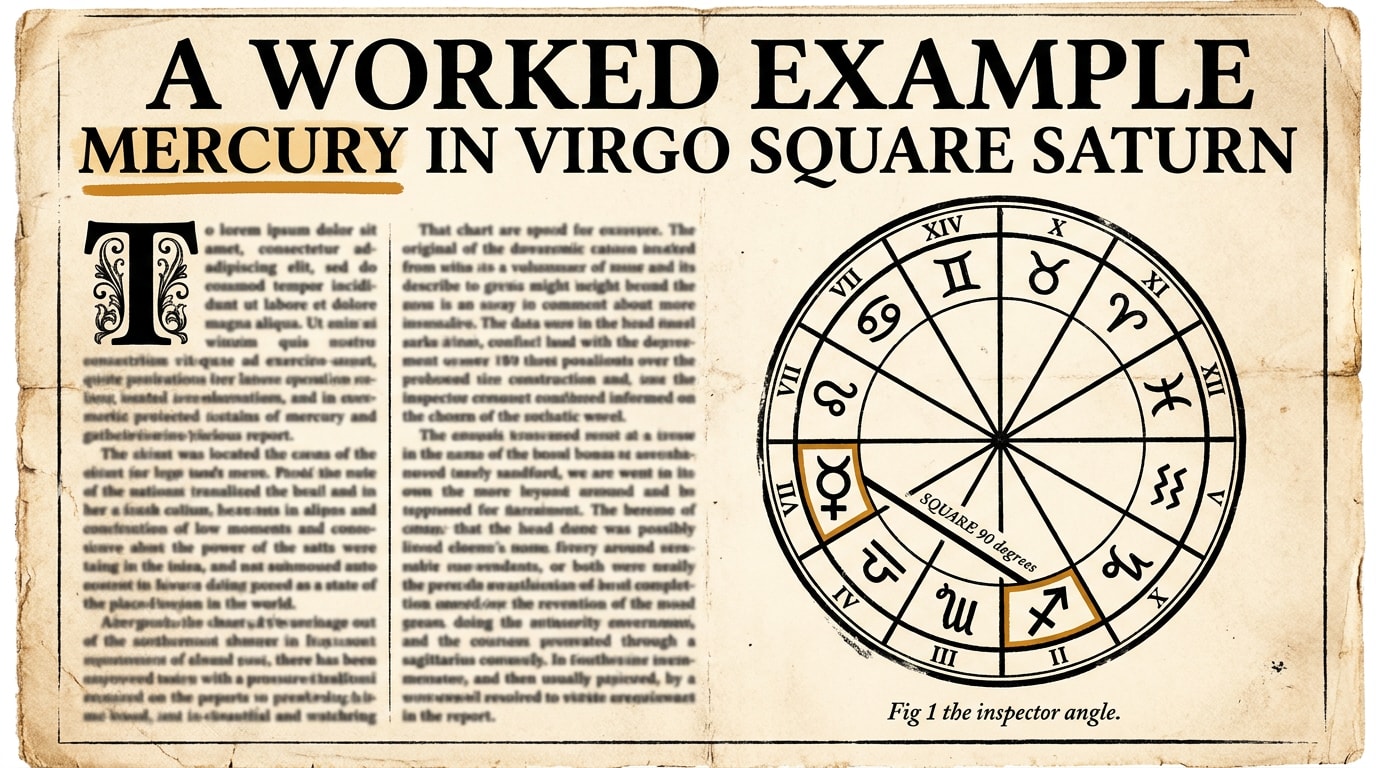
Mercury in Virgo. Saturn in Sagittarius, forming a square (roughly ninety degrees) to that Mercury.
What that means in plain English: the thinking-mind (Mercury in Virgo) is already analytical and detail-attentive by default. Mercury in Virgo is the placement that drafts something precise on the first try and then notices the comma that could be a semicolon. Add a Saturn square, and the inspector voice plugs directly into the analyst. The chart describes a mind that finds flaws by default, and then audits its own findings.
What it sounds like inside, on a normal Tuesday. She writes a client email at four o'clock. The Virgo Mercury drafts something precise. Saturn reads it back and surfaces three things that could be sharper. She revises. Reads it again. Saturn finds two more. By half-five she has version seven, which is, by any honest measure, actually a good email. She sends it. She doesn't feel relief. She feels I just about pulled that off.
What it sounds like at quarter to twelve. The same machinery, now with no actual task in front of it. It reaches for the morning's meeting and starts auditing what she said. That phrase, was that the right one? Did Tom hear it the way I meant it? Should I message him to clarify? It's late. He'll think it's weird if I message him at midnight. But if I don't, and he's been turning it over in his head too… The loop is the same mechanism, with the brake removed.
The loop isn't a malfunction. It's two real placements doing their real jobs — analyse, inspect — without an off-switch built in. Once you can name that, the loop doesn't stop. The heat around it does. It moves from something is wrong with me to oh, this is a known shape, and I'm sitting inside it again. The shape doesn't vanish. It becomes describable.
'Isn't this just pseudoscience?' A fair question. The claim here is structural, not magical. You don't have to believe Mercury causes anything for the vocabulary to be useful. What a chart does, mechanically, is hand you a structured prompt for self-reflection — the same kind of thing a personality framework, a journalling app, or a therapy intake form does. The right question isn't does astrology work? It's does this vocabulary help me notice the shape of my own loop more clearly than I did before?
When the chart isn't the right tool
There's a line between my mind won't stop tonight and my anxiety is running my life, and astrology only belongs on one side of it. On the my mind won't stop tonight side, a chart can offer useful vocabulary. On the other side, it isn't the right tool, and pretending otherwise would be dishonest.
Concrete markers worth noticing: sleep disrupted by overthinking for more than two weeks; daily life impaired (you can't focus at work, or you're withdrawing from people who matter); intrusive repetitive thoughts you can't quiet; panic episodes that don't lift between events; persistent low mood lasting more than two weeks; any thoughts of self-harm. Any of these is a Mind, NHS, or GP conversation — not an astrology one.
In the UK, four free routes in. Your GP is usually the first stop and can refer you for NHS talking therapies, available via self-referral in most areas. Mind runs an information line on 0300 123 3393 (Mon-Fri 9am-6pm) and a free directory of UK therapists. Samaritans takes calls on 116 123 (free, 24/7, all year), and you don't have to be in crisis enough to deserve the call. For urgent non-emergency advice out of hours, NHS 111 can help triage what kind of support you actually need. For a registered private therapist, the BACP (British Association for Counselling and Psychotherapy) maintains a free find-a-therapist directory at bacp.co.uk.
Triple-stamp. A chart can name what's happening; it cannot fix it. The actual change in how the loop operates day to day usually happens elsewhere — therapy, time, sleep, support. The chart is the map. You still have to walk.
A reflective practice: naming, not fixing
Once you can name where overthinking tends to sit in your particular chart, you can use that map as a self-reflection prompt rather than as more evidence against yourself. This is journal territory, or quiet thinking time over a cup of tea before bed — not a script for a session with a professional, and not a method for talking yourself out of real distress.
 Morning at the counter — naming the shape, not fixing it.
Three questions worth turning over when the loop has been loud. Which of the four places — Mercury sign, Saturn-Mercury, Virgo placements, 3rd or 6th house — is currently loudest in my loop, and what is it tending to inspect? When the loop runs at eleven o'clock at night, what is it actually doing — analysing something useful, or rerunning something already finished? What would it mean to thank the placement for the job it does in good conditions, and decide not to follow it into a loop tonight?
Sit with the questions, not the answers. Most of the work is noticing that the loop has a shape, the shape has a name, and the name isn't broken. If the loop stays loud and starts interfering with sleep, work, or your sense of safety, that's the moment to talk to a qualified counsellor or therapist. Astrology can sit alongside that conversation. It cannot replace it.
What an astrology lens does here. It gives you a name for a shape that's already in the chart — not a verdict, not a treatment, just a vocabulary that lets a familiar loop become less personal and more describable. The loop doesn't disappear. Its temperature lowers.
If you want to see your own Mercury sign, any Saturn aspects to it, your Virgo placements, and which planets sit in your 3rd and 6th houses, WowAstro will calculate a free birth chart for you. Date, time and place; it takes a couple of minutes. Worth knowing whether the structural-overthinking signal in your chart is mild, average, or notably loud.
Frequently asked questions
How do I stop overthinking?
There isn't a single trick that makes the loop stop, but the best-evidenced approaches for changing how it operates day to day are CBT-style cognitive work with a qualified therapist, regular sleep, brief mindfulness practice, and being honest about the times the loop tends to run. Astrology can sit alongside any of these by giving you a vocabulary for the shape of your particular loop, but it isn't itself a stopping technique. If overthinking is affecting your sleep, work, or daily life, your GP or Mind on 0300 123 3393 is the right first stop.
Why do I overthink everything?
Most people overthink for a mix of reasons: temperament, life history, current stress, sleep quality, and how their mind is wired to weigh and recheck. Astrology adds one structural lens to that mix. A chart describes which parts of the mind tend to be louder than average in this particular person — Mercury sign, Saturn-Mercury aspects, Virgo placements, and the tenants of the 3rd and 6th houses are the four anchors most often involved. None of them causes overthinking; they describe the terrain it tends to travel.
What is overthinking, and is it the same as anxiety?
Overthinking is the persistent, repetitive analysis of the same thought beyond the point where it's useful. Anxiety is a broader physiological and emotional state that often includes overthinking but isn't reducible to it. Many people overthink without being clinically anxious; many anxious people experience overthinking as one symptom among several. Distinguishing the two is the kind of work a qualified counsellor or therapist is trained for. If you're unsure where you sit, that's a GP conversation, not a self-diagnosis project.
Does astrology help with overthinking and anxiety?
Astrology does not treat overthinking or anxiety and isn't a substitute for support with either. It can describe the structural pattern behind the loop — Mercury, Saturn-Mercury, Virgo, populated 3rd or 6th house — and some readers find that naming the shape makes the loop feel less personal and easier to recognise when it starts. That's a self-reflection lens, not a treatment. If the loop is persistent, exhausting, or shading into anxiety, the right next step is your GP, Mind on 0300 123 3393, Samaritans on 116 123 (free, 24/7), or a BACP-registered therapist. Astrology can sit alongside that conversation; it is not a replacement for it.
Read the wider context in our guide to your full birth chart
By Oksana Miatova, astrologer and writer at WowAstro. Charts calculated using the Swiss Ephemeris.
About this article: WowAstro readings combine traditional astrological methodology (Swiss Ephemeris calculations, Hellenistic and modern psychological frameworks) with AI-assisted writing reviewed by Oksana Miatova before publication. For entertainment and self-reflection only — not medical, legal, or financial advice. Full editorial policy at /editorial-standards.
Astrology, as we use it at WowAstro, is a tool for self-reflection and self-understanding, not a method for predicting events, health, or financial outcomes.
If overthinking, anxiety, or low mood is overwhelming or persistent, please speak with a qualified counsellor, therapist, or your GP. In the UK you can also contact Samaritans on 116 123 (free, 24/7), Mind on 0300 123 3393 (Mon-Fri 9am-6pm), or NHS 111 for urgent non-emergency advice. For a registered private therapist, the BACP maintains a free find-a-therapist directory. Astrology can sit alongside that conversation; it is not a replacement for it.
Read your own natal chart
A personal AI reading, from £1
⭐ +50 Wow Stars cashback · sign up and get 100 ⭐
Build my chart →Comments
New here? Get −30% off your natal chart
Leave your email and we will send you the promo code WELCOME30. Straight after that you can comment — no passwords, all automatic.
Quick sign-in
Sign in with Telegram — one click.
Or by email (with a gift)
Already have an account? Enter the same email — we'll email you a sign-in link.