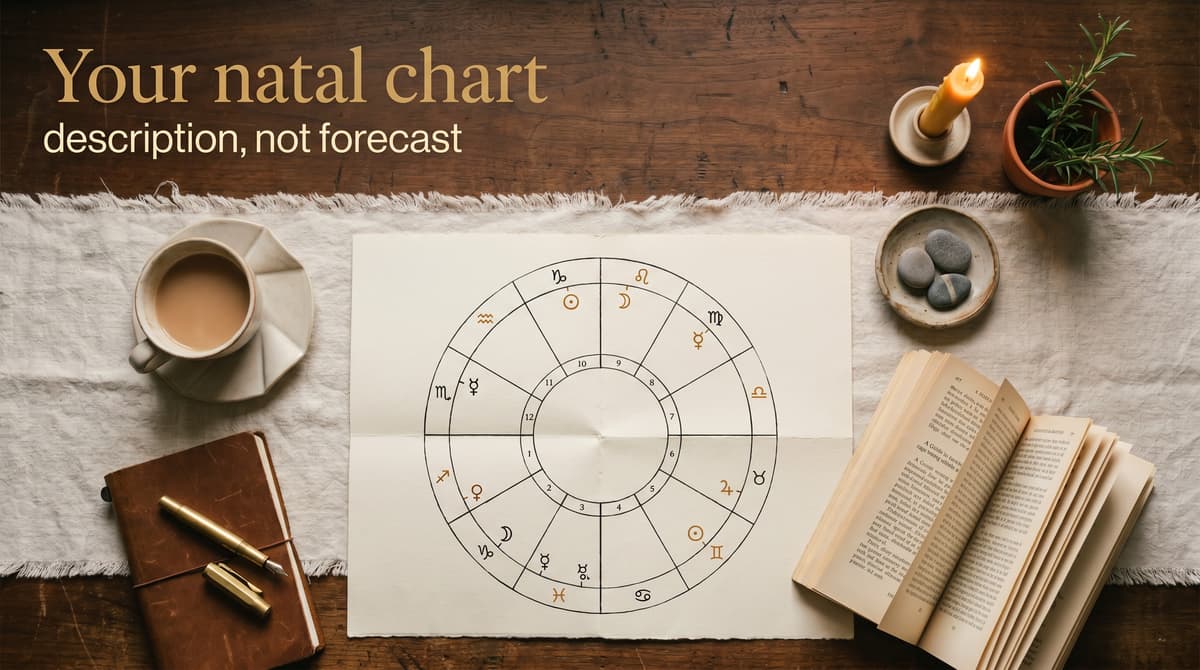
Your astrology rising sign, also called your Ascendant, is the version of you the room reads in the first thirty seconds before anyone has said a word. Door, surface, manner. People call it the mask, which is half right and half misleading. It isn't a disguise you chose. It's the visible part of you, already on the surface where strangers can read it.
Finding yours needs three things: your date of birth, your place of birth, and your time of birth, to the half-hour if you can. The first two are easy; the third is where this article does its honest work. Once you have it, the more interesting question follows: why does your rising sign matter at all when you already know your Sun? This guide answers both: what your rising sign is, how to find yours, and what it adds to the Sun-sign label you've been wearing since secondary school.
In short. Your astrology rising sign, also called your Ascendant, is the sign of the zodiac that was rising on the eastern horizon at the exact minute you were born. It describes the first impression you make on strangers: your manner, the visible style they pick up before they know you. To find yours you need your date, place and time of birth. Rising isn't the whole of you; it's the door other people walk through to reach you.
 sitting on step with coffee cup.
What an astrology rising sign actually is
Your astrology rising sign — astrologers also call it the Ascendant — is the zodiac sign that was rising on the eastern horizon at the moment of your birth, calculated from your date, time and place. The Earth rotates once every twenty-four hours, so the sign on the eastern horizon changes about every two hours. That's why birth time matters: a missed time can put your Rising in the wrong sign altogether. Sun, Moon and the Ascendant are the three placements traditional and modern astrologers consistently treat as the foundation of a chart read; WowAstro calculates yours using the Swiss Ephemeris, the same astronomical data professional astrologers rely on.
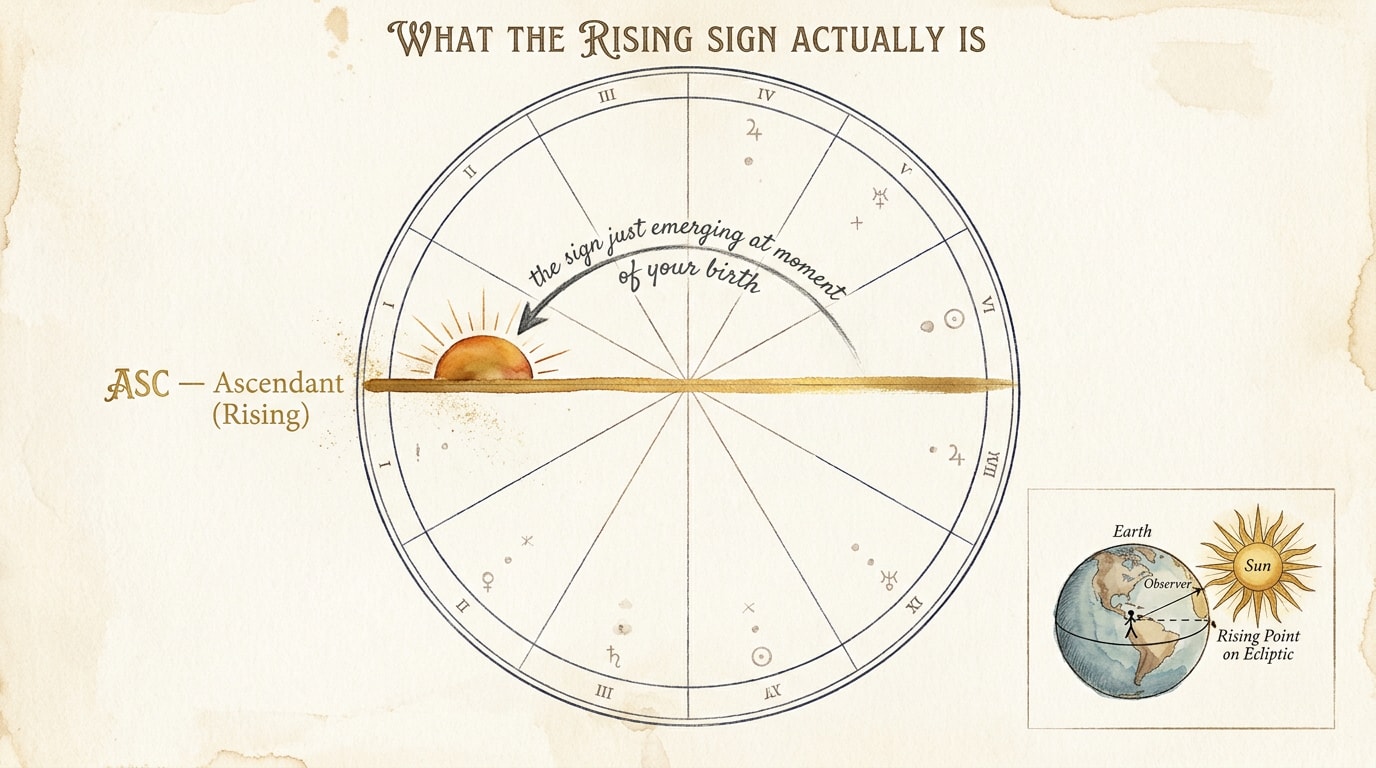
The Ascendant is the first layer most astrologers read because it carries a lot of signal for very little effort: it sets up the angles of the chart and decides which sign sits on the cusp of which house. It isn't a verdict and it isn't a forecast. It's the starting line of a longer read. For the full four-step way to read the rest of the chart once you've got your Rising, see our step-by-step walkthrough.
One honest note before we go further. Your rising sign is one placement of around ten in a Western birth chart. Reading only your Rising is reading a fraction of you: useful, but partial. The same is true of reading only your Sun. The chart starts to be interesting when several placements are sitting next to each other in the same room.
How to find your rising sign
To find your astrology rising sign you need three things: your date of birth, your place of birth, and your time of birth. Date and place are usually easy; the time is the variable that decides whether your Rising can be calculated reliably. The Ascendant shifts about every two hours as the Earth rotates, so a thirty-minute imprecision can be the difference between two adjacent Rising signs. Any astronomically-correct calculator (one using the Swiss Ephemeris or equivalent) will give you a reliable result once it has those three inputs. WowAstro does this free in two minutes.
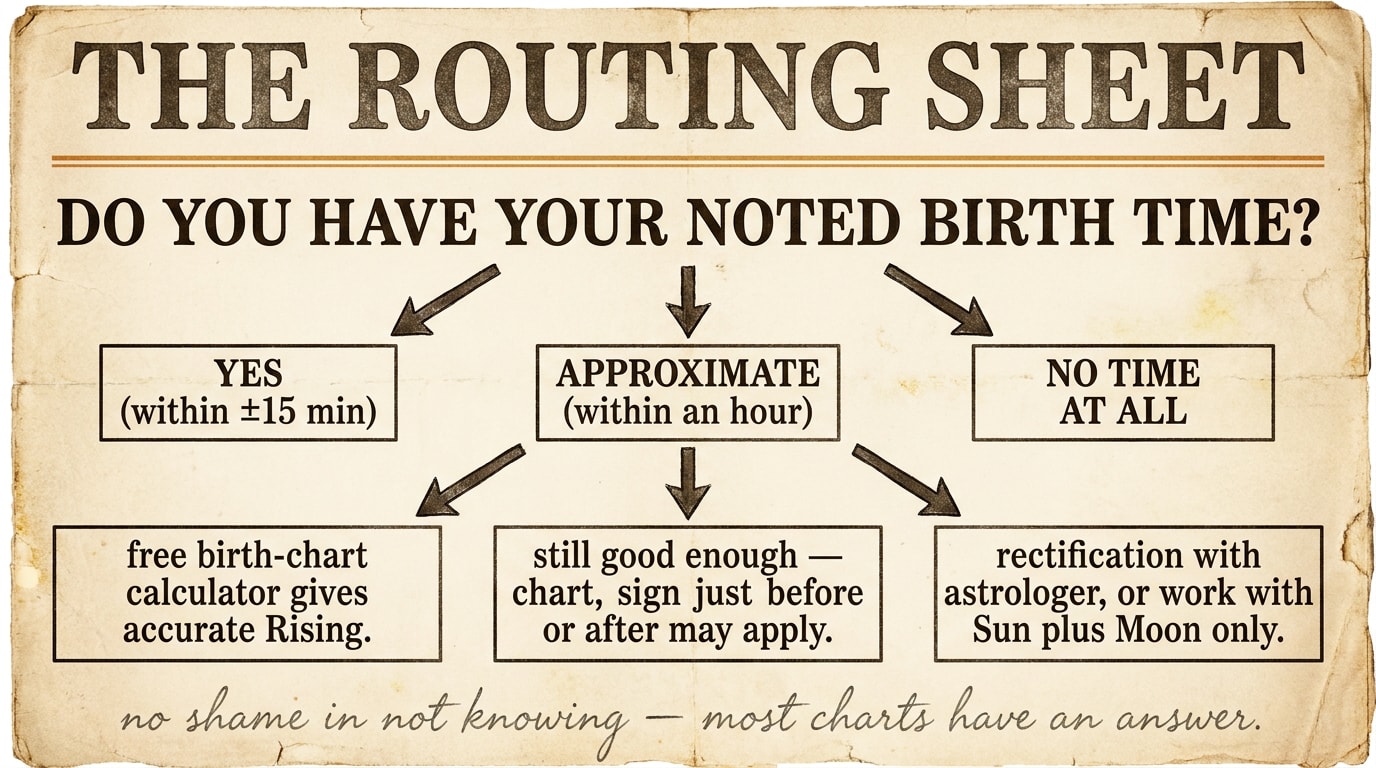
How accurate is accurate enough? Three honest cases.
If you have your birth time
If your time is noted to within fifteen minutes (most hospital birth records and UK birth certificates are), pull a free birth chart. You've got it. The result will sit confidently inside one sign and stay there even if your noted time is a few minutes out.
If you don't have your birth time
If you don't have a noted time at all, your Sun and Moon are still reliable; Rising is not. The Sun moves through about one zodiac sign per month and the Moon through one every two and a bit days, so date alone is usually enough for both. The Ascendant changes every two hours, so without a time it's effectively guesswork. Hospital records, baby books and birth certificates usually have the time noted; in the UK, the long-form birth certificate often includes it. Failing all of those, an astrologer can do something called rectification, which means working backwards from key life events to estimate your birth time. It's specialist work, not something a free calculator does for you.
If your time is approximate
If you have a time but it's approximate (your mother remembers it was "around five in the morning"), fifteen minutes either way is usually fine. Beyond about an hour, the Rising starts to drift between adjacent signs and is best treated as a best guess. If you're sitting near a cusp (within a few degrees of the boundary between two signs), rectification is worth considering.
The mask, honestly: what your rising sign actually describes
Your rising sign describes the social-greeting version of you: your manner, the style strangers notice first, the way you arrive in a room before anyone has heard you speak. It's the most visible layer of your chart. People often call this layer "the mask", which is half right and half misleading. A mask suggests a disguise you chose, something covering the real you underneath. The Ascendant isn't that. It's not chosen and it isn't covering anything; it's simply the visible surface you arrived with, already on the outside where others can read it. Read your Rising as a doorway, not as a deception: real, but partial.
 putting on coat to leave.
In one line. Your rising sign isn't the fake you and it isn't the whole you. It's the visible part of you, already on the outside where strangers can read it.
There's a useful timescale here. The Sun shows up over months and years, the slow direction your character grows along. The Rising shows up over seconds, the immediate impression a stranger picks up at a doorway. Two people with the same Sun sign can feel completely different in a first meeting because their Rising signs are doing different work. That's one of the reasons "I'm a Sagittarius" rarely captures the whole experience of meeting someone.
What each of the twelve rising signs means
Each of the twelve rising signs describes a different first-impression style. These descriptions are of the surface, the manner the room notices, not the whole personality underneath. Astrological tradition assigns each sign a quality (cardinal, fixed or mutable) and an element (fire, earth, air or water), and the rising sign carries those into the way you first appear: fiery Risings tend to register as direct, earthy Risings as measured, airy as quick and sociable, watery as receptive. Find yours below; read it as a sketch of the surface, not a verdict on the whole.
| Rising sign | What the room reads first |
|---|---|
| Aries Rising | Direct, energetic, slightly impatient; the room registers you before you sit down. |
| Taurus Rising | Steady, calm, unhurried; first impression is grounded reliability and an even voice. |
| Gemini Rising | Quick, talkative, restless; you read as bright and curious even when you're tired. |
| Cancer Rising | Warm, watchful, slightly guarded; people sense care in the room before they see it. |
| Leo Rising | Warm, generous, presentational; you take up confident space without much effort. |
| Virgo Rising | Neat, observant, slightly reserved; first impression is competent attention to detail. |
| Libra Rising | Poised, gracious, socially attuned; you read as easy, fair-minded company. |
| Scorpio Rising | Composed, watchful, hard to read; presence first, words later. |
| Sagittarius Rising | Open, breezy, forthright; you read as warm and approachable on first meeting. |
| Capricorn Rising | Composed, capable, slightly serious; the room reads you as grown-up in charge. |
| Aquarius Rising | Friendly but oddly self-contained; you read as interesting and a little apart. |
| Pisces Rising | Soft, attentive, slightly dreamy; people often can't quite place your manner. |
If yours doesn't match how you feel from the inside, that gap is normal, and it's the next thing worth understanding.
Why your rising sign isn't your sun sign
Your rising sign and your sun sign describe two different layers of you, not two competing answers about you. The Sun describes the core you're growing into over years; the Rising describes how strangers first read you in seconds. Most pop-astrology only knows your Sun sign because the Sun is calculated from date alone, and date is the only thing newspaper horoscope columns ever asked for. Your Sun and Rising can be in the same element and broadcast a consistent message, or they can sit in temperamentally different signs, which is why people sometimes say you're not what I expected once they've known you for a while. Rising isn't a contradiction of your Sun; it's a different question about you, answered by a different part of the chart.
Try it as a worked example. Picture a person with a Capricorn Sun and a Sagittarius Rising. The pairing is illustrative: a plausible combination, not a real person.
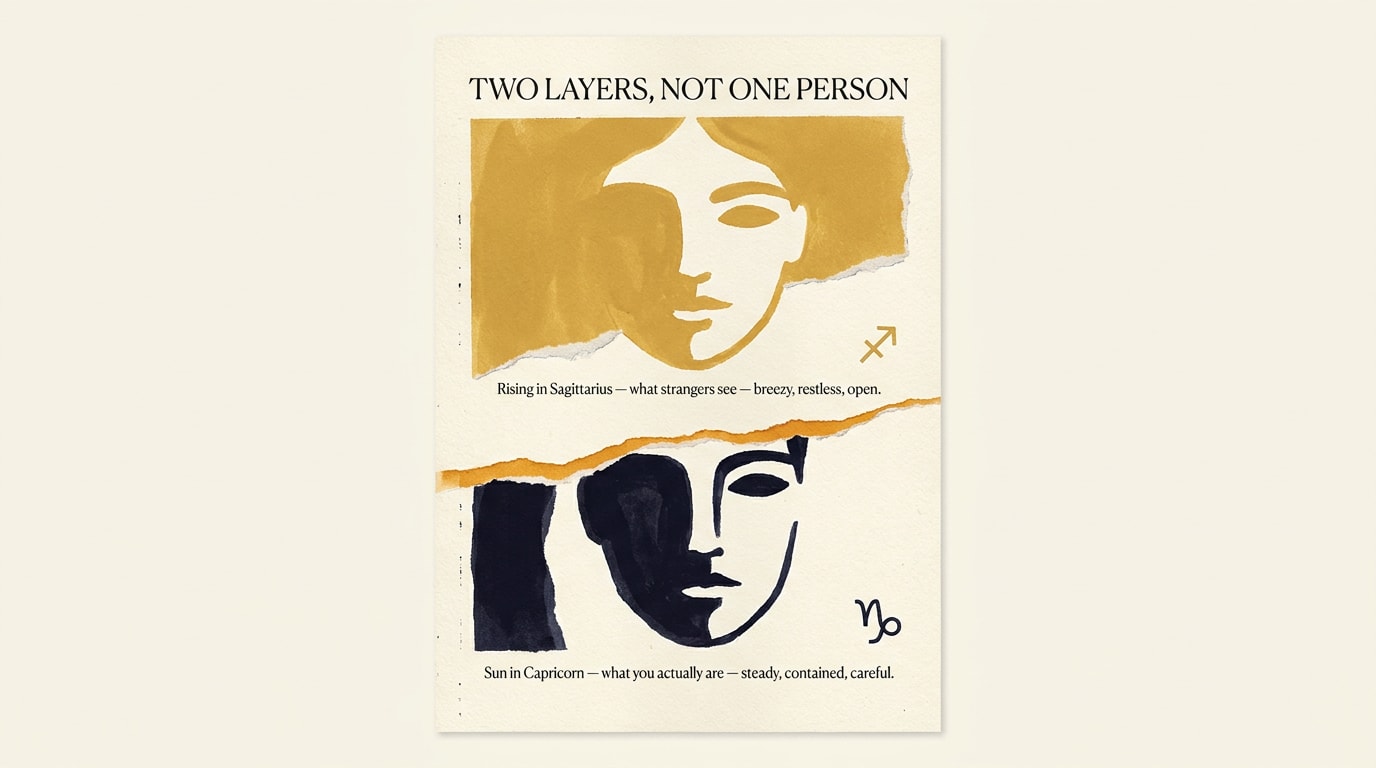
The Sagittarius Rising sets the surface: warm, breezy, forthright, the kind of person who makes small talk easily and tells you what they think within ten minutes. Underneath, the Capricorn Sun is doing slow, serious, structured work, building something with a long timeline, the kind of project that takes years and rarely gets mentioned at parties. Friends three years in may say I had no idea you were that ambitious. That's the gap doing its normal work: different layer, different timescale.
Neither sign is the "real" one. They describe two scales of the same person: the door (Sagittarius Rising) and the long climb behind it (Capricorn Sun). Your Moon describes a third layer, the interior emotional life you mostly keep private. If you'd like to read your Rising alongside your Sun and Moon, see our big three guide. And if that gap between visible Rising and growing Sun ever sounds, from the inside, like impostor syndrome, we wrote about that too.
What to do with your rising sign
Your rising sign is most useful as a prompt for self-reflection: a way of noticing the gap between how the room tends to read you and the self you know from the inside. It isn't a personality test to take, a verdict to obey, or a prediction of how things will go. It's a description of one visible layer. Used this way — as a prompt rather than a forecast — astrology sits comfortably with how modern Western practice positions itself and with how UK consumer guidance frames the field, which is entertainment and self-reflection.
 closing laptop, looking out window.
Try this. Find your rising sign (the easiest way is to pull a free birth chart). Read the description once, then sit with it for a week and notice the situations where it fits and the ones where it doesn't. That noticing, not the symbol on the page, is the actual work.
If you'd like to see your rising sign on your own real chart, WowAstro will calculate a free birth chart for you. Date, time and place is the whole input, and it takes a couple of minutes.
Questions readers ask
What is my astrology rising sign?
Your astrology rising sign, also called your Ascendant, is the sign of the zodiac that was rising on the eastern horizon at the exact minute you were born. It describes the first impression strangers form of you: your manner, your visible style, the way you arrive in a room before you've said anything. It's calculated from your date, time and place of birth. A free birth-chart calculator using the Swiss Ephemeris is enough to find yours; you don't need a paid reading for this first step.
How do I find my rising sign without my birth time?
The honest answer is you can't, reliably. The Ascendant moves on about every two hours as the Earth rotates, so without an accurate time the calculation is effectively guesswork. Your Sun and Moon are still reliable from date alone, but Rising needs a noted time to within about fifteen minutes. Hospital records, baby books and the long-form birth certificate usually have the time noted. If none of those exist, an astrologer can do something called rectification, which means working backwards from key life events to estimate the time. It's specialist work and not something a free calculator does for you.
Why is my rising sign different from my sun sign?
Because they describe two different parts of you, calculated from different things. Your Sun sign is calculated from your date of birth alone and describes the core you're growing into over months and years. Your rising sign is calculated from your time and place of birth and describes how strangers first read you in seconds. They can be in compatible signs (same element, broadcasting a consistent message) or in temperamentally different ones, which is why people sometimes say you're not what I expected after a few months of knowing you. Neither is more real; they answer different questions about you.
Does my rising sign matter more than my sun sign?
Neither matters more; they describe two different layers of you. Your Sun is the slow vector of your character; your Rising is the immediate surface. The Sun is closer to who you're becoming; the Rising is closer to how the room reads you on first meeting. A useful way to hold it: the Sun is the work, the Rising is the introduction. Pop-astrology mostly knows your Sun because newspaper horoscope columns only ever asked for your date of birth. That habit doesn't mean the Sun is the only thing that matters; it means the column wasn't asking enough questions.
Read the wider context in our guide to your full birth chart
A note on what this is. Astrology, as we use it at WowAstro, is a tool for self-reflection and self-understanding, not a method for predicting events, health, or financial outcomes. Read your rising sign as a description, take what's useful, leave the rest.
About this article: WowAstro readings combine traditional astrological methodology (Swiss Ephemeris calculations, Hellenistic and modern psychological frameworks) with AI-assisted writing reviewed by Oksana Miatova before publication. For entertainment and self-reflection only — not medical, legal, or financial advice. Full editorial policy at /editorial-standards.
Written by Oksana Miatova, astrologer and writer at WowAstro. Charts calculated using the Swiss Ephemeris, the same astronomical data working astrologers use.
Read your own natal chart
A personal AI reading, from £1
⭐ +50 Wow Stars cashback · sign up and get 100 ⭐
Build my chart →Comments
New here? Get −30% off your natal chart
Leave your email and we will send you the promo code WELCOME30. Straight after that you can comment — no passwords, all automatic.
Quick sign-in
Sign in with Telegram — one click.
Or by email (with a gift)
Already have an account? Enter the same email — we'll email you a sign-in link.