A Virgo sends her Libra colleague a proposal at 4:47 on a Thursday afternoon: "Final read. Going to client at six." Twenty minutes pass. He writes back: "Lovely. I do wonder if we should sit on it overnight — give Maya a chance to weigh in."
The cursor blinks. Sit on it overnight. What is that supposed to mean. She has read this proposal seven times — Maya has been across it since Tuesday — and the client is expecting it before close-of-play. Now there's a do wonder, and a give Maya a chance, as if the deadline is something he's negotiating with the air.
This is the Virgo-Libra dynamic on a Thursday afternoon. Nothing dramatic, no row to repeat afterwards. Just two slightly different operating systems for the question is this ready yet. The rest of this guide is about why adjacent signs aren't actually opposites (they share a boundary rather than an axis) and what the full synastry reveals about why Virgo-Libra either settles or stalls.
In short. Virgo and Libra are adjacent signs on the zodiac wheel, sitting at the boundary between the 6th house (work, refinement, self-improvement) and the 7th (partnership, fairness, the other). They aren't opposites and they aren't an easy aspect; they sit next to each other, 30° apart, sharing a transition rather than an axis. Compatibility tends to surface not as instant chemistry, but as a long negotiation about decision-speed and standards. Difficult, often. Doomed, rarely.
 A Thursday afternoon, mid-reply.
Are Virgo and Libra actually compatible?
Virgo and Libra sit directly next to each other on the zodiac wheel, 30° apart, which astrologers call a semi-sextile. Adjacency in astrology isn't an opposition. Opposition is the structural mirroring of signs that face each other across the wheel and answer one shared question from opposite ends. And it isn't a trine, the easy 120° angle where two signs flow into each other almost automatically. A semi-sextile is a transition. Virgo finishes a sequence; Libra begins the next one. The pair is shaped by what each is finishing and what each is beginning.
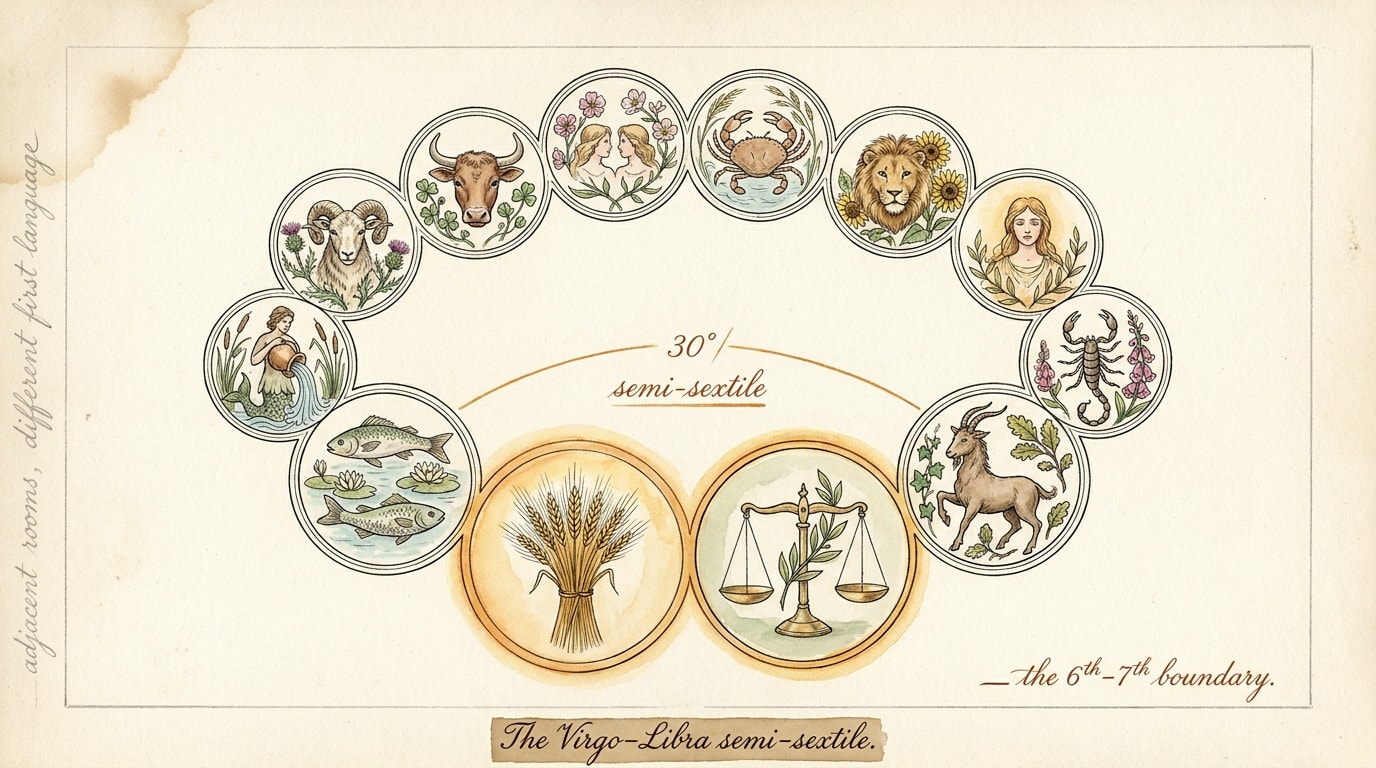
Virgo, the sixth sign of the zodiac, is mutable earth. It closes out the half of the wheel that's concerned with the self: the work, the body, the practical refinement of how a person actually lives. Libra, the seventh sign, is cardinal air. It opens the half of the wheel that's concerned with the other: the partner, the contract, the seat across the table. Between them is the boundary, the hinge point. That hinge is exactly what makes Virgo-Libra a real and slightly awkward pair. They aren't opposites in any meaningful astrological sense; they're neighbours. A full synastry, which compares ten placements each rather than two Sun signs, tends to show that the boundary matters more than either sign's apparent character.
| Virgo | Libra | |
|---|---|---|
| Mode | Mutable | Cardinal |
| Element | Earth | Air |
| Ruler | Mercury | Venus |
| House theme | 6th — work, service, refinement | 7th — partnership, fairness, the other |
| Sequence position | Closes self-half | Opens other-half |
The reason adjacent pairs feel less dramatic than opposite pairs, by the way, is that there's no shared axis to fight over. Virgo and Libra aren't locked into a single conversation from opposite ends. They simply meet at a doorway. One is leaving a room, the other is entering a new one, and the question is how much they're willing to notice the doorway is shared.
The 6th-7th boundary: from self to other
The 6th-7th house boundary is the line where the wheel turns from me, working on myself to me, turning toward you. In astrology, the 6th house describes daily work, service, the practical refinement of how a person actually lives: the desk, the habits, the next iteration of the spreadsheet, the quiet question of whether one's life is working. The 7th house describes the first real other: committed partnership, business partnership, the contract, the person you've chosen to consult before you decide.
Virgo lives the 6th-house theme as a default. Precision, usefulness, the next version of whatever's in front of her, the desire to make the work actually correct before anyone else sees it. Libra lives the 7th. The room. The other person's face. What is fair, what will land well, what will hold the relationship together. Both partners care about getting it right. They simply disagree about whether right is measured by the work itself or by the second opinion.
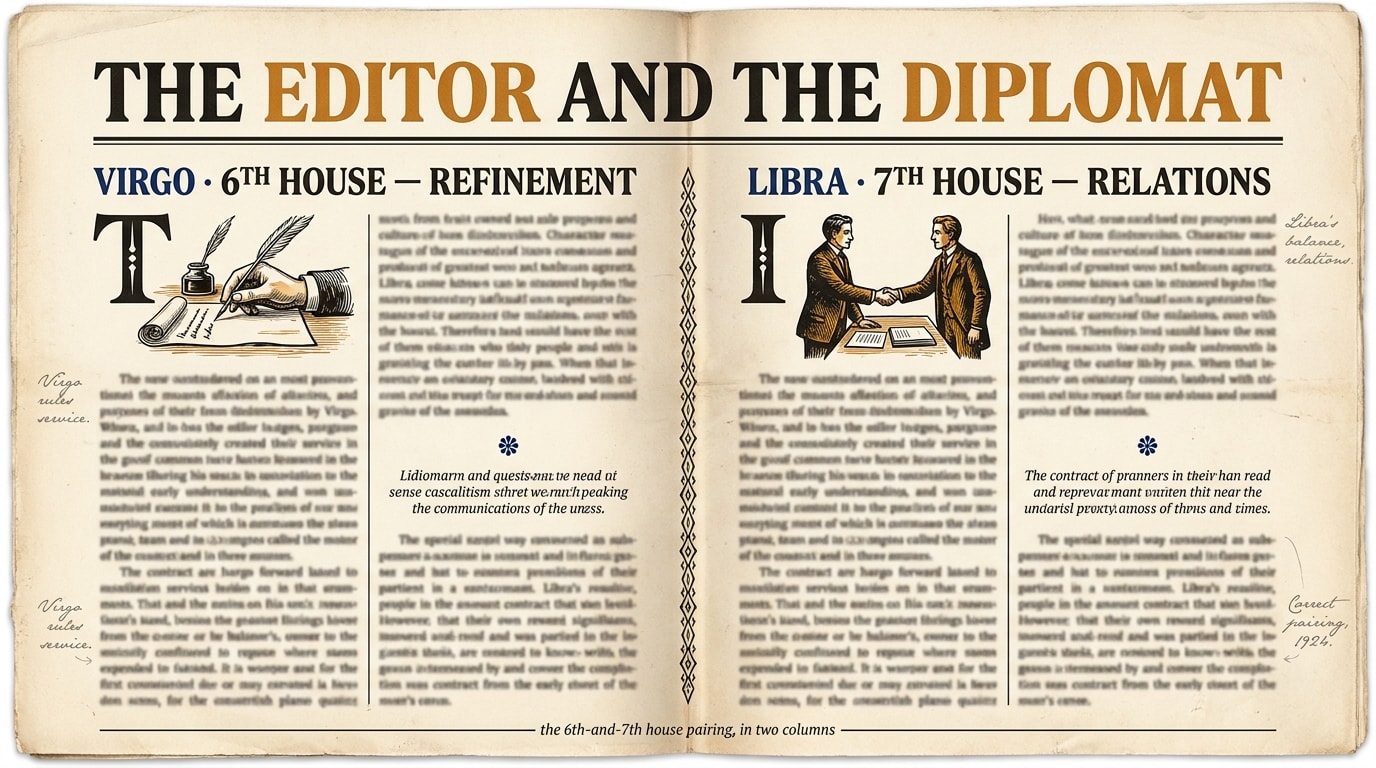
A metaphor that holds up. Virgo as the editor: reads the draft once more, fixes the comma, asks whether the third paragraph still earns its place, sends it back marked up because the work is going out under both names and the work has to be right. Libra as the diplomat: asks who else needs to read it, whether the tone will land with the senior partner, whether the second sentence should be softened so the recipient isn't put off before the request arrives. Both are about quality. One refines; the other harmonises. Neither is doing the other's job, and most of the trouble between them comes from each, briefly, deciding the other should be. (If you'd like a quick refresher on what Virgo and Libra are like as individual signs, the zodiac signs guide covers both.)
The Virgo who has decided the Libra "can't make a decision" is describing the diplomat from the editor's chair. The Libra who has decided the Virgo "can't stop tinkering" is describing the editor from the diplomat's table. Neither is wrong about the surface — both are missing what the other is for.
Mutable earth meets cardinal air: the decision-speed problem
Virgo is mutable earth, Libra is cardinal air, and the most consistent friction between them isn't values; it's speed. In astrology, the twelve signs divide into three modes: cardinal (initiators), fixed (holders), mutable (adjusters). Virgo adjusts. Libra initiates. Cardinal signs raise the question and want a decision in the room; mutable signs revise the answer one more time, then once more, looking for the better version.
Back to Thursday afternoon. The Virgo wants to send the proposal because she has worked it. Seven reads. Maya's notes folded in. The thing is ready, in her view, because she's the one who has done the work of making it ready. The Libra wants to consult one more person because that's how a fair decision is made in his view. Not because he doubts the work — because the decision has weight, and weight is something you carry collectively in his world. Neither is wrong. They're using two different methods to reach the same intended endpoint: something good, that lasts.
The shift that helps in practice is small and unromantic. Both partners name the decision-rhythm out loud. The Virgo says: "I want one more revision, then I'm sending it." The Libra says: "I want one more conversation with Maya, then I'm in." Now both timelines are visible. The relationship isn't trying to negotiate without knowing what either party is actually trying to do. It turns out most fights weren't about the proposal at all — they were about the silent assumption that the other person's rhythm was just stalling or just rushing. (If you've spent four days on a restaurant choice that ought to have taken nine minutes, by the way, you're not unusually indecisive together. You're doing mutable-earth-cardinal-air astrology more or less to the textbook. Now please someone book the restaurant.)
Mercury and Venus: the shared intelligence they don't realise they have
Virgo and Libra share something most adjacent pairs don't: the same broad intelligence region. Virgo is ruled by Mercury, the planet of mind and analysis. Libra is ruled by Venus, the planet of relating and aesthetic judgement. These two rulerships are next to each other on what astrologers call the personal-planet set; Mercury and Venus are the inner planets, the ones that sit closest to the Sun and shape the everyday flavour of how a person thinks and connects. They aren't enemies. They're functions of the same thinking-relating capacity.
Virgo notices what's wrong. Libra notices what's beautiful. Virgo edits the sentence; Libra reframes the sentence. Both are at work on the same paragraph. When the partnership goes well, both partners realise their tools are complementary rather than in conflict, and the work gets done in a way neither would manage alone. Three small scenes, to show the shape of it.
A Saturday morning. The Virgo is redrawing a kitchen layout, again, because the dishwasher and the corner unit are six centimetres at war and someone has to mind the gap. The Libra walks in, looks at the drawing, and says: "What if the table sat under the window. Then guests want to be in this room rather than just pass through it." The Virgo had not been thinking about guests; she had been thinking about clearance. The Libra had not been thinking about clearance; he had been thinking about the room as a place people would want to sit. The kitchen ends up working — properly working, in both senses.
 Listening, mid-sentence, mid-thought.
A Wednesday evening. The Libra is about to send a slightly awkward email to a colleague who has missed a deadline. He's drafted three versions, each more carefully worded than the last. The Virgo reads it over his shoulder. "The second sentence is doing the actual harm," she says, and rewrites it in plainer language. The email goes. The colleague replies within an hour, embarrassed and grateful. The Virgo wasn't being more diplomatic than the Libra — she was noticing where the mechanics of the sentence had gone wrong. He had been protecting the relationship; she was protecting the meaning. They had been working on the same paragraph all along.
A difficult dinner. Both at home. The Virgo manages the practical mechanics — drinks topped up, the slow guest gently included, the casserole timing. The Libra manages the social mechanics — who is talking to whom, when to change the subject, when to bring the quieter guest back in. The evening doesn't actually work without both of them, and they both know it, even when they don't say so.
A worked example: reading one Virgo-Libra synastry
Most compatibility guides explain the symbols and leave you to assemble them. Here's one chart, end to end. The two people below are illustrative, not a real couple — just a plausible pair of charts that show the moves.
Partner A (the Virgo): Sun in Virgo, Moon in Scorpio, Venus in Leo, Mars in Gemini, Rising in Capricorn. Partner B (the Libra): Sun in Libra, Moon in Pisces, Venus in Scorpio, Mars in Aquarius, Rising in Cancer.
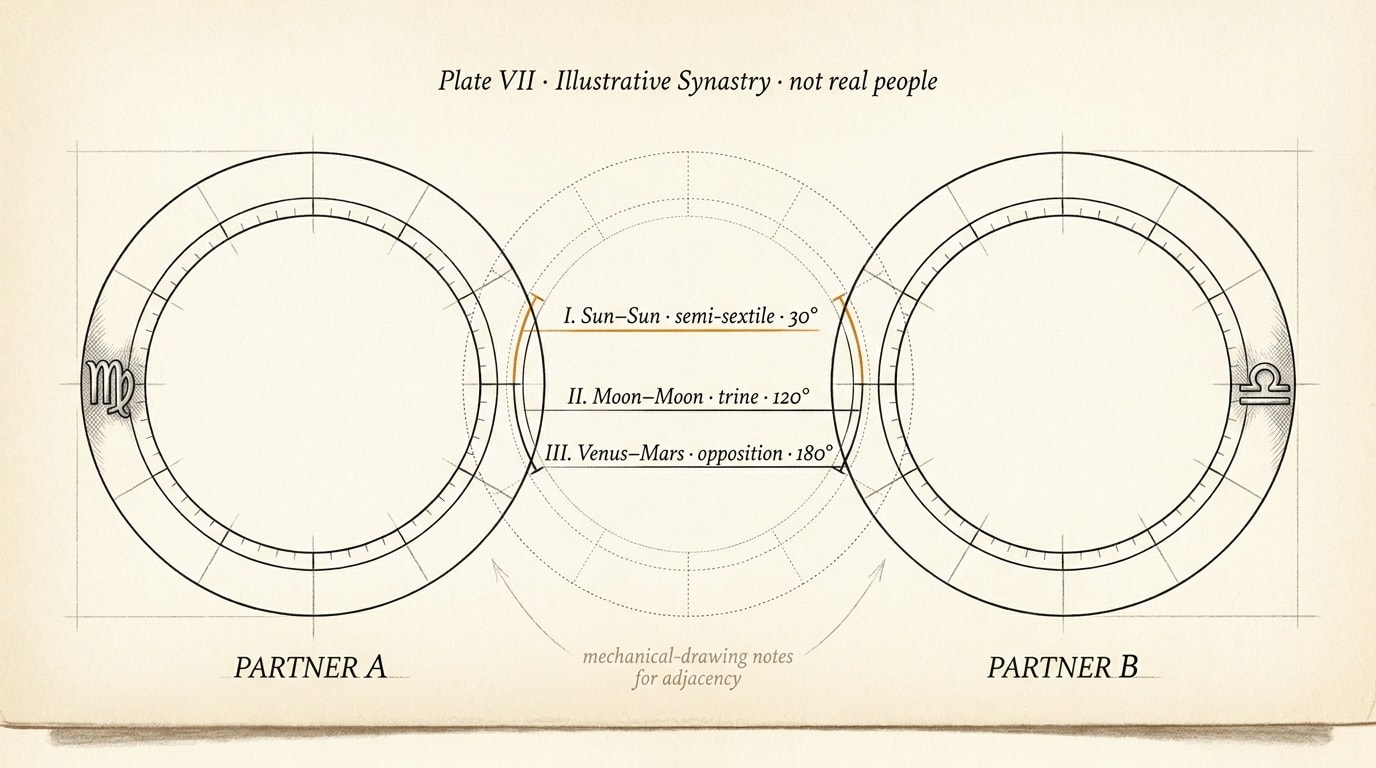
Start with the Suns. Virgo 15° to Libra 12° is the adjacency the rest of this guide has been about: a Sun-Sun semi-sextile, the precise 27° step from one sign into the next. Each one stands at the boundary of what the other is finishing or beginning. There's no automatic chemistry pulling them together and no automatic friction pulling them apart. What's there instead is the conscious negotiation of two signs that need to decide the relationship is interesting, rather than be told by the planets that it is.
Now the Moons. Scorpio Moon at 8° meeting Pisces Moon at 8° is an exact 120° trine, water to water. Where the Sun-Sun adjacency creates the conscious daily negotiation, the Moon-Moon trine creates an unconscious we get each other underneath it. He intuits when she's upset before she's named it; she knows when he needs to be left alone with a thought. The emotional rhythm is the part of the relationship neither of them has to work at, and a Virgo-Libra pair with a quietly flowing Moon connection often finds that the daily mood is the easy part, even when Thursday-afternoon decisions are the hard part.
Venus to Mars, a louder line. Partner A's Venus in Leo at 10° opposite Partner B's Mars in Aquarius at 12° is a close 2° opposition: a live current between aesthetic style and bold action. She's drawn to the unconventional moves he makes (the trip suggested at 11pm, the resignation letter delivered on principle). He's drawn to her warmth, the way she fills a room when she chooses to. They will argue about taste, repeatedly, and the argument will be charged in the way Venus-Mars oppositions are: pulled together and held in tension simultaneously.
House overlays do the structural work. Partner A's Virgo Sun falls into Partner B's 3rd house. To him, she reads as a sister-figure, a thinker, someone you talk things through with; the colleague-tone is built into the relationship from the first conversation. Partner B's Libra Sun falls into Partner A's 10th house, the house of public role and career. Over time, being with him changes how she shows up in the world. She becomes softer in tone with colleagues, more attentive to the room, more willing to take the slower decision. Ascendants: Capricorn Rising and Cancer Rising sit in opposition, which is to say their first-impression speeds are opposite. Capricorn reads guarded and formal; Cancer reads warm and immediately invested. Recognition is real but slightly awkward at first. She comes across more reserved than her Sun would suggest; he comes across more personally available than his.
What this read tells us. A Virgo-Libra pair with this synastry has a real working engine. The Sun-Sun semi-sextile gives them the conscious negotiation about pace. The Moon-Moon trine gives them the silent emotional rhythm that survives the negotiation. The Venus-Mars opposition gives them the live charge that keeps them interested in each other across years. The house overlays (her reading to him as a thinker, him reading to her as a public mirror) give the relationship two clear functions. None of this is "compatible" or "incompatible". It's the shape of a particular relationship.
 The structural negotiation, paused.
How to know if your Virgo-Libra is working
The difference between a healthy Virgo-Libra pairing and a stuck one isn't whether the partners argue, but whether they have stopped naming what they're each finishing and what they're each beginning. Stuck pairs read the other's method as a flaw. The Virgo decides the Libra "can't make a decision"; the Libra decides the Virgo "can't stop tinkering". Each has fixed the other as the problem, and the doorway between them — the boundary the whole pairing is built on — has been quietly closed.
Healing happens when both name the rhythm. I want one more revision, then I'm done. I want one more conversation, then I'm in. The gap between those two sentences becomes a working space rather than a verdict. Couples in the long form of this pair tend to say the same line in different words: we still slow each other down in exactly the way we did at the start, but we've stopped reading the slowdown as personal. The test isn't whether the friction goes away. It's whether the friction stays the question, or starts feeling like the answer.
If you'd like to see this on your own charts rather than an illustrative pair, WowAstro will run a full synastry for both of you using the Swiss Ephemeris, the same astronomical data working astrologers use. Date, time and place of birth for both; it takes a couple of minutes.
Questions readers ask
Are Virgo and Libra compatible?
Often, but not in the way sun-sign listicles suggest. Virgo and Libra are adjacent signs on the zodiac wheel, sitting 30° apart at the boundary between the 6th house (work, refinement) and the 7th (partnership, fairness). The compatibility tends to be a long, conscious negotiation about decision-speed and standards, rather than instant chemistry. Both signs share Mercury-Venus rulership at the level of personal planets, which gives them a shared intelligence region they don't always realise they have. Plenty of Virgo-Libra couples last well; plenty don't. The pairing rewards naming the difference rather than fixing it.
What attracts a Virgo to a Libra?
Usually the diplomatic angle. Virgo notices what's wrong; Libra notices what's beautiful. To a Virgo who has spent the week editing, the Libra arrives with a sentence that reframes the whole paragraph and makes the work feel finished rather than fixed. Virgo is also drawn, often quietly, to the social grace Libra extends without thinking about it: the way the room steadies when the Libra walks in. The risk is mistaking that grace for agreement; Libra is doing diplomacy, not capitulation, and the Virgo who reads it as the latter will be confused later.
Why do Virgo and Libra argue so much?
Mostly about decision-speed, not values. Virgo is mutable earth: adjusts, revises, wants the next iteration before committing. Libra is cardinal air: initiates the question, weighs the room, decides. The Virgo experiences Libra's "let me consult one more person" as indecision; the Libra experiences Virgo's "let me revise once more" as the same thing in a different costume. Both are trying to reach the same endpoint, a good thing, that lasts, through opposite methods. Once both partners name the rhythm out loud, the argument stops being about character and becomes about timing.
Do Virgo and Libra make a good marriage?
They can, if both partners treat the difference between them as the work rather than the problem. The long-form Virgo-Libra marriage tends to settle into a working division of labour where Virgo manages the practical mechanics and Libra manages the relational mechanics (bills and standards versus people and tone) without either reading the other's role as easier. Marriages that struggle tend to be ones where one partner has quietly decided the other's strength is a flaw. There is no astrological verdict on whether a particular Virgo-Libra marriage will last; the chart only describes the dynamic both partners are working with.
A note on what this is. Astrology, as we use it at WowAstro, is a tool for self-reflection and self-understanding, not a method for predicting events, health, financial outcomes or whether a relationship will last. Read a synastry chart as a description of a dynamic, take what's useful, leave the rest.
Written by Oksana Miatova, astrologer and writer at WowAstro. Charts calculated using the Swiss Ephemeris, the same astronomical data working astrologers use.
See what your charts say about each other
A personal AI synastry reading — not a sun-sign table, but an analysis of both natal charts across 8 areas of the relationship
Comments
New here? Get −30% off your natal chart
Leave your email and we will send you the promo code WELCOME30. Straight after that you can comment — no passwords, all automatic.
Quick sign-in
Sign in with Telegram — one click.
Or by email (with a gift)
Already have an account? Enter the same email — we'll email you a sign-in link.