Mara has saved eighty-seven pins to a Pinterest board called "taurus tat ideas". Glyphs. Bull heads. A long-horned silhouette in fine line. Constellation maps with a small clump of stars. Roses with a small symbol curled inside the petals. The Roman numeral II. A pair of peonies. A minimalist cow face. Her appointment at a London studio is next Thursday, and she is no closer to knowing what she actually wants.
Here is the honest reason the pins won't add up. "Taurus astrology tattoo" isn't one design question; it is three layered ones, and the Pinterest grid mixes the layers without telling you which is which. There is the glyph itself, the small condensed mark astrologers have been writing for centuries. There is the symbol set that Venus, the planet that rules Taurus, has gathered around itself across history. And there is the personalising layer that only your own birth chart can answer. Pull the three apart and choosing becomes easier — often a quieter design than the loudest pin on the board.
In short. A Taurus astrology tattoo lives in three layers. The glyph ♉, the symbol astrologers have written for the sign since the Hellenistic period, derived from an older bull-head pictograph. The Venus-ruled symbol set — rose, lotus, dove, mirror, swan, the things Western tradition has long associated with Taurus's ruling planet. And the constellation itself in the night sky, with Pleiades (the seven-sister star cluster in the Bull's neck) and Aldebaran (the bright red star marking the Bull's eye). A fourth question sits behind the three: where Taurus actually lives in your chart, not just on the sun-sign label.
 Eighty-seven pins, no clearer than at pin one.
The glyph itself ♉
The ♉ glyph is a stylised bull's head, two horns curling over a circle — and astrologers have been writing it in some form since the Hellenistic period. Open any sixteenth-century European astrological manuscript and the shape is already recognisable. Its current Unicode point is U+2649, which means it is now also one of the few three-thousand-year-old symbols that copies and pastes cleanly into a tattooist's design file.
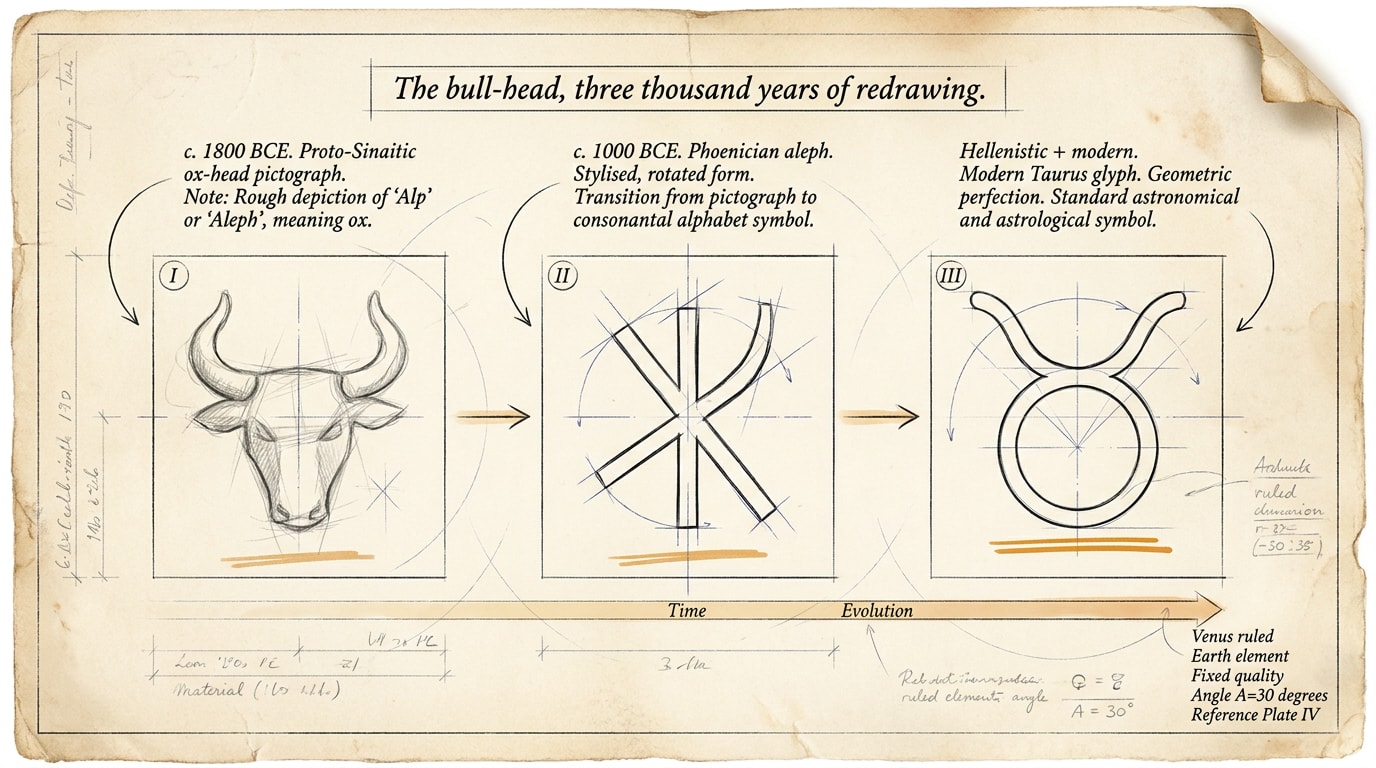
The glyph's older ancestry is genuinely interesting and slightly looser than the modern Unicode entry suggests. Palaeographers have noted that the Phoenician letter aleph (the first letter of the alphabet, ancestor of Greek alpha and Latin A) was originally an ox-head pictograph, drawn with two horns curving outward, flip a printed Α upside down and you can still see the shape. Whether the modern astrological ♉ descends directly from that pictograph, or arrives independently from a separate bull-head visual tradition, is a question palaeographers still discuss. What is solid: a stylised bull-head as celestial figure predates the modern glyph by millennia. Mesopotamian astronomical tablets from around 2100 BCE name the Bull of Heaven (GU.AN.NA), and the same star pattern has been read as a bull in unbroken continuity ever since. Some archaeoastronomers have even proposed that the bulls painted in the Lascaux cave in southern France around seventeen thousand years ago already mark the same Taurus star pattern — a hypothesis interesting enough to mention, speculative enough not to print on your arm as fact.
As a tattoo, the glyph is the most condensed astrological mark you can make. Small, legible to anyone who knows the symbol, invisible to anyone who doesn't, equally good behind the ear or on the inside of a wrist. If you want a Taurus tattoo that doesn't announce itself, this is it.
Venus and the symbol set
The reason a Pinterest board for "Taurus tattoo" is half flowers and birds and not just bulls is that Taurus is ruled by Venus in the Western tradition, and Venus's symbol set is the source of most of the soft, non-bull Taurus motifs. Western astrology assigns each sign to a ruling planet; Venus rules Taurus (its earth, sensual, fixed expression) and Libra (its air, relational, cardinal expression). The Venus correspondence-set is consistent across Hellenistic, medieval Arabic and modern Western lineages, and Nicholas Culpeper's "Complete Herbal and English Physician" (1652) lists most of the recognisable English-tradition Venus correspondences in one place.
The set that turns up most often in tattoo work:
| Symbol | Tradition | As a tattoo |
|---|---|---|
| Rose | Venus's flower across Greek, Roman and medieval European canon; Aphrodite's blossom in Greek myth | A single stem rose paired with the glyph — the most-used non-bull Taurus design |
| Lotus | Venus's flower in older Hellenistic-Egyptian syncretic texts (Isis assimilated to Aphrodite) | Less Western-traditional than the rose; more common in modern minimalist tattoo work — clean shape, less visually busy |
| Dove | Venus's bird in the Greco-Roman canon, drawing Aphrodite's chariot | A small dove or silhouette next to the glyph marks the Venus layer without spelling it out |
| Venus glyph ♀ | The circle-and-cross astronomers and astrologers still use for the planet | Pair ♉ and ♀ to mark the ruler-and-ruled relationship in two characters — small, precise |
| Swan, sweet herbs, honey | Quieter Venus correspondences | A swan's neck spiral or a small honeybee paired with the glyph picks up the Venus thread less obviously |
A rose, a dove or a lotus on a Taurus is rarely random. It's the Venus layer, the planet your sign answers to — showing up in the design.
The constellation itself
The third layer is the easiest to draw badly and the most rewarding to draw well. The Taurus constellation in the night sky carries two distinct visual landmarks that work as tattoos in their own right: the Pleiades, a tight open star cluster of seven sisters in the Bull's neck, and Aldebaran, the bright red star that marks the Bull's eye.
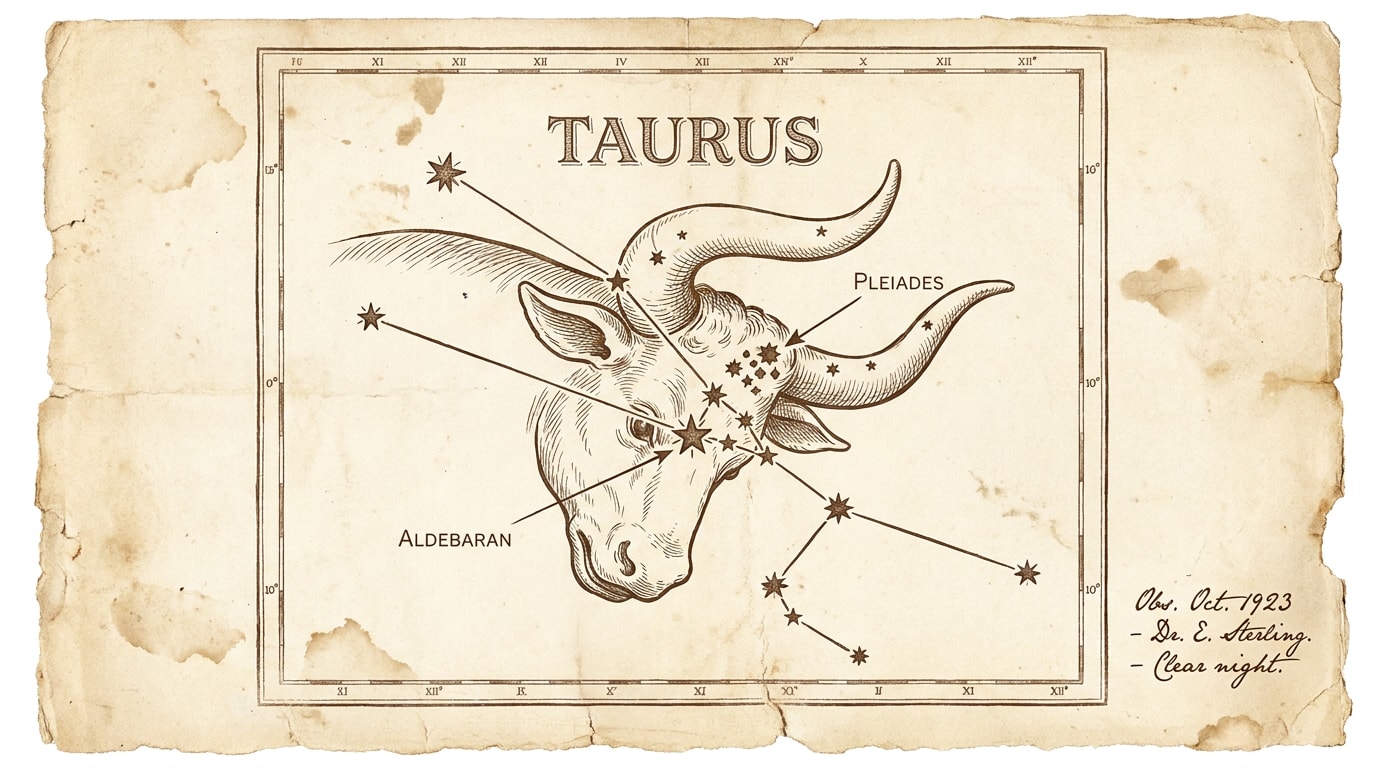
Pleiades, catalogued by Charles Messier in 1771 as M45 — is one of the closest open star clusters to Earth, roughly 440 light-years away, with seven to nine stars visible to the naked eye depending on sky conditions. Greek myth named them the Seven Sisters, daughters of Atlas and the sea-nymph Pleione, immortalised in Hesiod's "Works and Days" around 700 BCE as a calendar marker (their rising in spring meant it was time to plant; their setting in autumn, time to plough). In British skies, the Pleiades are visible to the naked eye from late November through early March, sitting clearly above the eastern horizon in the early evenings, a small misty patch you can find before you find Orion's belt.
Aldebaran, the bull's eye, is a different kind of star altogether: α Tauri in modern astronomy, a K5 red giant about sixty-five light-years away, the fourteenth-brightest star in the night sky. Its colour is a warm red-orange even to the naked eye, and on a clear winter night it sits unmistakably bright at the bottom edge of the V-shape that forms the Bull's face. As a tattoo, a single slightly larger dot among the Pleiades cluster's smaller dots reproduces what the eye actually sees in the sky — accurate, quiet, and unlike any of the bull-head pins on the Pinterest board.
The Bull of Heaven itself is older than the Greek myth: Mesopotamian astronomical tablets from around 2100 BCE record the constellation under the Sumerian name GU.AN.NA, and the Epic of Gilgamesh has Ishtar send the Bull of Heaven to punish Gilgamesh in a famous scene from Tablet VI. Taurus is, by most reasonable measures, the oldest constellation in continuous use anywhere on the planet. A constellation tattoo isn't just a star map; it's also one of the longest unbroken lines of cultural attention you can wear.
 The chart printout goes in your pocket before the reference images do.
What a tattoo can and can't claim. A Taurus tattoo commemorates a chart placement; it doesn't activate one. The tradition behind every symbol here, the glyph, the Venus correspondence, the constellation — is a language of symbolic association, not pharmacology. A rose on your wrist is not "working" on your Venus; it is honouring it. The distinction matters because plenty of tattoo studios and crystal-adjacent retailers blur it, and a permanent mark deserves clean language about what it is.
The personalising layer
A "Taurus astrology tattoo" search quietly assumes Taurus is your Sun, but Taurus might live somewhere else in your chart entirely, and if it does, that placement is often the more interesting answer to the design question than the sun-sign label. Every birth chart has ten planets (the Sun, the Moon, Mercury, Venus, Mars, Jupiter, Saturn, Uranus, Neptune, Pluto) each sitting in one of the twelve signs, and your Rising sign — the sign on the eastern horizon at the moment you were born, is set by your exact time of birth. Taurus can sit on any of those positions, and each one suggests a slightly different design.
A few short prompts, less prescription than orientation.
| Placement | What it describes | Design suggestion |
|---|---|---|
| Sun in Taurus | Core sense of self in the steady-grounded register | The glyph alone — it doesn't need anything extra |
| Moon in Taurus | Emotional weather: settled, food-loving, slow to move, soothed by familiar things | A small crescent moon paired with the glyph |
| Venus in Taurus | Venus in its own sign of rulership (old astrologers called this Venus "in dignity") | A rose, a lotus or the Venus glyph ♀ paired with ♉ |
| Mars in Taurus | Physical drive moves slowly, steadily, sensually rather than at a sprint | Horns or a confident bull head — the bull as a body, not just a symbol |
| Rising in Taurus | Others read you as grounded and physically present before knowing anything else about you | The constellation pattern, read as a body in the sky rather than a symbol |
Knowing which of these you have changes which design is yours rather than vaguely "Taurus". A reader with Sun in Taurus and nothing else might wear the glyph and stop there. A reader with three Taurus placements has more material to work with, and probably a more layered tattoo at the other end of it.
If you're booking one in the UK
A handful of practical pointers if you've decided which Taurus design you want and now you want to find a UK studio that will do the work well. Most of this is dull and useful, which is the usual register for advice that isn't trying to sell you anything.
Where to look. London concentrates the country's fine-line and astrologically-aware tattoo work in a few well-known studios, Frith Street Tattoo in Soho (established 1989, classic and fine-line), Sang Bleu London in Dalston (high-end fine-line, geometric, astrologically-literate), and a dozen or so independent studios in Hackney and east London. Outside London, Sacred Electric in Manchester is well known for botanical and fine-line work, and Forevermore in Bristol for minimal dotwork. Edinburgh, Brighton and Leeds each have a small handful of fine-line specialists. A useful search phrase is "fine-line tattoo studio + your city" rather than "zodiac tattoo" — the former returns craft-led studios, the latter returns Pinterest boards.
What to take to the consult. A print-out of your birth chart (any free chart calculator will produce one in a couple of minutes); three to five reference images you actually like, not your whole Pinterest board; the size and placement you have in mind, or a willingness to let the tattooist suggest one. A good astrology-aware tattooist will ask which placement you're commemorating; bringing the chart is the answer to that question before it is asked.
What to ignore. Studios advertising "manifestation tattoos", "energy-activation tattoos", "chakra-aligned ink" or anything that promises a tattoo will do something to your life are leaning on marketing language, not tattoo-craft language. A good tattooist designs and executes a symbol. What the symbol means to you is between you and your chart. The studio chooses how to draw it; the meaning is yours.
From the sun-sign label to your full Taurus chart
A Taurus astrology tattoo search assumes Taurus is your Sun, but the more interesting question, the one that turns a generic "Taurus tattoo" into a tattoo only you would wear — is where Taurus actually sits in your chart. Sun, Moon, Venus, Mars, Rising; any of those is a real reason to wear the mark, and each one slightly changes which version of the design fits.
 A few years on, it sits with you like a wedding ring.
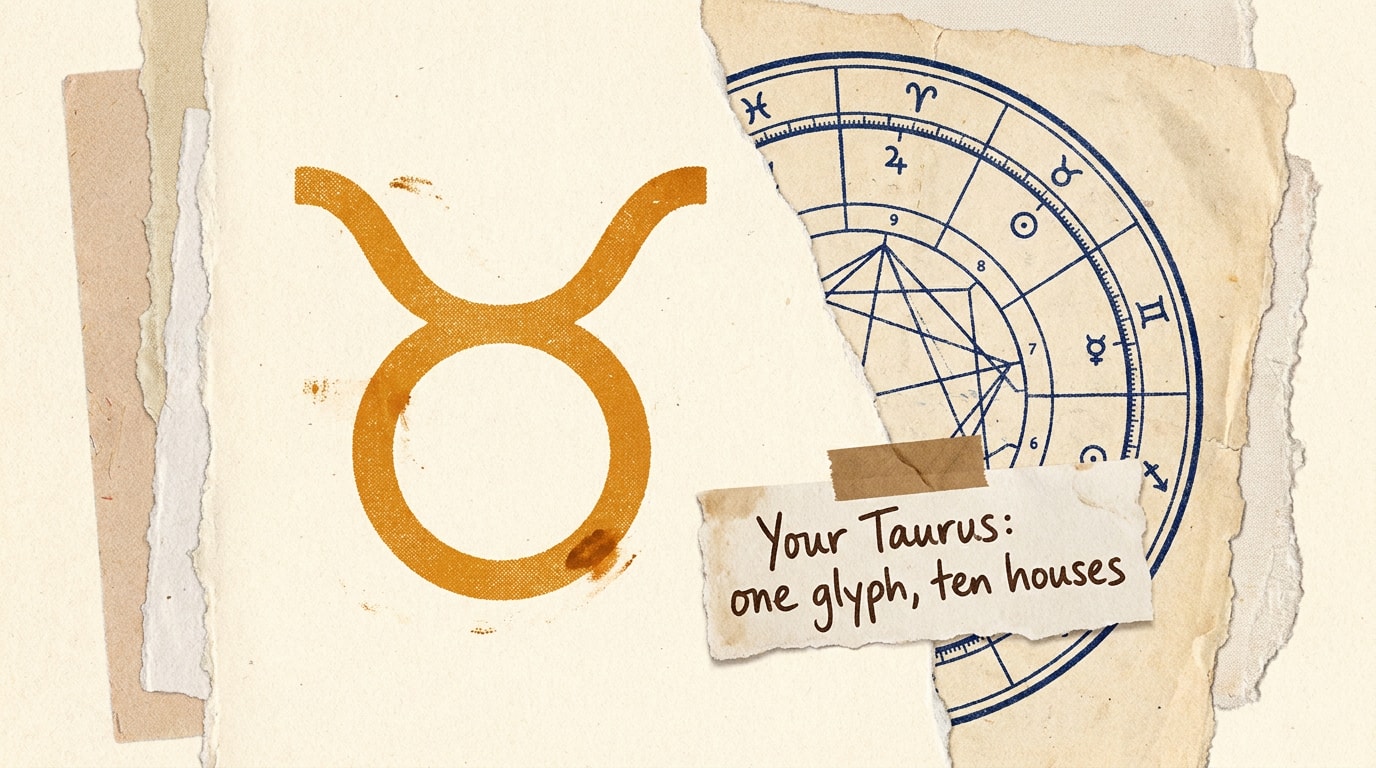
If you'd like to see where Taurus actually lives in your chart rather than the sun-sign label, the placements that determine which of the three layers is yours to wear — WowAstro will calculate a free birth chart for you. Date, time and place; it takes a couple of minutes. The tattoo is permanent. The chart is the longer description.
Questions readers ask
What does a Taurus astrology tattoo actually mean?
It lives in three structural layers, and treating it as one layer is why the Pinterest results feel so confusing. The first layer is the glyph ♉, a stylised bull's head astrologers have written in some form since the Hellenistic period and which appears in any sixteenth-century European astrological manuscript. The second layer is the Venus-ruled symbol set, rose, lotus, dove, the Venus glyph ♀, sweet herbs — because Taurus is ruled by Venus in the Western tradition (documented in Culpeper's 1652 "Complete Herbal" among many other sources), and Venus's correspondence-set is the source of most non-bull Taurus motifs. The third layer is the constellation itself, with Pleiades (the seven-sister open cluster, M45, around 440 light-years away) in the Bull's neck and Aldebaran (α Tauri, a red giant about 65 light-years away) marking the Bull's eye. A fourth layer sits behind all three: where Taurus actually lives in your birth chart, not just your sun-sign label.
Is the bull or the glyph the "real" Taurus tattoo?
Both are real; they live in different layers of the same idea. The glyph ♉ is the symbolic layer, the condensed mark astrologers have written for centuries, almost a written word for the sign. The bull as a literal figure (a head, a body, horns in profile) is the mythological-pictographic layer, which is older than the glyph and traces back to the Mesopotamian Bull of Heaven and to Greek myth. The constellation pattern of stars is the astronomical layer, which is older still — Taurus is the oldest constellation in continuous use. None of these is more "real" than the others; they're different ways the same sign has been visualised across about four thousand years. Pick the layer that matches the version of the sign you want to commemorate, and the design follows.
Can I get a Taurus tattoo if I'm not a Sun-Taurus?
Yes, and the tattoo can be more interesting because of it. The sun-sign you were told at twelve is one placement of ten in your chart, and Taurus can sit on any of them — Moon, Mercury, Venus, Mars, Jupiter, Saturn, the outer planets, or your Rising sign (set by the exact time of your birth). If you have your Venus in Taurus, you are wearing Venus in her own sign of rulership; the rose-and-glyph combination is your design. If you have your Moon in Taurus, the moon-and-glyph reads accurately. If you have a stellium in Taurus (several planets together in the sign), you have more to work with than the average Sun-Taurus. The mark commemorates whichever placement you're choosing to honour; the sun-sign label is one option, not the only one.
Will a Taurus tattoo activate my Venus energy?
No, and an honest tattooist will tell you so. The tradition behind every Taurus symbol here, glyph, Venus correspondence, constellation, is a language of symbolic association, not pharmacology. A rose on your wrist isn't doing something to your Venus; it's honouring her. The distinction matters because a permanent mark deserves clean language about what it is. If you want a tattoo because the symbol means something to you, because it commemorates a placement you have, a turning point, a quiet decision — that's a perfectly good reason, and tradition supports it. If a retailer or studio is selling you the idea that the ink itself will "activate", "manifest", "protect from" or "attract" something for you, they are selling you marketing language rather than craft. The mark is small, permanent and yours; what it means is determined by you, not by the ink.
Astrology, as we use it at WowAstro, is a tool for self-reflection and self-observation, not a method for predicting events, health or financial outcomes. A tattoo is a commemorative mark, not an activation device — the symbol carries the meaning you bring to it, no more and no less. Tattoos are permanent; take time before you book.
Written by Oksana Miatova, astrologer and writer at WowAstro. Charts calculated using the Swiss Ephemeris, the same astronomical data working astrologers use. Symbol and rulership history drawn from Nicholas Culpeper's "Complete Herbal and English Physician" (1652) and the standard Western astrological canon; constellation references from Hesiod's "Works and Days" (~700 BCE), Mesopotamian astronomical record, and modern positional astronomy.
Read your own natal chart
A personal AI reading, from £1
⭐ +50 Wow Stars cashback · sign up and get 100 ⭐
Build my chart →Comments
New here? Get −30% off your natal chart
Leave your email and we will send you the promo code WELCOME30. Straight after that you can comment — no passwords, all automatic.
Quick sign-in
Sign in with Telegram — one click.
Or by email (with a gift)
Already have an account? Enter the same email — we'll email you a sign-in link.