You find a birth-chart site, type in your date and place, and then the form asks for your time of birth. You don't have it. The cursor blinks in the empty field, and it's easy to assume that's the end of it, that without the time your chart is a write-off and there's no point going on.
It isn't a write-off. Without a birth time you can still get a real, meaningful chart, roughly the psychological half of it, and plenty of people do exactly that. What you keep is your Sun and every planet by sign, and the way those planets speak to each other. What you give up is the personal geography of the chart: your rising sign, your houses, the angles, and the precise Moon. This guide draws the line clearly, so you know which parts of a timeless chart you can lean on and which you can't.
In short. No birth time still gives you the "what" of your chart, the planets in their signs and the aspects between them. It's the personal "where", the ascendant and houses, that needs the exact minute. You keep the cast; you lose the stage.
The short version: two layers, and only one needs the clock
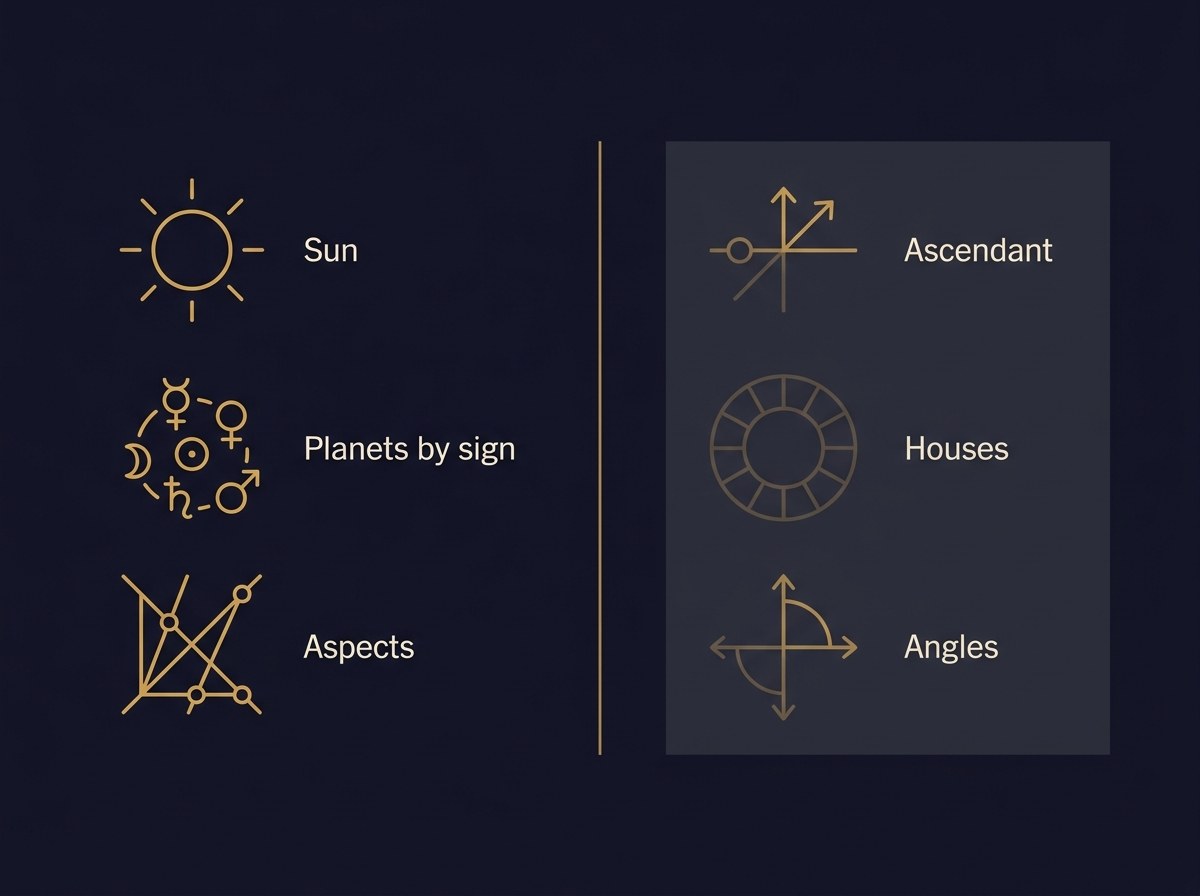
Think of a chart in two layers. The first is the cast of characters: the planets, each sitting in a sign that colours how it behaves. Your Venus in one sign loves differently from Venus in another; your Mars picks its fights in its own style. That layer barely depends on the clock.
The second layer is the stage those characters walk onto: the twelve houses, the areas of life where the drama actually plays out, and the ascendant, the front door of the chart that decides how the whole set is arranged. That layer is built entirely from the moment and place of your birth. Move the time and the set is rebuilt.
Without a birth time you have the first layer in full and the second barely at all. You know who's in the play and what they're like. You don't know which rooms they're standing in. It's worth grasping this before you take much from a chart online, because a lot of astrology's most personal-sounding claims live on that second layer. And you're in good company reading a chart this way: the Pew Research Center found that in 2024 around three in ten US adults had consulted astrology, tarot or a fortune-teller in the past year, most of them never thinking about birth times at all.
What holds up without the hour
Here's the part that survives a missing time intact.
Your Sun sign, first of all. The Sun takes about a month to cross a sign, so unless you were born on the very day it changed over, your Sun is certain.
Then every other planet by sign. Mercury, Venus and Mars, and the slower movers out to Pluto, all sit in the same sign for the whole of any given day. The hour you were born doesn't touch them. So your Mercury in Gemini, your Venus in Scorpio, your Saturn in Libra: all of that is solid ground.
And the aspects between the planets, the conjunctions, squares, trines and the rest. Because the planets hardly shift relative to one another across a few hours, the geometry they make with each other is set for the day. That matters, because those aspects carry a lot of a chart's character, its inner tensions and gifts, quite apart from any house. To make it concrete: a Venus in Scorpio locked in a tense square to Saturn says something real and specific about how you attach and guard your heart, and none of it leans on the hour you were born. Whole stretches of a chart work like that.
Put those together and you already have a genuine reading: your drives, how you love, how you think, where you meet friction and where things come easily. The "what" of you is fully on the table.
The one to handle with care: your Moon
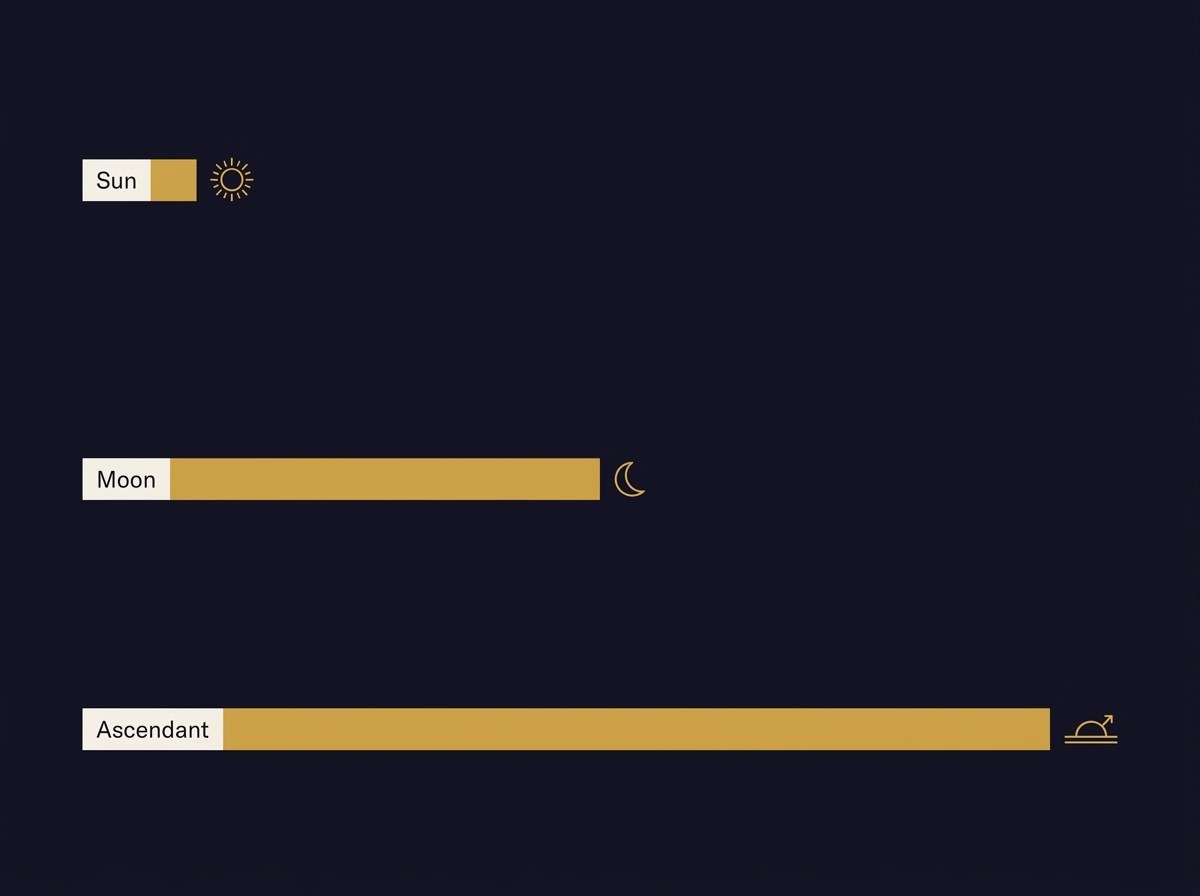
The Moon needs a word of caution, because it's the fastest thing in the chart. It covers roughly twelve to thirteen degrees of sky a day, a whole sign every two and a half days or so.
Most of the time that's no trouble. The Moon sits in one sign long enough that your date alone pins it down, and your Moon sign reads as clearly as any other placement. The catch is the small share of people born on a day the Moon was crossing between signs. If that's you, your date leaves two possible Moon signs, and only the time can decide which. Past the sign itself, the Moon's exact degree and the house it falls in stay out of reach without the hour. So treat your Moon sign as usually reliable, and hold the finer detail loosely.
What a timeless chart can't tell you
Now the honest column, the parts that genuinely need the minute.
Your rising sign, or ascendant, is first to go. It changes roughly every two hours and rolls through all twelve signs in a day, so without a time it could be almost anything. Pinning it down is its own task, and there's a separate guide to narrowing your rising sign if that's what you're after.
With the ascendant goes the whole house framework: the twelve life areas, which house each planet falls into, and the planets that rule each one. Shift the ascendant by a sign and the entire structure slides with it, so a planet that looked like it governed your career might just as easily belong to your home life. To picture it: a Mars in your tenth house looks like ambition and a fighting drive at work; nudge the ascendant one sign earlier and that same Mars slips into the ninth, where it looks instead like a hunger for travel or belief. Same planet, same sign, a completely different corner of life, decided by the minute. The Midheaven and the other angles, along with any aspects planets make to them, move the same way. So does the Part of Fortune, since it's worked out from the ascendant.
You also lose accurate personal timing. The techniques astrologers use to forecast, the ones that track when something is due, run off the exact chart and its house cusps, so without a real birth time they can't be trusted for your dates. This is also why even a few minutes can matter so much, and the mechanics of that are worth a read of their own.
Why your chart shows 12:00 — the noon-chart trick
 The blank that sends most people looking.
Generate a chart without a time and most software quietly sets it to twelve noon. That isn't a guess at your real birth; it's a working convention. Noon puts the Moon at roughly the middle of its day's travel, which keeps its position as close as it can be whichever way the truth lies.
Used well, a noon chart earns its keep. Take the layer that holds, the planets in their signs and their aspects, and set aside whatever the chart shows for the ascendant, the houses and the angles, because those are placeholders standing in for data you don't have. The trouble only starts when someone forgets the caveat and reads house positions off a noon chart as though they were real. Know to look past them, and noon serves you honestly.
How to get the rest back
If the missing "where" nags at you, there are three routes, in rough order of effort.
Start by checking the time isn't simply mislaid. A surprising number of people have a time sitting in a hospital record or an old cot card they never thought to look for; our guide on how to find your birth time walks through every place it hides.
If the paperwork really is blank, you can often still narrow things down. A rough window is enough to shortlist your rising sign, and the free rising-sign check shows which signs could have been rising on your birth date, so you can see how wide the uncertainty runs.
And if the time is properly gone, it can be rebuilt from the events of your life. That's what birth-time rectification does, working backwards from your dated milestones to a probable time; our rectification service does the work for you if you'd rather not.
None of it is urgent. A chart read honestly from your date alone already tells you a great deal about who you are. The rest can wait until you're curious enough to go looking for it.
Frequently Asked Questions
Can you read a birth chart without a birth time? Yes, a good part of one. Without a time you can still read your Sun and every planet by sign, and the aspects between them, which covers much of your character and psychology. What you can't read is the ascendant, the houses and the angles, the parts that depend on the exact minute. Think of it as the chart with its edges softened, not a blank.
Can I know my Moon sign without a birth time? Usually, yes. The Moon stays in one sign for about two and a half days, so your date alone is normally enough to fix it. The one exception is being born on a day the Moon changed sign, which leaves two options that only the time can decide between. Its exact degree and house always need the hour.
Can I know my rising sign without a birth time? Not from your date alone, because the rising sign changes every couple of hours. If you can narrow your birth to a window of an hour or two you can often shortlist it, and sometimes settle it. There's a fuller walkthrough in how to find your rising sign without a birth time.
Is a noon chart accurate? For the planets and their signs, yes; for anything time-based, no. A noon chart places the planets by sign correctly and keeps the Moon's error small, which is why astrologers reach for it when the time is unknown. Its ascendant, houses and angles, though, are placeholders and shouldn't be read as real.
Should I just guess a birth time? Better not to. A made-up time produces a real-looking ascendant and a full set of houses that are simply wrong, which misleads you more than an honest blank. If you want those parts, narrow the time properly or have the chart rectified. Until then, take the planets by sign and treat the rest as unknown.
Oksana Miatova is an astrologer and co-founder of WowAstro, working in the Western classical tradition with Swiss Ephemeris calculations. WowAstro builds birth charts and helps people recover an uncertain birth time from the events of their life. wowastro.com
For entertainment and self-reflection. Astrology isn't a substitute for professional medical, legal or financial advice.
Read your own natal chart
A personal AI reading, from £1
⭐ +50 Wow Stars cashback · sign up and get 100 ⭐
Build my chart →Comments
New here? Get −30% off your natal chart
Leave your email and we will send you the promo code WELCOME30. Straight after that you can comment — no passwords, all automatic.
Quick sign-in
Sign in with Telegram — one click.
Or by email (with a gift)
Already have an account? Enter the same email — we'll email you a sign-in link.