You sit down to build your birth chart, the form asks for your time of birth, and you stall. Maybe there's nothing written down. Maybe there's a number, but your mum shrugs and says "sometime in the morning, I think." Maybe the certificate in the drawer has a date and no time at all.
Here's the reassuring part, and the honest one. Most people can recover their birth time, or at least narrow it to a workable window. And a surprising number of people who are sure they "know" their time are working from a figure that was estimated, rounded, or written down after the fact. So this guide does two jobs: it shows you every realistic place to find and confirm your birth time, and it helps you judge whether the time you already have can be trusted.
The short version. Check documents first (the full certificate, hospital records, the old cot card), then family memory, then ask whether the time is precise enough for what you want. If it's genuinely lost, birth-time rectification can recover a probable time from the events of your life.
Start here: are you finding a time, or confirming one?
Before you spend an afternoon on hold to a hospital, work out which situation you're actually in, because the path is different.
If you have no time at all, your job is retrieval: documents, then family, then, as a last resort, rectification. Skip ahead to the sections on records and family.
If you already have a time but you're not sure it's right, your job is verification. That matters more than people think, and almost no one talks about it. A time on paper is not the same as the correct time, and later in this guide we'll look at why. For now, a quick rule of thumb: if your Sun, Moon and Rising all sit comfortably in the middle of their signs and don't budge across an hour either side of your recorded time, your existing time is almost certainly fine. If you were born close to midnight, near a sign's cusp, or your recorded time clashes with what your family remembers, it's worth being more careful.
Where your birth time is actually written down
Start with paper and pixels before you start with memory, because a record beats a recollection every time.

The long certificate, not the short one
Most people only ever hold the short-form birth certificate, which typically shows name, date and place, and no time. The long-form (or "full") certificate holds more detail and is the version worth ordering if you're chasing a time. A quick warning for UK readers, though: even the full certificate usually won't show your time of birth. More on that in a moment, because it trips people up constantly.
The hospital "baby card" — the source most UK parents actually kept
If you were born in a UK hospital, there's a good chance the single most useful document isn't official at all. It's the little card that sat on the cot, often called a baby card or cot card, noting your weight and, frequently, your time of birth. Parents kept these in memory boxes, baby books and the backs of photo albums far more often than they kept hospital paperwork. Ask whoever holds the family keepsakes to have a look. It's low-effort and it works more often than you'd expect.
Digital records and the messages sent that day
Modern births leave a modern paper trail, and this is where most guides go quiet. Worth checking:
- Hospital or maternity patient portals and any digital record you or a parent can log into.
- NHS or GP records, which can sometimes be requested and may reference the birth.
- Genealogy and records sites such as Findmypast or Ancestry, useful for older births.
- The messages sent around your arrival — the texts, emails or social posts a parent fired off announcing you, and the local newspaper birth announcement if your family placed one. People rarely think of these, and a timestamped "she's here, 6:52am!" message is as good as any certificate.
Does a UK birth certificate show the time of birth?
The short answer: usually not. Standard birth certificates in England and Wales do not record the time of birth. The one firm exception is multiple births, twins, triplets and so on — where the time is recorded specifically to establish the order the siblings arrived.
So if you're UK-born and hoping the certificate will settle it, adjust your expectations and go to the hospital records or the cot card instead. If you still want to order certificates, the systems are separate depending on where you were born:
- England and Wales — the General Register Office (GRO).
- Scotland — National Records of Scotland.
- Northern Ireland — the General Register Office for Northern Ireland (GRONI).
None of these will conjure a time onto a certificate that never recorded one, but they're the correct route for the official document, and the register office can point you toward the hospital or health board that would hold the delivery record.
Born outside the UK? Where to look
Practices vary a lot by country, and that's genuinely good news, because plenty of countries record the time as standard.
| Where | Best first source |
|---|---|
| United States | The long-form certificate from your state's vital records office (many US certificates do show the time). |
| Ireland, much of the EU | Civil registry / register office records; hospital maternity records. |
| India and South Asia | Hospital records and family records; the time is often noted for the kundali. |
| Older or rural births anywhere | Church or baptismal records, which frequently noted the hour. |
If you were born somewhere that simply doesn't record the time, and some places don't — treat that as a "family memory, then rectification" situation rather than a documents one.
Ask your family — and the questions that actually jog memory
When you ask "what time was I born?", you usually get a blank. The trick is not to ask for a number. Ask for the scene around it, and let the details reconstruct the hour.
Try these:
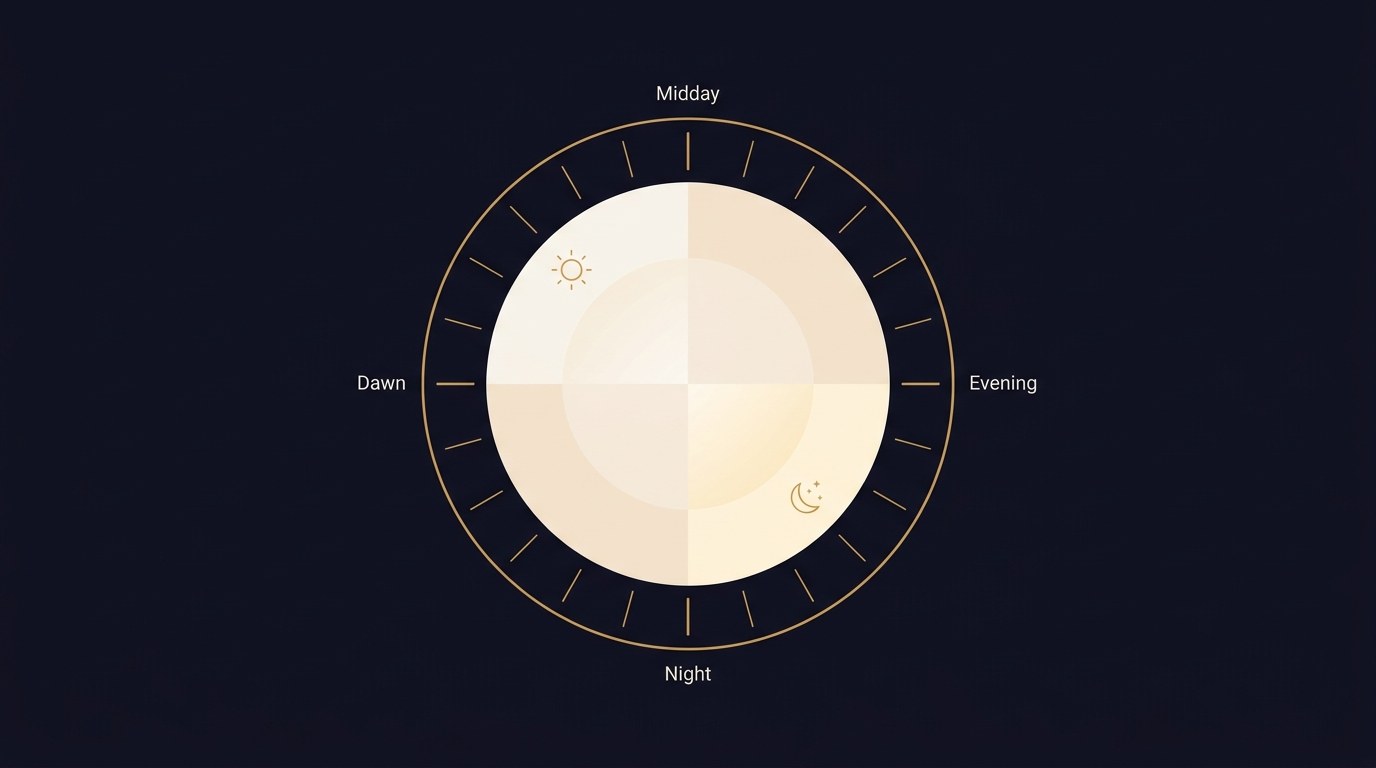
- Was it light or dark outside? Dawn, broad daylight, dusk or the middle of the night narrows a 24-hour day to a few hours instantly.
- Was it before or after a meal? People anchor memories to breakfast, lunch and dinner far better than to clocks.
- Who was there, and who did they phone? "I rang your nan on my way home from the night shift" carries a time inside it.
- Was there a shift change, or a particular programme on the telly? Oddly specific, oddly reliable.
 The hour often hides in a story.
Write down whatever you get, and treat it as an approximate window rather than a fact. Memory drifts, especially across decades, and a confidently remembered "half past ten" is worth holding loosely.
Can you really trust the time you found?
This is the part almost no one tells you, so read it even if you have a time you've trusted for years.
A recorded birth time is rarely as exact as it looks. Hospitals note the time to the minute, not the second, and in a busy delivery the moment someone glances at the clock can lag the actual birth. Some readers have described a nurse "counting backwards" to fill in a time nobody called out loud at the moment. Caesarean births are often timed to a specific procedural point rather than a first breath. And the time that ends up on paperwork can drift from the delivery itself, because filing and admin happen later.
None of this makes your time useless, far from it. A recorded time is a very good starting point. Just not gospel. And near a cusp, those few minutes are exactly where it bites. Which brings us to the obvious question.
You've got a rough window. Is that enough?
Sometimes, yes. If you only care about your Sun and Moon signs and the broad shape of your chart, an approximate time is plenty, and you can get a genuinely useful reading from it.
But the moment you want your rising sign and your houses, the "where" of your chart — precision starts to count. The ascendant changes sign roughly every two hours, and the house cusps shift within a single minute, so a loose time can hand you the wrong rising sign entirely. If your window still spans two or three possible rising signs, it's worth tightening.
And if it feels a bit much to fuss this precisely over a birth time, you're in very ordinary company. Pew Research Center found that around a quarter of US adults say they believe in astrology (2024), and closer to a third of the under-thirties. Wanting your chart to actually be yours is a normal thing to want.
Two honest next steps if your time is fuzzy. First, the free way: our rising-sign check shows which signs could have been rising on your birth date, so you can see how wide your uncertainty really is. Second, the deeper reads: does birth time actually matter walks through exactly what shifts when the time moves, and reading a chart without a birth time covers what you can still learn in the meantime.
When the time is genuinely gone: rectification
If you've tried the documents, the baby card, the hospital and the family, and there's still nothing, you're not out of options. Birth-time rectification works backwards: instead of asking for the time, it looks at the dated events of your life, a marriage, a move, a birth, a loss — and finds the birth moment whose chart best explains them.
Be clear-eyed about what it can and can't do. Done honestly, rectification gives you a probable time window and a most-likely minute with a confidence level, not a precise second. Anyone promising certainty is overselling. But for a lot of people it narrows an unknown day down to a workable window, which is often all your chart needs. If that's where you've landed, our birth-time rectification service walks you through it, and the pillar guide on how rectification works explains the method in plain terms.
Whatever you turn up — a cot card in a shoebox, a dawn your mum half-remembers, or a window worked back from the shape of your life — it's enough to begin with. Your chart has never needed you to be certain to the second. It just needs somewhere honest to start.
Frequently Asked Questions
Does a birth certificate show the time of birth? In the UK, standard England and Wales certificates do not show the time, except for multiple births. Many US long-form certificates do show it, and practice varies elsewhere. If your certificate has no time, your best sources are hospital records or the old cot card.
Can I get my birth time from the hospital years later? Often, yes. Maternity units and health boards keep delivery records, though how far back and how easily you can access them varies. Contact the hospital or, in the UK, the relevant health board, and ask specifically for the recorded time on your maternity or delivery record.
What if my parents don't remember? Don't ask for the number — ask for the scene. Light or dark outside, before or after a meal, who they phoned, what was on the telly. These anchors reconstruct an approximate window far more reliably than a straight "what time was I born?".
How accurate does my birth time need to be for astrology? It depends what you want. Sun and Moon signs are stable across a wide window. Your rising sign and houses are not, the ascendant changes about every two hours — so if you want those, aim to narrow your time to within a few minutes, or consider rectification.
Can astrology work at all without a birth time? Yes, partly. Without a time you can still read your Sun and planets by sign, which is a real chunk of the picture. What you lose is the houses, the rising sign and the exact angles — roughly the personal "where" of the chart. It's a reading with the edges softened rather than no reading at all.
Oksana Miatova is an astrologer and co-founder of WowAstro, working in the Western classical tradition with Swiss Ephemeris calculations. WowAstro builds birth charts and helps people recover an uncertain birth time from the events of their life. wowastro.com
For entertainment and self-reflection. Astrology isn't a substitute for professional medical, legal or financial advice.
Read your own natal chart
A personal AI reading, from £1
⭐ +50 Wow Stars cashback · sign up and get 100 ⭐
Build my chart →Comments
New here? Get −30% off your natal chart
Leave your email and we will send you the promo code WELCOME30. Straight after that you can comment — no passwords, all automatic.
Quick sign-in
Sign in with Telegram — one click.
Or by email (with a gift)
Already have an account? Enter the same email — we'll email you a sign-in link.