You are standing on the platform at Clapham Junction at 7.42 on a Tuesday with a cardboard cup of coffee, and the quiet thought arrives, almost in passing: is this the rest of it? Not a drama. Not a breakdown. Just a low, persistent note that the architecture you have built — the job, the partner, the mortgage, the version of you the school WhatsApp group knows — keeps working, and you can't quite tell whether it's still right.
If you have stood on that platform, or some other platform, somewhere in your early 40s, you have met the felt-shape of what gets called a midlife crisis. (It has a younger cousin, the quarter-life crisis, that visits in the late 20s; this article is about the older one.) Most of what the internet offers is either clinical or comic, and neither quite reaches the bit you are actually feeling. There is, as it happens, a structural reason this period lands when it does. Several long astronomical cycles overlap in your late 30s to early 50s, and the questions they often raise are the same ones you are now turning over with your coffee. Astrology has names for those windows.
This article won't fix the question — and astrology is not a substitute for talking to a qualified counsellor if the weight is more than you can carry alone. If what you are feeling has tipped past reflective into overwhelming, please contact your GP, Samaritans on 116 123 (free, 24/7), or Mind on 0300 123 3393. Astrology can sit alongside that conversation; it can't replace it.
In short. A midlife crisis is rarely a crisis and rarely just at midlife. It is the felt-shape of a window in your late 30s to early 50s when several long astronomical cycles overlap — most famously a Uranus opposition around age 42, a Saturn opposition around 44, and a Chiron return around 49 to 51. Each names a different review question. Astrology doesn't cure the questions. It gives them coordinates. The questions still belong to you.
 A late-life stock-take, long after the window has passed.
What "midlife crisis" actually is, and what astrology won't claim
The phrase midlife crisis was coined by the Canadian psychoanalyst Elliot Jaques in a 1965 paper called Death and the Mid-Life Crisis. He was describing what he saw in his patients: a period in the late 30s and early 40s when the awareness of mortality, the closing of certain doors, and a kind of unsentimental stock-take of one's life converged. The phrase has had a long career since, much of it cartoon — the sports car, the affair, the implausible new hobby. The construct itself is contested in modern psychology. A 2015 review by Margie Lachman and a 2024 University College London preprint by Barry both argue that the universal-crisis model overstates what most adults actually feel: the questions are real, the "crisis" framing often isn't.
Adjacent feelings often live in the same room: burnout from a job that no longer answers the right question; signs of burnout that did not announce themselves until your forties; the kind of overthinking that arrives at four in the morning and won't switch off; the meaning-of-burnout question that turns out to be a meaning-of-the-rest-of-life question wearing different clothes. None of this is unique to a midlife window, but it does often cluster there.
What we can say honestly is this. A recognisable window exists, somewhere in your late 30s to early 50s, when structural life questions tend to intensify. A chart doesn't diagnose anything; midlife questioning is not a disorder and not in the DSM. If what you are going through is overwhelming (sleep gone, drinking creeping up, thoughts of ending your own life), that is a conversation with a qualified counsellor or your GP, not an astrology article. Astrology can sit alongside professional support. It can't replace it.
What astrology can do is hand you a vocabulary for the timing of the window. Three long planetary cycles complete or oppose themselves in midlife, and their overlap is the structural reason this period feels dense for so many people.
Why the window lands around 42: the Uranus opposition
The planet Uranus takes about 84 years to orbit the Sun. Halfway through that orbit, roughly 42 years after you were born, Uranus reaches the point exactly opposite where it sat in your birth chart. That moment is called the Uranus opposition. The astronomy is verifiable: Uranus's orbital period is 84.02 Earth years, which makes the half-orbit a little over 42 years. WowAstro calculates these positions using the Swiss Ephemeris, the same astronomical data that working astrologers and professional astrology software rely on.
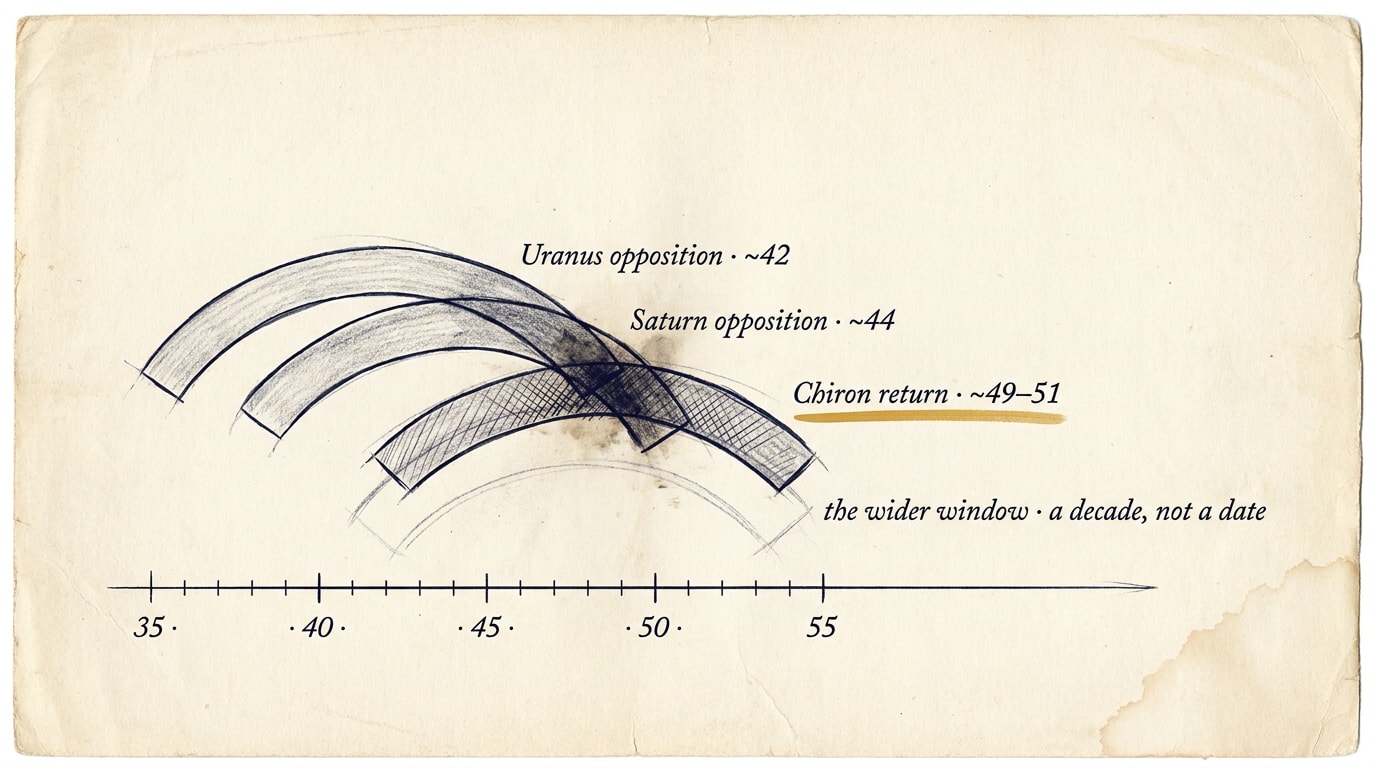
In the astrological canon, Uranus is the planet of disruption-of-pattern — the what if it weren't this way voice. A Uranus opposition is read as the window in which that voice gets specifically loud about the structures you built in your 20s and 30s. The astronomy is true and measurable; the interpretation is centuries-old observational language for what the window often surfaces. The astrology is not predicting an event; it is naming a recognisable shape that human beings keep arriving at around the same age.
If you want to know when your Uranus opposition is exact, you need your birth chart — date, time, and place. The behaviour of transits, the moving planets read against your natal chart, sits underneath everything that follows. The peer article on Saturn return gives the wider context for slow-planet cycles if you want the deeper transit primer.
The two other cycles that overlap: Saturn opposition and Chiron return
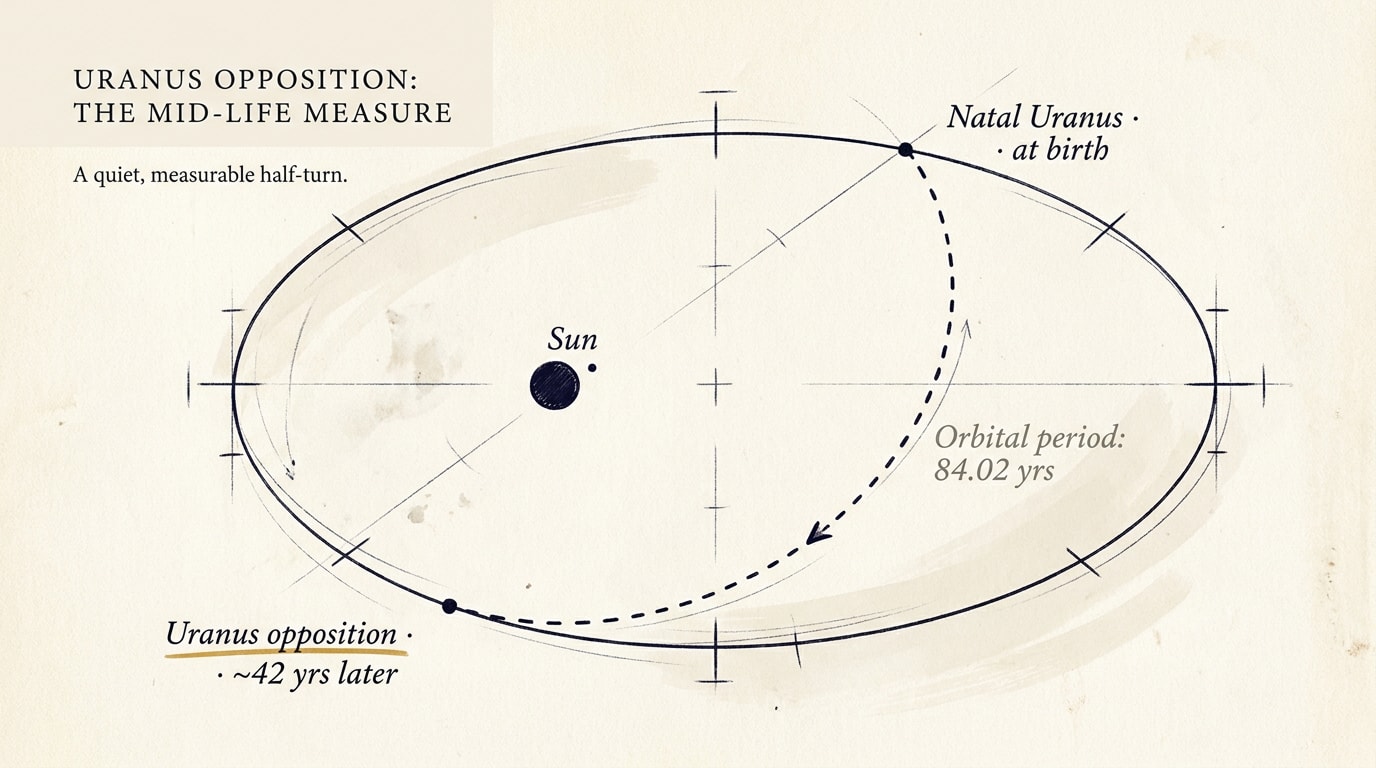
Uranus is not the only long cycle that arrives in midlife. Saturn opposes its natal position around age 44, and an icy body called Chiron returns to its natal point around age 49 to 51. Each names a different review question, and their overlap with the Uranus opposition is the structural reason a single decade can feel so loaded.
| Cycle | Approximate age window | Review question it raises |
|---|---|---|
| Uranus opposition | ~38 to 44 | What if it weren't this way? |
| Saturn opposition | ~44 | Is the structure I built holding? |
| Chiron return | ~49 to 51 | What old wound is asking for a second look? |
Three different cycles, three different review questions, overlapping across about a twelve-year span. That is the structural reason midlife feels dense for so many people. Not one Big Event. Three slow clocks all chiming roughly together.
What this window often correlates with, and what it doesn't
What this multi-cycle window often correlates with, in many people's accounts, is recognisable: a career reconsideration, a partnership taking a hard honest look at itself, the question of what the next twenty years are actually for, your body asking to be listened to in a way it didn't have to be at 32, old wounds asking for a second pass, the slow arrival of parent-care or parent-loss into the foreground. None of this happens to everyone. The absence of drama is not a failure of the cycle; some people pass through the window quietly, especially if they built the architecture of their life carefully on the way in.
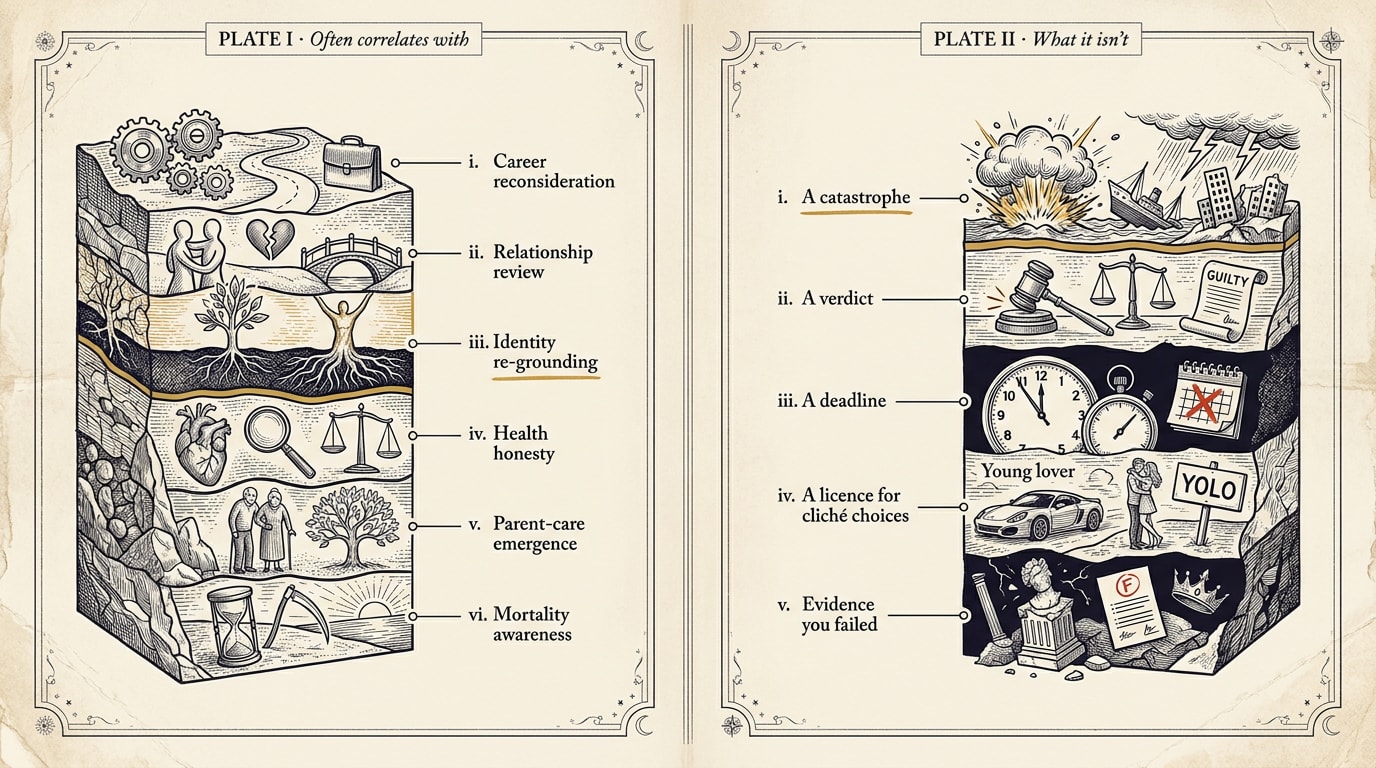
The correlates with framing matters. The alternative, Uranus causes the affair, Saturn brings the redundancy, Chiron triggers the breakdown — is both bad astrology and bad reasoning. It is bad astrology because the canonical literature does not claim causation; it claims pattern recognition. It is bad reasoning because correlation between a slow-planet cycle and the kinds of questions that arrive in most people's 40s anyway is a low bar of evidence. A chart names the window. It doesn't fix what surfaces inside it. The actual day-to-day shift in how you feel usually happens elsewhere: therapy, journalling, time, support, sometimes medication, sometimes a long honest conversation with someone who has known you a long time. The wider frame for what astrology can and can't do here is set out in our piece on astrology for self-understanding, if you want to step back from the specific window.
 After the class, a quiet glance back through the window.
The window isn't a verdict. Three long cycles overlapping isn't astrology doing something to you. It's the calendar of the human midlife review, marked in centuries-old vocabulary. The questions are yours; the timing is biological-and-astronomical. What you do with the answers is still up to you.
A worked example: Uranus opposition for someone born in August 1983
Here is how a Uranus opposition reads in one illustrative chart. The person is a plausible composite, not a real human being. Born on the 15th of August 1983; on that date Uranus sat at approximately 5° Sagittarius in the zodiac. That is the natal Uranus position.
The opposite point on the wheel, 180° around — is 5° Gemini. So this person's Uranus opposition is the window in which transiting Uranus crosses 5° Gemini.
Uranus entered Gemini in 2025 after a long stay in Taurus. It crossed 5° Gemini in two passes, roughly: a first direct pass in spring 2025, then a return through 5° Gemini in late 2025 to early 2026 once Uranus stationed retrograde. Two clear passes, over about fourteen months, depending on the precise Ephemeris dates. At the start of that window this person is 41 turning 42. By the end, 42 turning 43.
The midlife-crisis mythology says: catastrophe at 42. The astrology says, considerably more quietly: a window of about fourteen months in which the what if it weren't this way question often gets specifically loud. What it does not say is that this person will leave their marriage, buy a motorbike, or quit their job. Those are choices the person might make inside the window. The window itself is just the question's calendar.
Naming the window doesn't decide the answer. It makes the question's timing visible, and timing is half of what people mean when they say a chart helped them.
'Isn't this just dressing up a midlife mood?' A fair question, and worth taking seriously. The claim here is narrow and structural. Astronomical cycles return to their starting positions on predictable schedules: Uranus to its opposite point at about 42, Saturn to its opposite point at about 44, Chiron to its natal point at about 50. The astronomy is true and measurable. The interpretation, that those returns often correlate with recognisable life-stage questions — is centuries-old observational language, not a scientific claim. You do not have to believe Uranus causes anything for this to be useful. What it gives you is a vocabulary for a window human beings already pass through.
A reflective practice: naming the window, not finishing it
Once you can name the window, Uranus opposition first, then Saturn opposition, then the slower Chiron return — you can use it as a self-reflection prompt rather than as evidence that something is wrong with you. This is journal territory, or quiet thinking time over a cup of tea, not a session script and not a method for talking yourself out of real distress.
 A different kind of journalling: the breath after effort.
Three reflective questions worth turning over when the midlife questioning is loud. What did I build in my 20s and 30s that I assumed I would want forever, and which parts of it still answer the question of who I am becoming? If the next twenty years are visible from here, what is actually in them that I want to keep, and what was someone else's expectation I quietly carried? Where is the what if it weren't this way voice loudest in my life right now, and what is it asking me to look at more honestly?
Sit with the questions, not the answers. Most of the work is noticing the window has a shape, and the shape has a name. If the questions tip into something heavier, sleep going, drinking creeping up, the future shading into something you do not want to be in, thoughts of self-harm — that is the moment to call your GP or a qualified counsellor. The BACP find-a-therapist directory is the most established free route to a UK-regulated therapist; the NHS offers talking therapies through self-referral in most areas. Astrology gives you names for windows; therapy gives you tools to work with what surfaces inside them. They aren't substitutes for each other.
What an astrology lens does here. It hands you a calendar for a question you were going to ask anyway. Not a verdict, not a treatment — a vocabulary that lets the felt-shape of midlife become less personal and more describable.
If you want to know when your own Uranus opposition is exact, WowAstro will calculate a free birth chart for you. Date, time, and place; it takes a couple of minutes. Worth knowing whether your window is starting, peaking, or already moving past.
Questions readers ask
What is a midlife crisis, exactly?
A midlife crisis is a recognisable window, usually some time between the late 30s and early 50s, when structural life questions intensify. The phrase comes from Elliot Jaques (1965), and the construct has been contested ever since: more recent reviews including Lachman (2015) and Barry (UCL 2024) argue that the universal-crisis model overstates what most adults actually feel. The felt experience is real. The "crisis" label often overstates it. Astrology offers a timing vocabulary for the window, Uranus opposition around 42, Saturn opposition around 44, Chiron return around 49 to 51 — without claiming the experience is a diagnosis.
Do men experience midlife crisis differently from women?
The astronomical cycles, Uranus opposition, Saturn opposition, Chiron return — arrive on the same schedule regardless of gender; the chart does not know whether you are a man or a woman. What differs is the cultural permission to name and discuss the questions. The UCL Barry 2024 review highlights a male-psychology gap: men in the UK are less likely to seek talking therapy and more likely to white-knuckle through the window in private. The questions are the same. The support routes need to be made visible, particularly for men whose social worlds do not make space for the conversation. If that is you, the helplines at the foot of this piece are for you too.
When does a midlife crisis usually happen?
Most people who describe a midlife window locate it between the late 30s and early 50s, roughly the span from a Uranus opposition (around 42) to a Chiron return (around 49 to 51). Exact months depend on your birth chart. The Uranus opposition window is typically twelve to eighteen months because Uranus crosses the opposite point in two passes, sometimes three, owing to its retrograde structure. The wider midlife window — Uranus and Saturn and Chiron together, is closer to a decade than a single date.
Does astrology help with a midlife crisis?
Astrology does not treat a midlife crisis and is not a substitute for support if what you are feeling is heavy or persistent. It can describe the window, the period when the questions tend to land — and naming the window often makes its weight feel less personal. If the feeling tips into something heavier (sleep going, drinking creeping up, thoughts of self-harm), the right next step is a qualified counsellor, your GP, or a crisis line. In the UK, Samaritans on 116 123 is free and runs 24/7. Mind on 0300 123 3393 runs an information line Monday to Friday. For non-urgent NHS guidance, NHS 111 is the right number. Astrology sits alongside any of those conversations; it cannot replace them.
Written by Oksana Miatova, astrologer and writer at WowAstro. Charts calculated using the Swiss Ephemeris, the same astronomical data working astrologers rely on. Orbital periods confirmed against NASA JPL data.
Astrology, as we use it at WowAstro, is a tool for self-reflection and self-understanding, not a method for predicting events, health, or financial outcomes. The "midlife crisis" described here is a window of overlapping astrological cycles, not a fate.
If feelings of low mood, anxiety, hopelessness, or worthlessness are overwhelming or persistent, please speak with a qualified counsellor, therapist, or your GP. In the UK you can contact Samaritans on 116 123 (free, 24/7), Mind on 0300 123 3393 (Mon-Fri 9-6), or NHS 111 for non-emergency NHS guidance. For a regulated UK therapist, the BACP find-a-therapist directory is a good starting point. Astrology sits alongside that conversation; it is not a replacement for it.
Read your own natal chart
A personal AI reading, from £1
⭐ +50 Wow Stars cashback · sign up and get 100 ⭐
Build my chart →Comments
New here? Get −30% off your natal chart
Leave your email and we will send you the promo code WELCOME30. Straight after that you can comment — no passwords, all automatic.
Quick sign-in
Sign in with Telegram — one click.
Or by email (with a gift)
Already have an account? Enter the same email — we'll email you a sign-in link.