If you've ever Googled "gemini birthstone" on a friend's behalf (usually three days before her birthday, in a panic at a jewellery counter), you've met the same answer about six times in a row: pearl. Then, depending on which site you landed on, either nothing else, or fourteen other stones with vague claims about "balancing your air-sign energy". Neither version is much help if you wanted to actually choose something.
Here's what a Gemini birthstone actually is (three honest frames, not one) and how to choose between them without buying into mystical sales copy or the lazy "pearl, the end" summary.
In short. A Gemini birthstone falls into three traditions, not one. The modern June birthstones, pearl, moonstone and alexandrite, are a commercial American standardisation from 1912. The older Mercury-correspondence stones, agate, citrine, tiger's eye, chrysoprase, come from Renaissance lapidary traditions that pre-date the calendar list. And a Twin-themed pairing — two stones representing the dual nature of the sign — is the original frame you can build yourself. Gemini season runs roughly 21 May to 20 June; the zodiac signs overview sets the wider context.
 half-pint of ale, reading paper menu.
What "Gemini birthstone" actually means (two parallel traditions)
The phrase "Gemini birthstone" quietly carries two different traditions side by side, and most of the confusion online comes from sites that mix them up. The first tradition is the modern calendar-month list, which assigns one or two stones to each month of the year. The second is the older astrological tradition, which assigns stones to each zodiac sign through its ruling planet. June and Gemini overlap, but they aren't the same thing, and the stones they recommend overlap only a little.
The modern list (the one most jewellers and almost every search result quote) was standardised in 1912 by the American National Association of Jewelers. Pearl was the June stone. The list was revised in 1952 (adding alexandrite and moonstone), in 2002 (adding tanzanite for December), and most recently in 2016 (adding spinel for August). It's a commercial standardisation, not an ancient tradition. Pearl was picked for June largely because June needed a soft, recognisable, reasonably affordable summer stone, not because pearl has any astrological link to Gemini. Pearl is traditionally associated with the Moon, which rules Cancer, not Mercury.
The older astrological tradition assigns stones by sign, through the sign's ruling planet. In Western astrology, Mercury rules Gemini, and the Renaissance lapidary writers — Camillo Leonardi in 1502, then a long line of Italian and English compilers right up to George Frederick Kunz's The Curious Lore of Precious Stones in 1913 — associated Mercury with agate, and Gemini with agate as a result. That association is older than the modern June list by several centuries, and it tracks the symbolism rather than the calendar. If you came looking for a Gemini birthstone, the older agate answer is in many ways more "yours" than the pearl one, though both are legitimate, and the pearl tradition is now so well established that it counts too. Most modern astrologers, and most working jewellers asked for "a Gemini-specific stone", will quietly use both lists.
The modern June birthstones (pearl, moonstone, alexandrite)
The modern June birthstones, pearl, moonstone and alexandrite, are the three you'll see at every high-street jeweller from Hatton Garden down to John Lewis. They're a tidy little set, ranging from soft and traditional through luminous and slightly unusual to genuinely rare. None of them is astrologically Mercury-ruled, but all three have been part of the standardised June list long enough that most people now think of them as "Gemini stones" by association.
Pearl
Pearl is the headline June birthstone, soft, classical, often the only one a non-specialist jeweller will name. It's an organic gem, formed inside molluscs, and its symbolism in Western traditions leans lunar: cool, reflective, inward-facing. Pearl earrings at Liberty London or John Lewis typically run from around £30 for a simple cultured-pearl pair up to £200 or more for a high-quality cultured set, and Hatton Garden specialists will go considerably higher for South Sea or Tahitian pearls. The reason pearl ended up as the June stone in 1912 isn't astrological — it was a commercial choice for an affordable, recognisable June stone, but it has been the canonical answer for over a century now, and for anyone wanting a safe traditional gift for a June birthday, it does the job.
Moonstone
Moonstone is a variety of orthoclase feldspar with a quiet inner glow, astronomers call the optical effect adularescence, the soft shifting blue-white sheen that seems to float just under the surface of the stone. It was formally added to the modern June list in 1952. Moonstone is more interesting to look at than pearl for many people — that floating inner light feels alive in a way pearl doesn't, and it sits well with the Gemini archetype's affinity for shifting registers. It's also affordable: a moonstone pendant in silver at Astley Clarke or an independent UK gem dealer will typically run £40 to £150, and rainbow moonstone, the more iridescent variant, sits in roughly the same range.
Alexandrite
Alexandrite is the third and most unusual of the modern June stones, and the one that's worth a quick honest note about price. Natural alexandrite is rare. It was first discovered in the Russian Urals in 1830 and named for the future Tsar Alexander II, its signature trick is colour change: green in daylight, reddish-purple under tungsten light. Natural stones in any meaningful carat size run from a few hundred pounds up into the thousands per carat, well outside most gift budgets. Synthetic alexandrite, grown in a lab, shows the same colour-change behaviour and runs at perhaps £20 for a set in silver. As a symbolic birthstone, synthetic alexandrite is fine — it's the same mineral, just grown faster, and most "alexandrite" jewellery on the British high street is synthetic.
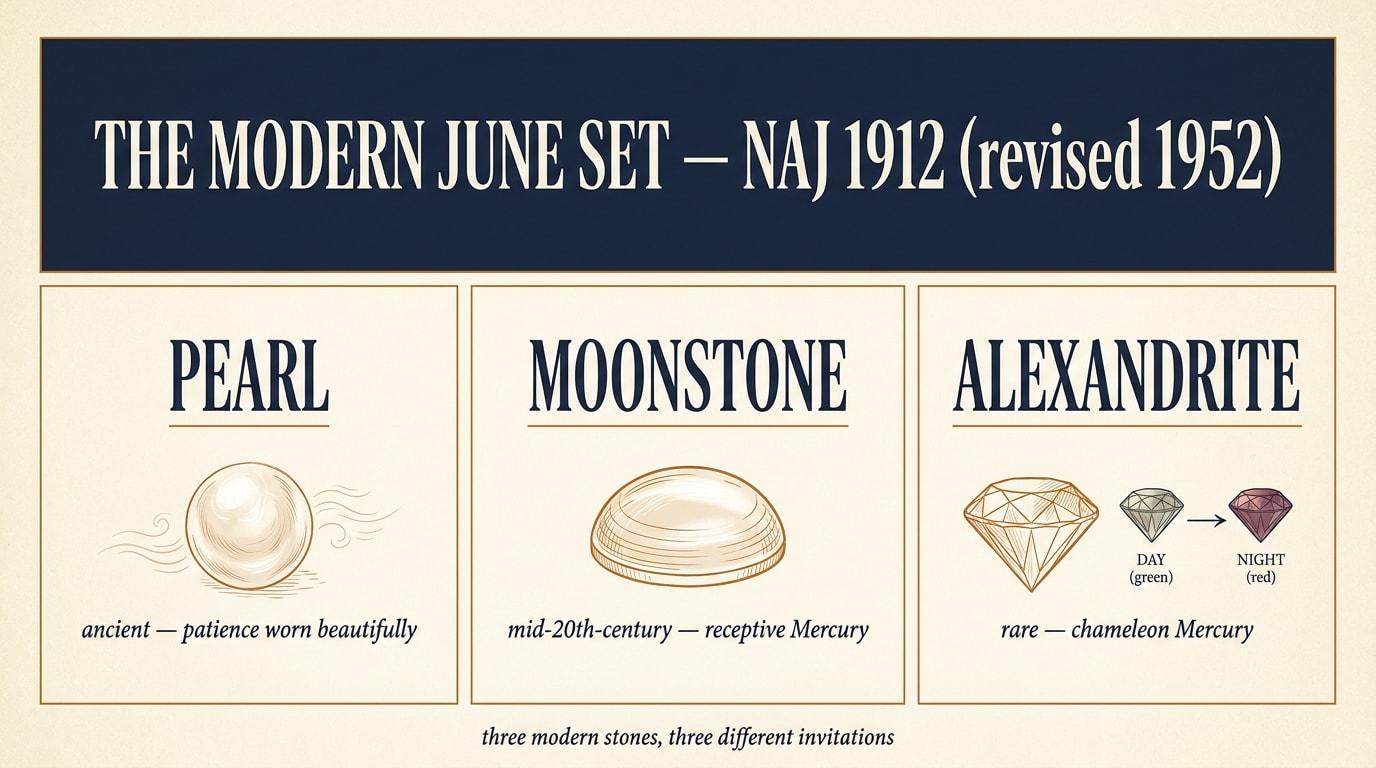
That's the modern set — soft, luminous, and rare, in roughly that order. If you came here wanting a quick clean June gift, any of the three works. The honest astrological story, though, sits a layer down.
The older Mercury-correspondence stones (agate, citrine, tiger's eye, chrysoprase)
Long before the 1912 jewellers' list, Western astrology assigned stones to zodiac signs through their ruling planet. Gemini's ruler is Mercury, the planet of communication, movement and the bright quick mind, and the stone the Renaissance lapidaries kept coming back to for Mercury was agate.
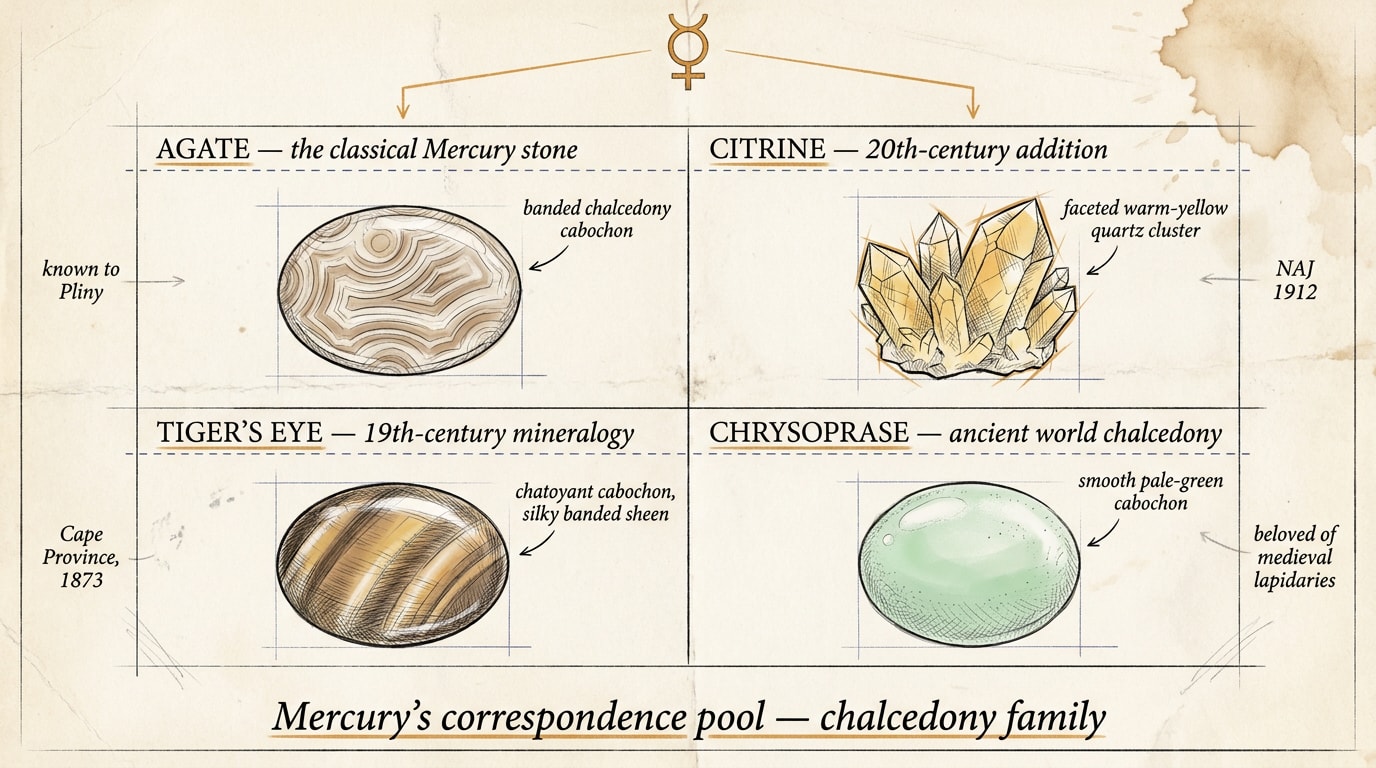
Agate is a banded, layered form of chalcedony, quartz with visible parallel layers in subtle bands of grey, brown, cream and sometimes blue or green. Camillo Leonardi's Speculum Lapidum of 1502, the standard Renaissance lapidary, attributed agate to Mercury, and George Frederick Kunz's The Curious Lore of Precious Stones in 1913, the standard early-modern English reference, repeated and extended the attribution. The reason given in the older tradition is pleasing whether or not you buy the symbolism: the visible layers of an agate — patterns within patterns, lines that don't quite repeat, match the Mercurial idea of layered communication, ideas inside ideas. Agate is also genuinely affordable. A polished agate bracelet on Etsy UK or at a London market stall runs £15 to £50; a carved agate signet ring, perhaps £50 to £150.
 rolling up mat.
Citrine, the warm yellow-to-amber variety of quartz, came into association with Mercury and Gemini later, mainly through twentieth-century commercial astrology compendia (the Cunningham-era encyclopaedias and their successors). It's a sunnier counterpart to agate, often paired with it in gift sets aimed at Gemini. Citrine pendants run £40 to £150 at Astley Clarke or independent UK silversmiths.
Tiger's eye, that golden-brown banded quartz with the cat's-eye shimmer, entered the modern Mercury-stone list largely through 19th-century mineralogy, when South African specimens became widely available; the cat's-eye effect (correctly called chatoyancy) felt suitably bright and alert for Mercury. Chrysoprase, the apple-green chalcedony, is the oldest of the four (Hellenistic and Roman jewellers were using it freely), and was attributed to Mercury in some medieval lapidaries on the strength of its bright, quick green. Both run affordably: tiger's eye beads £10-30, chrysoprase pendants £40-120 at UK gem dealers.
These four — agate, citrine, tiger's eye and chrysoprase — are the older, astrologically "proper" Gemini stones, and they tend to be both more affordable and more visually varied than the modern June set. If you wanted a Gemini-specific gift with a story to tell, any of them will earn its place.
Why these stones? A note on Mercury and the Twin archetype
Mercury, in Western astrology, is the planet of communication, the messenger between worlds, the same Mercury who, in classical mythology, was Hermes: the swift god with winged sandals, dual-natured, equally at home guiding souls down to the underworld and carrying messages back up. Mercury rules two signs, Gemini and Virgo — the only planet outside the Sun and Moon to rule two signs, in the traditional scheme. That dual rulership is part of why Gemini, the sign of the Twins, fits Mercury so well: a planet that does two jobs, ruling a sign whose symbol is two figures.
That gives you the basis for the original frame, a Twin-themed pairing. Rather than choosing one Gemini stone, you choose two that talk to each other. Agate paired with citrine makes a balanced set: agate's grounded layered quiet beside citrine's warm bright energy. Pearl paired with moonstone makes a softer, more lunar set: pearl's classical reflectiveness beside moonstone's shifting iridescence. Tiger's eye paired with chrysoprase makes a warm-cool set: golden alertness beside cool green calm. Most jewellers won't market it this way — the "paired birthstone" concept is more interesting than commercial, but it's a way of using the Gemini archetype rather than just labelling it.
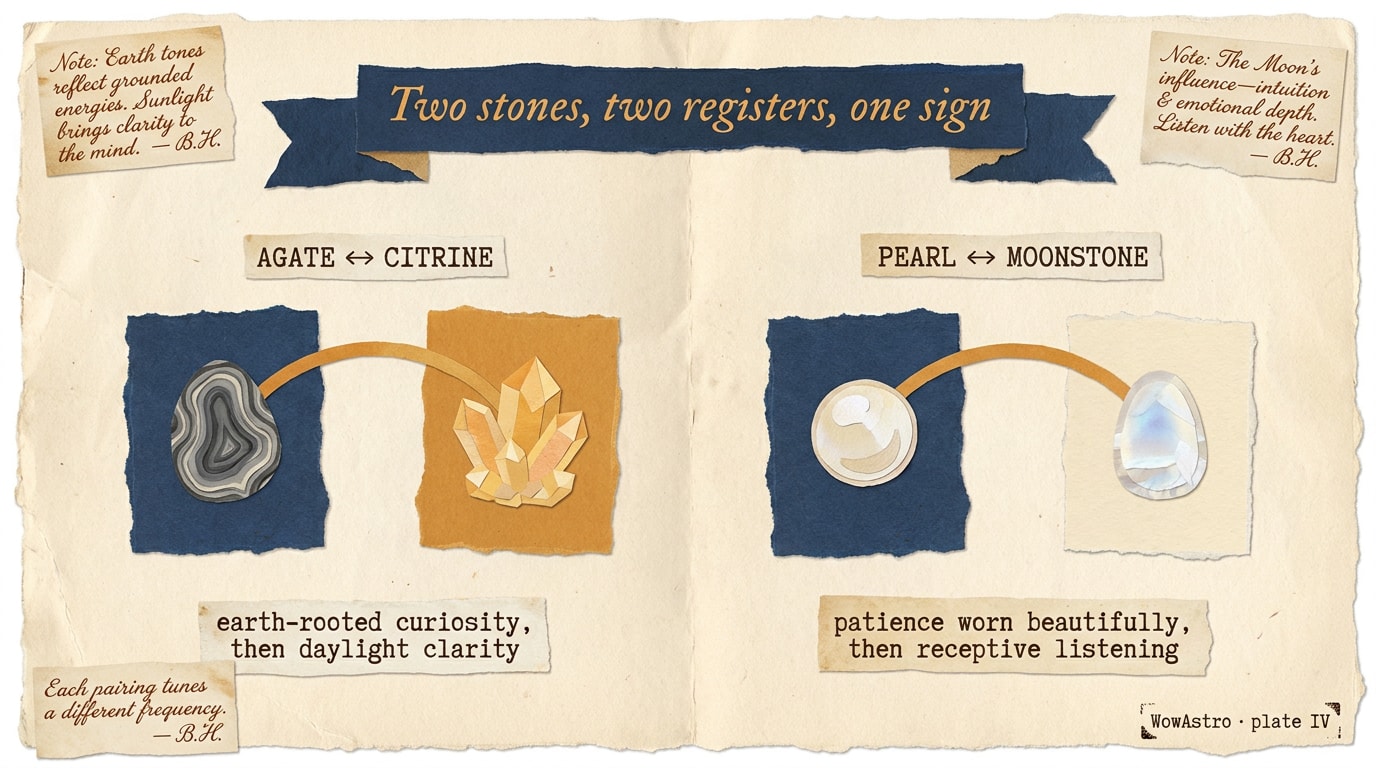
Two stones, two registers, one sign. That's a properly Gemini gift in a way that one stone, however lovely, isn't.
A note for cluster shopping. If you're choosing a Gemini birthstone as a gift, the Twin-pairing concept also solves the practical problem of "two people on the list" — a Gemini Sun in your family is rarely the only Gemini you know, since the sun-sign cluster repeats roughly every four weeks across June birthdays. Two affordable pieces (agate plus citrine, or moonstone plus pearl) often work better than one expensive piece for two recipients.
If your birthday is on the May/June edge
Gemini season runs roughly 21 May to 20 June. The exact boundary shifts by about a day between years because the Sun changes sign at a different clock-time each year, so a birthday on 20 or 21 May (the Taurus-Gemini edge) or 20 or 21 June (the Gemini-Cancer edge) might land either side of the line depending on the year and birth time. If your birthday falls comfortably inside that window, you're a Gemini Sun and any of the stones above apply.
If you're a late-May birthday, anywhere from 21 to 31 May, you have an interesting overlap: emerald is the May birthstone (the older Taurus-month stone), so by the calendar tradition you also have a claim on emerald, while by zodiac you're already a Gemini and the Mercury-ruled stones are yours. Some late-May Geminis happily collect both. If you're a 20 or 21 June birthday and the cusp question matters, an exact calculation of the sign-change for your year will settle it: you can calculate a full natal chart and the date-time-place will tell you which side of the line you came in on.
 sketching with charcoal.
What to do with this if you're picking a stone
Your Gemini birthstone is most useful as a starting point. Three frames, not one, and the choice depends on the gift, the budget, and how much you care about the astrological lineage. Three practical moves.
First, if you want the safe traditional answer with maximum recognisability, the modern June set works: pearl earrings (£30-200, Liberty London, John Lewis, Hatton Garden) for a classical gift; moonstone pendant (£40-150, Astley Clarke or independent UK silversmiths) for something a little more interesting; alexandrite (synthetic, £20-80) for the most unusual of the three at a real-world budget.
Second, if you want the older astrological answer, the Mercury-ruled stones cover a wider price range and feel more "Gemini-specific": an agate bracelet (£15-50, Etsy UK or any London market jeweller) is the most direct lineage; citrine pendant (£40-150) is the brighter cousin; tiger's eye beads (£10-30) for a more masculine gift; chrysoprase (£40-120) for something with quiet ancient history.
Third, if you want the Twin-pairing original answer, choose two stones that talk to each other (agate with citrine, pearl with moonstone, tiger's eye with chrysoprase), and let the pairing carry the symbolism the single stone never quite does.
And if the curiosity has lasted this far, the stone is only one of ten ways the Gemini Sun shows up. The Gemini star sign is a useful starting point in astrology, but the Moon, Rising sign, Mercury sign and the other six planets fill in the rest of the picture. WowAstro will calculate your free birth chart: date, time and place, and it takes a couple of minutes. The full chart adds the other nine, and most of what makes a particular Gemini that Gemini lives there, in the layering rather than in the Sun sign alone.
Questions readers ask
What is the birthstone for Gemini?
A Gemini birthstone falls into one of three traditions, depending on which list you're reading. The modern calendar list, standardised by the American National Association of Jewelers in 1912, gives pearl as the June birthstone, with moonstone and alexandrite added in 1952. The older astrological tradition, rooted in Renaissance lapidary works like Camillo Leonardi's of 1502 and George Frederick Kunz's The Curious Lore of Precious Stones of 1913, assigns stones through the ruling planet; Gemini's ruler is Mercury, and the classical Mercury stone is agate, with citrine, tiger's eye and chrysoprase added by later commercial astrology. A third frame — paired stones representing the Twin archetype — lets you combine two, such as agate with citrine or pearl with moonstone, in a way the single-stone answer never quite captures.
Why is pearl the June birthstone if Gemini's ruling planet is Mercury?
Because the modern June birthstone is a commercial standardisation, not an astrological one. The 1912 American National Association of Jewelers list assigned pearl to June largely because June needed a soft, recognisable and reasonably affordable summer stone, pearl was an obvious commercial choice. Pearl is traditionally associated with the Moon, which rules Cancer, not with Mercury, which rules Gemini. The older astrological Gemini stone is agate, and most working astrologers today recognise both lists as legitimate — one calendrical and commercial, the other planetary and traditional.
My birthday is 21 May or 21 June — am I a Gemini, and which stone applies?
It depends on the year and your birth time. Gemini season runs roughly 21 May to 20 June, but the exact moment the Sun crosses into and out of Gemini shifts by about a day between years because the Sun changes sign at a different clock-time each year. If you were born within a day of either boundary, the only honest answer comes from calculating the exact sign-change for your year. If you're a late-May Gemini, you also have a calendar claim on emerald (the May birthstone); if you're a 20 or 21 June birthday, the chart settles whether you came in as a Gemini or as a Cancer.
Do Gemini Moon and Gemini Rising have birthstones too?
Traditionally, no, the birthstone systems are Sun-based, because they're tied to either the calendar month (modern list) or the Sun's zodiac sign (older list). Some modern astrologers extend the idea by recommending the ruling-planet stone of your Moon or Rising sign — so a Gemini Moon or Gemini Rising would also align with Mercury-ruled stones like agate or citrine on this extended reading. That's a contemporary practice rather than a classical one, but it's a sensible extension if you find the Sun-only list too narrow. Finding out your Moon and Rising signs takes your exact birth time and place.
A note on what this is. Astrology, as we use it at WowAstro, is a tool for self-reflection and self-understanding, not a method for predicting events, health or financial outcomes. The Gemini birthstone descriptions on this page are traditional symbolic correspondences from astrological and lapidary canon — used here for entertainment and meaning-making, not as active medicinal, financial or causal agents. Stones don't heal, balance, attract or manifest. They sit in a long history of human meaning-making, which is a legitimate reason to wear or gift one; the rest is sales copy.
Written by Oksana Miatova, astrologer and writer at WowAstro. Charts calculated using the Swiss Ephemeris, the same astronomical data working astrologers use.
Read your own natal chart
A personal AI reading, from £1
⭐ +50 Wow Stars cashback · sign up and get 100 ⭐
Build my chart →Comments
New here? Get −30% off your natal chart
Leave your email and we will send you the promo code WELCOME30. Straight after that you can comment — no passwords, all automatic.
Quick sign-in
Sign in with Telegram — one click.
Or by email (with a gift)
Already have an account? Enter the same email — we'll email you a sign-in link.