Three friends, three different January birthdays, three different Chinese zodiac animals — and at least one of them looked it up on a different website and got a different answer. Somewhere in that confusion is a real question: what are the Chinese zodiac signs by year, how do you find yours, and is this the same as your star sign or a different thing entirely?
Short answer to the last one first: it's a different thing entirely. Chinese zodiac and Western zodiac are two separate systems with different mechanics — different sources, different boundaries, different ways of telling someone apart from someone else. They can sit alongside each other, but they don't collapse into one reading. The rest of this page is how to find your Chinese animal without getting it wrong, what each of the twelve traditionally means, and how the two systems relate when both apply to the same person.
In short. The Chinese zodiac assigns one of twelve animals to each lunar year, repeating in a fixed twelve-year cycle: Rat, Ox, Tiger, Rabbit, Dragon, Snake, Horse, Goat, Monkey, Rooster, Dog, Pig. Your animal is decided by the lunar year you were born in — which starts at Chinese New Year (late January to mid-February), not 1 January. The system is separate from Western astrology; the animal describes your traditional temperament archetype, not your Sun-position reading.
 turning a page slowly.
What the Chinese zodiac actually is (and isn't)
The Chinese zodiac is a twelve-year cycle of animals, one per lunar year, used across East Asia in roughly the same casual register as Western Sun signs are used in the UK — a quick way to ask "what kind of person are you?" without committing to a long answer. It is not the Chinese version of your star sign. The two systems use different inputs, run on different cycles, and describe different things.
The Western zodiac uses where the Sun was on the day you were born, sliced into twelve thirty-degree segments along a yearly path; your sign changes roughly every month. The Chinese zodiac uses which lunar year you were born in, on a twelve-year animal cycle; your sign changes once a year, at Chinese New Year. Western sorts by season; Chinese sorts by year. Western sliced human temperament into element-archetypes (fire, earth, air, water); Chinese into animal-archetypes (the twelve).
This matters because it means a single person has both readings, and the readings don't conflict. Someone born on, say, 15 July 1990 is Horse in the Chinese system (1990 was a Horse year) and Cancer in the Western system (the Sun was in Cancer that day). Both are "true" within their own system. They describe different layers; reading one doesn't cancel the other, the way knowing someone's profession doesn't cancel knowing their accent.
If you've come to this page knowing your Western Sun sign and wondering whether the Chinese sign overrides it: nothing overrides anything. They sit beside each other. Most people who use both find one slightly more useful than the other for self-recognition; some find both useful for different questions.
Why the year boundary moves: Chinese New Year, not 1 January
Your Chinese zodiac year is decided by the lunar calendar, which begins at Chinese New Year — a date that falls between late January and mid-February depending on the new moon, not on 1 January. Most online year-tables show calendar-year boundaries ("1990 = Horse"), which is right for most of the year but wrong for anyone born in the first six or seven weeks. This is the single most common reason people get a different animal from a different website.
The mechanism is simple. The Chinese calendar is lunisolar, meaning each new lunar month starts on a new moon, and the year as a whole is anchored to align loosely with the solar seasons. The first day of the lunar year — Chinese New Year — is the first new moon between 21 January and 20 February. That moves the boundary by up to a month, year to year. Anyone born after 1 January but before Chinese New Year is in the previous lunar year, and therefore the previous animal.
A worked example. Chinese New Year in 2007 fell on 18 February. Someone born on 1 February 2007 is in the year that started in February 2006 — the Year of the Dog — even though 2007 as a calendar year was the Year of the Pig. A naïve year-table that just says "2007 = Pig" will give them the wrong animal.
Here are the Chinese New Year dates for the last few decades as a quick reference; if your birthday is in January or the first two weeks of February, this is the table that matters.
| Year | Chinese New Year | Year | Chinese New Year | Year | Chinese New Year |
|---|---|---|---|---|---|
| 1980 | 16 Feb | 2000 | 5 Feb | 2020 | 25 Jan |
| 1985 | 20 Feb | 2005 | 9 Feb | 2021 | 12 Feb |
| 1990 | 27 Jan | 2007 | 18 Feb | 2023 | 22 Jan |
| 1995 | 31 Jan | 2010 | 14 Feb | 2024 | 10 Feb |
| 1998 | 28 Jan | 2015 | 19 Feb | 2025 | 29 Jan |
| 1999 | 16 Feb | 2018 | 16 Feb | 2026 | 17 Feb |
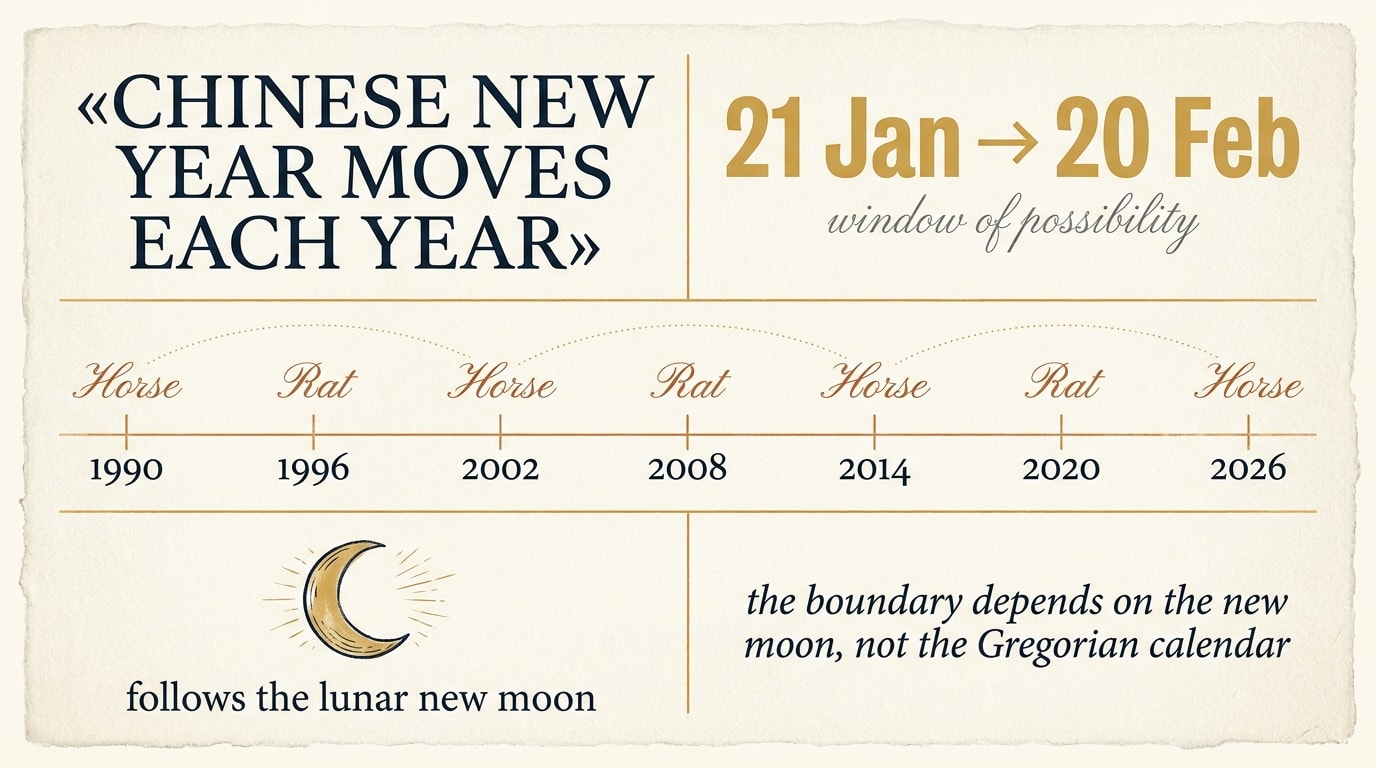
If you were born in January or the first half of February, check the exact Chinese New Year date for your birth year before deciding which animal you are. Born before it: you're the previous year's animal. Born on or after it: you're the new year's animal.
Find your Chinese zodiac animal by birth year
The twelve animals repeat in a fixed order on a twelve-year cycle, so once you know one anchor year you can count forwards or backwards in twelves and land on the right animal. The cycle order is Rat, Ox, Tiger, Rabbit, Dragon, Snake, Horse, Goat, Monkey, Rooster, Dog, Pig — and then back to Rat for the thirteenth year. Use the table below as the quick lookup; remember that for January and early-February birthdays, the Lunar New Year rule from the previous section applies.
| Year | Animal | Year | Animal | Year | Animal |
|---|---|---|---|---|---|
| 1948 | Rat | 1976 | Dragon | 2004 | Monkey |
| 1949 | Ox | 1977 | Snake | 2005 | Rooster |
| 1950 | Tiger | 1978 | Horse | 2006 | Dog |
| 1951 | Rabbit | 1979 | Goat | 2007 | Pig |
| 1952 | Dragon | 1980 | Monkey | 2008 | Rat |
| 1953 | Snake | 1981 | Rooster | 2009 | Ox |
| 1954 | Horse | 1982 | Dog | 2010 | Tiger |
| 1955 | Goat | 1983 | Pig | 2011 | Rabbit |
| 1956 | Monkey | 1984 | Rat | 2012 | Dragon |
| 1957 | Rooster | 1985 | Ox | 2013 | Snake |
| 1958 | Dog | 1986 | Tiger | 2014 | Horse |
| 1959 | Pig | 1987 | Rabbit | 2015 | Goat |
| 1960 | Rat | 1988 | Dragon | 2016 | Monkey |
| 1961 | Ox | 1989 | Snake | 2017 | Rooster |
| 1962 | Tiger | 1990 | Horse | 2018 | Dog |
| 1963 | Rabbit | 1991 | Goat | 2019 | Pig |
| 1964 | Dragon | 1992 | Monkey | 2020 | Rat |
| 1965 | Snake | 1993 | Rooster | 2021 | Ox |
| 1966 | Horse | 1994 | Dog | 2022 | Tiger |
| 1967 | Goat | 1995 | Pig | 2023 | Rabbit |
| 1968 | Monkey | 1996 | Rat | 2024 | Dragon |
| 1969 | Rooster | 1997 | Ox | 2025 | Snake |
| 1970 | Dog | 1998 | Tiger | 2026 | Horse |
| 1971 | Pig | 1999 | Rabbit | 2027 | Goat |
| 1972 | Rat | 2000 | Dragon | 2028 | Monkey |
| 1973 | Ox | 2001 | Snake | 2029 | Rooster |
| 1974 | Tiger | 2002 | Horse | 2030 | Dog |
| 1975 | Rabbit | 2003 | Goat | 2031 | Pig |
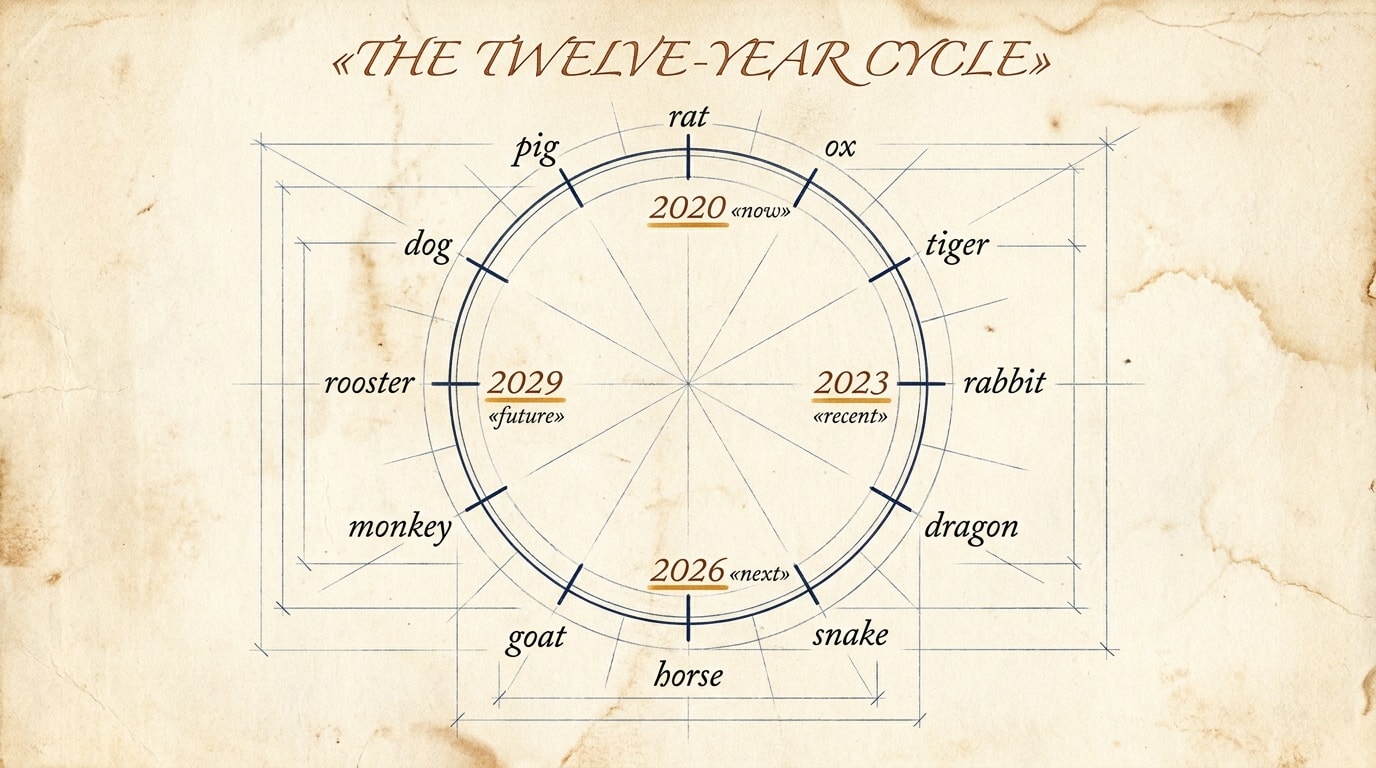
If your birthday is in March through December, the table is the whole answer. If it's in January or the first half of February, glance back at the Lunar New Year dates in the previous section to settle which side of the boundary you came in on.
The 12 Chinese zodiac animals in plain English
What follows is the traditional reading of each animal, kept short and adult. Read each as a casual character-key — the kind of thing a friend says about a colleague, not a personality verdict.
Rat is the first animal in the cycle: sharp, resourceful, the planner who notices what's worth noticing. A Rat tends to read a room quickly and make the small useful move before anyone else does. Underestimated for being agreeable on the surface; the gears underneath are usually moving.
Where the Rat moves fast, the Ox moves carefully. Steady, methodical, slow to decide and slow to be moved off a decision once made. The colleague who always shows up on time, knows where the project actually stands, and almost never quite asks for the credit; quietly underestimated for the same reasons.
Tiger is bold and restless — the one who starts the thing. Charismatic in a room, often the first to disagree with whoever just spoke; both the leadership and the friction are part of the same package. Best around people who don't take the disagreement personally.
If you've ever known someone who could defuse a tense table with a quiet sentence, you've met a Rabbit. Gentle, observant, the diplomat of the cycle. People relax around them. The traditional reading calls Rabbit soft-spoken; the realistic reading is that quiet noticing is what keeps the peace.
Dragon is the room-warmer — the natural centre-of-the-table, confident, generous, occasionally a little too generous with their certainty. The cultural favourite of the twelve; Dragon years often see a small uptick in births across parts of East Asia, which is its own kind of evidence about how the archetype is regarded.
The Snake plays the long game. Thoughtful, private, slow to speak, slow to trust, surprisingly funny once you're past the threshold. The colleague you don't quite realise is the smartest one in the room until two years in, by which point they've quietly arranged something useful.
A Horse is independent and energetic — the one allergic to being managed. Travels, changes jobs, opens the conversation no one else would. Best when given the long lead and trusted to come back with something interesting; worst when fenced in for someone else's convenience.
Goat — sometimes also called Sheep or Ram, depending on the translation — is the sensitive, artistic one of the cycle. Tends to be the most aesthetically inclined of the twelve, the one who notices the colour of the wall. Sometimes accused of being soft, which mistakes care for fragility.
 reading handwritten letter.
Monkey is clever and playful — the problem-solver who finds the angle no one else spotted, then tells you the joke about solving it. Best around people who can keep up with the speed; bored otherwise, and a bored Monkey is something everyone notices.
Rooster is precise and observant; will tell you the truth before you've finished asking. Often the best-dressed person in the room and the most honest one in it; both are part of the function rather than two separate facts about a Rooster.
The Dog is loyal and principled, quietly suspicious of anyone who isn't. The friend who'd help you move at three in the morning and also remember the time you didn't return their book. A steady sense of fairness is the through-line; almost everything else follows from it.
Pig is the last in the cycle: generous, sincere, often more capable than they let on. The host. The one who organised the thing and now mostly wants you to enjoy it. Sometimes underestimated for being kind, which usually says more about the people doing the underestimating.
In short. Read your own animal as a starting sketch, not a verdict; then read the ones of two or three people you actually know and see whether the sketches match the people.
A worked example: born in 1990
To see how the Chinese and Western systems coexist, take one date and map both. Someone born on 15 July 1990 is Horse in the Chinese zodiac and Cancer in the Western zodiac. Same person, same date, two different readings — and neither one cancels the other.
Here is the working. The year 1990 was a Horse year on the twelve-year cycle, and Chinese New Year 1990 fell on 27 January, so anyone born from 27 January 1990 through to the day before Chinese New Year 1991 is Horse. The 15th of July falls inside that window. For the Western reading, the Sun was in Cancer on 15 July 1990 — Cancer runs roughly from 21 June to 22 July, and 15 July is squarely inside.
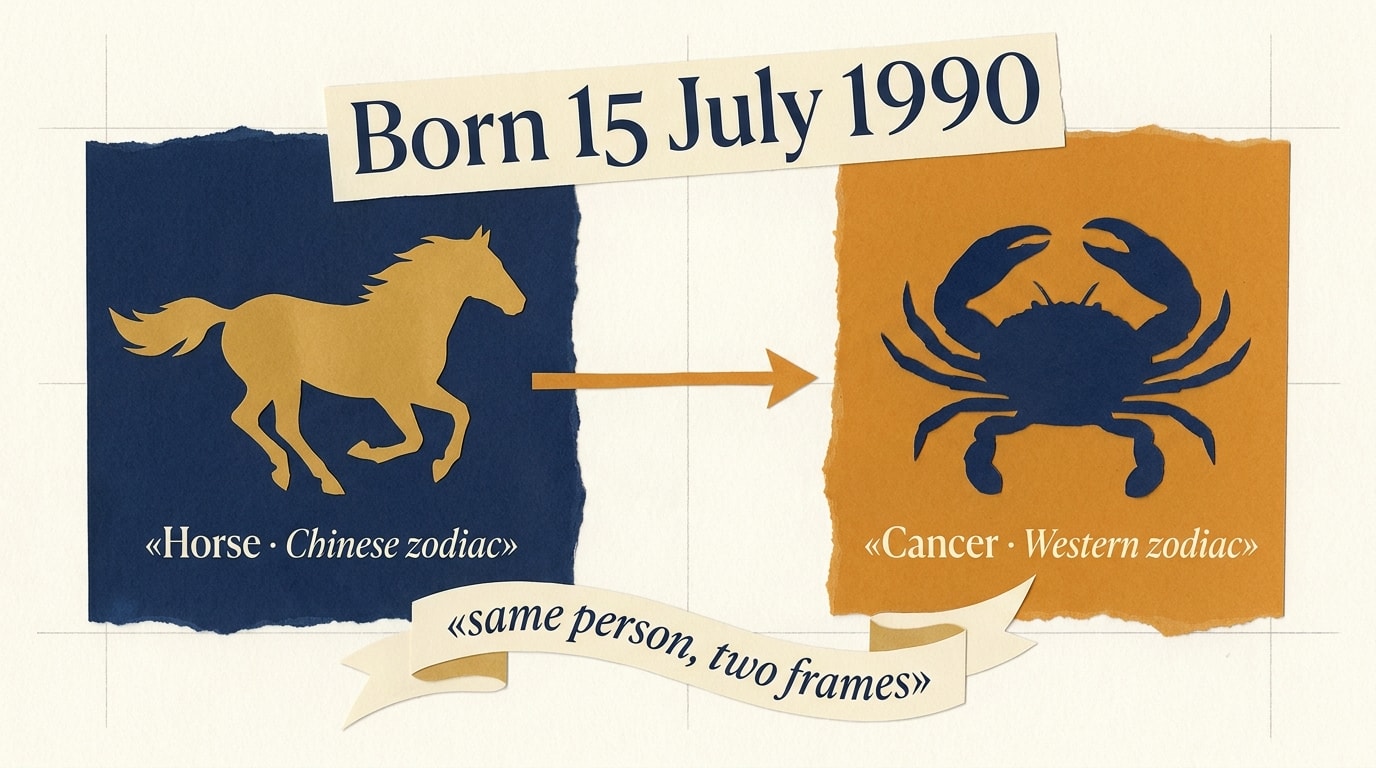
Now the readings. The Chinese reading says Horse: independent, energetic, allergic to being managed. The Western reading says Cancer: home-making, emotionally tuned, soft on the outside and surprisingly durable underneath. The two descriptions are different but not in conflict — they are describing different layers, the way a cuisine description and a temperament description both apply, separately, to the same cook. Most people who use both frames find that one of them lands a little harder for them; some find that the combination feels more accurate than either alone.
If you'd like the full Western reading for your own date — including which of the twelve Western signs your Sun was in, plus the Moon and Rising sign, which most people find more interesting than the Sun on its own — that's a different page.
How seriously to take it (and where to go next)
The Chinese zodiac is most useful at the register it's actually used at in East Asia: a casual conversational temperament-shorthand, useful for self-reflection and a quick character-sketch of someone, not a forecast of events. It sits alongside Western astrology rather than competing with it; many readers find one frame more useful than the other, some find both, and almost nobody finds either one a literal predictor of what's going to happen on Tuesday.
 sitting cross-legged on a rug with a.
Neither system is in the prediction business in any verifiable sense; both are descriptive frameworks. The practical question is whether a particular frame helps you notice something useful — about yourself, about a friend, about why a relationship is the shape it is. Sometimes the Chinese frame catches something the Western frame missed, and sometimes the other way around.
Three practical moves, then. First, read your own animal and the animals of the four or five people closest to you as a quick character-key; you'll know within a paragraph each whether the sketches match the people. Second, if you were born in January or early February, double-check your animal against the Lunar New Year date for your birth year — it is the single most common mistake. Third, if you'd like the Western reading for the same date, your free Western daily horoscope takes a couple of seconds, and works alongside whatever the Chinese reading already gave you.
Questions readers ask
What's my Chinese zodiac sign if I was born in January or early February?
If you were born in January or the first two weeks of February, your animal depends on whether your birthday falls before or after Chinese New Year for that specific year. Chinese New Year is the first new moon between 21 January and 20 February, so its date moves year to year. Born before it: you are the previous calendar year's animal. Born on or after it: you are the new calendar year's animal. The most common mistake is taking the calendar-year-only table from a portal site and getting the wrong animal by a month. The Chinese New Year date list in the section above gives the boundary for the most-asked-about years.
What is the difference between Chinese zodiac and Western zodiac?
They are two separate systems with different mechanics, even though both are called "zodiac" in English. The Western zodiac uses the Sun's position on your date of birth, sliced into twelve roughly thirty-day segments; your sign changes about once a month. The Chinese zodiac uses which lunar year you were born in, on a twelve-year animal cycle; your sign changes once a year, at Chinese New Year. Western signs are element-archetypes (fire, earth, air, water); Chinese signs are animal-archetypes (Rat through Pig). They describe different layers of the same person; reading one does not cancel the other.
What animal is 2026 in the Chinese zodiac?
2026 is the Year of the Horse — specifically from 17 February 2026 (Chinese New Year) through 5 February 2027. Anyone born between those two dates is a Horse on the twelve-year cycle. Note the boundary: someone born on, say, 10 February 2026 is still in the previous year (Snake), because Chinese New Year 2026 had not yet arrived. The next Horse year after 2026 will be 2038.
Are Chinese zodiac compatibility readings real?
Chinese zodiac compatibility — the traditional pairings of which animals "get on" with which — is a cultural framework with no scientific basis, in the same way Western Sun-sign compatibility is. It's used in East Asia at the same casual register as the rest of the system: useful as a conversation-prompt about a relationship, sometimes mildly accurate as a personality-pattern observation, but not a predictor of whether a particular relationship will work. The thing that decides whether two people get on tends to be the same in any zodiac system: how they talk, what they want, and whether they show up when it matters.
Read the wider context in our guide to your full birth chart
A note on what this is. Both the Chinese zodiac and Western astrology, as we use them at WowAstro, are tools for self-reflection and self-understanding, not methods for predicting events, health, or financial outcomes. Read the twelve animals as descriptions of temperament — take what's useful, leave the rest.
About this article: WowAstro readings combine traditional astrological methodology (Swiss Ephemeris calculations, Hellenistic and modern psychological frameworks) with AI-assisted writing reviewed by Oksana Miatova before publication. For entertainment and self-reflection only — not medical, legal, or financial advice. Full editorial policy at /editorial-standards.
Written by Oksana Miatova, astrologer and writer at WowAstro. Western charts calculated using the Swiss Ephemeris, the same astronomical data working astrologers use; Chinese zodiac dates verified against published lunar-calendar tables (see Wikipedia: Chinese New Year for the full historical date list).
Read your own natal chart
A personal AI reading, from £1
⭐ +50 Wow Stars cashback · sign up and get 100 ⭐
Build my chart →Comments
New here? Get −30% off your natal chart
Leave your email and we will send you the promo code WELCOME30. Straight after that you can comment — no passwords, all automatic.
Quick sign-in
Sign in with Telegram — one click.
Or by email (with a gift)
Already have an account? Enter the same email — we'll email you a sign-in link.