Three apps, three slightly different verdicts. Astrology.com tells you to brace for tension at work; Vogue says today is about emotional release; Cafe Astrology mentions a Moon-Mercury square but doesn't quite translate what that means. You're a Cancer, you read your horoscope most mornings, and you'd quite like to know whether any of this is actually telling you something — or whether everyone's making it up as they go along.
Short answer: a daily horoscope isn't a verdict about your day. It's a description of today's sky, read through your Cancer Sun sign. The mechanics behind it are simpler than the prose suggests, and once you can see them, the "accurate one day, rubbish the next" pattern starts to make a kind of sense.
In short. A daily Cancer horoscope describes where the Moon and a few key planets sit in the sky today, interpreted through Cancer Sun temperament. Today and tomorrow differ because the Moon moves about thirteen degrees a day and changes sign every two and a half days. A general daily reads only your Sun sign — one of ten things on your full chart — which is why some days it lands and some days it doesn't.
 Most Cancers read their horoscope half-attentively, half-honestly.
What a daily Cancer horoscope actually is
A horoscope for Cancer today is a short read of today's sky filtered through one piece of your chart, your Cancer Sun. Astrologers look at where the Moon currently sits, which sign it's moving through, and the closest aspects it's making to other planets, then describe how that combination tends to feel through a Cancer-Sun lens. Twelve such reads (one per sign) are published every morning by sites like Astrology.com and Horoscope.com, all built from the same underlying transit chart for the day. A daily horoscope is a weather report on the sky, not a forecast for your specific life; the difference matters more than it sounds.
A few words in plain English before we keep going. A transit means where planets are now, as opposed to where they were when you were born. An aspect means the angle between two planets; astrologers care about the angle because particular angles (90 degrees, 120 degrees) tend to have particular textures. A Moon sign is which of the twelve zodiac signs the Moon is currently moving through. The Moon is the fastest body in the system, and most of the "feel" of a daily horoscope comes from the Moon's current location.
Cancer is one of the four water signs — temperament built around feeling, atmosphere, what isn't being said. A Cancer daily reads as today's transit chart filtered through that temperament. It won't tell you what happens next. Anyone promising that is selling something.
Why today and tomorrow differ for Cancer
Today and tomorrow differ because the Moon moves quickly across the sky, changing sign every two and a half days and shifting its angles to the other planets hour by hour. Most of the daily-horoscope feeling comes from the Moon. It's the fastest-moving body the system tracks, which is why daily reads change quickly. In 24 hours the Moon moves about thirteen degrees, roughly half a zodiac sign; in 48 hours it can move into a different sign altogether, with a different temperament and different aspects to other planets. When an astrologer writes "today" and "tomorrow" horoscopes for Cancer, they're often describing two different Moon configurations, not the same day from two angles.
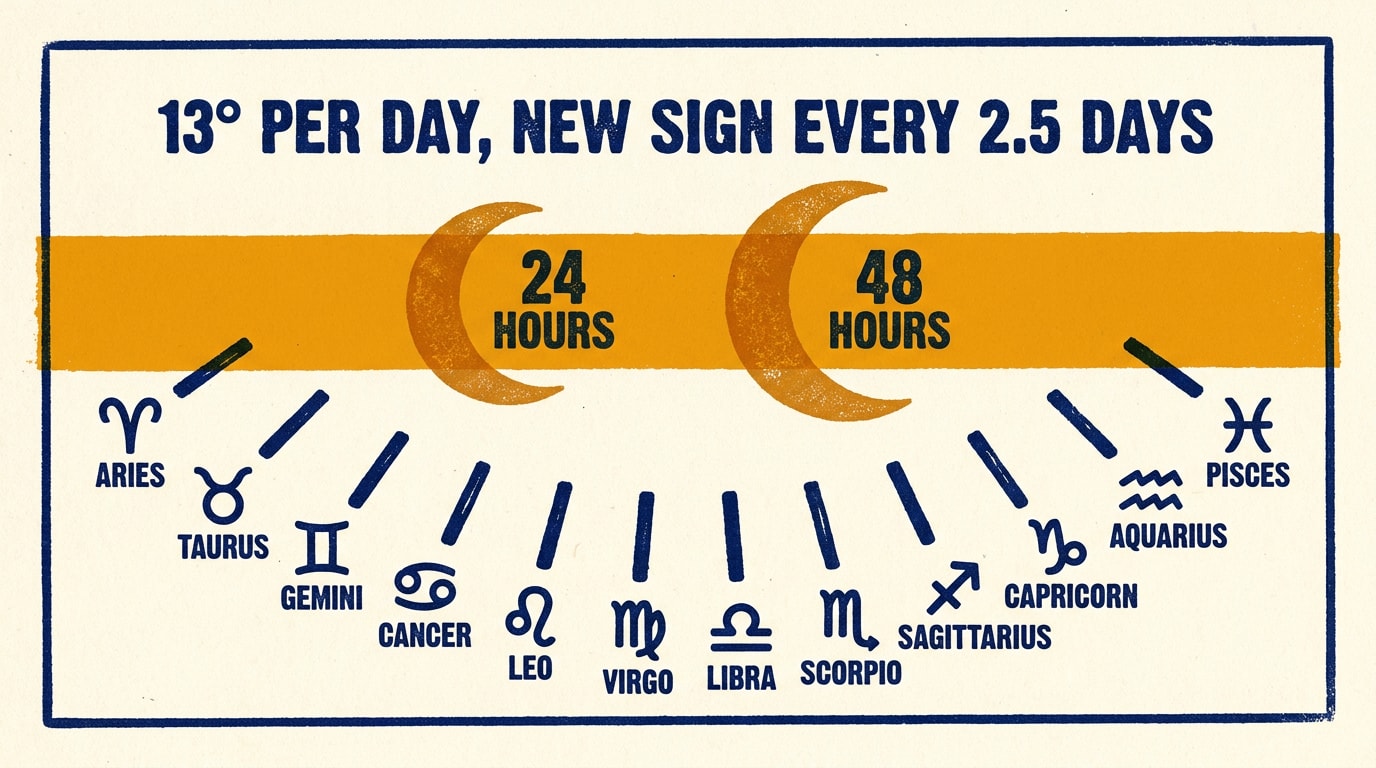
Two terms worth knowing before they confuse you. The sky is divided into 360 degrees, with each zodiac sign occupying 30 of them; that's how astrologers measure where planets are. The other is a void-of-course Moon, a brief window when the Moon has finished its last aspect to other planets before changing sign. Astrologers often describe these as quieter periods, with no big new starts; treat the description as a tendency people notice, not a rule about your day.
The clearest way to see today-versus-tomorrow in practice is to notice the Moon sign in each daily read. If your horoscope says "today the Moon moves through Libra" and "tomorrow the Moon enters Scorpio", you're reading two genuinely different astrological textures: an air-sign Moon (cool, social, talkative) and a water-sign Moon (deeper, quieter, more inward). The prose around it is interpretation; the transit itself is the part you can verify.
Are daily horoscopes accurate?
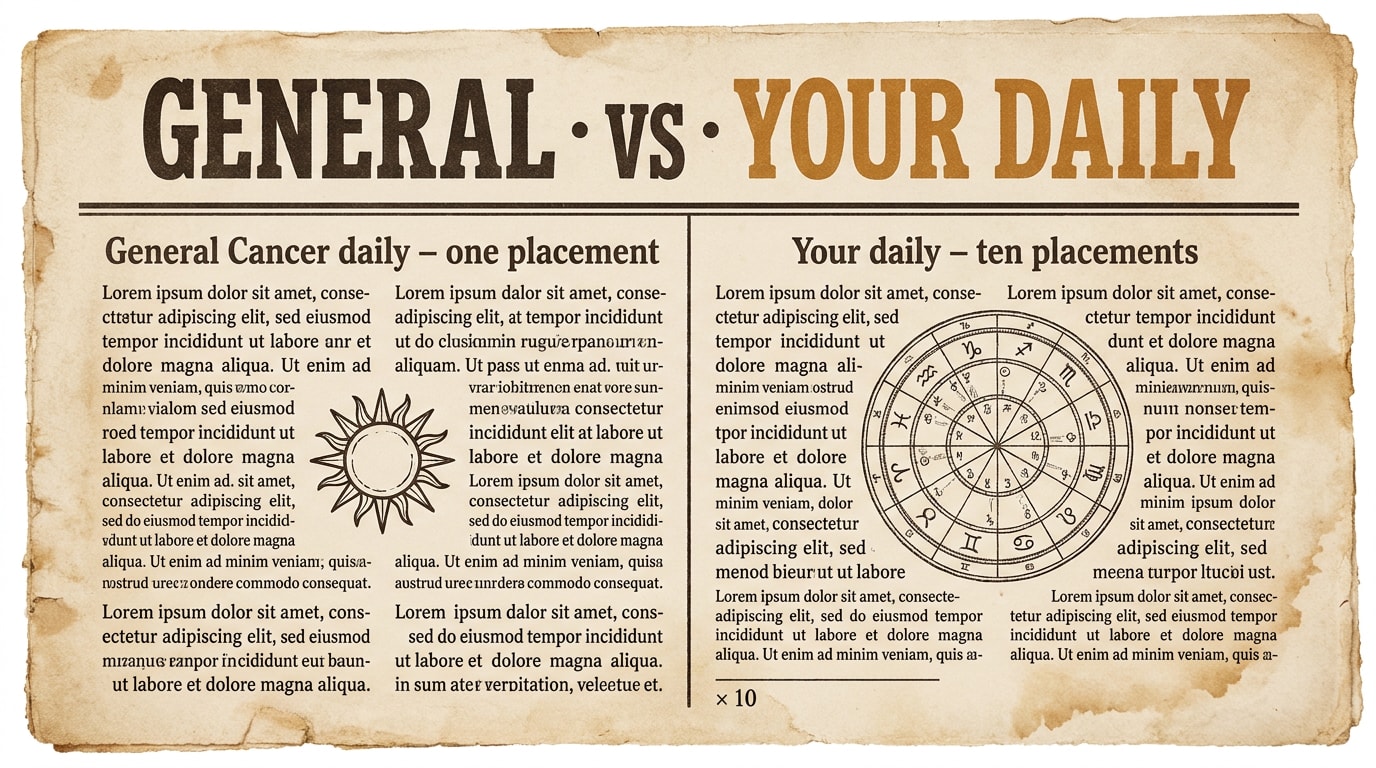
A horoscope today for Cancer is accurate for the slice of life it actually describes — roughly one tenth of the picture — and only when today's transits happen to resonate with the rest of your chart. A general daily Cancer horoscope reads only one placement: your Cancer Sun. It doesn't know your Moon sign (your emotional weather), your Rising sign (the first impression you make), or any of the seven other placements on your birth chart. That's the structural reason two Cancers can read the same horoscope and one nods along while the other rolls their eyes: their other nine placements are different.
 A general daily reads one tenth of you.
If you've ever felt like the horoscope landed perfectly one day and described someone else entirely the next, you weren't being inconsistent. The horoscope was. Daily sun-sign horoscopes sit in the entertainment and self-reflection bracket, not the prediction bracket. By their own design, they read only one twelfth of you; that's not a bug, it's the format.
The honest version of "accuracy" for a daily horoscope looks like this. The underlying transit (where the Moon is, which planet it's in aspect with) is measurable astronomical fact, accurate in the way a tide chart is accurate. The prose interpretation, the verdict-language about what it "means for Cancers today", is a craft skill that varies wildly between writers. The relevance of any given day to your actual life depends entirely on whether the transit touches your particular chart, which a generic sun-sign daily has no way of knowing.
What's a transit, in plain English
A transit is simply where a planet sits in the sky right now, as opposed to where it sat the moment you were born. Your birth chart is a fixed snapshot — the planets keep moving after you're born, and "transits" are the ongoing motion measured against that snapshot. When a daily horoscope says "the Moon is squaring your Sun today", it means the Moon's current position forms a 90-degree angle with where your Sun was on your birth date: a temporary configuration that lasts a few hours, not a permanent fact about your life. Once you can mentally translate transit-language as "what the sky is doing today vs where it was when you were born", the rest of daily-horoscope vocabulary stops feeling like a wall.
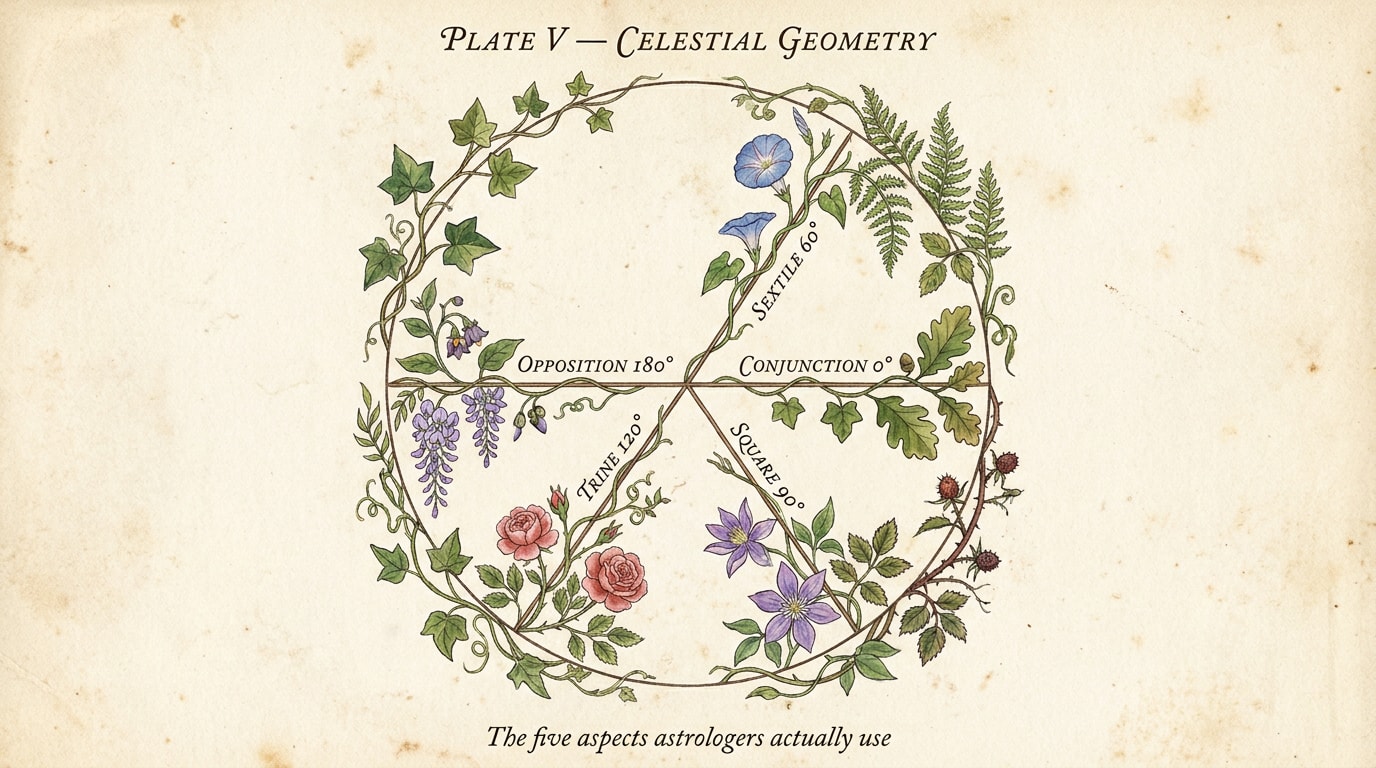
The minimum vocabulary you actually need:
| Term | Plain English |
|---|---|
| Transit | Where a planet is now |
| Aspect | The angle between two planets |
| Square (90°) | Friction, push to action |
| Trine (120°) | Ease, support |
| Conjunction (0°) | Same point, blended |
| Moon sign | Which sign the Moon is currently in |
| Mercury retrograde | Mercury appearing to move backwards from Earth, often described as a communication-and-tech-glitch window |
The vocabulary sounds technical because it is, and it isn't. The maths is straightforward (angles between two planets in a circle), and the prose around it does most of the mystifying. Once you can name the angle, you can read past the editorial flourish and see what's actually being described.
One line. A daily horoscope describes today's transits (mostly the Moon's), filtered through your Cancer Sun. The transit is real; the verdict around it is editorial.
How to read your daily horoscope critically
Read your daily horoscope as a description of the current sky, look for the mechanic behind the prose, and treat the verdict-language ("expect this", "trust your gut") as decoration, not instruction. Most daily horoscopes are written quickly for general Sun-sign audiences and lean on verdict-language to feel decisive; the underlying transit information is usually accurate, the "what you should do about it" layer is editorial flourish. If you skim a daily horoscope and notice the actual astrological mechanic mentioned ("Moon enters Leo today", "Mercury squares Saturn", "void-of-course Moon between 2pm and 5pm"), you can verify it yourself on any free transit chart (astro.com publishes one), and decide for yourself what it might mean for your day. Daily horoscopes work as gentle observation prompts when you read them this way; they don't work as schedules.
Three practical moves are worth keeping in mind.
The first is to find the mechanic. Look past the prose for the actual transit named: which sign is the Moon in, which planets are in aspect. Many Cancers describe this as "I started skimming for the actual planetary words instead of the predictions, and the horoscope got more useful."
Ignoring verdict-language is the second. When a daily says something definitive about your day, ask what transit is supposed to cause that, and whether the same transit might mean something else in your particular life. It usually does, because your full chart is twelve times richer than any one Sun sign.
The third move is to cross-check with your own day. A daily horoscope earns its keep when you notice the mechanic in passing ("huh, the Moon's in Scorpio, that's why everything feels a bit heavier this afternoon"), not when you build the day around it. Astrology rewards the reader who treats it as quiet observation, not as a verdict to be obeyed.
From general Cancer to your Cancer
A general Cancer daily reads only your Sun sign; a personalised daily reads your full chart — which is why personalised tends to feel less generic. Your Cancer Sun is one of ten placements on your birth chart; a daily horoscope that knows your Moon, Rising and the rest can describe today's sky as it actually meets your particular configuration, not as a one-size-fits-twelve template. The same transit (say, Moon in Scorpio today) lands differently for a Cancer with a Capricorn Moon than for a Cancer with a Pisces Moon; the general daily can't distinguish them, a personalised one can. Once you've read enough general dailies to feel the shape of the format, the next sensible step is to see what a daily looks like when it knows the other nine.
If you'd like to see what the sky looks like through your particular chart rather than through a generic horoscope today for Cancer, WowAstro's daily horoscope calculates from your birth chart (date, time and place) using the same Swiss Ephemeris data working astrologers use. Most daily horoscopes will go on being half-right for the average Cancer. Yours, however, is not the average Cancer.
 Astrology rewards the quiet observer, not the obedient reader.
Questions readers ask
What does Cancer horoscope today mean?
A daily Cancer horoscope is a description of today's sky, read through Cancer Sun temperament. Astrologers look at where the Moon is currently sitting, which sign it's moving through, and which planets it's in aspect with, then write how that combination tends to feel for a Cancer Sun. It's a general read, one of twelve published every day, and it covers roughly one tenth of your astrological picture (the Sun being one of ten things on a full chart). Read it as a gentle observation about today's sky rather than a verdict on your day, and it tends to be more useful.
Are daily horoscopes accurate?
A daily horoscope is accurate for the slice of life it actually describes (today's transits, read through one of your ten placements), and only when that transit happens to resonate with the rest of your chart. The underlying astronomy is precise; the Moon really is where the daily horoscope says it is. The prose interpretation, the verdict-language about what the transit "means for Cancer today", is editorial craft that varies wildly between writers. Read for the mechanic, not the verdict.
What's a transit for Cancer?
A transit, for Cancer or any other sign, is simply where a planet sits in the sky right now compared with where it sat at the moment of your birth. Your birth chart is a fixed snapshot; the planets carry on moving afterwards, and "transits" measure the ongoing motion against that snapshot. A daily Cancer horoscope is built from today's transits, most of all from the Moon's current position, read through your Cancer Sun. So "Mercury square your Sun today" means Mercury's current position forms a 90-degree angle to where your Sun was on your birth date.
How is today different from tomorrow for Cancer?
Today and tomorrow differ for Cancer mainly because the Moon moves around thirteen degrees a day, and changes sign every two and a half days. That's enough motion that today's Moon and tomorrow's Moon often sit in different signs altogether, with different temperaments and different aspects to other planets. The other planets (Sun, Mercury, Venus, Mars and the slower ones) barely move in 24 hours, so most of the day-to-day variation in your Cancer horoscope comes from the Moon. If you compare today's and tomorrow's reads and notice the Moon sign has changed, you've found the main reason they feel different.
A note on what this is. Astrology, as we use it at WowAstro, is a tool for self-reflection and self-observation, not a method for predicting events, health, or financial outcomes. Read your daily horoscope as a description of the current sky, take what's useful, leave the rest.
About this article: WowAstro readings combine traditional astrological methodology (Swiss Ephemeris calculations, Hellenistic and modern psychological frameworks) with AI-assisted writing reviewed by Oksana Miatova before publication. For entertainment and self-reflection only — not medical, legal, or financial advice. Full editorial policy at /editorial-standards.
Written by Oksana Miatova, astrologer and writer at WowAstro. Charts calculated using the Swiss Ephemeris, the same astronomical data working astrologers use.
Your year ahead — what 2026 has waiting
A personal AI forecast for 12 months — based on your natal chart and the year's transits, with weekly and monthly themes
Comments
New here? Get −30% off your natal chart
Leave your email and we will send you the promo code WELCOME30. Straight after that you can comment — no passwords, all automatic.
Quick sign-in
Sign in with Telegram — one click.
Or by email (with a gift)
Already have an account? Enter the same email — we'll email you a sign-in link.